A couple of recent TMRO.tv SpacePod short video reports:
* The Waves of Gravity – SpacePod 11/6/15
* International Space Cooperation Moves Forward – Space Pod 11/01/15
The latest episode of Xploration Outer Space on Hulu is devoted to the topic of rockets: Season 2 Episode 8: Rockets – Oct.31.15.
There are up to 12 slots available for college student experiments on a NASA high altitude balloon flight:
NASA Seeks Student Experiments for Edge-of-Space Balloon Flight
NASA is accepting applications from graduate and undergraduate university students to fly their science and technology experiments to the edge of space on a scientific balloon mission.

“It’s incredibly rewarding to support the students flying these experiments, many of whom are getting their first real taste of hands-on engineering and science,” said Debbie Fairbrother, chief of NASA’s Balloon Program Office. “Programs like HASP are key to educating, training, and inspiring the next generation.”
A panel of experts from NASA’s Wallops Flight Facility in Virginia, Columbia Scientific Balloon Facility in Palestine, Texas, and LaSPACE will review the applications and select the finalists for the 2016 flight opportunity. The deadline for applications is Dec. 18. A question-and-answer teleconference for interested applicants is scheduled for Nov. 13. Interested school teams should contact Greg Guzik at guzik@phunds.phys.lsu.edu for more information.
HASP can support up to 12 student-built payloads. It houses and provides power, mechanical support, interfacing, data downlink and command uplink communications for the instruments. Launched from NASA’s balloon launch facility in Fort Sumner, New Mexico, flights typically last 12 to 15 hours, flying at an altitude of approximately 23 miles.
NASA’s scientific balloons offer low-cost, near-space access for payloads weighing up to 8,000 pounds to conduct technology demonstration tests as well as scientific investigations in fields such as astrophysics, heliophysics and atmospheric research. Depending on the goals and objectives of a specific mission, balloon flight durations can run hours to multiple days or weeks for longer-term tests and data collection.
Since 2006, the HASP program has selected more than 110 payloads for flights, involving more than 800 students from across the United States. Past student groups have flown instruments to flight test compact satellites and prototype long-range communication devices, perform space science experiments, sample particles at the edge of space, perform remote sensing experimentation, test rocket nozzles, and measure infrasound to correlate with geophysical events.
For information about NASA’s education programs, visit: http://www.nasa.gov/education
Emily Calandrelli hosts a new episode in her series Xploration Outer Space on Hulu: Space Disasters.
I’ve posted here many times about JP Aerospace, which has been flying high altitude balloons and airships for over 30 years. Founded and led by John Powell, the part professional, part volunteer organization has won USAF contracts, carried out multiple promotional flights for companies from around the world, and developed a number of innovations in the technology of Near Space.
Furthermore, JPA has a very active education program. Over 50,000 students have had their PongSats taken to the edge of space for free by JPA.
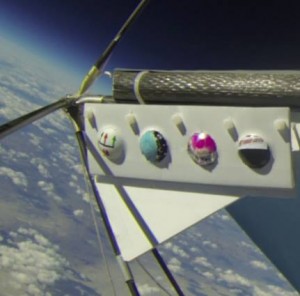 Four PongSats mounted on a JPA balloon structure
during a high-altitude flight in October 2014.
A PongSat is a ping-pong ball with a tiny experiment inside of it. A few years ago, JPA introduced the Mini-Cube, which provides a standardize plastic box structure, 5 cm to a side, in which more sophisticated and elaborate experiments can be enclosed and flown for a fee to Near Space.

Back in May I posted about an ebook written by Gregory N. Cecil that provides a step-by-step tutorials for teachers, students, and anyone else on how use a Mini-Cube for low-cost educational Near Space experiments and demonstrations. The book is now available in paperback: Classroom Laboratory at the Edge of Space: Introducing the Mini-Cube Program.
A book written for secondary public and private school STEM instructors, home schooling, and undergraduate STEM courses of study explaining how to set up their own student focused “space program” utilizing the Mini-Cube Program. With this Informal STEM Project Based Learning Activity, students can have the unique, affordable, and challenging opportunity to send experiments via high altitude balloon to an altitude of 100,000 feet (20 miles or 32 km), commonly known as the “edge of space.” Utilizing the scientific method, team work, research, and communicating in writing the results and applications for peer review, students will participate in the full cycle of an actual experiment from the original question to the published results and conduct true science at the edge of space.
Utilizing the scientific method, team work, research, and communicating in writing the results and applications for peer review, students will participate in the full cycle of an actual experiment from the original question to the published results and conduct true science at the edge of space.
Here is the table of contents for the book:
