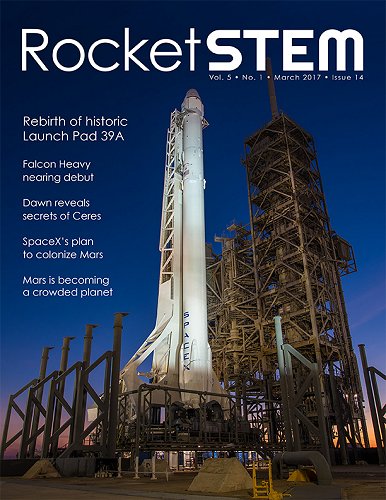
We’re launching another issue of RocketSTEM to celebrate the start of our organization’s fifth year. While half a decade has been quite a journey for us, it is nothing compared to the 50-plus-year history of Kennedy Space Center’s Launch Complex 39A. From racing the Russians to the Moon during the Apollo program, through the construction of the International Space Station during the Space Shuttle program, and now the most recent launch of the Falcon 9 rocket by SpaceX, the world-famous launch pad has quite a story to tell. Speaking of SpaceX, the private space firm is also preparing to launch its biggest ever rocket – the Falcon Heavy – from Pad 39A later this year. But the company’s founder, Elon Musk, is already laying the groundwork for an even bigger rocket – the Interplanetary Transport System – that will allow humanity to colonize Mars and explore even further out into the solar system. In the meantime, a fleet of orbiters and rovers from three space agencies are busy checking out the Red Planet, while NASA’s Dawn spacecraft has been been analyzing a dwarf planet named Ceres.
All that – and more – in this issue of RocketSTEM magazine.
And, as always, every issue remains free to read online or download as a PDF.
TABLE OF CONTENTS
Exploring Mars – Eight rovers and orbiters from three space agencies are at the Red Planet.
Helo, Mars! – Learn to compute flight data for the proposed Mars Helicopter Scout.
Historic Pad 39A – The launch pad has been America’s gateway to space for five decades.
Falcon Heavy – SpaceX is gearing up to debut its new rocket later this year.
SpaceX goes bigger – The Interplanetary Transport System may open up the solar system to exploration.
Dawn’s harvest – Spacecraft has been revealing secrets of Ceres, a dwarf planet.
There is still time to submit your artwork to the LEO Art Challenge, which is open to “All full-time students at any grade level between the ages of 13 and 22 are eligible”. It is sponsored by Enterprise In Space (EIS) and is a program of the National Space Society.
Low Earth Orbit Art Challenge
Imagine & share with us the exciting environment of Low Earth Orbit in one of many ways.
Are you ready for the next great adventure? To mark the first steps of the National Space Society’s Enterprise In Space (E(S) program that will send over 100 student experiments into Low Earth Orbit (LEO), we are offering this worldwide search to find a group of kindred spirits to embark on this exciting adventure challenge.
We want to see what a low Earth orbit adventure means to you! Imagine yourself as a professional engineer, designer, advertiser, writer, or artist that has been hired to create promotional materials about LEO and its environment. What topic or aspect about LEO would your choose to promote? What format would you use to present it to your customer? Show us, and you could become part of history as one of the first groups of students to win the chance to virtually make this incredible journey into low Earth orbit.
You can be one of the first EIS virtual crew members!
On Tuesday 8th November 2016, 10:30 LT, -18°C: our Hybrid sounding rocket HEROS 3 rocket was launched from ESRANGE, Kiruna [Sweden]. At almost perfect weather conditions and great visibility it reached an apogee of 32.3 km according to GPS and acceleration data and was successfully recovered with the drogue and main parachute being released. This sets a new record for European student and amateur rocketry. Furthermore, to our knowledge this is also a new altitude world rocket for hybrid rockets built by students. The maximum speed of HEROS 3 was 2600 km/h with a Mach number of 2.3. The hybrid rocket engine delivers 10 kN of thrust with a paraffin-based fuel and Nitrous Oxide as the oxidizer.
Justin Park of Intergalactic Education comes on to talk about a new space related game, Space World. Already far in development, Space World uses real-life space situations to help educate.
Space news topics covered:
* Launches * SpaceX RTF shifts to January * Cassini beams back first images from new orbit * ESA budget and ISS commitment resolved * Dark Matter may be smoother than expected * John Glenn * LIGO resumes search for gravitational waves
TMRO is viewer supported:
TMRO:Space is a crowd funded show. If you like this episode consider contributing to help us to continue to improve. Head over to http://www.patreon.com/tmro for information, goals and reward levels. Don’t forget to check out our SpacePod campaign as well over at http://www.patreon.com/spacepod
The First Enterprise In Space Competition to Tackle Space Debris Launched by Enterprise In Space & Kepler Space Institute
Washington, DC – December 6, 2016: Enterprise In Space (EIS), a non-profit program of the National Space Society (NSS), and the Kepler Space Institute have partnered with Global Aerospace Corporation (GAC) to launch the “Orbital Debris Mitigation” competition. In order to drive innovation forward in technology to remove the space debris orbiting Earth, EIS and its partners are offering university student teams a chance to propose experiments for space debris mitigation.
To enter the contest, university student teams may submit a white paper in either one of two competition categories. Category one is to design an experiment that fits on a CubeSat to detect, track or collect orbital debris. The second is to design an experiment to help evaluate the performance of GAC’s Gossamer Orbit Lowering Device (GOLD) that will de-orbit a CubeSat.
“Currently, there are over 500,000 pieces of space debris orbiting the Earth and traveling up to 17,500 miles per hour, potentially causing serious damage to any satellite or spacecraft,” said Kerry Nock, President of GAC. “At GAC, we have invented a device for removing this debris called the Gossamer Orbit Lowering Device, or GOLD. GOLD uses a lightweight, continuously inflated envelope to increase the drag area and accelerate the natural orbital decay process of antiquated satellites and large orbital debris by orders of magnitude.”
Up to three members of the grand prize winning team will receive complimentary registration to present their white papers at the National Space Society’s International Space Development Conference® (ISDC), May 25-29, 2017 in St. Louis, Missouri. Grand prize winners will have their experiment results paper will be published in Ad Astra magazine and an industry trade journal for orbital space debris mitigation and remediation. One member of the grand prize team will also receive an R.S. Kirby Memorial Scholarship, valued at $5,000, from the Kepler Space Institute to be applied towards a full certificate program. The R.S. Kirby Memorial Scholarship aims to encourage space advocates the world over.
To learn more about the Orbital Debris Mitigation Competition or to enter, visit the contest page at enterpriseinspace.org/space-debris and become a part of NewSpace future.
About Enterprise In Space: The National Space Society’s Enterprise In Space (EIS) is the world’s first NewSpace education program. EIS provides access to STEAM education to all through the open online EIS Academy and an artificial intelligence tutor under development named Ali. The program’s first Academy-wide project is the design, launch, and retrieval of a 3D-printed spacecraft carrying 100+ active and passive experiments from K-postgrad student teams from all around the world.
About Kepler Space Institute: Kepler Space Institute (KSI) is dedicated to providing educational programs, research solutions, and publications to the public, industry, and governmental organizations in support of continuing Space Exploration, Commercialization, and Colonization. Through cutting edge research, exploration and development of space resources, KSI helps facilitate the expansion of human civilization from Earth into Space, with the primary goal of benefiting humans everywhere on Earth and beyond.
About Global Aerospace Corporation: Global Aerospace Corporation (GAC) was founded in 1997 by former NASA/JPL engineers and scientists as a commercial research and development firm. GAC maintains its corporate office in Irwindale, California, where it develops prototypes and works its projects in a 4,300 sq. ft. R&D office/industrial space. These facilities are used to conduct task engineering work, assembly, integration, and testing of hardware as it is prepared for flight, as well as project meetings and report writing. Our facilities meet Federal, California, and Los Angeles County environmental laws and regulations. Our corporate activities include technical analysis and research, aerospace mission and system concept development, aerospace technology research and development, deep ocean systems research and development, and system design, prototyping, and demonstration. Our corporate team is highly qualified with over 400 years of cumulative aerospace experience.
About the National Space Society: NSS is an independent nonprofit educational membership organization dedicated to the creation of a spacefaring civilization. NSS is widely acknowledged as the preeminent citizen’s voice on space, with over 50 chapters in the United States and around the world. The Society publishes Ad Astra magazine, an award-winning periodical chronicling the most important developments in space. To learn more, visit www.nss.org.