Category Archives: Education

“Launchboxes” provided by Purdue for K-12 student experiments on suborbital spaceflights

A Purdue group has developed a simple box for grade school kids to fly experiments on suborbital spaceflights of the Blue Origin New Shepard rocket vehicle:

Purdue School Launchboxes available to send school experiments into space

Standing less than a foot tall and weighing a few ounces, the rectangular box doesn’t seem like much but Purdue’s School of Aeronautics and Astronautics hope it will represent the first step for schools nationwide wanting to conduct zero-gravity experiments in space.

A few aluminum Launchboxes already have been shipped out this summer and more interest is expected as students return to K-12 schools across the nation, said Steven Collicott, professor of aeronautics and astronautics.

Collicott said the Launchboxes allow schools to focus on the experiments they want to send up on private suborbital rockets and also expose students and teachers to Purdue engineering.

“Teachers should be thinking and working with students about what’s going inside the box and the purpose of their experiment, not how to house it on the rocket,” Collicott said. “These Purdue School Launchboxes enable more schools to fly their own original experiments to space by taking this mundane, low-tech stumbling block out of the way for teachers.”
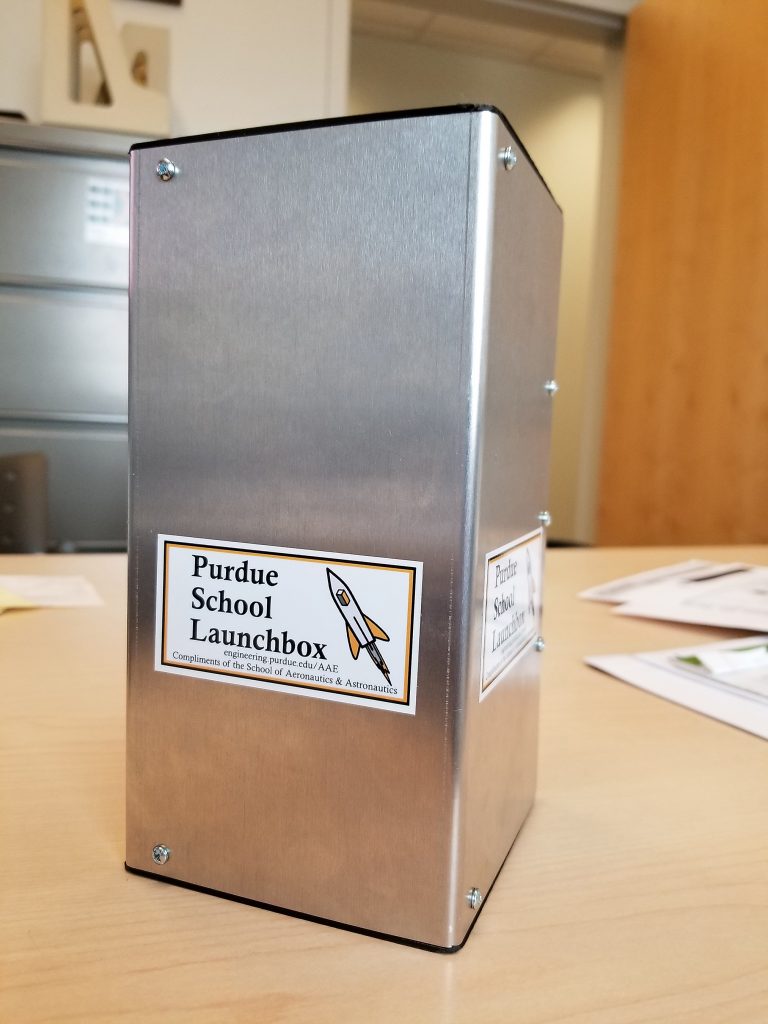
The 8-inch by 4-inch aluminum Launchbox being distributed by Purdue’s School of Aeronautics and Astronautics is intended to help K-12 schools prepare experiments to launch aboard suborbital rockets. (Photo/School of Aeronautics and Astronautics)

In December, Collicott and his students finished a two-year project working with second-graders from Cumberland Elementary School in West Lafayette to send up an experiment aboard a Blue Origin rocket launch to determine whether fireflies could light up in space.

Compliments from Blue Origin officials about the box used for the firefly experiment led Collicott to look into possible production. His findings: Launchboxes were so inexpensive that they could be given away to interested schools and other organizations.

“We email the schools some computer files for 3D printing the plastic end caps,” he said. “Then we ship them the pre-formed aluminum for the box plus the fasteners and instructions for assembly.

“It’s a simple solution that stayed simple.”

Once completed, the boxes are 8 inches by 4 inches and allow schools to work within the 1-pound payload limit. The boxes are strong enough to support a 15-pound weight to prove that their strength is sufficient for the stresses of the launch to space.

The Blue Origin New Shepard rocket reaches space at a height of 60 miles in the air, much higher that any balloon or aircraft.

“That flight opportunity is now available to schools all over the world at roughly half the cost of high school football uniforms,” Collicott said. “Any school district in the country that plays football can now afford space flight.

“Just like their athletic booster clubs, schools can finance these flights with a “Rocket Booster Club,” he added.

Schools or other organizations interested in getting a Purdue School Launchbox can email Collicott at collicott@purdue.edu and include “Purdue School Launchbox” in the subject line.

Writer: Brian L. Huchel, 765-494-2084, bhuchel@purdue.edu

Source: Steven Collicott, 765-494-2339, collicott@purdue.edu

=====
 

Rocket Lab to launch an Electron with 5 payloads including Irvine CubeSat built by high schoolers

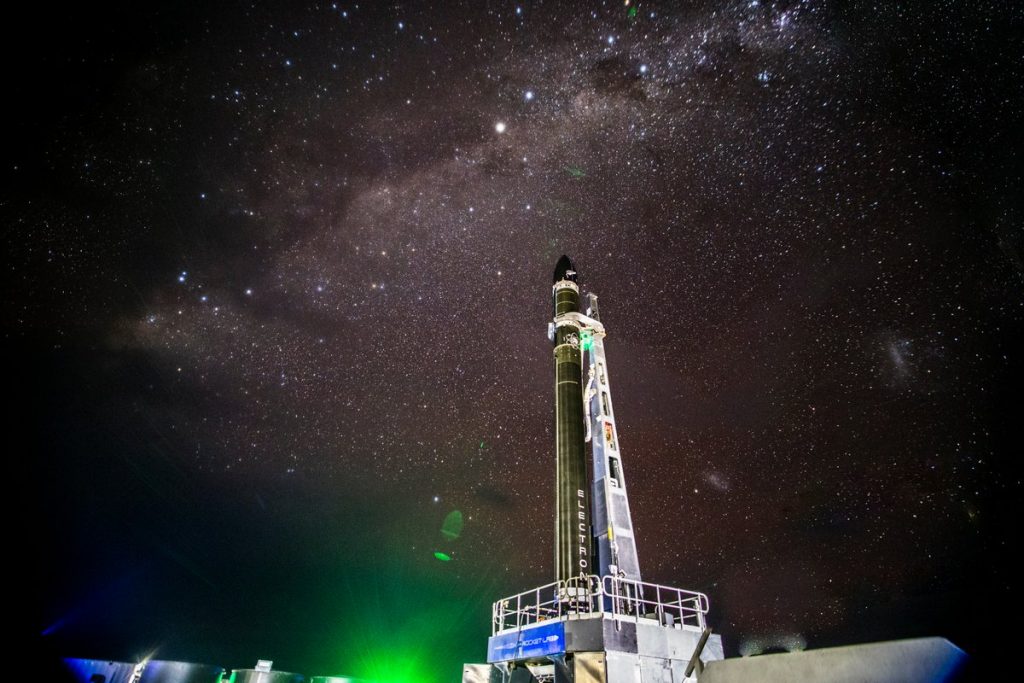
This evening US time and Saturday afternoon New Zealand time, Rocket Lab will attempt to launch the third Electron rocket into orbit.

The Electron on the pad at Mahia. (Photo credits Kieran_Fanning)

The rocket is to lift off from the Mahia Peninsula on the east coast of New Zealand‘s North Island. You can watch the launch via the rocketlabusa.com/live-stream webcast.

The vehicle is carrying four payloads for commercial companies plus the Irvine CubeSat built by high school students in Irvine, California.

The Irvine CubeSat Program is a revolutionary STEM initiative based in Irvine, California. With over 100 members from six public high schools, the program collectively strives to assemble, test, and launch a solar powered CubeSat. It aims to inspire the next generation of innovative thinkers, creators, programmers, and explorers.

Here is a video about the program:

The company’s press kit (pdf) has lots of information about the mission. See also Rocket Lab set for first operational Electron launch with five payload elements – NASASpaceFlight.com.

====


Base11 Space Challenge: $1M prize for a student team whose liquid-fueled rocket reaches 100km

The non-profit organization Base 11 led by Landon Taylor has organized a rocketry competition for university students that is offering a $1M cash prize:

The Base11 Space Challenge is a $1 million+ prize for a student-led university team to design, build, and launch a liquid-propelled, single-stage rocket to an altitude of 100 kilometers (the Karman Line) by December 30, 2021. Annual competitions and prizes mark milestone achievements in the process including design of the liquid-fuel rocket, static testing of the engine, and smaller pop-up innovation challenges to be announced. The biggest purse, which is fully funded, is the $1 million prize for launching the rocket to the edge of space.

The mission behind the Base 11 Space Challenge is to dramatically increase the science, technology, engineering, and mathematics (STEM) talent in the United States with greater representation and inclusion of women and minorities, while empowering the future workforce with the education and skill-training necessary for jobs in the aerospace and related industries.

This video gives an overview of the program:

And a video of the debut event held for the program last week:

====

2018 Reach for the Stars ~ National Rocket Competition

A message from Jack Colpas co-director of the RFTS Competition:

Reach for the Stars ~ National Rocket Competition

Through a NASA grant the Florida Space Grant Consortium sponsored 100 kids in the Reach for the Stars ~ National Rocket Competition. Building and launching a solid-fuel powered rocket is a fantastic way to turn kids on to STEM (Science, Technology, Engineering, Math) subjects.

Five national winners will be determined by local competitions. They will celebrate at Space Camp / US Space & Rocket Center in Huntsville, Alabama – under an October Sky.

NASA and the Florida Space Grant Consortium are Helping Kids Reach for the Stars

Everyone agrees – we need to get more kids interested in STEM careers. To do that we need to get them excited about STEM subjects. Building and launching a solid-fuel powered rocket is a fantastic way to turn kids on to the STEM subjects. Nothing lends itself to Science, Technology, Engineering and Math like rocketry. After all – this is Rocket Science!

To meet that need the Florida Space Grant Consortium, under the direction of Dr. Jaydeep Mukherjee, arranged for a NASA grant that funded 100 students from across Florida. Each of the students, from four different schools, received a rocket kit to buid and launch, supplies for two launches, an achievement certificate and registration in the national competition. The schools received a Launch Set and certificate of involvement.

“To keep the playing field even – we are hoping to get similar grants in the other 49 states. This is, after all, a national competition.” says RFTS co-director Jack Colpas.

The Florida schools helped by the grant were identified by the economic need of its students. Thus giving the opportunity to kids who might not have had the chance to compete. The Imagine School, West Melbourne, STEAM Director, Brendan Williams / Bagdad Elementary School, Santa Rosa – Science Teacher, Tammy Dillard / Shaw Elementary, Tampa – SPARK teacher, Angela Williams / King Middle School, Milton – Science Teacher, Cathy Thompson; have a majority of their students on Free or Reduced Lunch Programs.

The teachers involved in the grant, rave about the opportunities it provides for their students.

Brendan Williams, “….most of my students could not afford to use Estes rockets. This grant will give them a chance to take their rocketry design and love of STEM to the next level. Giving these students opportunities like this opens their eyes to the possibilities for their lives that might then open doors for them as they grow up.”

Tammy Dillard, “I would like to be able to offer them more exposure to things that they would not normally have. Being able to construct a rocket and actually fly it! Without this grant, they would never have the chance. This opportunity will enable them to try and try again something wonderful. What they discover through this experience will be monumental.”

Cathy Thompson, “I am very excited to help the team compete with the rockets. These kids are very interested in flight and science. Most do not get these opportunities outside of school.”

Angela Williams, “This activity would expose them to STEM activities at a level they have never seen. I’m certain it would spark their interest to continue in other STEM activities and subjects in the future. I would also like to encourage the girls to be involved in this science building activity.”

An indication of the grant’s success can be seen in competitor Jordyn Presley from Bagdad Elementary School. She did so well that she won the local event at her school – and was one of the top five entries nationwide. As a national winner she will travel to Space Camp in October to celebrate with the other national winners.

Contestants – ages 10 to 18 – compete at an event held at their own location. It is fun, affordable (no travel expense or hassle) & easy to run (step-by-step video covers rocket construction and launch). After two launches and parachute landings, the closest average distance to a target wins the local event. Local winner’s results are sent to the national headquarters to determine the five national winners.

The five national winners in the Reach for the Stars ~ National Rocket Competition will be invited to celebrate in grand fashion at  Space Camp / US Space & Rocket Center in Huntsville, Alabama under an ‘October Sky’. There they will be presented a Space Shuttle Challenger commemorative medal with certificate signed by Astronaut Jon McBride. Captain McBride piloted the Challenger on her early missions.

With their families, the winners they will continue their celebration. – experiencing Astronaut training simulators, seeing amazing space memorabilia, visiting Shuttle Park and standing under the massive Saturn V rocket. They get to launch their rockets from Homer Hickam Field – named after NASA engineer and author of the memoir, Rocket Boys aka October Sky.

Competition co-director, Kathy Colpas says,

“We promise the national winners – memories to last a lifetime and bragging rights for generations to come. Launching their rockets from a historical location and receiving a medal presented by an Astronaut allows us to fulfill our promise.”

The Competition honors the memory of Christa McAuliffe, 1st Teacher-in-Space. Everyone involved in the Competition receives a certificate that bears Christa’s likeness and her quote, “Push yourself as far as you can. Reach for the stars!” The background of the certificates is the artwork of Astronaut & Moonwalker, Alan Bean.

Ten Astronauts recommend the RFTS Competition. Several have presented medals to the national winners. Two, US Senator Bill Nelson and Kennedy Space Center Director Bob Cabana, encourage the kids in video clips prepared specially for the competitors.

Competitions are already being held across the country. Local competitions can be held anytime throughout the year. Your kids can’t win it – if they’re not in it!

For photos and more details about the competition go to: www.RocketCompetition.com .

Video: Planetary Post with Robert Picardo – “Mojave Test Flight”

Here is the latest episode of The Planetary Post with Robert Picardo courtesy of the Planetary Society:

Our PlantVac performed well in its test flight on the Xodiac rocket in the Mojave desert, but first Robert takes us to D.C. for the first Planetary Science Caucus event.

====