Category Archives: Education

Cygnus cargo ship deploys CubeSats for NanoRacks

Following its departure from the ISS last week, a Northrop-Grumman Cygnus cargo vessel has deployed three CubeSats, including MySat-1, which was built by students in the UAE, and KickSat-2, which originated with a Cornell university program led by Zac Manchester and involved a Kickstarter campaign with contributors assigned to one of hundred tiny “Sprite” chipsats to be released from the “mothership”.

NanoRacks arranged for the deployments and has posted the following release about the program:

NanoRacks Completes Sixth CubeSat Deployment
from Cygnus Spacecraft, Continues Historic Program

February 14, 2019 – Dulles, Virginia – Last night, NanoRacks successfully completed the Company’s sixth CubeSat deployment mission from Northrop Grumman’s Cygnus spacecraft. Cygnus (S.S. John Young) departed the International Space Station on February 8th, 2019 and performed a number of on-orbit activities, including yet another historic NanoRacks deployment.

Cygnus maneuvered to a higher-than-Space Station altitude (445 kilometers) where the NanoRacks External Cygnus Deployment mission released two of the three CubeSats on board into orbit, MySat-1 and the second CHEFSat satellite. The spacecraft then lowered to an altitude of 300 kilometers to deploy KickSat-2.

The deployment of MySat-1 marks an additional historic moment for NanoRacks, being the first payload that NanoRacks has launched and deployed from the United Arab Emirates (UAE). MySat-1 is a joint program from Yahsat, Khalifa University of Science and Technology, and Northrop Grumman, and is the first satellite built at the Yahsat Space Lab in Masdar City, and among the first to be developed by local students.

“We could not be more excited about all of the activity happening in the space industry in the UAE,” says NanoRacks Vice President of Business Development and Strategy, Allen Herbert. “We have a number of groundbreaking programs in the works, and the MySat-1 deployment is the perfect way to kick start NanoRacks activities in the region.”

KickSat-2 was selected for flight by NASA’s CubeSat Launch Initiative (CSLI) and was launched as the sole CubeSat in the Educational Launch of Nanosatellites-16 (ELaNa-16) mission complement, sponsored by the NASA Launch Services Program (LSP).

KickSat-2 was deployed well below the International Space Station altitude due to the satellite sub-deploying smaller “ChipSats,” a prototype representing a disruptive new space technology. These ChipSats, also known as “Sprites,” are tiny spacecraft that include power, sensors, and communication systems on a printed circuit board measuring 3.5 by 3.5 centimeters, with a thickness of just a few millimeters and a mass of just a few grams. The ChipSats are expected to be in orbit for merely a few days before burning up.

“This entire mission is a testament to the flight safety teams in-house at NanoRacks and at NASA’s Johnson Space Center, and the flight operations team at Northrop Grumman,” says NanoRacks External Payloads Manager, Henry Martin. “We were able to shepherd some extremely challenging payloads through the NASA system on a timeline that met the needs of our customers. This required a lot of teams working very closely together, and we’re proud to have yet another successful mission that demonstrates the extended use of cargo vehicles.”

The NanoRacks External Cygnus Program is the first program to have leveraged a commercial resupply vehicle for use beyond the primary cargo delivery to Space Station, demonstrating the future possibilities for using cargo vehicles for the NanoRacks Space Outpost Program and other commercial space station activities. With successful completion of this mission, NanoRacks has deployed 35 satellites from the Cygnus into multiple orbits.

“Thank you again to the teams at NASA and Northrop Grumman for allowing our creativity in orbit to grow with our customers’ dreams,” continues Martin.

To date, NanoRacks has deployed 231 satellites into low-Earth orbit.

For additional updates, follow @NanoRacks on Twitter.

For NanoRacks media inquiries, please email Abby Dickes, adickes@nanoracks.com.

About NanoRacks: NanoRacks LLC, an XO Markets company, is the world’s leading commercial space station company. NanoRacks believes commercial space utilization will enable innovation through in-space manufacturing of pharmaceuticals, fiber optics – and more, allow for transformational Earth observation, and make space a key player in finding the solution to Earth’s problems.

Today, the company offers low-cost, high-quality solutions to the most pressing needs for satellite deployment, basic and educational research, and more –in over 30 nations worldwide. Since 2009, Texas-based NanoRacks has truly created new markets and ushered in a new era of in-space-services, dedicated to making space just another place to do business.

In 2017, the Company announced their long-term plans via the NanoRacks Space Outpost Program. This program is dedicated to the repurposing of the upper stages of launch vehicles in-space and converting these structures into commercial habitats, both humanly and robotically tended, throughout the solar system.

====

Archaeology from Space: How the Future Shapes Our Past

Videos: “Remote Sensing for Conservation & Biodiversity” – NASA webinar

These two videos are from a NASA webinar on the use of satellite Remote Sensing for Conservation & Biodiversity applications.

NASA ARSET: Remote Sensing for Conservation, Session 1/2

Conservation and biodiversity management play important roles in maintaining healthy ecosystems. Earth observations can help with these efforts.

Session One: Remote Sensing for Conservation This session will focus on remote sensing for habitat suitability, species population dynamics, and monitoring wildfires. Download materials from this presentation: https://arset.gsfc.nasa.gov/land/webi… This training was created by NASA’s Applied Remote Sensing Training Program (ARSET). ARSET is a part of NASA’s Applied Science’s Capacity Building Program. Learn more about ARSET: http://arset.gsfc.nasa.gov/

NASA ARSET: Remote Sensing for Biodiversity, Session 2/2

Session Two: Remote Sensing for Biodiversity. This session will focus on the Group on Earth Observations Biodiversity Observation Network (GEOBON), Marine Biodiversity Observation Network (MBON), and essential biodiversity variables. Download materials from this presentation: https://arset.gsfc.nasa.gov/land/webi……

====

Archaeology from Space: How the Future Shapes Our Past

Student and amateur CubeSat news roundup – Feb.4.2019

A sampling of recent articles, press releases, etc. about student and amateur CubeSat / SmallSat projects and programs:

** NTU Singapore Deploys Its Ninth Satellite Into Space – Asian Scientist Magazine

Nanyang Technological University (NTU), Singapore, has successfully launched and deployed its ninth satellite. NTU’s first foray into space began 20 years ago. The first project was a communication payload codenamed Merlion, while the main satellite body was developed by the University of Surrey, UK. The latest satellite, called the AOBA VELOX-IV cube satellite, was built by a team led by Mr. Lim Wee Seng, executive director of NTU’s Satellite Research Centre, while its new altitude determination and control algorithm was developed by Professor Cho Mengu’s research team at the Kyushu Institute of Technology, Japan. It was launched from the Japan Aerospace Exploration Agency (JAXA) Epsilon-4 rocket.

** USI students make history with UNITE CUBE SAT deployment – 14NEWS.com

Two years of hard work came to fruition Wednesday morning when students from USI [University of Southern Indiana] watched their handmade satellite launched from the International Space Station.

The team was selected to design, build, and monitor the UNITE CUBE SAT satellite. The device is designed to measure plasma levels in the ionosphere, study the Earth’s orbit and measure temperature readings when the satellite re-enters the atmosphere.

“It was a lot of testing and development,” said Ryan Loehrlein, a USI senior and assistant team leader on the UNITE project. “We were doing prototyping with the boards. We were outside in below freezing temperatures at times just making sure the satellite would work. So actually seeing it launch today and getting to see it launched into space it’s one of those things that…it’s hard to let go of it because we’ve been doing it so long.”

See also Satellite made by USI students launched into space – 14News.com

** New nanosatellite system captures better imagery at lower cost — ScienceDaily

Ben-Gurion University researchers have developed a new satellite imaging system that could revolutionize the economics and imagery available from space-based cameras and even earth-based telescopes.

“This is an invention that completely changes the costs of space exploration, astronomy, aerial photography, and more,” says Angika Bulbul, a BGU Ph.D. candidate under the supervision of Prof. Joseph Rosen in the BGU Department of Electrical and Computer Engineering.

In a paper published in the December issue of Optica, the researchers demonstrate that nanosatellites the size of milk cartons arranged in a spherical (annular) configuration were able to capture images that match the resolution of the full-frame, lens-based or concave mirror systems used on today’s telescopes.

** AMSAT news on student and amateur CubeSat/smallsat projects: ANS-034 AMSAT News Service Special Bulletin

  • AMSAT Announces 50th Anniversary Space Symposium in Washington, DC
  • Es’hail-2/P4A Designated Qatar-OSCAR 100 (QO-100)
  • NEXUS Designated as Fuji-OSCAR 99 (FO-99)
  • OrigamiSat-1 Granted FO-98 OSCAR Number
  • Frank Bauer KA3HDO Appears on Ham Talk Live
  • The ARISS Team Thanks You for Your Tremendous Support in 2018!
  • ARRL Board Creates Permanent ARISS Committee
  • European Astro Pi Challenge 2018/19: Mission Zero
  • 2019 HamSCI Workshop Call for Papers and Speakers
  • AMSAT-DL Website Now Multilingual
  • Changes to the AMSAT-NA TLE Distribution for January 31, 2019
  • How to Support AMSAT
  • Upcoming Satellite Operations
  • Satellite Shorts from All Over

** General CubeSat/SmallSat info:

===

** Reposting –  From Basement to Orbit – A New Class of Personal Satellites by Joe Latrell — Kickstarter – Crowdfunding the launch of a picosat PocketQube.

Development is nearly complete. The design for the PocketQube is finalized, and the hardware is now functional. There are still some integration processes and software work to do along with various testing requirements. We are also in the process of getting our licensing with the FCC, ITU, and other government agencies. We have spent nearly $50,000 getting to this point. To take it across the finish line, we need to raise $50,000 more. Our plan is to launch Discovery in 2019 into a 500 km (310 miles) Sun synchronous orbit. This location gives the Discovery optimal viewing of the Earth and makes it easier for us to retrieve data and upload new instructions. But in order to be ready to fly, we have to finish a lot of fine details between now and then.

More at Kickstarter campaign starts to finance launch of garage-built cubesat | Behind The Black.

====


Check out the Best Selling Electronics at Amazon

Student and amateur CubeSat news roundup – Jan.27.2019

A sampling of recent articles, press releases, etc. about student and amateur CubeSat / SmallSat projects and programs:

** From Basement to Orbit – A New Class of Personal Satellites by Joe Latrell — Kickstarter – Crowdfunding the launch of a picosat PocketQube.

Development is nearly complete. The design for the PocketQube is finalized, and the hardware is now functional. There are still some integration processes and software work to do along with various testing requirements. We are also in the process of getting our licensing with the FCC, ITU, and other government agencies. We have spent nearly $50,000 getting to this point. To take it across the finish line, we need to raise $50,000 more. Our plan is to launch Discovery in 2019 into a 500 km (310 miles) Sun synchronous orbit. This location gives the Discovery optimal viewing of the Earth and makes it easier for us to retrieve data and upload new instructions. But in order to be ready to fly, we have to finish a lot of fine details between now and then.

More at Kickstarter campaign starts to finance launch of garage-built cubesat | Behind The Black.

** Winner Announced for the 2018 Altair Feko Student Competition – HPC Wire – Design of a CubeSat antenna by Didier Goulet-Tran, an under-graduate student from Polytechnique Montreal, Canada, wins student tech contest-

Goulet-Tran’s entry utilized Feko to design planar reflect array antenna, where the whole antenna system can be folded on one side of the satellite and saving space for CubeSat application. The challenge in the design of reflect array is to choose the shape of the printed surfaces to form a collimated beam over a reasonable bandwidth. The designed reflect array was fabricated and its performance validated using measurements in anechoic chamber achieving a bandwidth of 6.5%.

** JAXA launches its first startup-built satellite RAPIS-1 & 6 other satellites | SpaceTech Asia – Japanese launch included the following university smallsats:

  1. AOBE-VELOX-4, a 2U cubesat designed by Japan’s Kyutech and Singapore’s Nanyang Technological University (NTU) to observe and image the Lunar Horizon Glow
  2. Hodoyoshi 2 or RISESat (Rapid International Scientific Experiment Satellite), a 50-kg satellite developed  by the University of Tokyo, and carrying 8 international scientific payloads
  3. OrigamiSat 1, a 3U Cubesat with a membrane deployment system, by Tokyo Institute of Technology (TITech), and
  4. NEXUS, a 1U cubesat for amateur radio, designed at Nihon University in collaboration with Japan AMSAT Association (JAMSAT).

** Sky is no limit for students at Space Kidz India – The Sunday Guardian Live – A recent launch of India’s PSLV included the secondary payload Kalamsat-V2, a student-built cubesat for technology demos.

HYDERABAD: When minutes after the Indian Space Research Organisation (ISRO)’s PSLV-C44 rocket soared into skies at 11.39 pm on Thursday, Chairman Dr K. Sivan congratulated one and all in his teams, but importantly the students from Chennai, who made Kalamsat V2, the world’s lightest satellite that went into space along with DRDO’s Microsat and their leader Dr Srimathy Kesan.

Dr Srimathy Kesan, who runs Space Kidz India (SKI) from T. Nagar in Chennai, was the center of applause from across the country for her school boys who built the tiny cube satellite weighing just 1.2 kg. She went ecstatic with her mobile continuously getting calls and messages since Friday morning and told this newspaper on phone from Chennai that: “My dream comes true and I am overwhelmed.”

See also India’s 1st Rocket Launch of 2019 Sends 2 Satellites Into Orbit – space.com.

** AMSAT news on student and amateur CubeSat/smallsat projects: ANS-027 AMSAT News Service Special Bulletin

  • OrigamiSat-1 Requests Help for Testing 5.84 GHz Downlink
  • OrigamiSat-1 Reception Challenges
  • AO-85 Operations Re-Started – Telemetry Requested
  • ARISS TV Transmitter Back on Earth for Inspection, Possible Repair
  • ARISS Officers Elected
  • Upcoming ARISS Contact Schedule
  • Limited ISS SSTV Scheduled for January 30 – February 1
  • Registration Open for “VHF Super Conference”
  • AMSAT 50th Anniversary Awards Program
  • Upcoming Satellite Operations
  • NASA Administrator Addresses Furloughed Employees
  • Australia’s First Commercial Launch Facility to be Built
  • India Will Fly 100 Student Satellites
  • Satellite Shorts From All Over

General CubeSat/SmallSat info:

====


Check out the Best Selling Electronics at Amazon

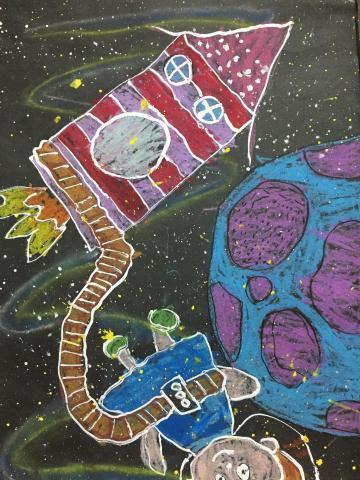
Winners announced for Space Foundation’s Int. Student Art Contest

The winners of the Space Foundation‘s ninth international student space art contest, co-sponsored by Firefly Aerospace, have been selected. See the gallery of terrific winning entries here.

Winners of the Space Foundation’s
9th Annual International Student Art Contest Announced

  • 25 winners selected from 61 countries
  • 3,908 entries submitted
  • Space Achievement Award winner is Xinyi Christine from New Jersey
Xinyi Christine, Space Achievement Award 13 – 14 Years Old, USA

COLORADO SPRINGS, Colo. (Jan 23, 2019) — The Space Foundation has announced the winners of its 9th Annual Space Foundation International Student Art Contest, co-sponsored by Firefly Aerospace. The 25 winners represent five U.S. states and 12 countries, with one entry chosen for the Space Achievement Award.

The Space Foundation invited public, private and homeschool children from around the world, ages 3-18, to submit original artwork depicting the theme, “Where Will Your Spaceship Take You?” The contest is free to enter every year, and the response for 2019 included more than 3,900 entries from 36 U.S. states and 61 countries, including Lithuania, United Arab Emirates, Kenya and Mongolia.

“Everything that has been constructed existed first in the imagination of its architect,” said Firefly CEO Dr. Tom Markusic. “We are inspired by the vision of these student space architects as they imagine ‘where their spaceships will take them.’”

Rui Xi, 1st Place 3 – 4 Years Old, Malaysia

The winning entries will be shown at the Space Foundation’s 35th Space Symposium, to be held April 8-11, 2019, at The Broadmoor in Colorado Springs, Colo., USA. After the Symposium, the winning art will be displayed at Space Foundation Headquarters and Discovery Center in Colorado Springs.

“I have greatly enjoyed personally viewing thousands of inspired contest entries over the years,” said Nancy Reed, Director – Marketing & Creative Services for the Space Foundation.  “I treasure gained insights from my involvement with the contest – that young artists’ creativity, desire to win and their view of space is universal throughout the world and transcends world politics and differing ideologies – a wonderful thing indeed!”

The winners will receive an astronaut autograph, certificate, ribbon and an art kit.

Adeena, 3rd Place 9 – 10 Years Old, Indonesia

In August 2019, the Space Foundation will make an announcement about the 2020 contest.

About the Contest

Students were invited to enter artwork in the following media formats: drawing, painting, mixed media and digital. The contest featured eight age categories, with first, second and third place honors for each of the age categories, plus one Space Foundation Achievement Award.

Jun Yao, 1st Place, 7 – 8 Years Old, China

The 2019 winners are listed by first name only in consideration of the children’s privacy.

3 – 4 Years      

  • 1st Place – Rui Xi, Malaysia
  • 2nd Place – Naajiha, Bangladesh
  • 3rd Place – Pulasi, Sri Lanka

5 – 6 Years      

  • 1st Place – Sansthita, India
  • 2nd Place – Hangyu, China
  • 3rd Place – Richard, United States

7 – 8 Years      

  • 1st Place – Jùn yáo, China
  • 2nd Place – Ruixi, China
  • 3rd Place – KeXin, China

9 – 10 Years    

  • 1st Place – Aaron, United States
  • 2nd Place – Xu Yuan, United States
  • 3rd Place – Adeena, Indonesia

11 – 12 Years  

  • 1st Place – Peter, United States
  • 2nd Place – Timur, Russia
  • 3rd Place – Maria, Ukraine

13 – 14 Years  

  • 1st Place – Crystal, United States
  • 2nd Place – Daria, Ukraine
  • 3rd Place – Jonathan, United States

15 – 16 Years  

  • 1st Place – Adrian, United States
  • 2nd Place – Natalie, United States
  • 3rd Place – Ziqing, China

17 – 18 Years  

  • 1st Place – Calum, United States
  • 2nd Place – Adriana, United States
  • 3rd Place –  Eva Sophie, Germany

Space Achievement Award   

Xinyi Christine, United States, Age 14

Where to See the Artwork
Winning artwork submitted for this year’s contest can be seen on the International Student Art Contest website gallery at http://art.spacefoundation.org/winners-gallery/2019, and all of the submitted artwork can be seen at http://art.spacefoundation.org.

About the Judges

Space Art Expertise

  • Richard Green, senior artist/designer with more than 20 years’ experience in creating and designing for the video game, aerospace and industrial design industries, Seattle, Washington.
  • Joe Vinton, digital artist, Renderosity Artist of the Year, Burton, Trent, United Kingdom.

Children’s Art Expertise

  • Hans Wolfe, middle and upper school visual arts, Visiting Artist Coordinator, Art Department Chair, The Colorado Springs School, Colorado Springs, Colorado.

Commercial Art Expertise

  • Lourn Eidal, Assistant Art Director, Crystal Peak Design, Colorado Springs, Colorado.
  • Susanne Arens, President, Crystal Peak Design and Art Director, photographer, fine artist, college instructor, Executive Director of the Pikes Peak Studio Tour, Springs Recovery Connection board member, Colorado Springs, Colorado.

About Firefly Aerospace

Firefly is developing a family of launch vehicles to provide industry-leading affordability, convenience and reliability for dedicated light to medium lift launches. Firefly’s Alpha and Beta vehicles utilize common technologies, manufacturing infrastructure and launch capabilities, providing LEO launch solutions for up to one and four metric tons of payload respectively. Alpha and Beta will provide the space industry with access to frequent launches at the lowest cost/kg, enabling ambitious commercial and exploration missions from LEO to the Moon. Headquartered in Cedar Park, Tex., Firefly has additional presence in Washington, D.C., Dnipro, Ukraine, and Tokyo, Japan. Firefly is financed by Noosphere Ventures of Menlo Park, Calif. Learn more by visiting fireflyspace.com.

About the Space Foundation
Founded in 1983, the Space Foundation is a 501(c)(3) and the world’s premier organization to inspire, educate, connect, and advocate on behalf of the global space community. It is a nonprofit leader in space awareness activities, educational programs, and major industry events, including the annual Space Symposium. Space Foundation headquarters is in Colorado Springs, Colo., USA, and has a public Discovery Center, including El Pomar Space Gallery, Northrop Grumman Science Center featuring Science On a Sphere® and the Lockheed Martin Space Education Center. The Space Foundation has a Washington, D.C., office and field representatives in Houston and the Florida Space Coast. It publishes The Space Report: The Authoritative Guide to Global Space Activity, and through its Space CertificationTM and Space Technology Hall of Fame® programs, recognizes space-based innovations that have been adapted to improve life on Earth. Visit both of our websites www.SpaceFoundation.org and DiscoverSpace.org – and follow us on Facebook, Twitter, Instagram, LinkedIn and YouTube.