Category Archives: Education

Student and amateur CubeSat news roundup – Jan.26.2020

A sampling of recent articles, press releases, etc. related to student and amateur CubeSat / SmallSat projects and programs (find previous smallsat roundups here):

** Ireland’s student built EIRSAT-1 Cubesat undergoing antenna tests: The image below shows Ireland’s first official satellite, EIRSAT-1, a 2U CubeSat, in preparation for testing in ESA’s Hertz antenna test chamber: Testing for Ireland’s first satellite – ESA ESTEC

Educational Irish Research Satellite 1, or EIRSAT-1 for short, is being built by students and staff of University College Dublin, who are participating in ESA Education’s Fly Your Satellite! programme.

At just 22 by 10 by 10 cm, the miniature EIRSAT-1 is smaller than a shoebox but is still equivalent in complexity to a standard space mission.

Normally the EIRSAT-1 student team would have joined the test campaign in person, but current Covid-19 restrictions made this impossible. Instead the team delivered their self-made Antenna Deployment Module (ADM) plus a mock-up of the satellite body, along with detailed test preparation procedures.
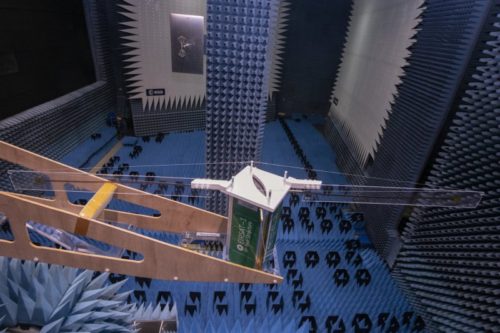
“Ireland’s first space mission, EIRSAT-1, seen taking place at ESA’s Hertz antenna test chamber”. Credits: ESA

See earlier item here and also this article from 2018: Ireland’s First Ever Satellite Moves One Step Closer to Launch into Space: EIRSAT-1 designed by a team of University College Dublin students – NovaUCD.

** ** Embry-Riddle student group builds CubeSat Hermes-1. The Embry-Riddle Future Space Explorers and Developers Society (RFSEDS) has several projects underway including Hermes-1, which they plan to launch in 2021:

Project Hermes is a 1U cubesat development project and is ERFSEDS first satellite effort. Our team is in the design development phase and is planning to launch the project within the next two years. Hermes is communications based satellite that will be used to communicate with the Hermes ground team.

Building their own ground station for communications, the Hermes ground team is certified with HAM Radio Technician liscenses.

** Interview with a 16 year old CubeSat experimenter: Cubesat Experiments With Julie Sage, a Gen Z Aspiring Astrophysicist – Via Satellite

Julie Sage is an aspiring astrophysicist, science communicator, and the host of SuperNova Style Science News. At just 16-years-old, she’s been doing some real science with running a variety of different experiments on cubesats, including material testing.

** AMSAT news on student and amateur CubeSat/smallsat projects: ANS-173 AMSAT News Service Special Bulletin

  • AMSAT Announces Candidates for 2020 Board of Directors Election
  • AMSAT Announces GridMaster Award
  • CAS-6 Online
  • Amicalsat – Aurora Pictures
  • Raspberry Pi FUNcube Satellite Telemetry Decoder Now Available
  • ORI Announces ARRL Foundation Grant Award
  • ORI Announces YASME Foundation Grant Award
  • 38th Annual AMSAT Space Symposium and Annual General Meeting Moving to Virtual Event
  • Upcoming Satellite Operations
  • ARISS News
  • Hamfests, Conventions, Maker Faires, and Other Events
  • Satellite Shorts From All Over

See also

  • 6th anniversary of NANOSATC-BR1 | Southgate Amateur Radio News
    Friday, 19-06-2020, completes six years since we successfully launched the NANOSATC-BR1, CubeSat 1U, which was launched on June 19, 2014, from Yasny Base, in Russia. The first Brazilian Scientific Nanosatellite remains in operation, sending telemetry to the Earth Stations of the NanosatC-BR Program, Cubesats Development and Amateur Radio Support Stations.

General CubeSat/SmallSat info:

**  [WEBINAR] Cubesats Made Easy: Streamlining Integration & Collaboration for Australian Space MissionsAustralian Centre for Space Engineering Research Engineering

In this webinar, we will be focusing on the questions that must’ve crossed every developer’s mind, i.e. “Someone else must’ve have this problem too! How did they solve it?” Sometimes, it’s about the lack of time and manpower, sometimes it’s about the problem’s complexity. With our panellists, we will explore these problems and current (and potentially future) solutions, and how collaboration may help especially in the Australian context. This webinar will cater to both newcomers, where we streamline up-to-date resources, and to the experienced, where we can share ideas on how to make things better. These include:

1. A survey on Australian small satellite developers
2. Existing standards, available resources, and what are the current shortfalls?
3. Interfacing subsystems – hardware and software issues
4. Space Communications – RF issues and how cloud solutions may help
5. Building a Cubesat developer’s community – open source approaches?

** Tracking CubeSats with a Telescope – Bruce Van Deventer

CubeSats are miniature satellites typically deployed into low earth orbit. A standard 1U CubeSat is a cube ten centimeters on a side. Here, I tracked three different CubeSats on the night of 6/17 at our dark site observatory. Tracking is performed blind, meaning there is no optical assist to help the telescope point to the target. These videos are shot using a Celestron RASA 11 telescope and the ZWO ASI 6200 mono camera, operated in 8 bit video mode, quarter frame size, 100ms exposure. That video is further cropped here to make it easier to find the satellite.

=== Amazon Ad ===

Introduction to CubeSat Technology and Subsystem:
Orbit Design, Debris Impact, and Orbital Decay Prediction


Student and amateur CubeSat news roundup – June.9.2020

A sampling of recent articles, press releases, etc. related to student and amateur CubeSat / SmallSat projects and programs (find previous smallsat roundups here):

** Univ. of New Hampshire students to built CubeSat to study Earth’s upper atmosphereUNH Space Science Center offers out of this world experience – Univ. of New Hampshire

Scientists from the University of New Hampshire’s Space Science Center will use a $4.6 million grant from NASA to create a project that will offer a diverse group of college students from across the country hands-on research experience designing and building small satellites that will be launched into outer space and collect data for one of NASA’s space missions.

The Student Collaboration Project, led by Noé Lugaz, a research associate professor of physics, aims to work in conjunction with NASA’s Interstellar Mapping and Acceleration Probe (IMAP) mission and build off of the collected data to provide firsthand research experience for undergraduate and graduate students and help to diversify the field of space science.

“We’re missing out on so much potential with great people out there,” said Lugaz. “Most science projects are publicly funded, and we want to expand access to college students who are qualified and have a passion for science to get involved, no matter what their major. We are hoping to inspire them, even if it’s just for one year. We think we can really start to make a difference.”

Project coordinators will recruit the first group of students from three universities–UNH, Howard University in Washington, D.C. and Sonoma State University in California. During the five-year project, students from each university will design and build a CubeSat–a small satellite the size of a half-gallon of milk–that will have an instrument that can quantify the concentration of oxygen in the Earth’s upper atmosphere and provide scientists with clues about the effects of the solar wind. This is the region where many satellites are located and knowing more about the atmosphere’s density could help determine their orbit and lifetime.

The student built CubeSats will launch in 2024 separately from the main IMAP mission but at the same time in order to collect complementary data. The CubeSats will be in space for about four months and will be located much closer to the Earth than the other IMAP instruments.

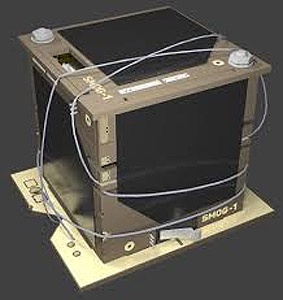
** Technical Univ. of Budapest SMOG/P/ATL-1 picosats measure spectra usage globally.

The pocketqube style satellites were launched in Dec. 2019 along with four other picosats on a Rocket Lab Electron rocket and ejected into orbit via a deployer from Alba Orbital.

SMOG-P pocketqube -Technical Univ. of Budapest

See also SMOG-P (MO-105) and ATL-1 (MO-106) – CubeSat and LEO Satellites – AMSAT Deutschland e.V. Forum.

** RamSat built by Oak Ridge Tennessee middle school students to go to the ISS in the autumn:  For members: RMS satellite scheduled to launch in September – Oak Ridge Today

The small cube satellite built by Robertsville Middle School students with help from teachers, mentors, and NASA is scheduled to launch on a resupply rocket to the International Space Station in September, and it could be deployed into orbit a few hundred miles above Earth in October.

Testing of the satellite and its components, including a battery test and vibration tests, was scheduled to start this week.

** AMSAT news on student and amateur CubeSat/smallsat projects:

ANS-152 AMSAT News Service Special Bulletin:

  • Temporary Rule Waivers Announced for 2020 ARRL Field Day
  • IARU-R2 Workshop Videos Available
  • Digital Mode Experiments Conducted on Linear Satellites
  • SpaceX Launches Successfully Toward ISS
  • Moonbounce Contact via FT8 Could be a First
  • Mid-Altitude Balloon Race Planned for June 1
  • ARISS News
  • Upcoming Satellite Operations
  • Hamfests, Conventions, Maker Faires, and Other Events
  • Satellite Shorts From All Over

ANS-159 AMSAT News Service Special Bulletin:

  • Newly Revised 2020 Digital Edition of “Getting Started with Amateur Satellites” Now Available
  • Amateur Radio on the International Space Station (ARISS) Team in the United States Creates a New Organization: ARISS-USA
  • AMSAT President’s Statement on Creation of ARISS-USA
  • Back Issues of The AMSAT Journal Available to AMSAT Members
  • AO-73 Now in Full-Time Transponder Mode
  • VUCC Awards-Endorsements for June 2020
  • KG5FYJ Assigned to Upcoming ISS Mission
  • A New Way to Obtain GP Data (aka TLEs)
  • Hamfests, Conventions, Maker Faires, and Other Events
  • Upcoming Satellite Operations
  • Satellite Shorts from All Over

See also:

General CubeSat/SmallSat info:

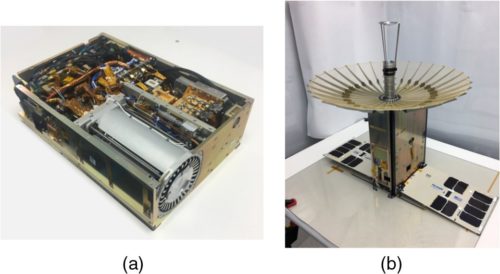
RainCube: “(a) The integrated radar payload and flight avionics in the 6-U bus chassis. (b) The fully integrated RainCube satellite including the solar panels and the deployed radar antenna.” Credits: SPIE, RainCube
    • Coast Guard Auxiliary Supports Research Efforts – MarineLink – “As part of the DHS Science & Technology Polar Scout CubeSat project, the RDC constructed a satellite ground station in Fairbanks, Alaska. This labor-intensive effort required the construction of an 18-foot radome structure. The successful completion on this ground station provided a valuable resource for the Coast Guard and DHS while testing CubeSat technology in support of Arctic search and rescue.

** Smallsat built at UNSW Canberra at the Australian Defence Force Academy to fly on next Rocket Lab Electron launch:

**  NASA STEM Stars: CubeSats

“NASA STEM Stars” is a web-chat series that connects students with subject matter experts to learn about STEM careers and ask questions about STEM topics. This week, “NASA STEM Stars” is joined by aerospace engineer Allison Evans, who specializes in CubeSats. Learn about her path to NASA and how she ended up building and testing spacecraft the size of a loaf of bread.

** Hiber smallsat constellation will provide IoT services for a diversity applications such as assisting beekeepers:

** 1st “Make Space Boring” virtual conference – Jason Kanigan – Lowering the 40%+ Smallsat Failure RateCold Star Technologies – YouTube

Jason Kanigan of Cold Star Tech speaks at the first “Make Space Boring” virtual conference. His topic is lowering the awful 40%+ partial plus full mission failure rate of small satellites.

** Building small satellite/cubesat missions in Indian universities

What goes into building a cubesat program at a university? What are the difference between university teams trying to build satellites in India against US? How can we improve the overall ecosystems in academia to build more student missions in India? Here are some great insights from Sharan. NewSpace India Episode 25 June 5, 2020

=== Amazon Ad ===

Introduction to CubeSat Technology and Subsystem:
Orbit Design, Debris Impact, and Orbital Decay Prediction

Student and amateur CubeSat news roundup – May.24.2020

A sampling of recent articles, press releases, etc. related to student and amateur CubeSat / SmallSat projects and programs (find previous smallsat roundups here):

** NASA grant for Univ. of Hawaii team developing CubeSat kits for undergraduate projects:  UH awarded $500K to develop small-satellite educational kits | University of Hawaiʻi System News

In a bold new initiative to inspire the next generation, NASA has awarded $2.4 million to six universities, including the University of Hawaiʻi at Mānoa, as part of its Artemis Student Challenges. UH Mānoa received $500,000 to create to create an affordable 1U CubeSat kit, which will help develop a robust aerospace program starting at the undergraduate level, including hardware, software and an online lab course.

UH Mānoa will generate hands-on learning opportunities related to orbital and suborbital CubeSats, miniaturized satellites for space research, containing all of the subsystems of fully functioning passive satellites. Each CubeSat will include onboard computing, communication components, dynamic sensors, an infrared camera and an electrical power system. Undergraduate students will help develop all aspects of the project under the guidance of Hawaiʻi Space Flight Laboratory (HSFL) engineers, and will have paid internship positions.

“We are proving that smallsats are absolutely within the realm of an undergraduate education and will develop this course into a national online course in the public domain through a popular online learning platform,” said Frances Zhu, Hawaiʻi Institute of Geophysics and Planetology assistant researcher.

The hands-on learning opportunities will be supplemented with online learning resources. The grant will also be used to assist CubeSat projects from states that are not yet part of NASA’s CubeSat Launch Initiative. This team will include a broad network of students from Hawaiʻi and Washington to perform the initial evaluation of the learning products.

Here was the grant announcement: NASA Funds Artemis Student Challenges to Inspire Space Exploration | NASA

University of Hawaii, Honolulu – $500,000: The university will generate hands-on learning opportunities related to orbital and suborbital CubeSats containing all of the subsystems of a fully functioning passive satellite. Each CubeSat will include onboard computing, communication components, dynamic sensors, an infrared camera and an electrical power system. The hands-on learning opportunities will be supplemented with online learning resources. The grant will also be used to assist CubeSat projects from states that are not yet part of NASA’s CubeSat Launch Initiative. This team will include undergraduate students from the University of Hawaii in Honolulu. A broad network of students from Hawaii and Washington will be included in performing the initial evaluation of the learning products.

UH Manoa awarded $500k for Artemis Project – Hawaii Space Flight Laboratory

New faculty member, Dr. Frances Zhu, recently applied for and won one of six NASA Artemis Student Challenge Awards. She is the PI on this exciting new project to create a foundation enabler 1U CubeSat for $5000 or less per unit with an online lab course. This will help undergraduate programs interested in starting an aerospace track to do so. The goal of the kit is not solely for space flight, it can be used as a tabletop sensor suite, avionics for a sounding rocket, the payload balloon or suborbital mission, a sensor pack for a rover, and more. The team responsible for designing, fabricating, and testing the kit will include HSFL Facu lty, Staff, and undergraduate students. The project kickoff was held on May 18.

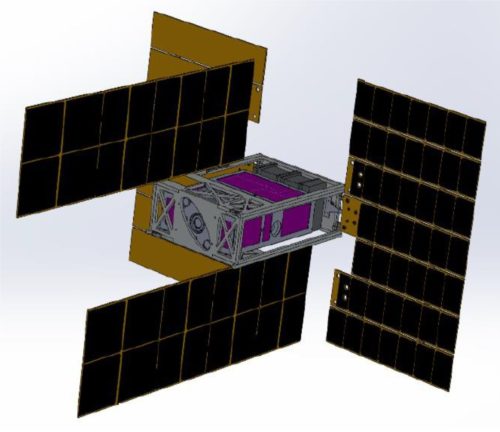
Diagram of the NEUTRON-1 CubeSat in development by  the Hawaii Space Flight Laboratory (HSFL) at the Univ. of Hawaii. The spacecraft will measure low energy neutron flux in the low Earth orbit environment. Credtis:HSFL


** AMSAT news on student and amateur CubeSat/smallsat projects:

ANS-138 AMSAT News Service Special Bulletin

  • AMSAT Receives PPP Funds During COVID-19 Pandemic
  • [HuskySat-1 (HO-107) Transponder is Open – ARRL]
  • HuskySat-1 Designated OSCAR 107 (HO-107)
  • AMSAT Executive VP Congratulates HuskySat-1 Team
  • New Satellite Frequency Chart Is Free to Members
  • ARISS Continues Test of MultiPoint Telebridge Contact via Amateur Radio
  • 10th Annual GNU Radio Conference Goes Virtual
  • AMSAT-EA Receives IARU Coordination for Two Satellites
  • AO-7 Delivers Stunning Contact
  • UN Launches Second Space4Youth Competition
  • Upcoming Satellite Operations
  • ARISS News
  • Hamfests, Conventions, Maker Faires, and Other Events
  • Satellite Shorts from All Over

 ANS-145 AMSAT News Service Weekly Bulletins

  • AMSAT Announces 2020 Field Day Rules
  • AMSAT Awards Update
  • AO-27 Returns from the Dead
  • Updated GOLF Project Information Available
  • Changing HuskySat-1 Keps Name in FoxTelem
  • Hack-a-Sat Team Boasts Exceptional Participation
  • Upcoming Satellite Operations
  • ARISS News
  • Hamfests, Conventions, Maker Faires, and Other Events
  • Satellite Shorts From All Over

See also: Two New Chinese Ham Satellites Expected to Launch in September – ARRL.org

General CubeSat/SmallSat info:

** Launching Both CubeSats and Events With SEDS Rice President Ryan Udell – Via Satellite

SEDS Rice Chapter President Ryan Udell gives us an example of next-gen space leadership. An engineering major eager to connect his fellow students with the greater space industry, Ryan has taken it upon himself to revamp the SEDS chapter at his university, transforming the club from a single member to over 30!

From there, he founded and hosted the inaugural Owls in Space Symposium event, which featured attendees such as NASA Administrator Jim Bridenstine and NASA astronaut Dr. Peggy Whitson. Additionally, he led Rice University’s entry into the NASA CubeSat launch initiative project, which was 1 of 18 winners to be launched into space. 

In this episode, On Orbit talks to Ryan about the similarities and differences in leading (and launching) two very different projects, and what it takes to be a next-gen space leader.

** Craig Clark – Pioneering the UK Smallsat Industry – Cold Star Project S02E37

Founder & CSO of AAC Clyde Space Craig Clark is on the Cold Star Project, and our topic is how Clyde has strongly contributed to the pioneering of the UK small satellite industry. With host Jason Kanigan, Craig shares:

– what the most important thing he learned from 11 years as a team leader at Surrey Satellite Tech was
– a snapshot of the UK space industry…where he believes its principle expertise or competitive advantage is, and where it is headed
– what he learned on the UK’s Space Leadership Council, and what impact he believes the Council has
– how Clyde minimizes the smallsat field’s awful 40+% partial plus full mission failure rate…what he has learned about refining quality assurance to produce cubesats in bulk without compromising reliability
– what the most challenging thing at the moment is, given that getting people together to manufacture something is not easy to achieve
– the mission he is most proud of so far, and why.

AAC Clyde Space website: https://www.aac-clyde.space/

=== Amazon Ad ===

Introduction to CubeSat Technology and Subsystem:
Orbit Design, Debris Impact, and Orbital Decay Prediction

Student and amateur CubeSat news roundup – May.11.2020

A sampling of recent articles, press releases, etc. related to student and amateur CubeSat / SmallSat projects and programs (find previous smallsat roundups here):

** Alabama university student-led CubeSat project to study radiation shielding properties of lunar regolith: ASGC cube satellite would explore using lunar soil as human radiation shield – Univ. Alabama at Huntsville

Science aboard an Alabama Space Grant Consortium (ASGC) student-led cube satellite mission called AEGIS could be valuable to developing future human outposts on the moon and in space travel to Mars if NASA gives the go-ahead for a 2022 flight.

Based at The University of Alabama in Huntsville (UAH), ASGC member universities are Alabama A&M University, Auburn University, Tuskegee University, The University of Alabama, The University of Alabama at Birmingham, UAH and the University of South Alabama, and all are involved in AEGIS.

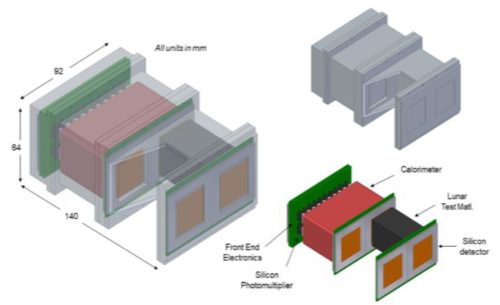
An experiment to test the radiation-shielding properties of simulated lunar soil, or regolith, is aboard the AEGIS CubeSat under development. The science is important to future lunar colonies because transporting shielding materials to the moon will be expensive, says Dr. Michael Briggs, assistant director of UAH’s Center for Space Plasma and Aeronomic Research (CSPAR) and a principle research scientist who is advising the AEGIS science mission.

CAD rendering of the AEGIS cubesat. Credits: J.Fuchs & M. Halvorson UAH

“In contrast, lunar regolith will be readily available,” he says. “Calculations show that lunar regolith will work well as a shield and NASA is studying its use as a construction material. Our goal is to improve our knowledge of its radiation shielding capacity.”

Future Mars missions could benefit from spacecraft that use lunar regolith as shielding.

“Since the lunar gravity is weaker than the Earth’s,” Dr. Briggs says, “it could be easier to use lunar material for radiation shielding for a spaceflight to Mars.”

ASGC’s 6U CubeSat measures slightly smaller than 4x8x12 inches. The craft will achieve an egg-shaped cislunar orbit that will swing it out from the Earth toward the moon and then back to Earth again.

“It is crucial to test the shielding in a radiation environment equivalent to what astronauts will be exposed to on the surface of the moon or while traveling to Mars,” Dr. Briggs says.

AEGIS mission is funded by NASA’s CubeSat Launch Initiative (CSLI). Over 120 students from Alabama colleges will be involved. The spacecraft will be launched into a high earth orbit as a secondary payload on a SLS mission as early as 2021 or 2022.

For more details about AEGIS, ee the paper The Alabama Experiment on Galactic-Ray In-Situ Shielding (AEGIS) Project: A Multi-University 6U CubeSat for Radiation Shielding Analysis and Workforce Development. J. Fuchs & M. Halvorson, (pdf).

“Instrument overview with major elements and dimensions labeled. Two sides of the instrument readout eparately for control and shielded background comparison.” Credits: J.Fuchs & M. Halvorson UAH

**  Michigan Technological University sending second student built satellite to ISS. The Stratus CubeSat will be deployed in March 2021.

Stratus vehicle is a three-axis-stabilized thermal infrared telescope that will be used to image atmospheric clouds. Using asynchronous stereo image processing, the data from Stratus will provide Cloud Fraction, Cloud Top Wind, and Cloud Top Height information that can be used to reconcile climate models. If successful, a number of inexpensive Stratus spacecraft could be deployed in the future to gather hyper-local weather data.

The first MTU project,  Oculus-ASR, was deployed last summer: And Then There Were Two: MTU’s Next Student-built Satellite Set to Launch in 2021 | Michigan Technological University News

Once successfully deployed, Stratus will be the University’s second orbiting nanosatellite. The first, Oculus-ASR, was launched from Cape Canaveral in June 2019. Another satellite, Auris, designed to monitor communications emissions from geostationary satellites, has cleared system concept review in the design and development phase of the Air Force Research Lab University Nanosatellite Program (AFRL UNP). 

Bill Predebon, J.S. Endowed Chair of the Department of Mechanical Engineering-Engineering Mechanics in the College of Engineering, welcomed the news of a second satellite launch with praise for King and Aerospace Enterprise team members. “It is amazing that Michigan Tech will have a second student-built satellite in space next year.”

Development of Stratus has been slowed by the Coronavirus shutdowns but work will soon resume.

Michigan Tech Aerospace Team Program Manager Troy Maust, a fourth-year computer engineering major, has been working on the CubeSat project for about a year. 

“This mission has been in the works for much longer,” he said. “As with Oculus, I estimate more than 200 students and alumni have been part of this mission; it wouldn’t be possible without them. I am delighted to see these years of hard work pay off.”

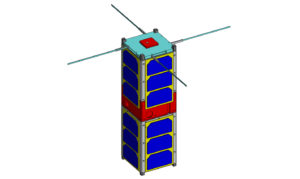
The 10-by-10-by-30-centimeter, 4.4-kilogram Stratus CubeSat is considerably smaller than the 70-kilogram Oculus-ASR, a microsat which measures 50-by-50-by-80 centimeters. But both, as well as Auris, are classed in the broader category of nanosatellites, the craft that represent an important development in space industry trends. 

Stratus CubeSat in development. Credits: Michigan Tech (MTU)

** AMSAT news on student and amateur CubeSat/smallsat projects:

**** ANS-124 AMSAT News Service Special Bulletin

  • New AMSAT Membership Portal Launched, March/April 2020 Edition of The AMSAT Journal Now Available
  • AMSAT President Hails Launch of Wild Apricot Membership Portal
  • Call for Nominations – 2020 AMSAT Board of Directors Election
  • RS-44 Transponder Now Active
  • Virginia Tech Camera on AO-92 Takes Stunning Photos, Additional Passes Planned Tuesday, May 5th
  • Redesigned AMSAT CubeSat Simulator Launched
  • Changes to AMSAT TLE Distribution for April 30, 2020
  • FCC Adopts Updated Orbital Debris Mitigation Rules
  • VUCC Awards-Endorsements for April 2020
  • Space Apps COVID-19 Challenge Virtual Hackathon, May 30-31
  • On-Line Student STEM: TI Codes Contest 2020
  • First Guatemalan Satellite Deployed from the ISS
  • Former AMSAT Area Coordinator, Prominent DXer Herb Schoenbohm, KV4FZ, SK
  • During the COVID-19 Pandemic, ARISS to Begin Experimental Demonstrations of School Contacts using a Multipoint Telebridge Amateur Radio Approach
  • Hamfests, Conventions, Maker Faires, and Other Events
  • Upcoming Satellite Operations
  • Satellite Shorts from All Over

**** ANS-131 AMSAT News Service Special Bulletin

  • 2019 Back Issues of The AMSAT Journal on launch.amsat.org
  • Call for Nominations – 2020 AMSAT Board of Directors Election
  • New Chinese Amateur Satellites Expected to Launch in September
  • Cubesat Developers Workshop Presentations Available
  • Visual Observations Of RS-44 Underway
  • Hack-a-Sat Call for Participation
  • NASA TV To Air Cygnus Departure From Space Station
  • Online Amateur Radio Satellite Talk on Zoom
  • Satellite Distance Records Set
  • Upcoming Satellite Operations
  • ARISS News
  • Hamfests, Conventions, Maker Faires, and Other Events
  • Satellite Shorts From All Over
  • [Update: ANS-131b Special Bulletin: HuskySat-1 Transponder is Open]

General CubeSat/SmallSat info:

** Benoit Chamot – CubeSat Attitude Control: ADCS from CubeSpace – Cold Star Project S02E34

Head of Sales & Marketing for CubeSpace Benoit Chamot is on the Cold Star Project, and with host Jason Kanigan we’re looking at attitude determination and control systems (ADCS) for satellites. We discuss:
– how Benoit earned Masters degrees from both Lausanne and MIT, and the projects involved
– the critical ADCS system for satellites, and the components they’re made of such as sun sensors, reaction wheels, PCBs
– why CubeSpace chose to focus on reaction wheels, designing and manufacturing their own CubeWheel product
– why the company encourages South African space industry and opportunities for young engineers

CubeSpace website: https://www.cubespace.co.za/

** CubeSat – YouTube: Now includes several videos of presentations at the recent 2020 CubeSat Developers Workshop such as, A Standard Micro Propulsion System for CubeSats, by Joe Cardin, Chris Day (VACCO Industries):

** The AMSAT CubeSatSimThe CubeSat Simulator Project Page

This video shows the new AMSAT CubeSatSim, a low cost functional model of a 1U CubeSat nanosatelite. The video shows the boards and frame in the new version and the use of FoxTelem software to decode telemetry.

=== Amazon Ad ===

Introduction to CubeSat Technology and Subsystem:
Orbit Design, Debris Impact, and Orbital Decay Prediction

Videos: Night sky highlights for May 2020

[ Update 2: What’s Up: May 2020 – Skywatching Tips from NASA JPL

What astronomy highlights can you see in the sky in May 2020? Venus, Sirius and the Milky Way. With so many of us staying home these days, here’s a look into the sky at dusk and dawn with an eye toward the vast stretches of wide open space right above our heads. Additional information about topics covered in this episode of What’s Up, along with still images from the video, and the video transcript, are available at https://solarsystem.nasa.gov/whats-up… Credit: NASA/JPL-Caltech

UpdateSkywatch: What’s happening in the heavens in May – The Washington Post.

]

** Tonight’s Sky: Space Telescope Science Institute – YouTube

In May, we are looking away from the crowded, dusty plane of our own galaxy toward a region where the sky is brimming with distant galaxies. Locate Virgo to find a concentration of roughly 2,000 galaxies and search for Coma Berenices to identify many more. Keep watching for space-based views of galaxies like the Sombrero Galaxy, M87, and M64.

** What’s in the Night Sky May 2020Alyn Wallace – YouTube

** What to see in the night sky: May 2020BBC Sky at Night Magazine – YouTube

Pete Lawrence and Paul Abel guide us through May’s stargazing highlights.

=== Amazon Ad ===

Imagined Life: A Speculative Scientific Journey among the Exoplanets
in Search of Intelligent Aliens, Ice Creatures, and Supergravity Animals