Category Archives: Space Arts

Exoplanet art

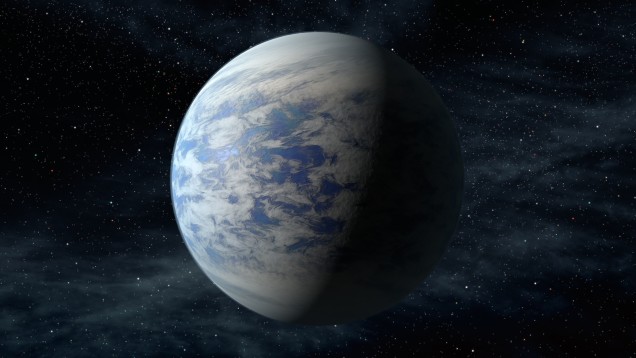
I mentioned earlier here that artist renderings of exoplanets can’t be taken too seriously. However, while their appearances are fictional, such works can still be quite pleasing to peruse and ponder. Check out this great gallery of exo-Earths: Visit the Super-Earths We’ve Found, in These Gorgeous Artworks – io9.

Kepler_69C_NASAJPL

Kepler 69C – NASA JPL

Capturing the SpaceX Falcon 9 launch with a pencil

Check out Wendy Clark‘s excellent drawing of last Friday’s launch of the SpaceX Falcon 9 with the Dragon capsule on top:

[]

SpaceX CRS-3 Dragon” by Wendy Clark


The Space Project: Space sound inspired songs from 14 different artists

Lefse Records will release the album Space Project  on April 18th. It is a collection of songs by 14 different artists who were challenged to use sounds transmitted from the Voyager spacecraft  as inspiration for their songs:

Last Thanksgiving, Matt Halverson, who runs the Portland-based label Lefse Records, was talking with his brother in law, Exogenesis President and Chief Scientist Sean Anklam, who described a trove of recordings the NASA-launched Voyager space probes had made in the outer solar system. Halverson, the Walter White to Anklam’s Hank Schrader, was overtaken by an idea: to commission imaginative artists to create songs and soundscapes out of the Voyager recordings. The interest among musicians—including , Spiritualized, Beach House, The Antlers, Mutual Benefit, Blues Control and others—was overwhelming. Lefse will release the resulting album, entitled Space Project, on April 19, Record Store Day. It will be available on vinyl, CD, and as a 7” box set.

The audio tracks that form the raw material for Space Project were recorded by the Voyager 1 and Voyager 2 space probes that NASA launched in 1977 and still uses to study the outer solar system. The satellites carry numerous instruments fine-tuned to record in different portions of the electromagnetic spectrum. The “sounds” recorded by the Voyager probes aren’t sounds in the conventional sense; rather, they are electromagnetic radiation fluctuations in the magnetosphere of the planets, moons and large asteroids the Voyager probes traveled near. Each celestial body is composed of different elements, has its own size and mass, and therefore sounds unique.

Jupiter:
A Porcelain Raft: “Giove”
B The Antlers: “Jupiter”

Miranda:
A Mutual Benefit: “Terraform”
B Anna Meredith: “Miranda”

Neptune:  
A The Spiritualized Mississippi Space Program: “Always Together With You (The Bridge Song)”
B The Holydrug Couple: “Amphitrites Lost”

Uranus:
A Youth Lagoon: “Worms”
B Blues Control: “Blues Danube”

Saturn:
A Beach House: “Saturn Song”
B Zomes: “Moonlet”

Earth:
A Absolutely Free: “EARTH I”
B Jesu: “Song of Earth”

Io:
A Benoit & Sergio: “Long Neglected Words”
B Larry Gus: “Sphere of Io (For Georg Cantor)”

For Canadian readers, the music can be heard now at First Play: The Space Project CBC Music.

TheSpaceProject_LefseRecords_b289720c

===

Find lots of links to resources for “space sounds” and music inspired by them in the HobbySpace  Natural Space Music section.

Update April.17.14: Another article plus two songs from the album in this posting.

OPTICKS: Bouncing space art off the Moon

Leonard David reports on the OPTICKS project, which plans to beam artworks from the Humans in Space Art Contest to the Moon and back: To the Moon with an Artistic Bounce! – Coalition for Space Exploration.

OPTICKS is described as follows:

a project by Daniela de Paulis in collaboration with Jan van Muijlwijk and the CAMRAS team

OPTICKS is a live radio transmission performance between the Earth and the Moon during which images are sent to the Moon and back as radio signals. The project has been realized by visual artist Daniela de Paulis (IT/NL) in collaboration with Jan van Muijlwijk and the CAMRAS radio amateurs association based at Dwingeloo radio telescope (NL). Each live performance is made possible thanks to the collaboration of radio enthusiasts Howard Ling (UK), Bruce Halász (Brazil) and Daniel Gautschi (CH).

OPTICKS employes a technology called Earth-Moon-Earth or Moonbounce, developed shortly after WWII by the US Military as a form of reliable radio communication also used for espionage purposes. EME uses the Moon as a natural reflector for radio signals.

In October 2009 Daniela de Paulis and Jan van Muijlwijk started pioneering a new application of Moonbounce technology, called Visual Moonbounce, which allows sending images to the Moon and back, combining Radio Astronomy with amateur radio technologies.

The title OPTICKS is inspired by Newton’s discoveries of the light spectrum, reflection and refraction. Similarly, the colours composing an image – converted into radio signals – are bounced off the Moon (reflected and refracted) by its surface during each live performance.

The performance is introduced by live sounds of amateurs radio signals captured by the Dwingeloo antenna tracking the moon.

Here is a video of one of their performances from 2012:

“Heaven’s Carousel” artwork unveiled at Hubble telescope conference

A press release from ESA/Hubble:

New artwork unveiled at the Science with
the Hubble Space Telescope IV conference 

Last week researchers from around the world gathered at the Accademia dei Lincei in Rome for the Science with the Hubble Space Telescope IV conference. The event celebrated the history of Hubble’s extraordinary achievements, and looked to the future at what might yet be achieved and how the James Webb Space Telescope will build on our knowledge of the Universe. As part of this celebration artist Tim Otto Roth revealed a new artwork, Heaven’s Carousel, inspired by Hubble’s work on the accelerating expansion of the Universe.
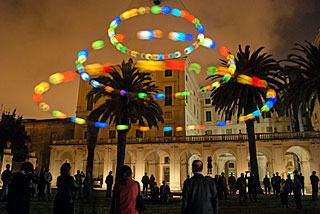
Heaven's Carousel premiere
Click to Enlarge
Credit: 
NASAESA, and Pam Jeffries

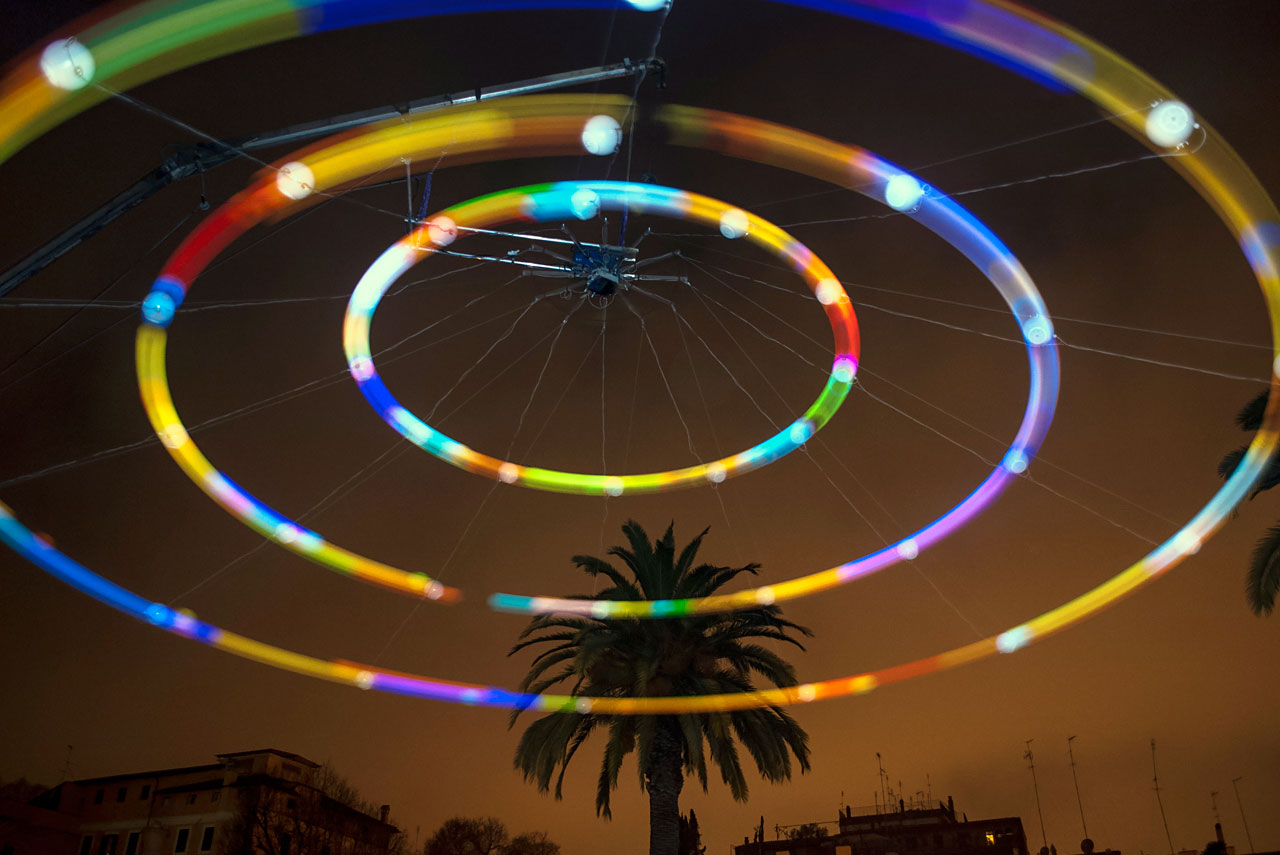
The “new astronomy-inspired art installation premiered in Rome at the Science with the Hubble Space Telescope IV conference.  The installation, named Heaven’s Carousel, links together the fields of art, music and astronomy. Conceptualised and designed by German artist and composer Tim Otto Roth, the work is inspired by novel work on the accelerating expansion of the Universe by Nobel laureate Adam Riess (STScl), Greek cosmology and Renaissance astronomers. “

The artwork takes the form of a rotating carousel, with 36 illuminated spherical loudspeakers mounted on long strings and illustrates some of Hubble’s key findings and the physical processes that underpin Hubble’s work [1].

“Being inside the installation is like being inside a sound Universe,” says artist Tim Otto Roth“When you look up at the night sky you see it in black and white, but in reality it is full of colours, colours which are too faint to be perceived by the eye’s colour receptors. It is the most dominant of these colours that I have translated into sound as part of the Heaven’s Carousel.”

In representing the Universe in this way Heaven’s Carousel allows the audience to experience phenomena such as the Doppler effect [2]. This phenomenon has been key to many of the discoveries discussed at the conference as it lets us know just how fast the galaxies observed by Hubble are moving away from or towards us. This can be experienced within the sound installation where at the centre of the installation there is no significant effect, but as the visitor moves outwards the frequencies start to oscillate dramatically and weave into a mesmerising sound tapestry.

During the 25-minute sound performance the other phenomena and processes that inspired the piece become evident. For example the progress from the high pitched and bright blue tones that represent the beginning of the Universe to the deep tones of red and low frequency sounds that illustrate what we observe in the distant Universe with Hubble today.

The premiere on Monday 17 March was very well attended and speeches were given by Tim Otto Roth and Adam Reiss, Nobel Prize winner and advisor to the artist, whose work was crucial to showing that the expansion of the Universe is accelerating.
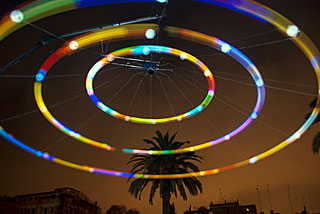
Heaven’s Carousel
Click to Enlarge

The immersive installation shows another way that Hubble has inspired new thinking over its 24 years in orbit. It provided the perfect accompaniment to the conference, which involved four days of talks from fields as broad as dark energy, the Hubble Frontier Fields, exoplanet research and Solar System research, to name but a few.

“As we celebrate Hubble’s splendid 24 years in orbit” says ESA Hubble Space Telescope project scientist Antonella Nota. “We are left to marvel at the accomplishments humanity can achieve when there is collaboration between communities. On this occasion, we celebrate the partnership between NASA and ESA which led to the creation of Hubble. A partnership which set the foundation for the James Webb Space Telescope and many more ventures to come.”

Hubble has allowed us to peer into the ancient Universe, to find planets outside the Solar System, to map the dark matter that lurks within galaxy clusters and to say that the expansion of the Universe is accelerating. In the words of John Grunsfeld, NASA Associate Administrator and former astronaut, who has visited Hubble on three occasions:

“Hubble has taken us further than we knew possible towards answering the biggest questions humanity has ever thought to ask: Where did we come from? Where are we going? And, are we alone?”

As part of the conference John Grunsfeld gave a talk on his experience of the Hubble service missions. These missions not only kept Hubble alive, but have also given Hubble a new lease of life through the installation of the wide-field camera, WFC3, on this last mission. This new camera is part of the reason that Hubble is still in constant use and a major theme of the conference was where Hubble will take us next. It is clear that, even with the James Webb Space Telescope on the horizon, Hubble still has a great deal left to offer.