The latest episode of “Space to Ground” from NASA on ISS activities this week :
A couple of other ISS relate videos:
** The Orbital ATK Cygnus cargo craft departs from the ISS on Wednesday:
** Exercising on the ISS:
====
The latest episode of “Space to Ground” from NASA on ISS activities this week :
A couple of other ISS relate videos:
** The Orbital ATK Cygnus cargo craft departs from the ISS on Wednesday:
** Exercising on the ISS:
====
Here is this week’s Earth to Ground report from NASA on activities related to the International Space Station:
Some other recent NASA videos:
** Astronauts on the International Space Station use amateur radio to talk with students all over the world about life and work in space. In October, flight engineer Joe Acaba made an historic contact with the Maria Montessori Institute Educational Unit in San Cristobal, Venezuela: the first-ever educational ham radio contact in that country’s history, courtesy of the Amateur Radio on International Space Station program. Here’s a look at the excitement on the ground as more than a dozen elementary and middle school students got their chance to talk to a man in space. For more on ARISS: http://www.ariss.org/
** Inside KSC! for Dec.1, 2017:
** DIY Glacier Modeling with NASA’s Virtual Earth System Laboratory – A new NASA Earth science simulator allows anyone with a computer to try their hand at do-it-yourself glacier modeling. Test it for yourself at https://vesl.jpl.nasa.gov .
====
Here is this week’s Space to Ground report from NASA on activities related to the International Space Station:
Some additional related NASA videos:
====
Here’s the latest “Space to Ground” report from NASA on activities related to the International Space Station:
A video of the rendezvous and docking of the Orbital ATK Cygnus cargo ship at the ISS two days after its launch from Wallops Island, Virginia:
Crew members talk about Thanksgiving:
Aboard the International Space Station, Expedition 53 Commander Randy Bresnik and his crewmates, NASA’s Joe Acaba and Mark Vande Hei and Paolo Nespoli of the European Space Agency (ESA) offered their thoughts about being in orbit during the Thanksgiving holiday and the meals and food they will enjoy in orbit during a series of messages downlinked on Nov. 15. Bresnik and Nespoli are in the final weeks of their five and a half month mission on the station, heading for a landing in Kazakhstan on Dec. 14, while Acaba and Vande Hei will remain in orbit through late February.
====
Some miscellaneous items of interest:
** This Performance Artist Is Also a Candidate for Space Travel – Creators – Sarah Jane Pell is a “Artist Astronaut” who believes that
… the artistic and astronautics components of her work have equal weight. In other words, the art isn’t supplementary. “Calling art supplementary is like calling it decoration,” Pell tells Creators.
“The capacity of an artist is deeper, more complex and culturally significant: stemming from a philosophy of aesthetics and poetics from the sublime to the beautiful and grotesque and everything in between. It is an act, action and activism, a way of being in the world that translates curiosities, insights and provocations about our being in time. It can be invention, experimentation, improvisation, expression, and calculated methodical gesture and mark. Art may manifest in music, movement, the material arts and letters. Art knows no bounds, and therein lays the capacity for new discovery.”
** NASA Opens $2 Million Third Phase of 3D-Printed Habitat Competition | NASA – NASA invites participates to enter the 3-D Printed Habitat Challenge competition:
Future missions to the Moon, Mars and beyond will require innovative options to shelter our explorers, and we won’t be able to carry all of the materials with us from Earth. NASA’s 3D-Printed Habitat Challenge, a Centennial Challenges competition, seeks ways to create or develop the technologies needed to create such habitats on-site, and challenges citizen inventors to lead the way. Today, NASA and challenge partner Bradley University of Peoria, Illinois, announce the opening of Phase 3 of the competition for team registration.
“The ideas and technologies this competition has already produced are encouraging, and we are excited to see what this next phase will bring,” said Monsi Roman, program manager of NASA’s Centennial Challenges. “The solutions we seek from our competitions are revolutionary, which by nature makes them extremely difficult. But this only fuels our teams to work harder to innovate and solve.”
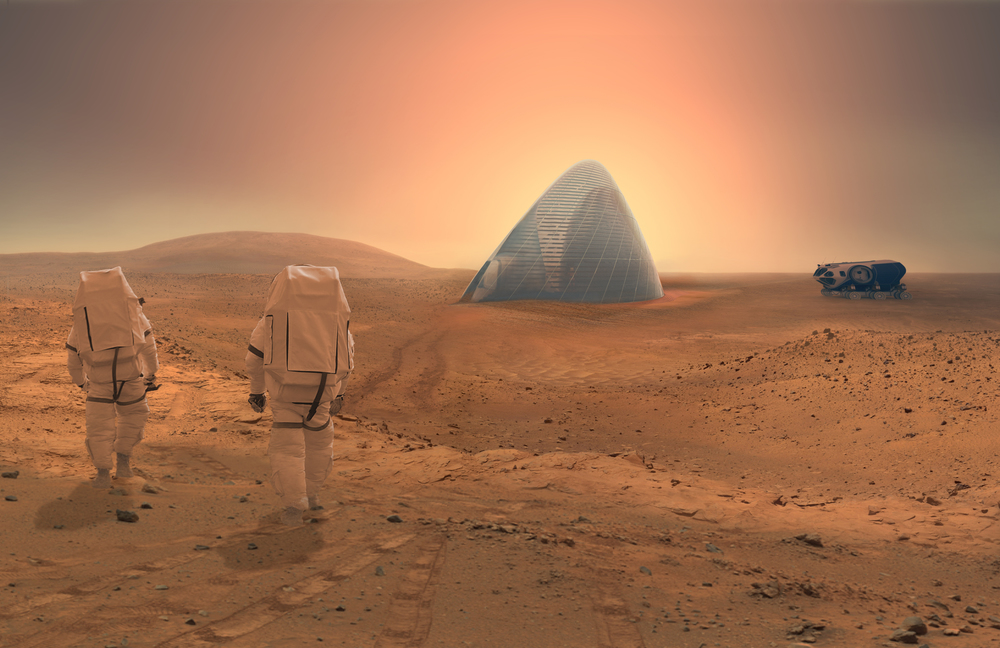
The goal of the 3D-Printed Habitat Challenge is to foster the development of new technologies necessary to additively manufacture a habitat using local indigenous materials with, or without, recyclable materials. The vision is that autonomous machines will someday be deployed to the Moon, Mars or beyond to construct shelters for human habitation. On Earth, these same capabilities could be used to produce affordable housing wherever it is needed or where access to conventional building materials and skills are limited.
Bradley University President Gary Roberts said the school is honored to be the challenge partner once again. “Bradley prides itself on experiential learning and student engagement,” Roberts said. “This challenge isn’t something our students can learn about in a textbook or in a classroom. This is a forward-thinking concept coming to life, and they have a chance to see it firsthand. They will meet the people making it happen and learn about the ideas that are fueling innovation. This could change the way they imagine the future and push their creative limits.”
The 3D-Printed Habitat Challenge is divided into phases. The Phase 1: Design Competition called on participants to develop state-of-the-art architectural concepts and was completed in 2015. The Phase 2: Structural Member Competition focused on manufacturing structural components and was completed in August 2017.
The now-open Phase 3: On-Site Habitat Competition challenges competitors to fabricate sub-scale habitats using indigenous materials with or without mission-generated recyclables, and offers a $2 million total prize purse. Phase 3 has five levels of competition. Interested teams may register through Feb. 15, 2018. Full details, schedule and rules can be found here.
** Scientists find potential ‘missing link’ in chemistry that led to life on earth | EurekAlert! – An interesting finding that could illuminate a key step in bringing together the ingredients that led to the formation of life on earth:
Origins-of-life researchers have hypothesized that a chemical reaction called phosphorylation may have been crucial for the assembly of three key ingredients in early life forms: short strands of nucleotides to store genetic information, short chains of amino acids (peptides) to do the main work of cells, and lipids to form encapsulating structures such as cell walls. Yet, no one has ever found a phosphorylating agent that was plausibly present on early Earth and could have produced these three classes of molecules side-by-side under the same realistic conditions.
TSRI chemists have now identified just such a compound: diamidophosphate (DAP).
====