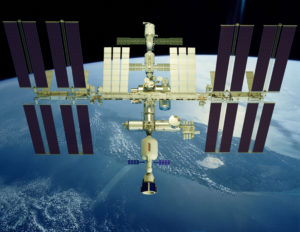
Here is the latest episode in NASA’s Space to Ground weekly report on activities related to the International Space Station:
** Down to Earth – Enjoy the View
In this episode of “Down to Earth – Enjoy the View,” NASA astronaut Mike Foreman shares how his perception of Earth changed during his time in space. He explains a shift in his worldview known as “the Overview Effect,” a term coined by space philosopher Frank White. #SpaceStation20th
** NASA ready to sending more plants and a new way to handle seeds to the International Space Station
Sending people to the Moon and Mars requires understanding how to provide nutrition for astronauts who may be away from Earth for extended periods of time. One solution is growing food in space, which can be challenging. To learn more, scientists will send three types of leafy greens and a new way to handle seeds in space to the International Space Station.
Launching from NASA’s Wallops Flight Facility in Virginia on Northrop Grumman’s 13th cargo resupply mission, the VEG-03 series of experiments will send a new crop, amara mustard, to the orbiting laboratory. Red romaine lettuce and ‘extra dwarf’ pak choi – which astronauts have grown and eaten in space – also will return to the station.
Researchers at NASA’s Kennedy Space Center in Florida planted the pak choi and amara seeds in containers called plant pillows, but for red romaine lettuce, they inserted the seeds into a new type of seed-handling material called seed film. This water-soluble, dissolving film is the same material as a breath freshener strip. It will allow the crew to plant the seeds into pillows themselves, something that has never been done in orbit before. This could allow astronauts to pick and choose what crops they want to grow from a collection of seeds on the space station.
** Pre-Launch Briefing for the Antares Cygnus CRS-13 Mission
how, for each Starship, there would be 72 round trip flights to the Moon for every round trip flight to Mars. SpaceX could sell 72X more tickets if using their Starship for the Moon. For this reason, the Starship might end up being a Moon rocket initially.
For the last year, a great deal of work has been done developing one of the most extensive space advocate websites. This website covers many aspects of space development, exploration, settlement, policy, and achieving Earth independence. Not very many topics have been left out of the website. So, check it out at: DevelopSpace.info
Near-term plans for the Network are to inform more space advocates about the website and Network and the organizing of more working groups to move specific fields forward.
** The “Value of Mars Settlement” was discussed by Bishop James Heiser at the Mars Society Convention:
Starship, which is currently in development for future deep-space travel, will be able to ferry as many as 100 passengers beyond low-Earth orbit. The way to achieving that goal is by reducing the cost of spaceflight. He would like for anyone who wants to go to Mars, to be able to.
“Needs to be such that anyone can go if they want, with loans available for those who don’t have money,” Musk wrote.
To that end, Musk said he wants to build a fleet of at least 1,000 Starships—and launch at least three of them every day.
The Starship system is the latest in SpaceX’s troupe of increasingly larger rockets. In 2018, the California-based aerospace company launched and landed its Falcon Heavy rocket for the first time, generating 5 million pounds of thrust from the rocket’s 27 engines. But even that’s not powerful enough for Mars-based missions.
“Megatons per year to orbit are needed for life to become multi-planetary,” Musk tweeted on Thursday.
But the ship would also be able to navigate the tenuous Martian atmosphere and land safely on the red planet’s surface.
Musk estimates that a fleet of 1,000 Starships, able to tote 100 megatons of stuff to Mars, would be required to build a permanent settlement. That fleet could transport about 100 passengers each, totaling 100,000 people per year.
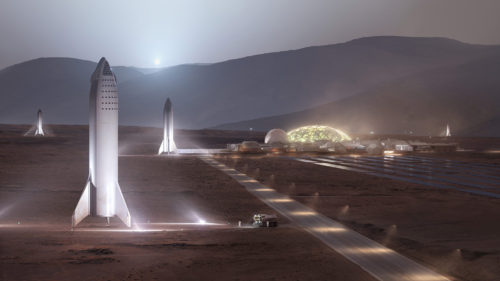
A SpaceX vision of a Mars settlement built with people and cargo transported via Starships.
What struck me however was the nature of the place and the experience of living at a polar station that had to manage on the supplies on hand, during an arctic winter with no sun and temperatures routinely colder than -90 degrees Fahrenheit. In many more ways that the situation at the Mars Society’s Utah facility, the U.S. South Pole station did a great job of simulating closely what living at an early Mars base will be like.
Interestingly, some of the differences would like make living on Mars easier then at that 1999 station. Because of the lack of full atmosphere on Mars, any Mars base must be sealed from the outside environment. At the south pole, they did not do this, so that the inside temperatures were generally colder than one would like. This also meant that the crews were somewhat oxygen-starved by the end of the mission, as the facility was also at about 9,000 feet elevation and thus had a thinner atmosphere then what you’d likely find inside a Martian base.
A crew of six scientists returned from “the moon” Saturday to wrap up two weeks exploring a mock lunar landscape on the side of a Hawaiian volcano.
The scientists began their mission on Jan. 18 and have been working and living at the Hawaii Space Exploration Analog and Simulation, or HI-SEAS, habitat as part of the third EuroMoonMars mission (EMMIHS-III) — a series of analog missions run in collaboration with the European Space Agency, the International MoonBase Alliance and HI-SEAS.
The habitat, located on a remote slope of Mauna Loa on the Big Island of Hawaii, has hosted groups of researchers and explorers on analog moon and Mars missions since its installation in 2013. Analog missions such as this put researchers in remote environments that mimick a stay on Mars or, in this case, the moon. In this environment they can conduct research while testing what it might be like for humans to spend time at a remote, off-Earth location.
The Hi-SEAS space habitat simulation facility on the northside of Mauna Loa, Hawaii
If there’s one thing the limited research shows, it’s that it’s hard to predict who will cope best and work well together as the weeks and months, maybe even years, wear on. Many factors can boost the chances of success, however, especially if crew members give each other precisely the kind of support and encouragement that people in prison are deprived of.
A well-performing team needs talented leaders and a closely knit group of people. They need to build trust between each other while they’re training, long before the rocket blasts off. Diverse, international crews could help to overcome some challenges that might come up, but that diversity also sometimes results in cultural and interpersonal problems. A larger crew would likely perform better than a smaller one, but the team’s size will always be limited by how much weight and fuel can be launched.
Once they’re in space, people need to keep busy, and they need to think they have something worthwhile to do, even if it’s actually of limited value. They also need a tiny bit of privacy and entertainment at times, which might include something they brought from home or a simulation of the family and friends they left behind. While at work, the crew members need clear goals and procedures to follow in a wide range of situations. Only people shown to be resilient under pressure for long periods and who have strong teamwork skills even in stressful, sleep-deprived conditions should be part of the crew.
** Building lunar settlements will likely rely on 3D printing techniques like that used by ESA in a test of making blocks from simulated Moon dust: 3D-printed block of moondust – ESA
The hollow cell structure of this 1.5 tonne block, 3D printed from simulated lunar dust, let it combine strength with low weight, like bird bones.
The building block is on show in the laboratory corridor of ESA’s ESTEC technical centre in the Netherlands, visited during public tours from neighbouring Space Expo.
ESA has subsequently investigated other types of lunar 3D printing, including solar sintering and ceramics.
Closeup of a 3D-printed block of simulated Moon dust. Credits: ESA
** The Luna-27 rover is a Russian project in collaboration with ESA to investigate the resources of the southern polar region of the Moon. The rover is expected to launch in 2022. The PROSPECT instrument package, for example, will drill a meter deep into the regolith to examine various chemical properties and determine mineral and water content: One step closer to prospecting the Moon – ESA
Prospect includes a miniature laboratory called ProSPA which will analyse the soil samples retrieved by the drill. Precise measurements will help unearth the secrets of the Moon’s history and indicate whether future explorers could use lunar resources on their missions to help set up a lunar base.
The lunar south polar region is of great interest to lunar researchers and explorers because the low angle of the Sun over the horizon leads to areas of partial or even complete shadow. These shadowed areas and permanently dark crater floors, where sunlight never reaches, are believed to hide water ice and other frozen substances that could be analysed to better understand the natural processes that formed them, and used to produce resources such as oxygen and propellant in the future.
Here is the latest episode in NASA’s Space to Ground weekly report on activities related to the International Space Station:
** Christina Koch Undocks in Soyuz Crew Ship
** Christina Koch – Space Station Scientist
After almost a year in space, NASA astronaut Christina Koch is coming home. When Koch returns to Earth, she will have lived in space for 328 days, setting the record for the longest single spaceflight by a woman. During this record-setting mission, Koch spent many of her hours on science activities aboard the space station and wore many hats: farmer, biologist, physicist, engineer, test subject and many more. Learn more about the research being conducted on Station: https://www.nasa.gov/iss-science
** Christina Koch’s Memorable Moments: Part 5
328 days—nearly 47 full weeks in space—is the new record for the longest single spaceflight ever by a female astronaut or cosmonaut, set today by NASA astronaut Christina Koch as she completed her mission with a Soyuz landing in Kazakhstan. Koch talks about some of her cherished memories from a journey that has her now ranked seventh among NASA astronauts for cumulative time spent in space.
** Advice on Returning to Earth for Astronaut Christina Koch from Scott Kelly
After 328 days in space, NASA astronaut Christina Koch has returned to Earth, now holding the record for longest single spaceflight by a woman. Former NASA astronaut Scott Kelly, who holds the record for longest single mission by an American astronaut at 340 days in space, offers his advice on getting used to life back on Earth.
Here is the latest episode in NASA’s Space to Ground weekly report on activities related to the International Space Station:
** Christina Koch’s Memorable Moments: Part 4
The longest-ever single spaceflight by a female astronaut is now 322 days long, and still counting! Today NASA astronaut Christina Koch moved past her colleague Suni Williams into seventh place for most time spent in space among all American astronauts. With less than a week to go, Koch recalls the biggest surprise of the mission and the most memorable item she received on a cargo flight.
** Down to Earth – Black Velvet of Space
In honor of the space station 20th anniversary, NASA Astronaut Bill McArthur shares his experience living and working in space aboard the International Space Station in this episode of “Down to Earth – Black Velvet of Space.” As he describes it, he experienced a shift in his worldview known as “the Overview Effect,” a term coined by space philosopher Frank White.
** Northrop Grumman Cygnus cargo resupply vehicle departed from the ISS on Friday morning:
** Obtaining oxygen and metals from lunar regolith: Nearly half of the chemical content of lunar dust is oxygen and most of the rest contains metals, both essential for sustainable lunar settlements. Here is a report from ESA on research into an efficient way to extract these resources from lunar regolith: ESA opens oxygen plant – making air out of moondust – ESA
ESTEC’s oxygen extraction is taking place using a method called molten salt electrolysis, involving placing regolith in a metal basket with molten calcium chloride salt to serve as an electrolyte, heated to 950°C. At this temperature the regolith remains solid.
But passing a current through it causes the oxygen to be extracted from the regolith and migrate across the salt to be collected at an anode. As a bonus this process also converts the regolith into usable metal alloys.
In fact this molten salt electrolysis method was developed by UK company Metalysis for commercial metal and alloy production. Beth’s PhD involved working at the company to study the process before recreating it at ESTEC.
On the left side of this before and after image is a pile of simulated lunar soil, or regolith; on the right is the same pile after essentially all the oxygen has been extracted from it, leaving a mixture of metal alloys. Both the oxygen and metal could be used in future by settlers on the Moon. Samples returned from the lunar surface confirm that lunar regolith is made up of 40-45% percent oxygen by weight, its single most abundant element. Credits: ESA
“At Metalysis, oxygen produced by the process is an unwanted by-product and is instead released as carbon dioxide and carbon monoxide, which means the reactors are not designed to withstand oxygen gas itself,” explains Beth. “So we had to redesign the ESTEC version to be able to have the oxygen available to measure. The lab team was very helpful in getting it installed and operating safely.”
The oxygen plant runs silently, with the oxygen produced in the process is vented into an exhaust pipe for now, but will be stored after future upgrades of the system.
“The production process leaves behind a tangle of different metals,” adds Alexandre, “and this is another useful line of research, to see what are the most useful alloys that could be produced from them, and what kind of applications could they be put to.
The use of lava tubes on Mars as emergency shelters and storage has been advanced by researchers at the Antarctic Institute of Canada.
Lava tubes are formed from fast moving lava which later cools and forms roomy caves that might serve various functions for future human expeditions to the Red Planet.
Svetozar Zirnov, Daniel Polo, and Austin Mardon of the institute floated the idea at this week’s Seventh International Conference on Mars Polar Science and Exploration being held in Ushuaia, Tierra del Fuego, Argentina.
Science fiction often imagines our future on Mars and other planets as run by machines, with metallic cities and flying cars rising above dunes of red sand. But the reality may be even stranger – and “greener.” Instead of habitats made of metal and glass, NASA is exploring technologies that could grow structures out of fungi to become our future homes in the stars, and perhaps lead to more sustainable ways of living on Earth as well.
The myco-architecture project out of NASA’s Ames Research Center in California’s Silicon Valley is prototyping technologies that could “grow” habitats on the Moon, Mars and beyond out of life – specifically, fungi and the unseen underground threads that make up the main part of the fungus, known as mycelia.
“Right now, traditional habitat designs for Mars are like a turtle — carrying our homes with us on our backs – a reliable plan, but with huge energy costs,” said Lynn Rothschild, the principal investigator on the early-stage project. “Instead, we can harness mycelia to grow these habitats ourselves when we get there.”
Ultimately, the project envisions a future where human explorers can bring a compact habitat built out of a lightweight material with dormant fungi that will last on long journeys to places like Mars. Upon arrival, by unfolding that basic structure and simply adding water, the fungi will be able to grow around that framework into a fully functional human habitat – all while being safely contained within the habitat to avoid contaminating the Martian environment.
This video from the NIAC 2018 Symposium includes a presentation about the fungi construction starting at around the 1:25:00 point:
We propose a public/private partnership to develop and demonstrate space solar power at a sufficiently high technical level that commercial energy providers can subsequently build operational systems for high-energy-cost environments such as remote mining facilities. The outlines of the partnership are based on the successful Commercial Orbital Transportation Services program that helped develop the SpaceX Falcon 9 launcher/Dragon capsule and the Orbital Sciences Corp. Antares launcher and Cygnus spacecraft. The Space Solar Power Demo development described here features minimal NASA oversight, milestone-driven fixed-price payouts, minimal exit criteria, substantial commercial partner funding commitments, non-traditional contracts (e.g., Space Act Agreements with NASA), commercial partner choice of energy market and energy consumer, enabling system development (e.g., space robotics), and at least two winners.
** Settling the moons of Saturn: The Space Show – Tue, 01/14/2020 – In this interview, Janelle Wellons of NASA JPL talked about Titan and other moons of Saturn and commented on the possibility of someday putting human settlements on them:
** Weekly Space Hangout: December 18, 2019 – Anita Gale of Space Settlement Design Competitions
We record the Weekly Space Hangout every Wednesday at 5:00 pm Pacific / 8:00 pm Eastern. You can watch us live on Universe Today or the Weekly Space Hangout YouTube page. Tonight we welcome Anita Gale, retired Boeing Associate Technical Fellow with over 40 years of experience in Payload and Cargo Integration on crewed spacecraft, including Space Shuttle and Commercial Crew. She is currently an elected member of the National Space Society (NSS) Executive Committee. Anita co-founded Space Settlement Design Competitions which give high school students on six continents the experience of working on an aerospace industry proposal team to design and sell a space settlement in the context of “future history.” To learn more about the competitions, visit https://spaceset.org/ You can read Anita’s full bio at https://space.nss.org/anita-gale-biog…