Category Archives: Contests and Games

“Putt the Planets” – space app for iOS, Android and Kindle Fire

Check out the game Putt the Planets: The way the future was supposed to be!

It is available for iOS, Android, and Kindle Fire and sells for $1.

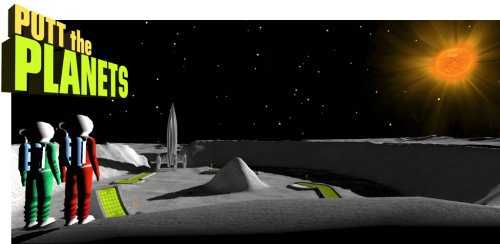
Putt the Planets banner

PUTT THE PLANETS

Take a grand tour of our Solar System, putter in hand! Travel from planet to planet, playing a few holes of mini-golf at each stop. It’s the way the future was supposed to be!

FEATURES:

  • BREATHTAKING mini-golf courses in exotic locales throughout the Solar System: planets, moons, comets, and more. Three courses — 54 holes in all!
  • SENSATIONAL golfing challenges featuring gravity, the forces of nature, astronomical phenomena, and historic space missions.
  • SPECTACULAR 3D planetary landscapes, based on the latest scientific discoveries.
  • THRILLING journeys from one planet to the next.
  • HYPNOTIZING Space Age bossa nova music.

The Space Show: New time for Bill Harwood interview + Don Flournoy and Sunsat Design Competition

Time Change For Sunday, Nov. 24, 2013 Program

SPECIAL TIME: The Sunday, Nov. 24, 2013 program time has been changed to 3-4:30 PM PST, (6-7:30 PM EST, 5-6:30 PM CST): We welcome William (Bill) Harwood to the program. Bill is the CBS News space consultant who has covered America’s space program full time for more than 25 years, focusing on space shuttle operations, planetary exploration and astronomy. Based at the Kennedy Space Center in Florida, Harwood provides up-to-the-minute space reports for CBS News and regularly contributes to Spaceflight Now and The New York Times.

CBS News:space is written, edited and maintained by CBS News space analyst William Harwood, who has covered America’s space program full time for three decades, focusing primarily on space shuttle operations, assembly of the International Space Station and planetary exploration. Based at the Kennedy Space Center in Florida, Harwood provides up-to-the-minute space reports for CBS News and CNET, including detailed email updates. He also contributes to Spaceflight Now and The New York Times. Listeners can talk with Bill Harwood or the host and express their views using toll free 1 (866) 687-7223, and by sending e-mail during the show to drspace@thespaceshow.com. Please note the toll free number is only available during a live Space Show program.

===

Dr. Don Flournoy of Ohio University was on the Space Show last Friday and discussed the International SunSat Design Competition, is offering $30,000 in prizes for winning designs of space based solar power systems: Dr. Don Flournoy, Friday, 11-22-13 -Thespaceshow’s Blog.

See also the recent announcement from the National Space Society, a partner in the contest: Participate in the International SunSat Competition – NSS

FAI Young Artists Contest for 2014

The FAI (Fédération Aéronautique Internationale, also known as The World Air Sports Federation) is sponsoring the FAI Young Artists Contest again:

The FAI Young Artists Contest is an international art contest for youngsters between the ages of 6 and 17. Each FAI Member Country sponsors the contest in their country, and the national winners are submitted to the International Jury each year.

The Theme for the 2014 contest is : Flying to save lives.

The entries can include space topics related to the contest theme and not just aviation.

The entry deadline is April 1, 2014.

“Travel bug’ going to the great geocache in the sky

Geocaching has become a popular “treasure hunt” activity around the world. Small stashes of miscellaneous items are hidden in containers in over 2.25 million spots around the globe and their locations archived at  www.Geocaching.com.  Participants use their GPS units to find a cache, which might be by a waterfall in a forest or behind a telephone pole along a city street. The geocacher can take an item from the cache but they should replace it with some new item.

Geocaching has now extended from earth into space: Geocaching in Space FAQ – The Geocaching Blog.

In 2008, Richard Garriott placed a small cache on the International Space Station during his visit there. This evening, a Soyuz with three new ISS crew members will blast off and arrive at the station in the morning. They include US astronaut Rick Mastracchio who will be carrying a Travel Bug Dog Tag. A travel bug is a Trackable item that simply has an ID that is registered at www.geocaching.com and as it is moved from cache to cache, the movers write about the tag’s travels on the website. Garriott left one on the station and Mastracchio will take a new one that is sponsored by the 5th grade class of Chase Elementary School in Waterbury, Connecticut and add it to the cached on the station. He will, however, return it to the class when he returns from space in six months.

For more details see:


NASA, Harvard & TopCoder sponsor contest to develop deep space networking protocols

NASA, Harvard Business School, and the TopCoder open software organization have opened the NASA Tournament Lab (NTL), which is sponsoring a contest to develop Data Tolerant Networking  (DTN) techniques, such as “a method by which cryptographic keys can be exchanged in a network suffering from connectivity disruptions”. DTN is particularly needed to deal with the  challenges of deep space communications such as long delays. NASA needs you to bring the Internet to deep space – VentureBeat

Here is a press release for the competition:

NASA, Harvard & TopCoder Partner to Develop a Secure Solar System Internet Protocol

SAN FRANCISCO, CA–(Marketwired – Oct 31, 2013) – TopCoder, the world’s largest professional development and design community, with NASA and the Harvard-NASA Tournament Lab (at Harvard’s Institute for Quantitative Social Science), today announced the launch of a series of innovation challenges that will develop foundational technological concepts for disruption tolerant deep space networking.

NASA has made significant progress in developing Disruption Tolerant Networking (DTN) protocols that aide in deep space communication. DTN protocols are an approach to network architecture that seeks to address the potential for lack of continuous connectivity in deep space. It is meant to aid NASA in the exploration of the solar system by overcoming communication time delays caused by interplanetary distances, and the disruptions caused by planetary rotation, orbits and limited transmission power.

While DTN protocols are currently able to transmit information, the disruptive and time delayed environment in space makes secure communication difficult. TopCoder is challenging its members to create a mechanism by which cryptographic keys are initialized, distributed and validated while using DTN protocols in order to provide secure communications over vast distances in space.

There are currently three DTN challenges available on the TopCoder website :

1. Security Key Challenge: Strengthen DTN communication by adding the ability to include cryptographic keys.
2. Delay-Tolerant Payload Conditioning (DTPC) Challenge: Validate an implementation of the DTPC protocol developed by Marshall Space Flight Center.
3. Licklider Transmission Protocol (LTP): Add “sender authentication” to the space flight implementation of the protocol.

TopCoder is inviting its members and anyone else in the world to help create the future of space exploration by participating in the DTN Challenge Series. Learn more at www.topcoder.com/dtn.

Comments on the news:

“Born out of a belief that 10 years in the future (i.e. about 2023) a richer networking environment than point-to-point radio links would be required to communicate, a small team of developers debated the architecture of an interplanetary Internet,” said Vinton Cerf, Distinguished Visiting Scientist, NASA Jet Propulsion Laboratory and Vice President and Chief Internet Evangelist at Google. “Today, that vision is being fulfilled with prototype operations on the surface of Mars and in orbit, on the International Space Station and on board the EPOXI comet-visiting spacecraft.”

“Contest-based innovation has proven to be an important complement to existing internal efforts to solve important technological problems,” said Karim R. Lakhani, Lumry Family Associate Professor of Business Administration at the Harvard Business School and Principal Investigator of the Harvard-NASA Tournament Lab. “The Disruption Tolerant Networking challenges represent an opportunity for citizens from around the world to make fundamental contributions to the future of space exploration and have a real impact on the space program.”

“The TopCoder community is helping us build a secure networking protocol to hold and transmit information that provides privacy within a time-delayed space-network,” said Rinat Sergeev, NASA Tournament Lab, Data Scientist and Institute of Quantitative Social Sciences, Harvard. “This is the first time we have tapped the professional crowd to help develop a major keystone in the future era of space exploration and look forward to seeing the community’s 600,000 member strong response.”

About TopCoder, Inc.

TopCoder, the community division of Appirio, is the world’s largest design and development community with more than 600,000 members globally. The TopCoder community creates digital assets including analytics, software and creative designs and solutions with a competitive, standards based methodology. For more information, please visit www.topcoder.com.