Category Archives: In Space Infrastructure

Videos: “Space to Ground” & other space habitat reports – July.23.2022

Here is the latest episode in NASA’s Space to Ground weekly report on activities related to the International Space Station:

** Astronaut Discusses Life Aboard Space Station During Farnborough Air Show – NASA Video

Aboard the International Space Station, Expedition 67 Flight Engineer Samantha Cristoforetti of ESA (European Space Agency) discussed living and working in space during an in-flight interview for the Farnborough Air Show in England July 22. Cristoforetti launched in April on the SpaceX Dragon spacecraft, named Freedom, for a science mission to advance scientific knowledge and demonstrate new technologies for future human and robotic exploration missions.

** Russian, European Space Agency Spacewalk Animation – NASA Video

Jul 20, 2022 Expedition 67 Commander Oleg Artemyev of Roscosmos and Flight Engineer Samantha Cristoforetti of European Space Agency, clad in Russian Orlan spacesuits, will conduct a spacewalk on Thursday, July 21, 2022. The primary objective is to install platforms and workstation adapter hardware near the 37-foot-long manipulator system mounted to the Nauka module. The spacewalkers also will relocate the arm’s external control panel, replace a protective window on the arm’s camera unit, and extend a Strela telescoping boom from Zarya to Poisk to facilitate future spacewalks. The European robotic arm will be used to move payloads and equipment outside the Russian segment of the station, joining the Canadian-built Canadarm2 robotic arm and the Japanese arm already supporting station maintenance, operations, and research. One of the first tasks will see Artemyev and Cristoforetti deploy 10 nanosatellites designed to collect radio electronics data during the spacewalk, which will be the 251st in support of station assembly, maintenance, and upgrades. Artemyev will wear a Russian spacesuit with red stripes, while Cristoforetti will wear a Russian suit with blue stripes. This will be the sixth spacewalk for Artemyev and the first for Cristoforetti, who will become the fourth European astronaut to conduct a spacewalk in a Russian spacesuit.

** Spacewalker tosses cubesats away from space station in this amazing view – VideoFromSpace

Watch Russian cosmonaut Oleg Artemyev deployed 4 of 10 cubesats during a spacewalk outside the International Space Station on July 21, 2022.

** Cubesat hits space station solar array ‘mildly’ after spacewalker deploys it – VideoFromSpace

A cubesat made ‘mild’ contact with a space station solar array after it was deployed by Russian cosmonaut Oleg Artemyev during a spacewalk outside the International Space Station on July 21, 2022. “I think it is okay because the first contact was very mild and the second contact was at the frame,” said Artemyev following the hit, which was out of view in the video.

** Expedition 67 SpaceX Dragon CRS-25 Cargo Ship Docks to International Space Station – July 16, 2022 –  NASA Video

Jul 18, 2022 Loaded with scientific experiments and supplies, the unpiloted SpaceX CRS-25 cargo ship automatically docked to the International Space Station July 16. The SpaceX spacecraft linked up to the Harmony module after launching July 14 from Florida with several tons of experiments and hardware.

** 15 Benefits of Space Station Research – NASA Johnson

The first decade of the International Space Station was the decade of construction. The second decade moved from initial studies to fully using the capabilities of the orbiting laboratory. We have now entered the decade of results. With more than 20 years of experiments conducted on station, more breakthroughs are materializing than ever before. Explore 15 of the ways the space station is benefiting humanity: https://go.nasa.gov/3ASkrrD

** International Space Station Benefits for Humanity 2022 – NASA Johnson

The 2022 edition of the International Space Station Benefits for Humanity publication is now available. This updated edition is packed with numerous benefits of the microgravity laboratory highlighting the groundbreaking discoveries helping society, technologies tested for future space exploration, new scientific breakthroughs, and contributions to the growing low-Earth orbit (LEO) economy. View the full Benefits for Humanity 2022 publication here: https://www.nasa.gov/stationbenefits

** How China will Complete its Space Station in 2022 (a Step-by-Step Recap) – Dongfang Hour

Welcome to another episode of the Dongfang Hour! In this video, we describe step-by-step how the Chinese Space Station will be fully assembled in 2022 and adopt its final T-shape configuration. At the end, we also speculate on what the Space Station could look like in the future if extended If you like what you see, please consider supporting us at patreon.com/dongfanghour !

00:00 Introduction to the Chinese Space Station
01:26 Wentian lab module (July 2022)
03:16 Mengtian lab module (October 2022)
03:54 Final cargo and crewed missions (Nov/Dec 2022)
04:35 Possible future extension?
07:04 Conclusion (and 100th episode!)

** Tianzhou-3 Cargo Craft Undocks from Space Station After Completing Missions – CCTV Video News Agency

Jul 17, 2022 China’s cargo spacecraft Tianzhou-3 undocked from the combination of the under-construction space station at 10:59 Beijing time Sunday, after completing all its missions, according to the China Manned Space Agency (CMSA).

** Shenzhou-14 Astronauts Preparing for Arrival of Wentian Lab Module – CCTV Video News Agency

Three Chinese astronauts Chen Dong, Liu Yang and Cai Xuzhe stationed in space are preparing for the arrival of Wentian laboratory module, which is set to be launched at the end of July.

** ISS Live video stream – IBM/ISS HD Earth Viewing Experiment

Currently, live views from the ISS are streaming from an external camera mounted on the ISS module called Node 2. Node 2 is located on the forward part of the ISS. The camera is looking forward at an angle so that the International Docking Adapter 2 (IDA2) is visible. If the Node 2 camera is not available due to operational considerations for a longer period of time, a continuous loop of recorded HDEV imagery will be displayed. The loop will have “Previously Recorded” on the image to distinguish it from the live stream from the Node 2 camera. After HDEV stopped sending any data on July 18, 2019, it was declared, on August 22, 2019, to have reached its end of life. Thank You to all who shared in experiencing and using the HDEV views of Earth from the ISS to make HDEV so much more than a Technology Demonstration Payload!

====
=== Amazon Ads ===

LEGO Ideas International Space Station Building Kit,
Adult Set for Display,
Makes a Great Birthday Present
(864 Pieces)

====

Outpost in Orbit:
A Pictorial & Verbal History of the Space Station

Videos: “Space to Ground” & other space habitat reports – July.16.2022

Here is the latest episode in NASA’s Space to Ground weekly report on activities related to the International Space Station:

** Science Launching on the Next SpaceX Cargo Resupply Mission to the Space Station – NASA

The 25th SpaceX cargo resupply services mission (SpaceX CRS-25) carrying scientific research and technology demonstrations to the International Space Station is scheduled for launch July 14from NASA’s Kennedy Space Center in Florida. Experiments aboard the Dragon capsule include studies of the immune system, Earth’s oceans, soil communities, and cell-free biomarkers, along with mapping the composition of Earth’s dust and testing an alternative to concrete. More: https://go.nasa.gov/3PENKTO

** SpaceX CRS-25: Genes In Space – ISS National Lab – YouTube

A student researcher intends to launch a genetic experiment to the International Space Station through the Genes in Space education program. This investigation seeks to evaluate water pathogens in space and validate “biobits”, a technology created by miniPCR (co-founders of the Genes in Space program with Boeing) for future inquiries. Learn more about this investigation and educational program here!

** Expedition 67 Astronaut Bob Hines Talks with WHP-TV in Harrisburg, Pennsylvania – July 13, 2022 – NASA Video

Aboard the International Space Station, Expedition 67 Flight Engineers Bob Hines and Samantha Cristoforetti of ESA (European Space Agency) discussed life and work aboard the orbital outpost during an in-flight event July 13 with WHP-TV in Harrisburg, Pennsylvania. Hines and Cristoforetti are in the midst of a science mission living and working aboard the microgravity laboratory. The goal of their mission is to advance scientific knowledge and demonstrate new technologies for future human and robotic exploration missions as part of NASA’s Moon and Mars exploration approach, including lunar missions through NASA’s Artemis program.

** SpaceX CRS-25 Cargo Dragon docks with space station – VideoFromSpace

See the approach and soft capture callout for the SpaceX CRS-25 cargo mission to the International Space Station. The capsule arrived at the orbital outpost on July 16, 2022. See the launch: https://www.space.com/spacex-crs-25-c…

** Shenzhou-14 Astronauts Preparing for Arrival of Wentian Lab Module – CCTV Video News Agency

Three Chinese astronauts Chen Dong, Liu Yang and Cai Xuzhe stationed in space are preparing for the arrival of Wentian laboratory module, which is set to be launched at the end of July.

** ISS Live video stream – IBM/ISS HD Earth Viewing Experiment

Currently, live views from the ISS are streaming from an external camera mounted on the ISS module called Node 2. Node 2 is located on the forward part of the ISS. The camera is looking forward at an angle so that the International Docking Adapter 2 (IDA2) is visible. If the Node 2 camera is not available due to operational considerations for a longer period of time, a continuous loop of recorded HDEV imagery will be displayed. The loop will have “Previously Recorded” on the image to distinguish it from the live stream from the Node 2 camera. After HDEV stopped sending any data on July 18, 2019, it was declared, on August 22, 2019, to have reached its end of life. Thank You to all who shared in experiencing and using the HDEV views of Earth from the ISS to make HDEV so much more than a Technology Demonstration Payload!

====

=== Amazon Ads ===

LEGO Ideas International Space Station Building Kit,
Adult Set for Display,
Makes a Great Birthday Present
(864 Pieces)

====

Outpost in Orbit:
A Pictorial & Verbal History of the Space Station
Videos: “Space to Ground” & other space habitat reports – July.8.2022

Here is the latest episode in NASA’s Space to Ground weekly report on activities related to the International Space Station:

** Nanoracks Bishop Airlock – International Space Station Trash Deployment – View #1 – Nanoracks – YouTube

On July 2, 2022, Nanoracks, powered by Voyager Space, opened the Bishop Airlock to deploy waste from the International Space Station. This was the first time that the Bishop Airlock was opened and closed for a full cycle. Nanoracks deployed approx. 350 lbs of trash.

** Nanoracks Bishop Airlock – International Space Station Trash Deployment – View #2 – Nanoracks – YouTube

** Expedition 67 – Space Station Astronauts Answer Florida Student Questions -July 6, 2022 – NASA Video

Aboard the International Space Station, NASA Expedition 67 Flight Engineers Bob Hines and Jessica Watkins of NASA answered pre-recorded questions about life and work on the orbital laboratory during an in-flight event July 6 with students at the Gifford Youth Achievement Center in Vero Beach, Florida. Hines and Watkins are in the midst of a science mission living and working aboard the microgravity laboratory to advance scientific knowledge and demonstrate new technologies for future human and robotic exploration missions as part of NASA’s Moon and Mars exploration approach, including lunar missions through NASA’s Artemis program.

** Fourth of July in space! Astronauts beam down message – VideoFromSpace

NASA astronauts Kjell Lindgren and Robert Hines share a Fourth of July message from the International Space Station. — The Fourth of July night sky: Here’s what you can see on Independence Day: https://www.space.com/fourth-july-202…

** What do you hear, Starbuck? – European Space Agency, ESA on Youtube

FedCon is one of Europe’s largest science fiction conventions, its 2022 edition held earlier this month in Bonn in Germany. Actors from the many incarnations of Star Trek, as well as Star Wars, Doctor Who, and other science fiction shows met with thousands of fans. ESA has been taking part in FedCon since 2015, with talks, panels, and a stand covering our space science, earth observation, and human exploration missions. At this year’s event, scientists and engineers from ESTEC, ESOC, and the EAC gave talks about JWST, Rosetta, mission operations, and careers with ESA.

In addition, to help celebrate FedCon’s 30th anniversary, ESA astronaut Samantha Cristoforetti sent a special message from her current Minerva mission on the ISS. She was dressed in an outfit worn by flight crew in the re-imagined Battlestar Galactica series (2004–2009) and wearing the dog tags of famed Viper pilot, Kara “Starbuck” Thrace. Samantha previously appeared as a speaker at FedCon in 2018 and also took part in a 2020 episode of the Space Rocks Uplink vodcast with Katee Sackhoff, who played Starbuck in the series. While we may not yet have invented a faster-than-light drive as used in Battlestar Galactica, ESA turns science fiction into science fact every day, exploring and studying the near-Earth environment, the Solar System, and the Universe beyond, to innovate, inform, and inspire. And we’re always happy to share that excitement with our friends around the world, through events like FedCon and much more.

** China’s Shenzhou-14 Crew Completes Several Missions in Orbit – CCTV Video News Agency

China’s Shenzhou-14 crew has stayed in orbit for over a month, completing several missions on board the space station core module Tianhe. On June 5, the Shenzhou-14 manned spacecraft was launched at the Jiuquan Satellite Launch Center. The trio became the third batch of astronauts to work in the Chinese space station and are expected to work there for six months. This time around, astronauts need to build the manned space environment after they enter Tianhe, setting the mode of the core module into a manned state and switching on equipment and facilities used for ventilation, purification, regeneration and water treatment. In addition, astronauts have conducted tests on water, air and microorganisms inside Tianhe.

This comes as some microorganisms may lead to health problems of the astronauts and can even be corrosive toward various of facilities. As such, astronauts have also installed and tested the facility used for carbon dioxide reduction in a bid to generate more oxygen in Tianhe. Furthermore, a material management system has been officially set up to assist astronauts in locating specific material in Tianhe for more efficiency. Right now, astronauts are carrying out experiments, covering maglev, non-package materials and aerospace medicine. For a safer travel outside the space station complex, astronauts have checked and tested the function and performance of Feitian spacesuits, which will protect astronauts when they conduct extravehicular activities from Wentian lab module.

While in Tianhe, astronauts also need to go through regular body checkups to monitor their health condition. Apart from body checkups, astronauts also train themselves with medical aid skills even in space to enable themselves to approach any potential emergencies. Working six days per week, the trio enjoys doing exercises with safety belts on, which are totally different from that on Earth, to keep fit and stay healthy. Later on, the Shenzhou-14 crew will deliver a livestream science lecture at China’s space station lab module Wentian, which is scheduled to be launched this month. It will be the first time for the crew to broadcast a live lecture from a space lab module. Previous space classes by the Shenzhou-13 crew were given from the station’s core module Tianhe. The trio will cooperate with the ground team to complete the construction of the country’s space station, developing it from a single-module structure into a national space laboratory with three modules — the core module Tianhe and two lab modules Wentian and Mengtian.

** ISS Live video stream – IBM/ISS HD Earth Viewing Experiment

Currently, live views from the ISS are streaming from an external camera mounted on the ISS module called Node 2. Node 2 is located on the forward part of the ISS. The camera is looking forward at an angle so that the International Docking Adapter 2 (IDA2) is visible. If the Node 2 camera is not available due to operational considerations for a longer period of time, a continuous loop of recorded HDEV imagery will be displayed. The loop will have “Previously Recorded” on the image to distinguish it from the live stream from the Node 2 camera. After HDEV stopped sending any data on July 18, 2019, it was declared, on August 22, 2019, to have reached its end of life. Thank You to all who shared in experiencing and using the HDEV views of Earth from the ISS to make HDEV so much more than a Technology Demonstration Payload!

====

=== Amazon Ads ===

LEGO Ideas International Space Station Building Kit,
Adult Set for Display,
Makes a Great Birthday Present
(864 Pieces)

====

Outpost in Orbit:
A Pictorial & Verbal History of the Space Station

Redwire makes first sale of space-manufactured optical crystal

Seems like the announcement shown below from Redwire Space of a commercial sale of optical crystal made in microgravity should be getting more attention. It will definitely provide some encouragement to the many companies building crewed and uncrewed orbital platforms for which space manufacturing is a key target market. Only a two gram sampling was bought but if sold in quantity at the same price, such crystal would bring in $2 million per kilogram, which is 100 to 1000 times the cost of sending a kilogram into space and bringing it back.

[I’ll note, though, that this is not in fact the first product made in space and sold on earth.  Micrometer-sized,  nearly perfectly round, latex spheres were made on Space Shuttle flights in the early 1980s . The were sold by the National Institute of Standards and Technology (NIST) as reference standards for calibrating optical instruments and for size comparisons for particles used in medicines, paints,  cosmetics, etc. The market was not enormous, however, and the number of space-made spheres soon satisfied the demand. For more details, see Monodisperse Latex Reactor (MLR): A materials processing space shuttle mid-deck payload and  Certification of 10μm Diameter Polystyrene Spheres (“Space Beads”) – Tom Lettieri, NIST (pdf).]

Redwire Opens New Commercial Market for In Space Production
with First Sale of Space-Manufactured Optical Crystal

JACKSONVILLE, Fla. (June 23, 2022) – Redwire Corporation (NYSE: RDW), a leader in space infrastructure for the next generation space economy, announced the first sale of its space-manufactured optical crystal to researchers at the Center for Electron Microscopy and Analysis (CEMAS), a leading electron microscopy facility, at The Ohio State University. The transaction recorded two grams of space-manufactured crystal were sold to Ohio State. Based on the sample size sold, the space-manufactured crystals have an approximate value of $2 million per kilogram.

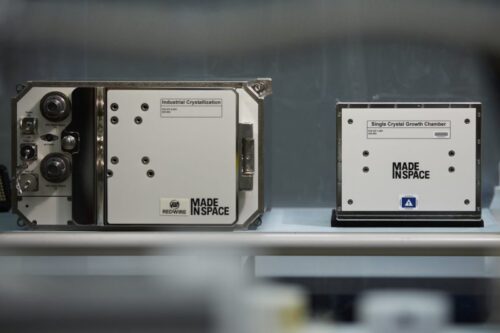
The space-enabled optical crystal was manufactured in Redwire’s Industrial Crystallization Facility (ICF) onboard the International Space Station (ISS). This transaction marks the first time that a space-enabled materials product has been sold on Earth—a significant milestone for space commercialization and a demand signal for Redwire’s space-based manufacturing.

Redwire crystallization modules used on the ISS to make optical crystals. Credits: Redwire

Space-manufactured optical crystals could provide significant improvements to high-power, large laser systems used on Earth. The high-energy laser market is seeing strong growth with an increasing number of terrestrial applications from advanced manufacturing and machining to weapons systems. These laser systems are enabled by high efficiency laser lenses that are produced using optical crystals.

Currently, optical crystals manufactured on Earth have lower damage thresholds due to gravity-induced inclusions and defects which limits the output of high-power laser systems since the lenses are subjected to laser-induced damage.  Space-manufactured optical crystals could improve system performance because they have a higher laser damage threshold due to fewer inclusions and defects because of the space manufacturing process.

“This is an exciting milestone that validates our commercialization plan for manufacturing space-enabled products in low-Earth orbit and further stimulates demand for in-space production,”

said Andrew Rush, Redwire’s President and COO.

“This is a watershed moment for space commercialization. While we are continuing to refine production techniques for a variety of products, we are now expanding our focus beyond pathfinder demonstrations to increasing production of space-enabled products sustainably, profitably, and at scale.”

[ Dr. John Horack, Professor and Neil Armstrong Chair in Aerospace at Ohio State, said,]

“The ability for Ohio State to work with space-grown crystals improves our ability to grow CEMAS as a signature materials characterization and research facility unlike any other, for space-based and terrestrial materials, addressing complex challenges in domains ranging from cancer to planetary science,”

CEMAS researchers will study the space-grown crystal and compare it to Earth-grown potassium dihydrogen phosphate (KDP) crystals using aberration-corrected electron microscopy to observe atomic-scale differences in impurities and defects between the two materials, something that has not yet been achieved. The space-manufactured crystal presents an opportunity for CEMAS to build the group’s capabilities for analyzing materials manufactured in space and those that could be returned from asteroids, the Moon and Mars in the future. The insights from this research could also inform the development process of space-manufactured optical crystals to optimize future products.

Launched in early 2021, ICF is a commercial in-space manufacturing facility designed to demonstrate microgravity-enhanced techniques for growing inorganic KDP crystals that are commonly used in high-energy laser systems on Earth.  The facility is just one of several Redwire ISS payloads developed with the purpose of catalyzing and scaling demand for commercial capabilities in LEO by producing high-value products for terrestrial use.

To learn more about Redwire’s in-space manufacturing capabilities, visit https://redwirespace.com/capabilities/ismo/

About Redwire: Redwire Corporation (NYSE: RDW) is a leader in space infrastructure for the next generation space economy, with valuable IP for solar power generation and in-space 3D printing and manufacturing. With decades of flight heritage combined with the agile and innovative culture of a commercial space platform, Redwire is uniquely positioned to assist its customers in solving the complex challenges of future space missions. For more information, please visit www.redwirespace.com.

=== Amazon Ad ===

Space Mining and Manufacturing:
Off-World Resources and Revolutionary Engineering Techniques

===

Graphene:
The Superstrong, Superthin, and Superversatile Material
That Will Revolutionize the World

Videos: “Space to Ground” & other space habitat reports – July.1.2022

Here is the latest episode in NASA’s Space to Ground weekly report on activities related to the International Space Station:

** Watch Cygnus cargo ship undock and move away from space station – VideoFromSpace

Northrop Grumman’s robotic Cygnus freighter, named S.S. Piers Sellers, undocked from the International Space Station on June 28, 2022. Full Story: https://www.space.com/cygnus-cargo-sp…

** Expedition 67 – Northrop Grumman CRS-17 Cygnus Cargo Craft Departs Space Station – June 23, 2022 – NASA Video

The unpiloted Northrop Grumman CRS-17 Cygnus cargo spacecraft was released from the nadir port of the Unity Module of the International Space Station June 28 by flight controllers on the ground in Houston, Texas. NG-17 launched February 19 on an Antares rocket from the Wallops Flight Facility in Virginia, beginning a two-day flight to the International Space Station delivering about 8,300 pounds of research, hardware, and science experiments to the microgravity laboratory. Following a June 29 deorbit engine firing, Cygnus will begin a destructive re-entry in which the spacecraft, filled with trash, will burn up in Earth’s atmosphere.

** Expedition 67 – Astronaut Jessica Watkins Talks with KNBC-TV Los Angeles – June 27, 2022 – NASA Video

Aboard the International Space Station, Expedition 67 Flight Engineer Jessica Watkins of NASA discussed life and work aboard the orbital outpost during an in-flight event June 27 with KNBC-TV in Los Angeles, California. Watkins is in the midst of a science expedition mission living and working aboard the microgravity laboratory. The goal of her mission is to advance scientific knowledge and demonstrate new technologies for future human and robotic exploration missions as part of NASA’s Moon and Mars exploration approach, including lunar missions through NASA’s Artemis program.

** Astronauts Complete Various Tasks to Construct China’s Own Space Station – CCTV Video News Agency

The three Chinese astronauts who have been piloting the Shenzhou-14 spaceship have completed a slew of tasks including material transfer and arrangement, manned space environment building, cabin equipment installation and debugging after the trio have spent 19 days at the Tianhe core module of China’s Tiangong space station.

** China’s Shenzhou-14 Astronauts Treat Space Station to Deep Cleanse – CCTV Video News Agency

After organizing the supplies aboard China’s Tiangong space station, the Shenzhou-14 crew gave it a deep cleanse. Regular cleaning is part of the daily routine of maintaining the space station. Astronauts also practice physical exercises to maintain muscle strength while in space.

** ISS Live video stream – IBM/ISS HD Earth Viewing Experiment

Currently, live views from the ISS are streaming from an external camera mounted on the ISS module called Node 2. Node 2 is located on the forward part of the ISS. The camera is looking forward at an angle so that the International Docking Adapter 2 (IDA2) is visible. If the Node 2 camera is not available due to operational considerations for a longer period of time, a continuous loop of recorded HDEV imagery will be displayed. The loop will have “Previously Recorded” on the image to distinguish it from the live stream from the Node 2 camera. After HDEV stopped sending any data on July 18, 2019, it was declared, on August 22, 2019, to have reached its end of life. Thank You to all who shared in experiencing and using the HDEV views of Earth from the ISS to make HDEV so much more than a Technology Demonstration Payload!

====

=== Amazon Ads ===

LEGO Ideas International Space Station Building Kit,
Adult Set for Display,
Makes a Great Birthday Present
(864 Pieces)

====

Outpost in Orbit:
A Pictorial & Verbal History of the Space Station