Category Archives: Space participation

Uwingu launches its first call for student grant applications

An announcement from Uwingu:

Uwingu Launches Its First Call for Grant Applications
Resulting Grants Will Fund Planetary Science Graduate Student Travel
to Report Research Results at Scientific Meetings During
This Time of Budget Cuts

Space startup Uwingu announced today that it is soliciting applications from planetary science graduate students to support their travel to report research results at scientific meetings in 2014 and early 2015. Applications are due by 30 April 2014 at 11:59 PM PST.

Uwingu expects to make 10-15 awards of travel grants from this solicitation by early June. Any graduate student completing their PhD in 2014 who is studying planetary science and/or exoplanets are eligible. Recipients must use the funds to present their research at a research conference occurring by 30 April 2015. Selections will be made based on material provided by applicants in the form at: http://tinyurl.com/Uwingu-TravelAwards.

Uwingu is a for profit, public engagement space company based in Boulder, CO, led by senior planetary scientists and astronomers (see http://www.uwingu.com/about-us/who-we-are/). Uwingu’s mission is to connect the public to space exploration in new ways and to create a grant fund to support a wide range of space efforts by individual space researchers, educators, and organizations.

Uwingu’s Mars Map Crater Naming Project at www.uwingu.com, which is funding these student grants, allows anyone with a connection to the Internet to help name approximately 590,000 unnamed, scientifically cataloged craters on Mars. The project aims to ultimately raise up to $10M for Uwingu’s grant fund.
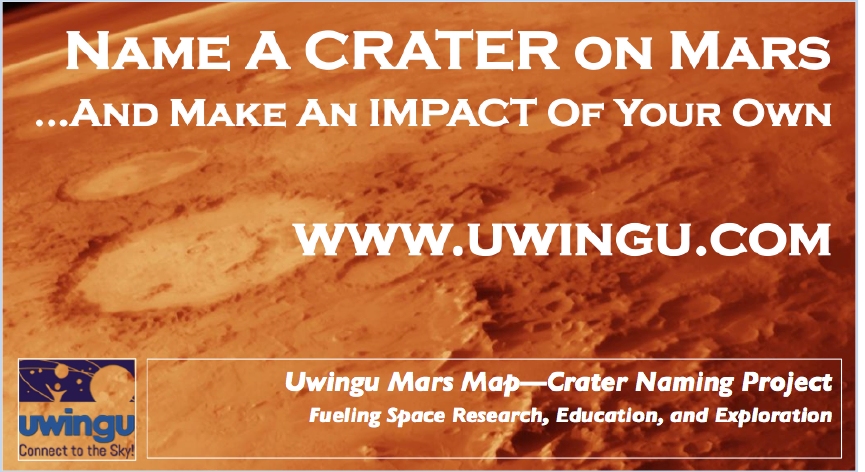
NameACraterOnMars_banner

Uwingu’s Mars map grandfathers in all the already named craters on Mars, opening the remainder up for naming by people around the globe. Prices for naming craters depend on the size of the crater, and begin at $5 dollars. Uwingu makes a shareable Internet link and a naming certificate available to each crater namer for each newly named crater. This public engagement project will culminate with the flight of Uwingufs Mars Map to Mars in 2018 aboard the Mars One 2018 robotic lander, currently in definition phase at aerospace giant Lockheed-Martin

Dr. Alan Stern, Uwingu’s CEO added, “We are excited to begin making grants to students and to supporting their research, and look forward to selecting the best applications we receive for funding. We expect to make more and more grant solicitations as revenues from our Mars Map Crater Naming Project continue to grow.”

NASA’s ‘Take the Plunge’ Challenge: Guess when LADEE hits the Moon

NASA invites you to make a guess as to when the LADEE spacecraft will smack the Moon:

Take the Plunge: LADEE Impact Challenge

 NASA’s Lunar Atmosphere and Dust Environment Explorer (LADEE) spacecraft is gradually lowering its orbital altitude over the moon. LADEE will continue to make important science observations before its planned impact into the lunar surface later this month.

When will it impact the lunar surface? NASA wants to hear your best guess!

Take the Plunge LADEE Impact Challenge

LADEE mission managers expect the spacecraft will impact the moon’s surface on or before April 21. On April 11, ground controllers at NASA’s Ames Research Center in Moffett Field, Calif., will command LADEE to perform its final orbital maintenance maneuver prior to a total lunar eclipse on April 15, when Earth’s shadow passes over the moon. This eclipse, which will last approximately four hours, exposes the spacecraft to conditions just on the edge of what it was designed to survive.

This final maneuver will ensure that LADEE’s trajectory will impact the far side of the moon, which is not in view of Earth and away from any previous lunar mission landings. There are no plans to target a particular impact location on the lunar surface, and the exact date and time depends on several factors.

“The moon’s gravity field is so lumpy, and the terrain is so highly variable with crater ridges and valleys that frequent maneuvers are required or the LADEE spacecraft will impact the moon’s surface,” said Butler Hine, LADEE project manager at Ames. “Even if we perform all maneuvers perfectly, there’s still a chance LADEE could impact the moon sometime before April 21, which is when we expect LADEE’s orbit to naturally decay after using all the fuel onboard.”

Anyone is eligible to enter the “Take the Plunge: LADEE Impact Challenge.” Winners will be announced after impact and will be e-mailed a commemorative, personalized certificate from the LADEE program. The submissions deadline is 3 p.m. PDT Friday, April 11.

For more information about the challenge and to enter, visit: http://socialforms.nasa.gov/ladee

“We want to thank all those that watched LADEE launch and have followed the mission these past months,” said Jim Green, NASA’s Director for Planetary Science at NASA Headquarters in Washington. “Our Moon holds a special place in so many cultures, and because of LADEE, we’ll know more than ever before about our nearest neighbor.”

LADEE’s mission marked several firsts. It was the first demonstration of Optical Laser Communications from space (sent data six times faster than radio), and the first deep space spacecraft designed and built “in house” at NASA’s Ames Research Center.  It was also the first payload to launch on a U.S. Air Force Minotaur V rocket integrated by Orbital Sciences Corp., Va., and was the first deep space mission to launch from NASA’s Goddard Space Flight Center’s Wallops Flight Facility on Wallops Island, Va., when millions watched the night launch on Sept. 6, 2013.

The vending-machine size spacecraft has been orbiting the moon since Oct. 6. On Nov. 10, LADEE began gathering science data, and on Nov. 20, the spacecraft entered its science orbit around the moon’s equator. LADEE has been in extended mission operations following a highly successful 100-day prime science phase.

LADEE’s three science payload instruments have been working to unravel the mysteries of the lunar atmosphere and dust environment acquiring to date more than 700,000 measurements. In its previous orbit, LADEE’s closest approach to the moon’s surface was between 20 and 50 km, and its farthest point was between 75 and 150 km – a unique position that allows the spacecraft to frequently pass from lunar day to lunar night, approximately every two hours. This vantage provides data about the full scope of changes and processes occurring within the moon’s tenuous atmosphere.

Scientists hope to address a long-standing question: Was lunar dust, electrically charged by sunlight, responsible for the pre-sunrise glow detected during several Apollo missions above the lunar horizon? LADEE also is gathering detailed information about the structure and composition of the thin lunar atmosphere.

A thorough understanding of these characteristics of our nearest celestial neighbor will help researchers understand other bodies in the solar system, such as large asteroids, Mercury, and the moons of outer planets.

SpaceUnited – a humanitarian space agency

David Livingston recently interview Adam Brinckerhoff about the SpaceUnited project: Adam Brinckerhoff, Friday, 3-28-14 – Thespaceshow’s Blog

SpaceUnited is described as “your nonprofit humanitarian space agency. Explore for good.” They define a “humanitarian space agency” as follows:

It’s a organization that helps people on Earth and beyond through the use of space technologies. Today, this help comes in the form of satellite imagery, improved housing, life-support systems, and science and education programs. Tomorrow it could mean interstellar Internet access; Mars and Moon aid; or a million other things.

Their primary goals currently appeared to be implementing Humanitarian Space Missions. Here are three current missions –

ExploraLab – Would you like to send something to the stratosphere? ExploraLab is your rocket-shaped experiment payload carrier. Simply create an experiment, put it into an ExploraLab, and drop it in the mail. We’ll make sure that it flies high and then gets delivered back to you!

SHIM-1 – SHIM-1 is a mission about saving lives. We’re working to purchase real-time satellite photos for humanitarian efforts, such as emergency relief organizations and international human rights watchdogs. Discover how you can help.

HOME-1 – HOME stands for Human Optimized Modular Environment. The mission of the HOME program is to improve human life by improving housing. We’re working on building HOMEs for on and off-Earth use. Check out this awesome project.

Two completed missions are BalloonSat-1 and BalloonSat-2.

You can follow their activities and progress at the SpaceUnited Blog. Also, SpaceUnited executives Troy Dunn and Adam Brinckerhoff present Google+ Hangouts every Tuesday at 11:30 AM MT in which they

discuss the humanitarian space exploration topic of the week, interview a guest, and answer your questions live!”

Here is a recent Hangout in which they discussed  “How To Do Space Exploration Yourself” :  SpaceUnited Hangout 3-18-14 – SpaceUnited –

JP Aerospace in Air & Space Magazine

Check out the excellent article by Mark Karpel about JP Aerospace and their near space exploits: To Space (Okay, Near-Space) in a Balloon: A little company dreams of replacing rocket power with buoyancy – Air & Space Magazine.

AMSAT, student satellites, and ISS amateur radio – Mar.30.14

Go to AMSAT News for the latest headlines about developments in amateur and student satellites and for updates about amateur radio on the ISS.

ANS 089 Weekly AMSAT Bulletin – March 29, 2014:
* FUNcube-1 / AO-73 Transponder Test – March 29
* Eighth Annual AMSAT/TAPR Banquet Speaker Announced
* AMSAT Awards Announced
* Radar outage prompts delay of Falcon 9 launch
* Lithuanian President’s greetings message sent from space
* PRN codes for KickSat Sprites released
* New frequency for Ukrainian PolyITAN-1 CubeSat
* Upcoming AMSAT Events
* ARISS News
* Satellite Shorts from All Over

Other smallsat news: