Here’s an overview of the MakerSpaces movement: Makerspaces: A Revolution in Sustainable Production – CustomMade.
Some additional resources:
Here’s an overview of the MakerSpaces movement: Makerspaces: A Revolution in Sustainable Production – CustomMade.
Some additional resources:
Don’t forget that the ISEE-3 Reboot Project will be hosting a livecast today of the lunar fly-by starting at 10:30 am PDT (1:30 am EDT) . The event will be webcast from McMoon’s at NASA’s Ames Research Center. (See earlier posting.)
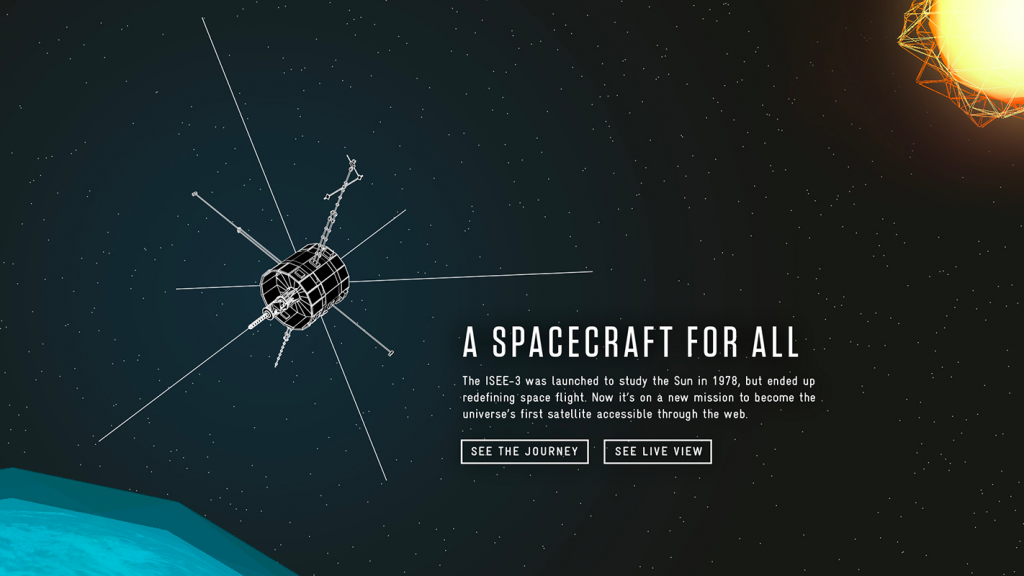
In the meantime, check out the interactive SpacecraftForAll.com site created by Google to illustrate the of the ISEE-3 spacecraft’s history and its route through the Earth-Moon system.

Update: Here is the recorded video of the livecast event:
Google is teaming with the ISEE-3 Reboot Project:
Google’s paired up with the team behind the first ever crowd-funded citizen space mission to launch SpacecraftForAll.com an interactive, multimedia resource for citizen scientists and space fanatics to access all the data collected by the ISEE-3 spacecraft.
The SpacecraftForAll site, tuned for the Google Chrome browser, is a
Chrome Experiment from Google – huge fans of open-source technology – weaving vivid storytelling with the latest web technologies (like WebGL interactive graphics) to create a hub for the data via the web.
For the upcoming fly-by of the Moon:
Tune in on Sunday, August 10 at 10:30am PT/1:30pm ET for the ISEE-3 Reboot Team’s livecast of the satellite’s lunar flyby, live from McMoon’s at NASA’s Ames Research Center.
Here’s a screen capture from – SpacecraftForAll :
Since my last post on the ISEE-3 Reboot Project, the team determined that it was impossible to restart the propulsion system due to the absence of the nitrogen pressurant gas needed to force fuel into the thrusters. They spacecraft therefore cannot be put into an orbit in the Earth-Moon system and will instead continue on its orbit around the sun.
The rest of the spacecraft system, including science instruments, are in good shape. So they plan to continue the project, focusing on carrying out citizen science activities with the data from the spacecraft:
From the latter posting:
While our original goal was to place ISEE-3 in a L-1 “halo” orbit, it will now do a flyby of the Moon and resume an orbit around the sun – an orbit nearly identical to Earth’s. We have begun the process of shutting down systems that are no longer needed and reconfiguring ISEE-3 to maximize science operations. We are also implementing plans that will allow us to listen to its science data no matter where it goes.
We will be beginning the “ISEE-3 Interplanetary Citizen Science Mission” on 10 August 2014 as the spacecraft flies by the Moon. We have a functional space craft that can do science and is already returning new data. All of our original citizen science objectives remain unchanged and are ready for implementation. In fact, we’ll be announcing some new partnerships shortly that will serve to turbocharge our efforts in this regard.
This will be the first citizen science, crowd funded, crowd sourced, interplanetary space science mission. A more detailed summary of recent activities and our partnership team will be posted at http://spacecollege.org/isee3
—
Here is a new update from today: ISEE-3 Science Status Report 7 August 2014 – Space College
—
Update: See post here about the fly-by livecast and the Google SpacecraftForAll.com site.
The advocacy organization Explore Mars has opened a crowd-funding campaign to back the ExoLance project to develop a system capable of looking for life below the surface of Mars. : ExoLance: Engineering the Science to Help Humanity Investigate Life on Mars – Indiegogo.
If proven, the ExoLance surface penetrator could be delivered to Mars if accepted as an experiment on a future NASA mission. The team has several prominent researchers including Dr. Chris McKay and Dr. Gil Levin. Levin was involved in the experiments on the Viking landers that looked for indications of microbial life :
NASA selected his Labeled Release life detection experiment for the Viking Mission, which landed on Mars in 1976. Positive results were obtained at both Viking landing sites. After years of study, Dr. Levin concluded, in 1997, that the experiment had detected living microorganisms.
This video outlines the project:
Here’s the official announcement:
Explore Mars Launches Indiegogo Campaign to Fund
Search for Subsurface Martian Life
WASHINGTON – August 1, 2014 – On July 31, 2014, at a special event held at American University in Washington, DC, Explore Mars, Inc. launched an Indiegogo crowdfunding campaign in support of its ExoLance project. ExoLance is an innovative privately-funded venture to search for life below the Martian surface.
“The search for life on another planet has been intriguing humanity for centuries,” commented Explore Mars Executive Director, Chris Carberry. “Through the ExoLance program, Explore Mars seeks to initiate a process that will determine once and for all whether there is life on Mars.”
In the first phase of ExoLance, lasting approximately 12 months, the penetrator delivery system will be developed and tested. In subsequent phases, Explore Mars will aggressively work on science payload options and advancing the delivery system to flight-ready status.
Aerojet Rocketdyne will provide the initial computer modeling for the penetrator impacts. It is anticipated that this will be completed within the next few months. Joe Cassady, Executive Director, Space for Aerojet Rocketdyne noted that, “We have a long history of supporting Mars exploration at Aerojet Rocketdyne and we are excited to be supporting the Explore Mars concept for ExoLance.” Also supporting ExoLance are Uwingu, The Planetary Society, Mars World, and the National Institute of Aerospace.
The Indiegogo campaign will run until the end of September, with a minimum goal of raising $250,000. However, the project also provides for secondary goals of over $1 million. Project updates will be announced periodically throughout the campaign.
According to Artemis Westenberg, President of Explore Mars, “the Explore Mars team is thrilled to initiate this project aimed at getting the answer to the most fundamental question we humans have: ‘are we alone in the universe?’ With Gilbert Levin (Viking life detection experiments) and Chris McKay (noted astrobiologist and planetary scientist) on the science side and Aerojet Rocketdyne on the engineering side, we believe that ExoLance will provide a method to query Mars about possible life very thoroughly.”
To support the ExoLance program and participate in the search for life on Mars, interested persons can visit the Indiegogo campaign website at http://indiegogo.com/projects/exolance.
Help Explore Mars determine if there is life on our neighboring planet. Let’s make history together.