Category Archives: Space participation

Seeds descended from the Apollo 14 “Moon Trees” to go to the lunar surface

UK space activist Phill Parker sent the following announcement to me about his latest project:

UK Man to Send Apollo 14 Moon Trees Back to the Moon in 2017 –
This Time to Land on the Moon!

Apollo 14 launched in the late afternoon of January 31, 1971 on what was to be the third US manned trip to the lunar surface. Five days later astronauts Alan Shepard and Edgar Mitchell landed in their Lunar Module “Antares” and walked on the Moon at the Fra Mauro region exploring “Cone Crater” while their colleague and fellow astronaut, Stuart Roosa, a former U.S. Forest Service smoke jumper, orbited above the Moon in the command module “Kitty Hawk”.

Packed in small containers in Roosa’s personal kit were hundreds of tree seeds, part of a joint NASA/USFS project. Upon return to Earth, the seeds were germinated by the US Forest Service. Known as the “Moon Trees“, the resulting seedlings were planted throughout the United States (often as part of the nation’s bicentennial in 1976) and some parts of the world. They stand as a tribute to astronaut Roosa and the Apollo program. [See NASA’s Moon Trees website.]
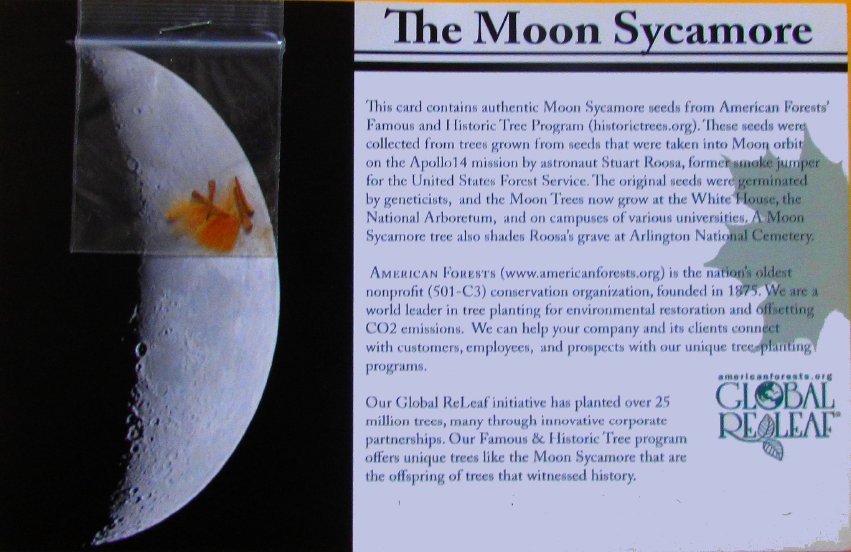
MoonSycamoreClick for larger image

The project began after Roosa was chosen for the Apollo 14 mission. Ed Cliff, Chief of the Forest Service, knew of Stuart Roosa from his days as a smoke jumper and contacted him about bringing seeds into space. Stan Krugman of the Forest Service was put in charge of the project and selected the seeds for the experiment. Seeds were chosen from five different types of trees: Loblolly Pine, Sycamore, Sweetgum, Redwood, and Douglas Fir. The seeds were classified and sorted, and control seeds were kept on Earth for later comparison.

Roosa carried about 400 – 500 seeds in his personal kit which stayed with him as he orbited the Moon in the command module “Kitty Hawk” in February, 1971. The seeds were then sent to the southern Forest Service station in Gulfport, Mississippi and to the western station in Placerville, California to attempt germination. Surprisingly, nearly all the seeds germinated successfully, and the Forest Service had some 420 to 450 seedlings after a few years (some from cuttings). Some of these were planted with their earth-bound counterparts as controls, (as would be expected, after over twenty years there is no discernible difference) but most were given away in 1975 and 1976 to many state forestry organizations to be planted as part of the nation’s bicentennial celebration.

1280px-The_Apollo_14_Prime_Crew_-_GPN-2000-001168Stuart Roosa, Alan Shepard, and Edgar Mitchell

Astronaut Stuart Roosa was born on 16 August 1933, in Durango, Colorado. He worked for the Forest Service in the early 1950’s as a smoke jumper fighting fires and later joined the US Air Force and became a test pilot. He was one of 19 people selected for the astronaut class of 1966 and was part of the astronaut support crew for Apollo 9. Following Apollo 14, Roosa was backup command module pilot for Apollo’s 16 and 17. He then worked on the Space Shuttle program until his retirement as a Colonel in the Air Force in 1976, the time when many of his trees were being planted.

Sadly, Stuart Roosa passed away in December, 1994. The Moon Trees continue to flourish, a living monument to our first visits to the Moon and a fitting memorial to Stuart Roosa.

Now, nearly 45 years later since the original Apollo 14 Moon Tree seeds were flown around the Moon, spaceflight enthusiast Phill Parker – from Newcastleunder- Lyme, Staffordshie,UK – is flying some more Moon Tree generational Sycamore seeds from the original Moon Tree seeds back to the Moon in 2017 aboard the Astrobotic Griffin Moon Mission One. This will act as a further tribute to astronaut Stuart Roosa and the US Apollo Project . But this time not just to orbit the Moon but to actually land them on the surface of the Moon for the first time in the lunar region called Lacus Mortis!

PhillParkersMoonSycamoreSeedsPhill Parker’s Apollo 14 Moon Tree Generational
Sycamore seeds that are set to be flown aboard the
Astrobotic 
Griffin lunar lander in 2017.

The Griffin unmanned lunar lander will be launched by a SpaceX Falcon 9 rocket from Cape Canaveral, Florida in 2017.
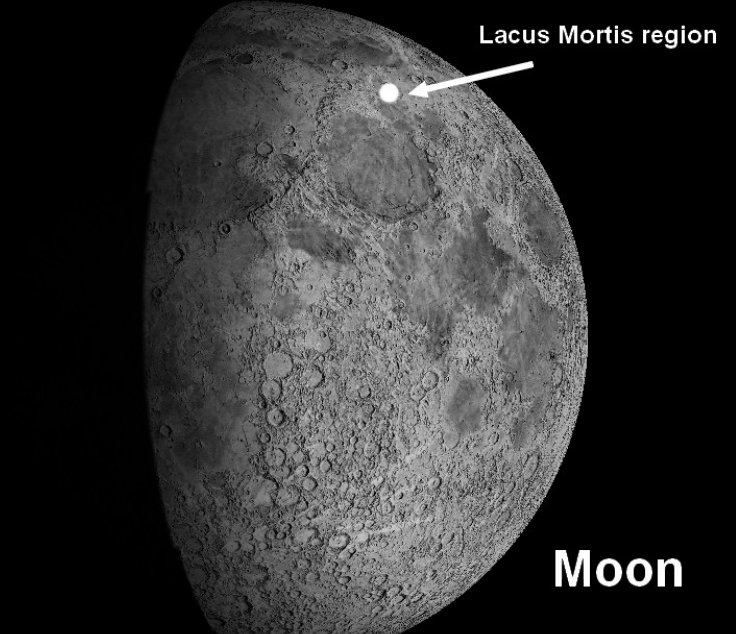
LacusMortisRegionOnTheMoon

===

Phill Parker authored many Apollo manned lunar landing articles for the British Interplanetary Society in the 1960s-70s – several of which are cited in NASA’s official Apollo Bibliography and,additionally, founded the West European Space Colony Society in 1975 which later merged with the prestigious US National Space Society (NSS). He has produced many spaceflight exhibitions at museums in the UK and delivered over 750 talks on space missions across UK since 1964, as well as writing dozens of articles on spaceflight.
SpaceVR seeks crowd-funding for immersive 3D live views from the ISS Cupola

SpaceVR is a startup company developing

the world’s first virtual reality platform allowing users to #BeAnAstronaut and experience space firsthand from any mobile, desktop or virtual reality device. Through the use of 3D, 360-degree cameras, SpaceVR technology feeds livestream footage from the International Space Station’s (ISS) Cupola observatory module back to Earth so consumers can experience space travel in immersive 3D virtual reality. 

The company is currently in a crowd-funding campaign that has reached just over $70k towards a $100k goal and they have 7 days remaining: SpaceVR: Step into Space by SpaceVR — Kickstarter.

The Kickstarter funds would cover the costs for

flight certification, launch costs, and 2D 16K resolution footage that will be physically down-massed (returned from space) to Earth 2x per year.

Here is a video describing the project:

The goal is to use the Virtual Reality system to bring the space experience to many more people than those who have actually flown in space;

Being in space and looking down at the earth, astronauts are hit with an astounding reality: our planet is a tiny, fragile ball of life, “hanging in the void”, shielded and nourished by a paper-thin atmosphere. It’s a phenomenon known as the Overview Effect.

Space is the final frontier, and everybody should have a chance to be a part of exploring it and, in turn, being influenced by it—to experience the Overview Effect. There’s a lot of excitement about exploring space by the people, for the people, and we can’t do it without you. Together we can make the universe accessible to everyone, inspire the next generation of explorers and get people excited about STEAM (Science, Technology, Engineering, Art and Math) fields.

The more supporters we have, the more cool virtual reality experiences we’ll be able to capture in space. And when we get there, you won’t just be a bystander to history; you’ll feel like an active participant, standing side by side with the astronauts. We will all be explorers together.

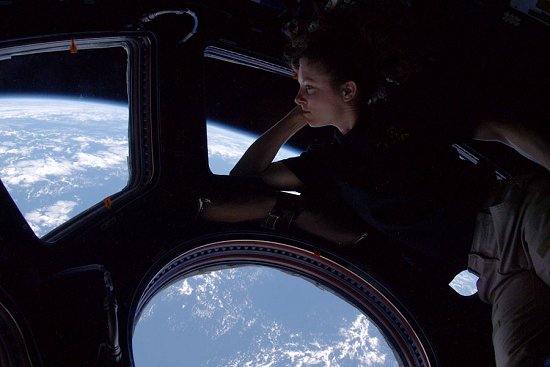
Astronaut Tracy Caldwell Dyson enjoyed the Cupola module in person:

cupolaview_iss14_500x366

Lunar Mission One and Astrobotic will take put your “Footsteps on the Moon”

Lunar Mission One is a non-profit organization seeking to raise public funding for space science projects. Their primary space science goal is to put a robotic spacecraft on the south pole of the Moon in 2024 to investigate water and other resources there. A Kickstarter campaign in 2014 raised over $1M.

They have a number of public involvement initiatives programs underway. This week, for example, they opened the Footsteps on the Moon campaign in which you upload “a photo of your footprints, feet or shoes” that will be sent to the Moon on digital storage.

CQI0rVFUEAATLiy[1]

The transport to the Moon will be via Astrobotic‘s lunar lander mission: Lunar Mission One Signs Deal with Astrobotic

Astrobotic Technology Inc. and Lunar Missions Ltd, the company behind the global, inclusive, not-for- profit crowd-funded Lunar Mission One, have signed a deal to send the first digital storage payload to the Moon. The payload will support Lunar Mission One’s ‘Footsteps on the Moon’ campaign, launched earlier today, which invites millions of people to include their footsteps – in addition to images, video and music – in a digital archive of human life that will be placed on the moon during Astrobotic’s first lunar mission.

“The partnership with Lunar Mission One is an exciting opportunity for individuals to store memorable information on the surface of the Moon,” says John Thornton, CEO of Astrobotic. “This is the first step in creating an archive of human civilization beyond Earth orbit.”

David Iron, CEO of Lunar Missions Ltd and the founder of Lunar Mission One says, “It was an easy choice to partner with Astrobotic, a global leader in commercial lunar capability. This deal allows us to offer an exciting new way to connect our supporters to the Moon during the early phase of Lunar Mission One’s development. We look forward to unveiling those plans very soon.”

Lunar Mission One is the latest addition to Astrobotic’s mission one manifest, and will be the first payload to enable a digital archive on the Moon.

David Iron, the founder of Lunar Mission One, writes the organization and the Footsteps program: Lunar Mission One: “Let’s All Stand on the Moon Together” – David Iron/Huffington Post

Most people watching the Moon landings in 1969 thought they would never make it to the Moon… but it’s time for a re-think. The astronauts left their prints and the rest of us just dreamed, but Lunar Mission One now intends to make it possible with their Footsteps on the Moon project.

We have secured a digital payload on the Astrobotic Moon Lander, slated for a 2017 launch. On it, we want to take a vast collection of pictures of your footsteps, shoes, wheelchair tracks or however you leave your impression on the Earth, and place them on the Moon. And we will do that for nothing in the hopes that we can take images from every single country on Earth.

In digital form, your footsteps will rest on the Moon, like the iconic boot prints left by the first astronauts, almost 50 years ago.

Follow the latest LMO activities at Lunar Mission One (@LunarMissionOne) | Twitter.

Low cost DIY ground station for weather satellite image reception

The HobbySpace Space Radio section has lots of information and web resources about home reception of satellite signals, especially for obtaining images from low earth orbit weather satellites. The price for such DIY systems was modest and now has gotten even cheaper.

Previously, one needed a wide-band radio tuner, which might cost a couple of hundred dollars, a simple antenna, a PC with a sound card, and some free software for turning the satellite data into images. Now with the arrival of Software Defined Radio programs, one can obtain a cheap “dongle”, i.e. a small device with a built-in tuner that plugs into a PC’s USB port for interfacing satellites signals to the PC.

Jason Davis of the Planetary Society gives a nice tutorial on building a system with about $50 in components (not counting a PC) that can be used for receiving weather sat images as well as data from a future LightSail mission: How to Download Weather Satellite Images from Space – The Planetary Society.

For additional info, Davis points to Receiving Weather Satellite Images for £8 – Matt Gray.

See also the RTL-SDR, a  very cheap software defined radio that uses a DVB-T TV tuner dongle”.

20150918_earth-noaa19_f537[1]A sample image from Jason Davis showing much of N. America
as received by his home ground station from the NOAA 19 satellite. 

NASA opens student competition for designs of inflatable heat shields

An announcement from NASA:

NASA Seeks Big Ideas from Students for Inflatable Heat Shield Tech

NASA is giving university and college students an opportunity to be part of the agency’s journey to Mars with the Breakthrough, Innovative, and Game-changing (BIG) Idea Challenge.

NASA’s Game Changing Development Program (GCD), managed by the agency’s Space Technology Mission Directorate in Washington, and the National Institute of Aerospace (NIA) are seeking innovative ideas for generating lift using inflatable spacecraft heat shields or hypersonic inflatable aerodynamic decelerator (HIAD) technology.

15-189a[1]
Artist’s rendering of a hypersonic inflatable aerodynamic decelerator technology concept. Credits: NASA
“NASA is currently developing and flight testing HIADs — a new class of relatively lightweight deployable aeroshells that could safely deliver more than 22 tons to the surface of Mars,” said Steve Gaddis, GCD manager at NASA’s Langley Research Center in Hampton, Virginia. “A crewed spacecraft landing on Mars would weigh between 15 and 30 tons.”

The NASA’s Mars Curiosity rover is the heaviest payload ever landed on the Red Planet — weighing in at only one ton. To slow a vehicle carrying a significantly heavier payload through the thin Martian atmosphere and safely land it on the surface is a significant challenge. NASA is addressing this challenge through the development of large aeroshells that can provide enough aerodynamic drag to decelerate and deliver larger payloads. HIAD technology is a leading idea because these kinds of aeroshells can also generate lift, which would allow the agency to potentially do different kinds of missions.

Interested teams of three to five undergraduate and/or graduate students are asked to submit white papers describing their concepts by Nov. 15. Concepts may employ new approaches such as shape morphing and pneumatic actuation to dynamically alter the HIAD inflatable structure.

Selected teams will continue in the competition by submitting in the spring of 2016 full technical papers on the concept. Up to four teams will present their concepts to a panel of NASA judges at the BIG Idea Forum at Langley in April 2016.

Each finalist team will receive a $6,000 stipend to assist with full participation in the forum. BIG Idea Challenge winners will receive offers ofpaid internships with the GCD team at Langley, where they can potentially work toward a flight test of their concept.

For more information about the challenge, and details on how to apply, visit the BIG Idea website at:

http://bigidea.nianet.org

For more information about NASA’s Space Technology Mission Directorate, go to:

http://www.nasa.gov/spacetech

15-189c[1]