** What’s Up: August 2022 Skywatching Tips from NASA – NASA JPL
What are some skywatching highlights in August 2022? The daily parade of four naked-eye planets in the mornings comes to an end this month. But there are still lots of great highlights, especially if you have access to binoculars. Plus, Saturn and Jupiter are returning to nighttime skies! The outlook for the Perseid meteors isn’t great due to a full moon on the peak night of August 12, but still it’s worth keeping an eye out for early Perseids after midnight the week before. And August is a great month to learn an easy-to-spot constellation – Cygnus the swan.
0:00 Intro 0:11 Planet-watching highlights 1:56 Perseid meteors outlook 2:34 The constellation Cygnus 3:45 August Moon phases
Additional information about topics covered in this episode of What’s Up, along with still images from the video, and the video transcript, are available at https://solarsystem.nasa.gov/skywatch….
In August, a flock of star-studded figures soars overhead. Look for the Vega and Lyra constellations, which point to Epsilon Lyrae and the Ring Nebula. You can also spot three bright summer stars: Vega, Deneb, and Altair, which form the Summer Triangle. Keep watching for space-based views of these and other stars and nebulas.
About this Series “Tonight’s Sky” is a monthly video of constellations you can observe in the night sky. The series is produced by the Space Telescope Science Institute, home of science operations for the Hubble Space Telescope, in partnership with NASA’s Universe of Learning. This is a recurring show, and you can find more episodes—and other astronomy videos—at https://hubblesite.org/resource-galle….
What’s in the night sky tonight? Pete Lawrence and Paul Abel reveal the stars, constellations, planets, conjunctions and deep-sky objects worth keeping an eye on in August.
Our monthly Sky Tour #astronomy #podcast provides an informative and entertaining 10-minute guided tour of the nighttime sky. Listen to the August episode to learn about the #shootingstars of the #Perseids, how to spot #Saturn, and tour the #stars of #summer.
Here is a collection of news, announcements, videos, and other resources that touch on the mingling of art and space:
=== Art in space
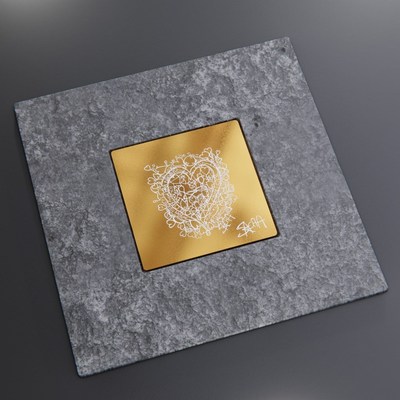
Sacha Jafri artwork,”We Rise Together – with the Light of the Moon“. To withstand the temperature extremes on the lunar surface, the design was etched onto a gold sheet mounted on an aluminum plate. Credits: Selenian
The artwork will be placed on the surface of the moon later this year by Spacebit, a company developing technology for space exploration, and Astrobotic Technology Inc., a company providing end-to-end delivery services for payloads to the moon. The humanitarian aspect of the mission has been put together by Selenian, a pioneering UAE company that specializes in the curation of art in space. This mission is also the first-ever commercial lunar mission under the NASA CLPS, and the landing site of Jafri’s artwork will be marked as a world heritage landmark.
The Astrobotic mission will launch on ULA’s first Vulcan rocket, which should lift off by the end of 2022 or the first quarter of 2023. The Peregrine Lander will carry a couple of dozen scientific and commercial payloads to the Lacus Mortis crater on northeast area of near side of the Moon.
The first official Artwork entitled ‘We Rise Together – with the Light of the Moon’, created by contemporary British Artist Sacha Jafri, will be placed on the Moon with the help of Selenian, a pioneering company that specialises in the curation of art in space, and Astrobotic, a commercial space company, in association with NASA under the Commercial Lunar Payload Services initiative known as NASA CLPS. The landing site will then become a world heritage landmark preserved forever.
The Artwork will be revealed to the world in a press conference next week. Jafri has used an aerospace grade aluminium gold plate as his canvas in order for the Artwork to be fully resilient to the lunar conditions and to last eternally on the Moon.
Jafri’s original work will be placed on the surface of the Moon triggering the release of a five-series NFT Charitable Collection. The original work will rest in the solitude of the Moon, emanating energy back to Earth. Five NFTs will launch to commemorate each stage of the mission – from the rocket launch entering the stratosphere, the Earth circumnavigation, the Moon sling-shot, the Moon landing and the legacy of the eternal artwork on the Moon.
In addition, 88 unique Hearts that fly to the Moon as part of the painting, will be released to the world as the Jafri ‘Moonheart NFTs’.
The art work shown above was revealed in February 2022:
Koons is best known for his popular sculptures of balloon animals created out of stainless steel. Now, some of his new sculptures will join the payloads on the outside of Nova-C. Specifically, the Koons sculptures will be encased in a transparent, thermally-coated cube that measures 6 inches on all sides, according to Intuitive Machines. The tiny sculptures will supposedly be the first “authorized” works of art to reach the lunar surface, according to Pace Gallery, which represents Koons — though that title will only work if Intuitive Machines can get to the Moon relatively soon.
Former NASA Astronaut and current Intuitive Machines Vice President, Jack Fischer says, “the Intuitive Machines team is passionate about this historic project. Koons’s sculptures, documented by the NFTs and housed in a transparent, thermally coated, sustainably built enclosed art cube, will be the first authorized artworks to be placed on the surface of the Moon, where they will remain in perpetuity.”
** Astrobotic’s Perigrine lander will also carry thousands of digitized artworks in The Peregrine Collection, a time capsule with contributions from over 1200 artists. The collection is included in the DHL MoonBox, one of a couple of dozen payloads in Astrobotic’s Moon Manifest. DHL is sponsoring the Moonbox to promote the company’s Lunar Logistics services, which assist any organization wanting to send a payload to the Moon.
The Peregrine collection is a part of the Lunar Codex project founded by Samuel Peralta. Two additional collections will travel to the Moon on subsequent missions as well. In total, over 20,000 artworks will be included on the three lunar missions.
Intuitive Machines will take the Nova Collection on the company’s IM-1 mission and the Polaris Collection will ride on Astrobotic’s second lunar lander.
** Artist Tristan Eaton in 2020 sent a selection of his work to space aboard the first SpaceX Dragon to carry a crew to the International Space Station.
When SpaceX asked me to create art to join these astronauts in space, I wanted to make something inspirational. Looking down from space to see all of Human Kind together on this tiny planet might remind you how much history and potential we have. Yet we have so much further to go.
With this in mind, I created a series of indestructible, 2 sided paintings made from gold, brass and aluminum to represent the duality of Human Kind, our past and our future.
With kindness, hope and science, Human Kind has changed the world many times over. For a better future, we can do it again.
On July 28, the companies Nanoracks LLC and Artemis Music Entertainment beamed two pieces of art to the International Space Station: a recording of Claude Debussy’s piano classic “Clair de Lune” and “Why Not Me,” a visual work by [Micah] Johnson featuring his character Aku, a Black boy who dreams of becoming an astronaut.
Both digital files circled Earth once, came back down and were minted as non-fungible tokens — the first-ever space-flown music and visual-art NFTs, respectively.
Micah Johnson is a former professional baseball player who has become a well-known figurative artist. Aku has become one of his most famous creations:
Aku is a character created by former MLB player turned artist, Micah Johnson, after hearing a young boy ask, “Can astronauts be black?”
This special rendition of Debussy’s Clair de Lune (‘Moonlight’), commissioned by Artemis Music LLC and performed by internationally renowned pianist Wing-Chong Kam, was beamed into space and orbited the Earth aboard the International Space Station on July 28th, 2021, in commemoration of the timeless beauty of Claude Debussy’s masterpiece and in celebration of the unity of music for all humankind.
The cosmic perspective of space inspires a cognitive shift in humans. Debussy’s Clair de Lune perhaps comes as close as possible to stirring the emotions of awe and wonder experienced by space travelers. The universe is full of music, and we humans are learning how to use music to not only understand the science of the universe, but to grasp our place in it.
“Music is what happens in the space between the notes.” – Claude Debussy
Artemis intends to use NFTs in support of the space arts. They plan to
enable partnerships with artists, producers, creators, and curators to connect musical and artistic works to the inspiration, perspective and opportunity of outer space. Combined with blockchain technology that preserves the uniqueness and provenance of underlying rights and intellectual property, the Artemis Space Network will allow the creation and transmission of space-flown creative works that directly connects creators, fans, and collectors anywhere in the world.
But the marquee payloads actually rode on the exterior of the capsule: In cooperation with Utah-based Uplift Aerospace, Blue Origin flew three portraits that Ghanaian artist Amoako Boafo painted on the capsule’s main chute covers.
“Suborbital Triptych” depicts Boafo’s mother; the mother of fellow artist Otis Kwame Kye Quaicoe, a childhood friend of Boafo’s; and Boafo himself.
Associate Professor of Integrated Media Julia Christensen is currently working with NASA scientists at the Jet Propulsion Laboratory (JPL) in Pasadena, California. She is working on a project envisioning artwork where no artwork has gone before: aboard an interstellar space mission en route to Proxima b, an exoplanet outside our Sun’s solar system.
The art that she would send would come from a project titled TREE OF LIFE
The Tree of Life is the primary project of a collaborative effort between Julia Christensen and scientists and engineers at NASA’s Jet Propulsion Laboratory to design spacecraft and interplanetary communication technology that can operate for 200 years or more. The project began out of a series of studies Christensen took part in at JPL about a future mission to Proxima B, in which a major conclusion was that we must transcend current frames of obsolescence in order to build a spacecraft that can complete a mission to Proxima B. The CubeSat is to be deployed in low-Earth orbit, and transmits data about its health/operations to a terrestrial tree, which is augmented to act as an Earthly antenna. At the site of the tree, simultaneously, a 200-year dataset is measured to describe the tree’s health and environmental conditions. That data will be translated into audible sonic frequencies that can be transmitted via radio between the tree and CubeSat, so that effectively, the tree and spacecraft can sing together in a 200-year duet.
There are few artists in the aerospace industry whose career was as varied or accomplished as Ted Brown. Ted began as a graphic designer with Douglas in 1962, and over the next four decades carved out an enviable career: he illustrated everything from the Buck Rogers imaginings of Philip Bono, Gemini and Apollo to the Shuttle Program. His art permeates the story of space exploration. It is in industry periodicals, newspapers and books and has been since the early sixties. You know his work. He is as ubiquitous as he is anonymous and that’s something I love about him, because I imagine that is exactly how he wanted it. So, this is the story of Ted Brown.
Ted Brown stands in front of one of his murals at the Kennedy Space Center Visitor Complex in 1980. Credits: NASA
Keats embedded into the hillside above Fontecchio a meteorite — an ordinary chondrite, whose parent body hails from the main asteroid belt between Mars and Jupiter. The space rock’s alien essence has therefore leached into the village’s groundwater and now courses through its pipes.
Those who drink from the fountain are thus infused with the essence of a space traveling alien rock
** Artist Depiction is a set of documentaries on space artists created by Clindar. The first two series of films profiled six space artists – Don Davis, Charles Lindsay, Rick Guidice, Pamela Lee, William K. Hartmann, and Pat Rawlings, The short films were originally available on Amazon Prime but can now be watched for free via the Clindar Youtube channel. See two of these below. A third series of Artist Depiction will be completed in 2023. (The profile of Steve R. Dodd is now on YouTube.)
** The on MARS project turns collections of images from the Perseverance rover into compelling montages.
This rover is equipped with 17 cameras that it used to film its descent on the red planet as well as its first steps on the Martian soil. Every day, it takes new pictures that are sent to Earth. Whether the photo is “successful” (instrument, rock; landscape) or not (black, gray, yellow or white square), the photos are published in the order in which they are received.
onMARS art prints are the result of the assembly of temporal series of photos taken by the rover, and respect the order in which these photos were captured, sent, received, processed and published here on Earth.
recent and past photos and videos from the world’s space agencies, artwork, diagrams, and amateur-processed space images. Bruce Murray, Planetary Society co-founder and emeritus director of NASA’s Jet Propulsion Laboratory, insisted that planetary missions take photos for the public as well as for scientists. Bruce literally helped change our view of the solar system.
“This oil painting from Planetary Society member Jackie Kingon is titled ‘Sunshield'”. Credits: The Planetary Society.
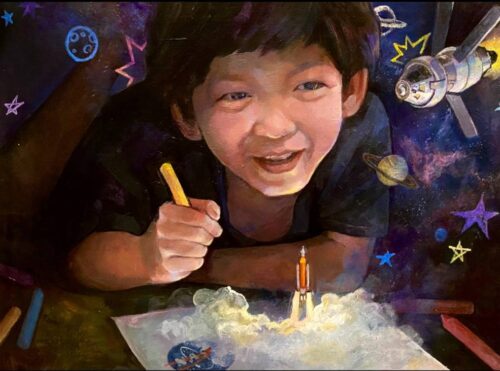
“Candice Lee, an 11th-grade student from Granada Hills Charter High School in Los Angeles, California, was named the grand-prize winner of NASA Langley Research Center’s Annual Student Art Contest.” Credits: NASA’s Langley Research Center
“A display featuring the winning submissions from the Commercial Crew Program’s 2022 Children’s International Artwork Contest hangs in the common area of NASA’s Astronaut Crew Quarters at Kennedy Space Center in Florida.” Credits: NASA, Click for larger image.
** The European Space Agency (ESA) frequently sponsors art contests in the Space for Kids program. Check out winning entrants in three recent contests:
NASA and Crayola Education are collaborating to infuse art and creativity with the unique teachings of space. As part of its mission to inspire the world through discovery, the agency is leveraging its compelling science, technology, engineering, and math content with Crayola’s work to bring creativity into classrooms and other learning environments. The two signed a Space Act Agreement April 28 to formalize the relationship.
=== Space Art Advocacy
** Space Renaissance International (SRI) is a “non-profit organization based in Europe, with members and supporters all around the globe“. SRI is
dedicated to getting humanity off-world, not just astronauts engaged in pioneering exploration, but humanity, en masse … because it is a natural progression in our development as a species. Humanity can’t continue to live in an unsustainable manner, within a closed-system. This is what has led to many of our current cultural and socio-economic problems.
The mission of SRI is to facilitate the development of mankind as an interplanetary society, with aspirations to see humanity grow to become an interstellar civilisation.
Here is a recent SRI video about the “important role” that “Art and Illustration play […] in the world of aerospace engineering“. The special guest is Aldo Spadoni, “an aerospace engineer and futurist”, who is
a veteran of numerous advanced development programs for NASA, the United States Air Force and Navy. He is a recipient of NASA’s Turning Goals Into Reality award for Reusable Launch Vehicle Development. Aldo created an award-winning simulation team at Northrop Grumman Aerospace Systems. He is President and Chairman of the Board of Trustees of the International Association of Astronomical Artists (IAAA). He is an accomplished self-taught artist and concept designer with four US patents to his credit.
Aldo’s consulting company, Aerospace Imagineering, specializes in the conceptual design, visualization and prototyping of advanced technology concepts and products. As a Hollywood technical consultant and concept designer, he supported the production of APOLLO 13, SUPERNOVA, STEALTH, IRON MAN 1 & 2, and other movie projects. He is currently the spacecraft technical advisor on the upcoming interstellar adventure film, PERSEPHONE. Aldo’s personal goals are to promote STEAM education and create compelling positive visions of humanity’s spacefaring future.
Can an artist inspire people to embrace space? This is what illustrator Peter Thorpe has been doing since the mid-1980s. Peter has typically worked as a book cover illustrator, but he has also done logos, magazine covers and posters.
The Mohammed Bin Rashid Space Centre (MBRSC) has launched the Emirates Space Art Programme (ESAP), which will document, capture, and share the emotions of the UAE’s historical advances into space through the culture and creative industries.
** The Art Imaginarium at the SETI Insitute aims to build a community that welcomes those who want to explore the intersection of art and science.
Science and art are more closely connected than people might expect, with each offering the other new perspectives and insights. We’re building an artistic community where everyone feels safe in expressing themselves and exploring the limits of their imaginations. We hope that this will be a space where people respect both the art and the science.
What is art? We do not want to constrain your creativity. Want to write a song? Draw in pencil? Create digital art? Bake a cake? Use pasta and beans? Go for it.
We invited our Art Imaginarium members to give us their take on the dot in our SETI Institute logo. They gave us versions by the dozens. From radio telescopes (including our own Allen Telescope Array) to aliens, and from geometry to math and physics, the SETI dots explored science and even philosophy.
On May 28, [2020], Frank Drake, celebrated scientist and Emeritus Trustee at the SETI Institute, turned ninety years old. To honor his birthday month, our Art Imaginarium group was challenged with Frank’s most well-known contribution to SETI, the Drake Equation. This equation seeks to put mathematical constraints on the existence of intelligent life in our own galaxy, the Milky Way.
Art Imaginarium Challenge: Johannes Kepler’s ‘Somnium’:
This month, we are asking the members of our Art Imaginarium and any interested artists to create artwork inspired by what many consider the first science fiction story, Johannes Kepler’s ‘Somnium’. The challenge is presented by the Director of our SETI Artist-in-Residence program, Bettina Forget. Kepler wrote the novel in 1608, and his son published it in 1634. The novel started as a way to defend Copernicus’ view of the solar system, with characters on the Moon viewing Earth. Read a translation of the novel, done by the Somnium Project, here: https://somniumproject.wordpress.com/… The Art Imaginarium is a Facebook group dedicated to the space where art meets science. Why art? Science and art are more closely connected than people might expect, with each offering new perspectives and insights. We’re building a global artistic community where everyone feels safe in expressing themselves and exploring the limits of their imaginations. We hope that this will be a space where people respect both the art and the science. What is art? We do not want to constrain creativity. Want to write a song? Draw in pencil? Create digital art? Bake a cake? Use pasta and beans? Go for it. Each month, we provide members with a challenge theme. How they interpret that theme is entirely up to them. Join the challenge here: https://www.facebook.com/groups/TheAr...
Art Imaginarium Challenge: First Contact. Institute co-founder Jill Tarter issued this challenge to Imaginarium members in September 2020:
During this week’s SpaceCafé, SpaceWatch.Global publisher Torsten Kriening spoke with self-confessed “spaceist”, astronautics and space engineering expert from the International Space University, Professor Chris Welch. Now the Head of the Space Payloads Laboratory at the ISU, Professor Welch’s career in space engineering has spanned several decades across multiple universities and institutions. He was previously the Director of Kingston University’s Aerospace Research Centre, and began his academic career at Cranfield University and the University of Kent. He is also President-elected of the British Interplanetary Society and fellow at the Royal Astronomical Society. His research and teaching interests span space propulsion systems, orbit mechanics and space exploration and his contributions to the sector are award-winning. In 2009 he received the Sir Arthur Clarke Award in recognition of his work in space education and outreach.
There’s no doubt that Professor Welch is one of the most decorated space academics alive, but you may be surprised to learn that his interests go well beyond engineering: he is also a self-described ambassador and interlocutor for the arts and space. In this week’s episode, he and Torsten discuss space art’s history, its development and future.
** What’s Up: July 2022 Skywatching Tips from NASA – NASA JPL
What are some skywatching highlights in July 2022? The naked-eye planets of dawn – Venus, Mars, Jupiter, and Saturn – dominate the sky, appearing more spread out each morning. Next, if you’re feeling the July heat, note the origin of “the dog days” of summer has to do with the bright star Sirius. Finally, if you can find a certain teapot-shaped pattern of stars in the evening, you’ll be looking toward the center of the Milky Way.
0:00 Intro 0:11 Morning planet lineup
0:40 Sirius and the “dog days” of summer
1:50 The Teapot and Milky Way core 3:11 July Moon phases
Additional information about topics covered in this episode of What’s Up, along with still images from the video, and the video transcript, are available at https://solarsystem.nasa.gov/skywatch….
In July, find the Scorpius constellation to identify the reddish supergiant Antares, which will lead you to discover a trio of globular star clusters. Keep watching for space-based views of these densely packed, spherical collections of ancient stars, as well as three nebulas: the Swan Nebula, the Lagoon Nebula, and the Trifid Nebula.
** What’s in the Night Sky July 2022 #WITNS | Milky Way core | Supermoon | Noctilucent Clouds – Alyn Wallace
00:00 Intro
01:40 Squarespace
02:40 Northern Hemisphere Night Sky
05:30 Southern Hemisphere Night Sky 07:24 Close Approaches 08:06 Full Moon
08:37 Meteor Showers 09:44 #WITNS Winners
Our monthly Sky Tour #astronomy #podcast provides an informative and entertaining 10-minute guided tour of the nighttime sky. Listen to July’s episode for #stargazing tips and learn about the #stars of #summer.
** What’s Up: May 2022 Skywatching Tips from NASA – NASA JPL
What are some skywatching highlights in May 2022? May provides some great planet spotting, including a close conjunction of Jupiter and Mars. At mid-month, a total eclipse of the Moon should delight skywatchers across the Americas, Europe, and Africa. And all month long, the Coma star cluster (aka, the Coma Berenices star cluster, or Melotte 111) is a great target for binoculars in the evening. YouTube Full Description (i.e., “Show More”)
0:00 Intro 0:11 Planet-spotting opportunities 1:02 Lunar eclipse
2:27 The Coma star cluster 3:33 May Moon phases
Additional information about topics covered in this episode of What’s Up, along with still images from the video, and the video transcript, are available at https://solarsystem.nasa.gov/skywatch….
In May, we are looking away from the crowded, dusty plane of our own galaxy toward a region where the sky is brimming with distant galaxies. Locate Virgo to find a concentration of roughly 2,000 galaxies and search for Coma Berenices to identify many more. Keep watching for space-based views of galaxies like the Sombrero Galaxy, M87, and M64. About this Series “Tonight’s Sky” is a monthly video of constellations you can observe in the night sky. The series is produced by the Space Telescope Science Institute, home of science operations for the Hubble Space Telescope, in partnership with NASA’s Universe of Learning. This is a recurring show, and you can find more episodes—and other astronomy videos—at https://hubblesite.org/resource-galle….
** What’s Up: April 2022 Skywatching Tips from NASA – NASA JPL
What are some skywatching highlights in April 2022?
The gathering of planets in the morning sky increases from three to four, as Jupiter joins the party. Two close conjunctions – between Mars and Saturn, and Venus and Jupiter – provide highlights at the beginning and end of the month. And the Big Dipper hosts a surprise: a double star you just might be able to “split” with your own eyes.
0:00 Intro 0:09 Morning planets & TWO conjunctions!
1:28 The Big Dipper’s hidden “double star”
3:09 April moon phases
Additional information about topics covered in this episode of What’s Up, along with still images from the video, and the video transcript, are available at https://solarsystem.nasa.gov/skywatch….
Clear April nights are filled with starry creatures. Near the Big Dipper, you will find several interesting binary stars. You can also spot galaxies like the Pinwheel Galaxy, M82, and M96—the last of which is an asymmetric galaxy that may have been gravitationally disrupted by encounters with its neighbors. Keep watching for space-based views of these celestial objects. About this Series “Tonight’s Sky” is a monthly video of constellations you can observe in the night sky. The series is produced by the Space Telescope Science Institute, home of science operations for the Hubble Space Telescope, in partnership with NASA’s Universe of Learning. This is a recurring show, and you can find more episodes—and other astronomy videos—at https://hubblesite.org/resource-galle….
With the arrival of April, you’re likely to spend more time outdoors under the stars. So why not bring along our monthly Sky Tour astronomy podcast? It provides an informative and entertaining 12-minute guided tour of the nighttime sky. Download the April episode to explore the fascinating movement of four planets in the sky before dawn.