Category Archives: Astronomy

ESO: The Pillars of Creation seen in 3D

The latest report from ESO (European Southern Observatory):

The Pillars of Creation Revealed in 3D
New study suggests that iconic structures more aptly
named the Pillars of Destruction

Using the MUSE instrument on ESO’s Very Large Telescope (VLT), astronomers have produced the first complete three-dimensional view of the famous Pillars of Creation in the Eagle Nebula, Messier 16. The new observations demonstrate how the different dusty pillars of this iconic object are distributed in space and reveal many new details — including a previously unseen jet from a young star. Intense radiation and stellar winds from the cluster’s brilliant stars have sculpted the dusty Pillars of Creation over time and should fully evaporate them in about three million years.

eso1518a_600x405

This visualisation of the three-dimensional structure of the Pillars of Creation within the star formation region Messier 16 (also called the Eagle Nebula) is based on new observations of the object using the MUSE instrument on ESO’s Very Large Telescope in Chile. The pillars actually consist of several distinct pieces on either side of the star cluster NGC 6611. In this illustration, the relative distance between the pillars along the line of sight is not to scale. Credit: ESO/M. Kornmesser

The original NASA/ESA Hubble Space Telescope image of the famous Pillars of Creation was taken two decades ago and immediately became one of its most famous and evocative pictures. Since then, these billowing clouds, which extend over a few light-years [1], have awed scientists and the public alike.

The jutting structures, along with the nearby star cluster, NGC 6611, are parts of a star formation region called the Eagle Nebula, also known as Messier 16 or M16. The nebula and its associated objects are located about 7000 light-years away in the constellation of Serpens (The Serpent).

eso1518c_600x375

This view shows how the MUSE instrument on ESO’s Very Large Telescope has created a three-dimensional view of the iconic Pillars of Creation in the star-forming region Messier 16. Each pixel in the data corresponds to a spectrum that reveals a host of information about the motions and physical conditions of the gas at that point. The slices of the data corresponding to some of the different chemical elements present are highlighted. Credit: ESO

The Pillars of Creation are a classic example of the column-like shapes that develop in the giant clouds of gas and dust that are the birthplaces of new stars. The columns arise when immense, freshly formed blue–white O and B stars give off intense ultraviolet radiation and stellar winds that blow away less dense materials from their vicinity.

Denser pockets of gas and dust, however, can resist this erosion for longer. Behind such thicker dust pockets, material is shielded from the harsh, withering glare of O and B stars. This shielding creates dark “tails” or “elephant trunks”, which we see as the dusky body of a pillar, that point away from the brilliant stars.

ESO’s MUSE instrument on the Very Large Telescope has now helped illustrate the ongoing evaporation of the Pillars of Creation in unprecedented detail, revealing their orientation.

MUSE has shown that the tip of the left pillar is facing us, atop a pillar that is is actually situated behind NGC 6611, unlike the other pillars. This tip is bearing the brunt of the radiation from NGC 6611’s stars, and as a result looks brighter to our eyes than the bottom left, middle and right pillars, whose tips are all pointed away from our view.

Astronomers hope to better understand how young O and B stars like those in NGC 6611 influence the formation of subsequent stars. Numerous studies have identified protostars forming in these clouds — they are indeed Pillars of Creation. The new study also reports fresh evidence for two gestating stars in the left and middle pillars as well as a jet from a young star that had escaped attention up to now.

For more stars to form in environments like the Pillars of Creation, it is a race against time as intense radiation from the powerful stars that are already shining continues to grind away at the pillars.

By measuring the Pillars of Creation’s rate of evaporation, MUSE has given astronomers a time frame for when the pillars will be no more. They shed about 70 times the mass of the Sun every million years or so. Based on the their present mass of about 200 times that of the Sun, the Pillars of Creation have an expected lifetime of perhaps three million more years — an eyeblink in cosmic time. It seems that an equally apt name for these iconic cosmic columns might be the Pillars of Destruction.
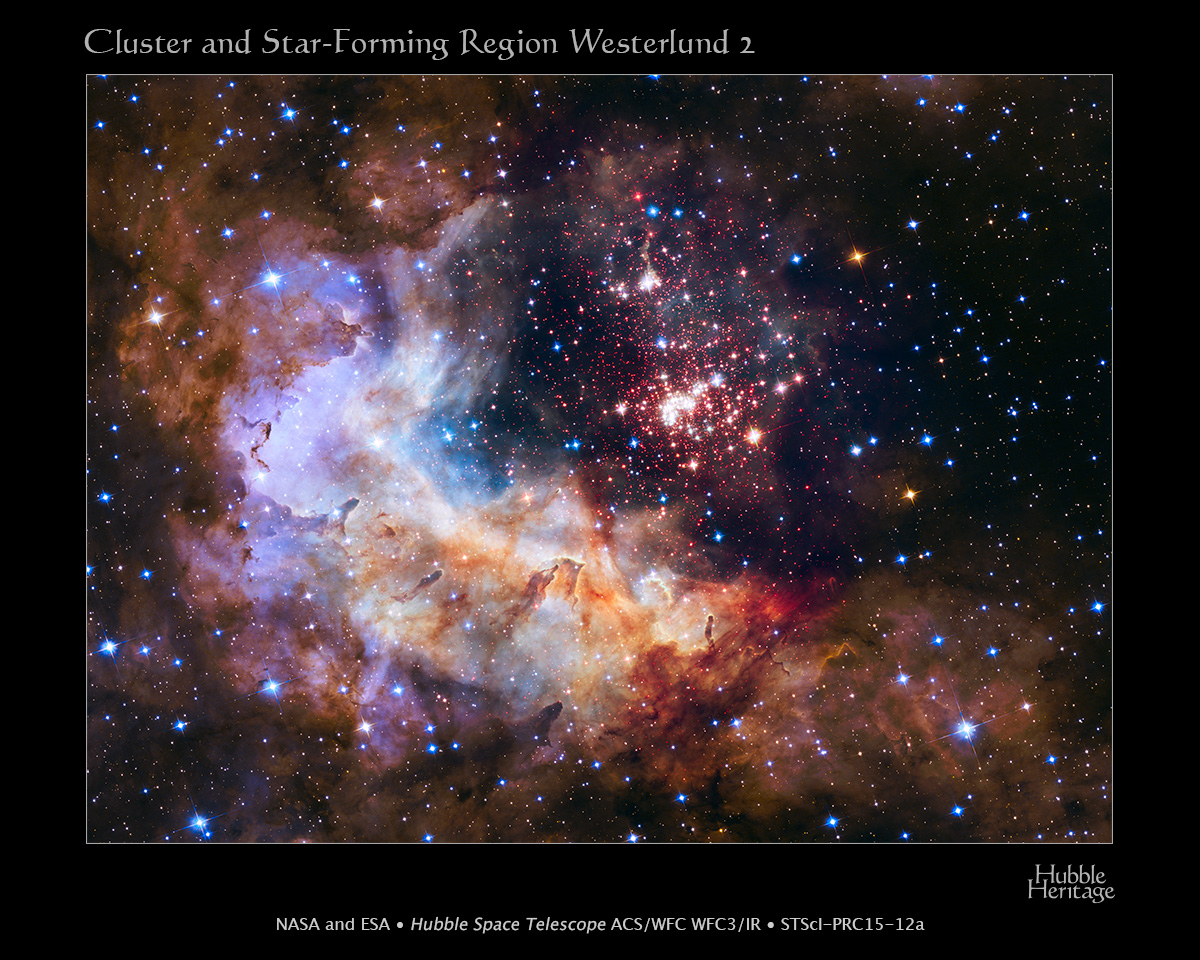
Hubble telescope celebrates 25 years in space

In celebration of the 25th anniversary of the launch of the Hubble Telescope, a beautiful image of the Westerlund 2 star cluster taken by the orbital observatory has been released: Hubble Space Telescope Celebrates 25 Years of Unveiling the Universe – HubbleSite.

0105-4x5color.aiWesterlund 2 star cluster. Zoomable version.

A 3-D visualization of the cluster:

Here’s a statement included with the release:

A new window to the universe opened for humanity on the morning of April 24, 1990, when NASA’s Hubble Space Telescope was lofted into space, riding atop a Promethean flame from the space shuttle Discovery.

“Even the most optimistic person to whom you could have spoken back in 1990 couldn’t have predicted the degree to which Hubble would re-write our astrophysics and planetary science textbooks,” said Charlie Bolden, NASA administrator and pilot of the mission that brought Hubble into orbit. “A quarter century later, Hubble has fundamentally changed human understanding of the universe and our place in it.”

Hubble’s scientific payoff has been immeasurable; it has shown us the universe as we never imagined.

“Hubble has changed the course of science with its discoveries and shown us the depth and beauty of the universe,” said John Grunsfeld, Hubble astronaut and associate administrator of NASA’s Science Mission Directorate at NASA Headquarters, Washington. “With both new observations and treasures hidden in the existing archive of data, Hubble will continue to unravel the mysteries of the cosmos in the years ahead.”

Above the hazy blur of Earth’s atmosphere, Hubble provides a larger-than-life, “super-rainbow” view of the universe: from ultraviolet, visible, and into near-infrared wavelengths of light. Hubble’s fantastic images unveil both beauty and cataclysmic disturbances across an unimaginably deep cosmic tapestry. Combined with the powers of NASA’s Great Observatories, Chandra, Spitzer, and the deorbited Compton Gamma-ray Observatory, Hubble painted a picture of the solar system and beyond that has changed astronomy forever.

Initially tasked to measure the expansion rate of the universe, find very distant galaxies, and investigate black holes, Hubble’s research has now covered nearly every frontier in deep-space astronomy: the expansion and acceleration rate of the universe, the apparent link between galaxy mass and central black hole mass; early galaxy formation shortly after the Big Bang; strange transient events in space; and the chemistry and potential habitability of planets orbiting other stars.

Hubble’s long exposures of the far universe have unveiled an “undiscovered country” of discordant objects, violent explosions, and tumultuous galaxy collisions. They tell the story of the dynamic evolution of the universe from the Big Bang.

Hubble has also provided a fascinating view of our own dynamic solar system, revealing colliding asteroids, changing aurorae and weather on planets and moons, and even enabling the detection of previously unknown moons.

More than being just a tool for astronomers, Hubble is the people’s telescope. It is one of the most influential scientific instruments ever built, reinvigorating and reshaping what the world perceives as outer space. Its images and discoveries have captured the imagination of people around the world, touching everything from pop culture to science fiction, from academia to art. Hubble has also substantially improved science, technology, engineering and mathematics (STEM) education nationwide. Its education materials are used by half a million teachers and six million students annually in all 50 states.

Thanks to five space shuttle servicing missions, totaling 32 astronaut space walks, and the multitude of scientists, engineers, and staff that worked on Hubble, the observatory has long out-lasted its planned end-of-mission in 2005. The observatory’s science capabilities are more powerful than at its launch, with upgraded instruments, computers, and control systems operating at top performance until at least the end of the decade.

With support from ESA (European Space Agency), Hubble has served as a trailblazer for planning humanity’s next big step into the cosmos. The James Webb Space Telescope (JWST), a partnership with ESA and the Canadian Space Agency, is scheduled for launch in 2018 and will see farther back in time than Hubble with its extended infrared capabilities. JWST will reveal fledgling galaxies from the first 200 million years after the Big Bang. It will also peer deeply into the dusty planet-forming disks around young stars that Hubble often sees in silhouette, and push the boundaries of learning about planets orbiting other stars.

TMRO Space Pods: Mice & seeds on the ISS, India’s human spaceflight program, Our Milky Way home

More Space Pod short video reports from TMRO.tv:

* Mousetronauts and Growing Seeds in Microgravity – Space Pod 04/22/15 – “Lisa Stojanovski discusses the different experiments that will performed on mice at the International Space Station as well as plant growth experiments.”

* India’s Human Spaceflight Program – Space Pod 04/21/15 – “Michael Clark talks about India’s human spaceflight program and the rockets that will enable them.”


* Living in the Galactic ‘Burbs – Space Pod 04/20/15 – “Ariel Waldman chats about our home in the Milky Way galaxy and displays her #spacehipster pride in explaining why the Spitzer Space Telescope is awesome.”

ESO: First measurement of an exoplanet’s visible light spectrum

A new report from ESO (European Southern Observatory):

First Exoplanet Visible Light Spectrum
New technique paints promising picture for future

Astronomers using the HARPS planet-hunting machine at ESO’s La Silla Observatory in Chile have made the first-ever direct detection of the spectrum of visible light reflected off an exoplanet. These observations also revealed new properties of this famous object, the first exoplanet ever discovered around a normal star: 51 Pegasi b. The result promises an exciting future for this technique, particularly with the advent of next generation instruments, such as ESPRESSO, on the VLT, and future telescopes, such as the E-ELT.

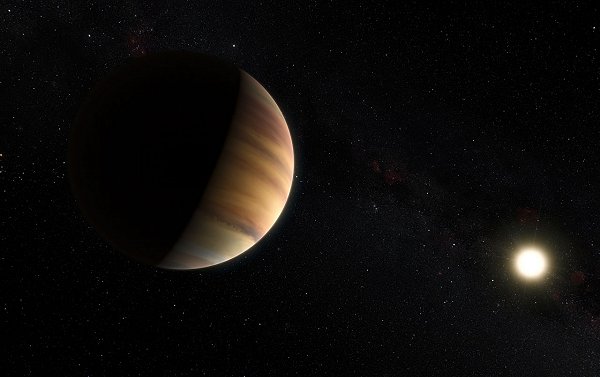
eso1517a_600x377

This artist’s view shows the hot Jupiter exoplanet 51 Pegasi b, sometimes referred to as Bellerophon, which orbits a star about 50 light-years from Earth in the northern constellation of Pegasus (The Winged Horse). This was the first exoplanet around a normal star to be found in 1995. Twenty years later this object was also the first exoplanet to be be directly detected spectroscopically in visible light. Credit: ESO/M. Kornmesser/Nick Risinger (skysurvey.org)

The exoplanet 51 Pegasi b [1] lies some 50 light-years from Earth in the constellation of Pegasus. It was discovered in 1995 and will forever be remembered as the first confirmed exoplanet to be found orbiting an ordinary star like the Sun [2]. It is also regarded as the archetypal hot Jupiter — a class of planets now known to be relatively commonplace, which are similar in size and mass to Jupiter, but orbit much closer to their parent stars.

Since that landmark discovery, more than 1900 exoplanets in 1200 planetary systems have been confirmed, but, in the year of the twentieth anniversary of its discovery, 51 Pegasi b returns to the ring once more to provide another advance in exoplanet studies.

The team that made this new detection was led by Jorge Martins from the Instituto de Astrofísica e Ciências do Espaço (IA) and the Universidade do Porto, Portugal, who is currently a PhD student at ESO in Chile. They used the HARPS instrument on the ESO 3.6-metre telescope at the La Silla Observatory in Chile.

Currently, the most widely used method to examine an exoplanet’s atmosphere is to observe the host star’s spectrum as it is filtered through the planet’s atmosphere during transit — a technique known as transmission spectroscopy. An alternative approach is to observe the system when the star passes in front of the planet, which primarily provides information about the exoplanet’s temperature.

The new technique does not depend on finding a planetary transit, and so can potentially be used to study many more exoplanets. It allows the planetary spectrum to be directly detected in visible light, which means that different characteristics of the planet that are inaccessible to other techniques can be inferred.

The host star’s spectrum is used as a template to guide a search for a similar signature of light that is expected to be reflected off the planet as it describes its orbit. This is an exceedingly difficult task as planets are incredibly dim in comparison to their dazzling parent stars.

The signal from the planet is also easily swamped by other tiny effects and sources of noise [3]. In the face of such adversity, the success of the technique when applied to the HARPS data collected on 51 Pegasi b provides an extremely valuable proof of concept.

Jorge Martins explains: “This type of detection technique is of great scientific importance, as it allows us to measure the planet’s real mass and orbital inclination, which is essential to more fully understand the system. It also allows us to estimate the planet’s reflectivity, or albedo, which can be used to infer the composition of both the planet’s surface and atmosphere.”

51 Pegasi b was found to have a mass about half that of Jupiter’s and an orbit with an inclination of about nine degrees to the direction to the Earth [4]. The planet also seems to be larger than Jupiter in diameter and to be highly reflective. These are typical properties for a hot Jupiter that is very close to its parent star and exposed to intense starlight.

HARPS was essential to the team’s work, but the fact that the result was obtained using the ESO 3.6-metre telescope, which has a limited range of application with this technique, is exciting news for astronomers. Existing equipment like this will be surpassed by much more advanced instruments on larger telescopes, such as ESO’s Very Large Telescope and the future European Extremely Large Telescope [5].

“We are now eagerly awaiting first light of the ESPRESSO spectrograph on the VLT so that we can do more detailed studies of this and other planetary systems,” concludes Nuno Santos, of the IA and Universidade do Porto, who is a co-author of the new paper.

—

Here is the paper: Evidence for a spectroscopic direct detection of reflected light from 51 Peg b, J. H. C. Martins et al, Astronomy & Astrophysics, April 2015 (pdf).

ESO: Possible first sign of self-interacting dark matter

A new report from the European Southern Observatory (ESO):

First Signs of Self-interacting Dark Matter?

For the first time dark matter may have been observed interacting with other dark matter in a way other than through the force of gravity. Observations of colliding galaxies made with ESO’s Very Large Telescope and the NASA/ESA Hubble Space Telescope have picked up the first intriguing hints about the nature of this mysterious component of the Universe.

eso1514a[1]

This image from the NASA/ESA Hubble Space Telescope shows the rich galaxy cluster Abell 3827. The strange blue structures surrounding the central galaxies are gravitationally lensed views of a much more distant galaxy behind the cluster. Observations of the central four merging galaxies have provided hints that the dark matter around one of the galaxies is not moving with the galaxy itself, possibly implying dark matter-dark matter interactions of an unknown nature are occuring. Credit: ESO

Using the MUSE instrument on ESO’s VLT in Chile, along with images from Hubble in orbit, a team of astronomers studied the simultaneous collision of four galaxies in the galaxy cluster Abell 3827. The team could trace out where the mass lies within the system and compare the distribution of the dark matter with the positions of the luminous galaxies.

Although dark matter cannot be seen, the team could deduce its location using a technique called gravitational lensing. The collision happened to take place directly in front of a much more distant, unrelated source. The mass of dark matter around the colliding galaxies severely distorted spacetime, deviating the path of light rays coming from the distant background galaxy — and distorting its image into characteristic arc shapes.

Our current understanding is that all galaxies exist inside clumps of dark matter. Without the constraining effect of dark matter’s gravity, galaxies like the Milky Way would fling themselves apart as they rotate. In order to prevent this, 85 percent of the Universe’s mass [1] must exist as dark matter, and yet its true nature remains a mystery.

In this study, the researchers observed the four colliding galaxies and found that one dark matter clump appeared to be lagging behind the galaxy it surrounds. The dark matter is currently 5000 light-years (50 000 million million kilometres) behind the galaxy — it would take NASA’s Voyager spacecraft 90 million years to travel that far.

This video using images from the NASA/ESA Hubble Space Telescope shows the rich galaxy cluster Abell 3827. The strange blue structures surrounding the central galaxies are gravitationally lensed views of a much more distant galaxy behind the cluster. Observations of the central four merging galaxies have provided hints that the dark matter around one of the galaxies is not moving with the galaxy itself, possibly implying dark matter-dark matter interactions of an unknown nature are occuring. Credit: NASA, ESA. Music: Johan B. Monell (www.johanmonell.com)

A lag between dark matter and its associated galaxy is predicted during collisions if dark matter interacts with itself, even very slightly, through forces other than gravity [2]. Dark matter has never before been observed interacting in any way other than through the force of gravity.

Lead author Richard Massey at Durham University, explains: “We used to think that dark matter just sits around, minding its own business, except for its gravitational pull. But if dark matter were being slowed down during this collision, it could be the first evidence for rich physics in the dark sector — the hidden Universe all around us.”

The researchers note that more investigation will be needed into other effects that could also produce a lag. Similar observations of more galaxies, and computer simulations of galaxy collisions will need to be made.

Team member Liliya Williams of the University of Minnesota adds: “We know that dark matter exists because of the way that it interacts gravitationally, helping to shape the Universe, but we still know embarrassingly little about what dark matter actually is. Our observation suggests that dark matter might interact with  forces other than gravity, meaning we could rule out some key theories about what dark matter might be.”

This result follows on from a recent result from the team which observed 72 collisions between galaxy clusters [3] and found that dark matter interacts very little with itself. The new work however concerns the motion of individual galaxies, rather than clusters of galaxies. Researchers say that the collision between these galaxies could have lasted longer than the collisions observed in the previous study — allowing the effects of even a tiny frictional force to build up over time and create a measurable lag [4].

Taken together, the two results bracket the behaviour of dark matter for the first time. Dark matter interacts more than this, but less than that. Massey added: “We are finally homing in on dark matter from above and below — squeezing our knowledge from two directions.”