Category Archives: Astronomy

ESO: Clear evidence that Messier 87 swallowed another galaxy

The ESO (European Southern Observatory)

Giant Galaxy is Still Growing
Messier 87 has swallowed an entire galaxy in the last billion years

New observations with ESO’s Very Large Telescope have revealed that the giant elliptical galaxy Messier 87 has swallowed an entire medium-sized galaxy over the last billion years. For the first time a team of astronomers has been able to track the motions of 300 glowing planetary nebulae to find clear evidence of this event and also found evidence of excess light coming from the remains of the totally disrupted victim.

The huge halo around giant elliptical galaxy Messier 87 appears on this very deep image. An excess of light in the top-right part of this halo, and the motion of planetary nebulae in the galaxy, are the last remaining signs of a medium-sized galaxy that recently collided with Messier 87. The image also reveals many other galaxies forming the Virgo Cluster, of which Messier 87 is the largest member. In particular, the two galaxies at the top right of the frame are nicknamed "the Eyes".
The huge halo around giant elliptical galaxy Messier 87 appears on this very deep image. An excess of light in the top-right part of this halo, and the motion of planetary nebulae in the galaxy, are the last remaining signs of a medium-sized galaxy that recently collided with Messier 87. The image also reveals many other galaxies forming the Virgo Cluster, of which Messier 87 is the largest member. In particular, the two galaxies at the top right of the frame are nicknamed “the Eyes”.

Astronomers expect that galaxies grow by swallowing smaller galaxies. But the evidence is usually not easy to see — just as the remains of the water thrown from a glass into a pond will quickly merge with the pond water, the stars in the infalling galaxy merge in with the very similar stars of the bigger galaxy leaving no trace.

But now a team of astronomers led by PhD student Alessia Longobardi at the Max-Planck-Institut für extraterrestrische Physik, Garching, Germany has applied a clever observational trick to clearly show that the nearby giant elliptical galaxy Messier 87 merged with a smaller spiral galaxy in the last billion years.

“This result shows directly that large, luminous structures in the Universe are still growing in a substantial way — galaxies are not finished yet!” says Alessia Longobardi. “A large sector of Messier 87’s outer halo now appears twice as bright as it would if the collision had not taken place.”

Messier 87 lies at the centre of the Virgo Cluster of galaxies. It is a vast ball of stars with a total mass more than a million million times that of the Sun, lying about 50 million light-years away.

Rather than try to look at all the stars in Messier 87 — there are literally billions and they are too faint and numerous be studied individually — the team looked at planetary nebulae, the glowing shells around ageing stars [1]. Because these objects shine very brightly in a specific hue of aquamarine green, they can be distinguished from the surrounding stars. Careful observation of the light from the nebulae using a powerful spectrograph can also reveal their motions [2].

The red and blue dots mark the position of the planetary nebulae whose motion revealed that Messier 87 has recently been struck by another, smaller galaxy, which has now fully merged with it. Those marked in red are moving away from us, and the blue ones toward us with respect to the galaxy as a whole.

Just as the water from a glass is not visible once thrown into the pond — but may have caused ripples and other disturbances that can be seen if there are particles of mud in the water — the motions of the planetary nebulae, measured using the FLAMES spectrograph on the Very Large Telescope, provide clues to the past merger.

“We are witnessing a single recent accretion event where a medium-sized galaxy fell through the centre of Messier 87, and as a consequence of the enormous gravitational tidal forces, its stars are now scattered over a region that is 100 times larger than the original galaxy!” adds Ortwin Gerhard, head of the dynamics group at the Max-Planck-Institut für extraterrestrische Physik, Garching, Germany, and a co-author of the new study.

The team also looked very carefully at the light distribution in the outer parts of Messier 87 and found evidence of extra light coming from the stars in the galaxy that had been pulled in and disrupted. These observations have also shown that the disrupted galaxy has added younger, bluer stars to Messier 87, and so it was probably a star-forming spiral galaxy before its merger.

“It is very exciting to be able to identify stars that have been scattered around hundreds of thousands of light-years in the halo of this galaxy — but still to be able to see from their velocities that they belong to a common structure. The green planetary nebulae are the needles in a haystack of golden stars. But these rare needles hold the clues to what happened to the stars,” concludes co-author Magda Arnaboldi (ESO, Garching, Germany).

ESO: Observational evidence of first generation of stars in the early universe

Here’s a new ESO report:

Best Observational Evidence of First Generation Stars in the Universe

Astronomers using ESO’s Very Large Telescope have discovered by far the brightest galaxy yet found in the early Universe and found strong evidence that examples of the first generation of stars lurk within it. These massive, brilliant, and previously purely theoretical objects were the creators of the first heavy elements in history — the elements necessary to forge the stars around us today, the planets that orbit them, and life as we know it. The newly found galaxy, labelled CR7, is three times brighter than the brightest distant galaxy known up to now.

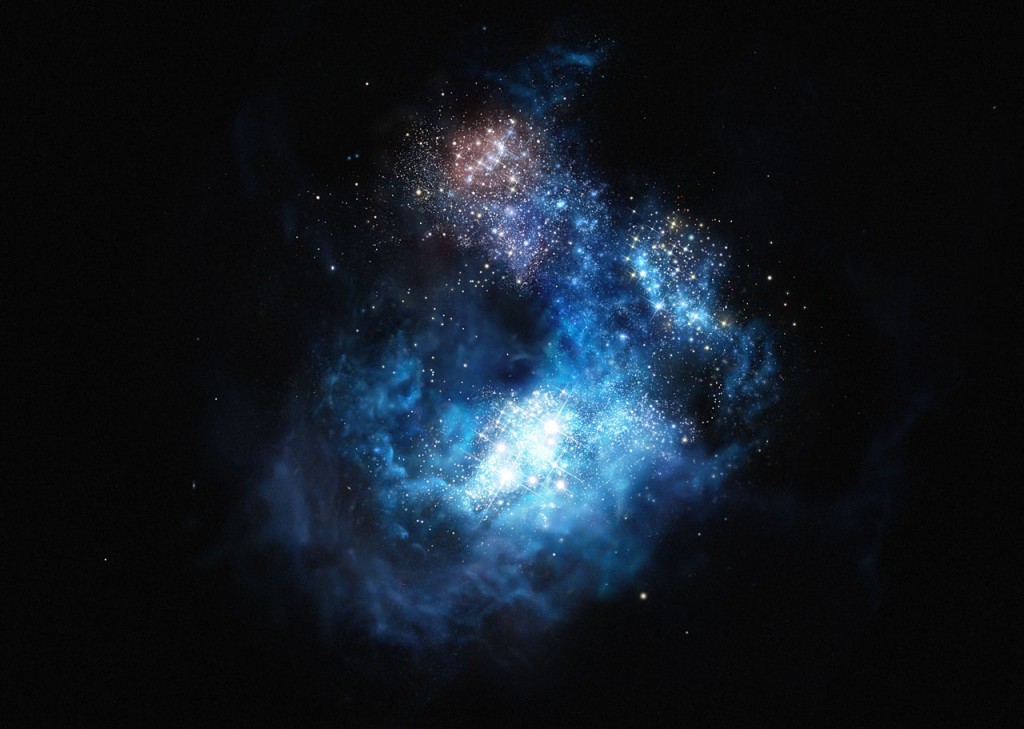
This artist’s impression shows CR7 a very distant galaxy discovered using ESO’s Very Large Telescope. It is by far the brightest galaxy yet found in the early Universe and there is strong evidence that examples of the first generation of stars lurk within it. These massive, brilliant, and previously purely theoretical objects were the creators of the first heavy elements in history — the elements necessary to forge the stars around us today, the planets that orbit them, and life as we know it. This newly found galaxy is three times brighter than the brightest distant galaxy known up to now.

Astronomers have long theorised the existence of a first generation of stars — known as Population III stars — that were born out of the primordial material from the Big Bang [1]. All the heavier chemical elements — such as oxygen, nitrogen, carbon and iron, which are essential to life — were forged in the bellies of stars. This means that the first stars must have formed out of the only elements to exist prior to stars: hydrogen, helium and trace amounts of lithium.

These Population III stars would have been enormous — several hundred or even a thousand times more massive than the Sun — blazing hot, and transient — exploding as supernovae after only about two million years. But until now the search for physical proof of their existence had been inconclusive [2].

A team led by David Sobral, from the Institute of Astrophysics and Space Sciences, the Faculty of Sciences of the University of Lisbon in Portugal, and Leiden Observatory in the Netherlands, has now used ESO’s Very Large Telescope (VLT) to peer back into the ancient Universe, to a period known as reionisation, approximately 800 million years after the Big Bang. Instead of conducting a narrow and deep study of a small area of the sky, they broadened their scope to produce the widest survey of very distant galaxies ever attempted.

Their expansive study was made using the VLT with help from the W. M. Keck Observatory and the Subaru Telescope as well as the NASA/ESA Hubble Space Telescope. The team discovered — and confirmed — a number of surprisingly bright very young galaxies. One of these, labelled CR7 [3], was an exceptionally rare object, by far the brightest galaxy ever observed at this stage in the Universe [4]. With the discovery of CR7 and other bright galaxies, the study was already a success, but further inspection provided additional exciting news.

The X-shooter and SINFONI instruments on the VLT found strong ionised helium emission in CR7 but — crucially and surprisingly — no sign of any heavier elements in a bright pocket in the galaxy. This meant the team had discovered the first good evidence for clusters of Population III stars that had ionised gas within a galaxy in the early Universe [5].

“The discovery challenged our expectations from the start,” said David Sobral, “as we didn’t expect to find such a bright galaxy. Then, by unveiling the nature of CR7 piece by piece, we understood that not only had we found by far the most luminous distant galaxy, but also started to realise that it had every single characteristic expected of Population III stars. Those stars were the ones that formed the first heavy atoms that ultimately allowed us to be here. It doesn’t really get any more exciting than this.”

Within CR7, bluer and somewhat redder clusters of stars were found, indicating that the formation of Population III stars had occurred in waves — as had been predicted. What the team directly observed was the last wave of Population III stars, suggesting that such stars should be easier to find than previously thought: they reside amongst regular stars, in brighter galaxies, not just in the earliest, smallest, and dimmest galaxies, which are so faint as to be extremely difficult to study.

Jorryt Matthee, second author of the paper, concluded: “I have always wondered where we come from. Even as a child I wanted to know where the elements come from: the calcium in my bones, the carbon in my muscles, the iron in my blood. I found out that these were first formed at the very beginning of the Universe, by the first generation of stars. With this discovery, remarkably, we are starting to actually see such objects for the first time.”

Further observations with the VLT, ALMA, and the NASA/ESA Hubble Space Telescope are planned to confirm beyond doubt that what has been observed are Population III stars, and to search for and identify further examples.

Notes

[1] The name Population III arose because astronomers had already classed the stars of the Milky Way as Population I (stars like the Sun, rich in heavier elements and forming the disc) and Population II (older stars, with a low heavy-element content, and found in the Milky Way bulge and halo, and globular star clusters).

[2] Finding these stars is very difficult: they would have been extremely short-lived, and would have shone at a time when the Universe was largely opaque to their light. Previous findings include: Nagao, et al., 2008, where no ionised helium was detected; De Breuck et al., 2000, where ionised helium was detected, but alongside carbon and oxygen, as well as clear signatures of an active galactic nucleus; and Cassata et al., 2013, where ionised helium was detected, but of a very lowequivalent width, or weak intensity, and alongside carbon and oxygen.

[3] CR7’s nickname is an abbreviation of COSMOS Redshift 7, a measure of its place in terms of cosmic time. The higher the redshift, the more distant the galaxy and the further back in the history of the Universe it is seen. A1689-zD1, one of the oldest galaxies ever observed, for example, has a redshift of 7.5.

CR7 is located in the COSMOS field, an intensely studied patch of sky in the constellation of Sextans (The Sextant).

The nickname was inspired by the great Portuguese footballer, Cristiano Ronaldo, who is known as CR7.

[4] CR7 is three times brighter in terms of ultraviolet light emission than the previous titleholder, Himiko, which was thought to be one of a kind at this very early time. Dusty galaxies, at later stages in the history of the Universe, may radiate far more total energy than CR7 in the form of infrared radiation from warm dust. The energy coming from CR7 is mostly ultraviolet/visible light.

[5] The team considered two alternate theories: that the source of the light was either from an AGN or Wolf–Rayet stars. The lack of heavy elements, and other evidence strongly refutes both these theories. The team also considered that the source may be a direct-collapse black hole, which are themselves exceptional exotic and purely theoretical objects. The lack of a broad emission line and the fact that the hydrogen and helium luminosities were much greater than what has been predicted for such a black hole indicate that this, too, is unlikely. A lack of X-ray emissions would further refute this possibility, but additional observations are needed.

Video: TMRO Space Pod short reports – Astronomy and Telescopes

Below are recent TMRO Space Pod short video reports about astronomy and telescope topics.

TMRO Space Pods are crowd funded shows. If you like this episode consider contributing to help us to continue to improve. Head over tohttp://www.patreon.com/spacepod for information, goals and reward levels. Don’t forget to check out our weekly live show campaign as well over at http://www.patreon.com/tmro

* Discovering Andromeda – Space Pod 06/01/2015

Ariel Waldman discusses discoveries made about the Andromeda Galaxy, both new and old

* Astrobiology & Alien Pantone Palettes – SpacePod 06/08/15

This week Ariel Waldman talks about her love of astrobiology and two projects from Cornell University: one that’s creating a color palette of microorganisms we might one day find in the cosmos, and another that’s designing life as we don’t know it on Titan.

* Accessorize the Skies – SpacePod 06/05/15

TMRO Chief Astronomer Jared Head gives insight to a few additional options new astronomers may want to consider to enhance their telescope’s capabilities on their own.

* How to take photos with a Telescope – Space Pod 06/12/15

TMRO Chief Astronomer Jared Head describes how to take photos of celestial objects with special camera’s made to be used with telescopes.

ESO: Red Giant L2 Puppis and companion star creating butterfly planetary nebula

A new report from ESO (European Southern Observatory):

A Celestial Butterfly Emerges from its Dusty Cocoon

Some of the sharpest images ever made with ESO’s Very Large Telescope have, for the first time, revealed what appears to be an ageing star giving birth to a butterfly-like planetary nebula. These observations of the red giant star L2 Puppis, from the ZIMPOL mode of the newly installed SPHERE instrument, also clearly showed a close companion. The dying stages of stars continue to pose astronomers with many riddles, and the origin of such bipolar nebulae, with their complex and alluring hourglass figures, doubly so.

eso1523a[1]

Some of the sharpest images ever made with ESO’s Very Large Telescope have for the first time revealed what appears to be an ageing star in the early stages of forming a butterfly-like planetary nebula. These observations of the red giant star L2 Puppis from the ZIMPOL mode of the newly installed SPHERE instrument also reveal a close companion. The dying stages of the lives of stars continue to pose many riddles for astronomers. Credit: ESO/P. Kervella

At about 200 light-years away, L2 Puppis is one of the closest red giants to Earth known to be entering its final stages of life. The new observations with the ZIMPOL mode of SPHERE were made in visible light using extreme adaptive optics, which corrects images to a much higher degree than standard adaptive optics, allowing faint objects and structures close to bright sources of light to be seen in greater detail. They are the first published results from this mode and the most detailed of such a star.

ZIMPOL can produce images that are three times sharper than those from the NASA/ESA Hubble Space Telescope, and the new observations show the dust that surrounds L2 Puppis in exquisite detail [1]. They confirm earlier findings, made using NACO, of the dust being arranged in a disc, which from Earth is seen almost completely edge-on, but provide a much more detailed view. The polarisation information from ZIMPOL also allowed the team to construct a three dimensional model of the dust structures [2].

eso1523b[1]

Some of the sharpest images ever made with ESO’s Very Large Telescope have for the first time revealed what appears to be an ageing star in the early stages of forming a butterfly-like planetary nebula. The observations of the red giant star L2 Puppis from the ZIMPOL mode of the newly installed SPHERE instrument are combined here with infrared data from NACO, also on the VLT, which shows a dust loop deployed on the far side of the upper part of the nebula. The dying stages of the lives of stars continue to pose many riddles for astronomers. Credit: ESO/P. Kervella

The astronomers found the dust disc to begin about 900 million kilometres from the star — slightly farther than the distance from the Sun to Jupiter — and discovered that it flares outwards, creating a symmetrical, funnel-like shape surrounding the star. The team also observed a second source of light about 300 million kilometres — twice the distance from Earth to the Sun — from L2 Puppis. This very close companion star is likely to be another red giant of slightly lower mass, but less evolved.

The combination of a large amount of dust surrounding a slowly dying star, along with the presence of a companion star, mean that this is exactly the type of system expected to create a bipolar planetary nebula. These three elements seem to be necessary, but a considerable amount of good fortune is also still required if they are to lead to the subsequent emergence of a celestial butterfly from this dusty chrysalis.

This zoom video sequence takes the viewer from a broad vista of the southern Milky Way into a rich part of the constellation of Puppis. We finish with a very close-up look at the red giant star L2 Puppis, which is coming to the end of its life and probably starting to create a bipolar planetary nebula.  Credit: ESO/P. Kervella/N. Risinger (skysurvey.org)/DSS. Music: Johan B. Monell (www.johanmonell.com)

Lead author of the paper, Pierre Kervella, explains: “The origin of bipolar planetary nebulae is one of the great classic problems of modern astrophysics, especially the question of how, exactly, stars return their valuable payload of metals back into space — an important process, because it is this material that will be used to produce later generations of planetary systems.”

In addition to L2 Puppis’s flared disc, the team found two cones of material, which rise out perpendicularly to the disc. Importantly, within these cones, they found two long, slowly curving plumes of material. From the origin points of these plumes, the team deduces that one is likely to be the product of the interaction between the material from L2 Puppis and the companions star’s wind and radiation pressure, while the other is likely to have arisen from a collision between the stellar winds from the two stars, or be the result of an accretion disc around the companion star.

Although much is still to be understood, there are two leading theories of bipolar planetary nebulae, both relying on the existence of a binary star system [3]. The new observations suggest that both of these processes are in action around L2 Puppis, making it appear very probable that the pair of stars will, in time, give birth to a butterfly.

Pierre Kervella concludes: “With the companion star orbiting L2 Puppis only every few years, we expect to see how the companion star shapes the red giant’s disc. It will be possible to follow the evolution of the dust features around the star in real time — an extremely rare and exciting prospect.”

Notes

[1] SPHERE/ZIMPOL use extreme adaptive optics to create diffraction-limited images, which come a lot closer than previous adaptive optics instruments to achieving the theoretical limit of the telescope if there were no atmosphere. Extreme adaptive optics also allows much fainter objects to be seen very close to a bright star. These images are also taken in visible light — shorter wavelengths than the near-infrared regime, where most earlier adaptive optics imaging was performed. These two factors result in significantly sharper images than earlier VLT images. Even higher spatial resolution has been achieved with VLTI, but the interferometer does not create images directly.

[2] The dust in the disc was very efficient at scattering the stars’ light towards Earth and polarising it, a feature that the team could use to create a three-dimensional map of the envelope using both ZIMPOL and NACO data and a disc model based on the RADMC-3D radiative transfer modeling tool, which uses a given set of parameters for the dust to simulate photons propagating through it.

[3] The first theory is that the dust produced by the primary, dying star’s stellar wind is confined to a ring-like orbit about the star by the stellar winds and radiation pressure produced by the companion star. Any further mass lost from the main star is then funneled, or collimated, by this disc, forcing the material to move outwards in two opposing columns perpendicular to the disc.

The second holds that most of the material being ejected by the dying star is accreted by its nearby companion, which begins to form an accretion disc and a pair of powerful jets. Any remaining material is pushed away by the dying star’s stellar winds, forming an encompassing cloud of gas and dust, as would normally occur in a single star system. The companion star’s newly created bipolar jets, moving with much greater force than the stellar winds of the dying star, then carve dual cavities through the surrounding dust, resulting in the characteristic appearance of a bipolar planetary nebula.

ESO: ALMA antenna array obtains detailed view of star making in distant universe

Here is a new article from ESO (European Southern Observatory):

Most Detailed View Ever of Star Formation in the Distant Universe

ALMA’s Long Baseline Campaign has produced a spectacularly detailed image of a distant galaxy being gravitationally lensed. The image shows a magnified view of the galaxy’s star-forming regions, the likes of which have never been seen before at this level of detail in a galaxy so remote. The new observations are far more detailed than those made using the NASA/ESA Hubble Space Telescope, and reveal star-forming clumps in the galaxy equivalent to giant versions of the Orion Nebula.

eso1522a[1]ALMA’s Long Baseline Campaign has produced a spectacularly detailed image of a distant galaxy being gravitationally lensed, revealing star-forming regions — something that has never been seen before at this level of detail in a galaxy so remote. The new observations are far more detailed than any previously made of such a distant galaxy, including those made using the NASA/ESA Hubble Space Telescope, and reveal clumps of star formation in the galaxy equivalent to giant versions of the Orion Nebula.

The left panel shows the foreground lensing galaxy (observed with Hubble), and the gravitationally lensed galaxy SDP.81, which forms an almost perfect Einstein Ring, is hardly visible.

The middle image shows the sharp ALMA image of the Einstein ring, with the foreground lensing galaxy being invisible to ALMA. The resulting reconstructed image of the distant galaxy (right) using sophisticated models of the magnifying gravitational lens, reveal fine structures within the ring that have never been seen before: Several dust clouds within the galaxy, which are thought to be giant cold molecular clouds, the birthplaces of stars and planets.

Credit: ALMA (NRAO/ESO/NAOJ)/Y. Tamura (The University of Tokyo)/Mark Swinbank (Durham University)

ALMA’s Long Baseline Campaign has produced some amazing observations, and gathered unprecedentedly detailed information about the inhabitants of the near and distant Universe. Observations made at the end of 2014 as part of the campaign targeted a distant galaxy called HATLAS J090311.6+003906, otherwise known as SDP.81. This light from this galaxy is a victim of a cosmic effect known as gravitational lensing. A large galaxy sitting between SDP.81 and ALMA [1] is acting as a lens, warping the more distant galaxy’s light and creating a near-perfect example of a phenomenon known as an Einstein Ring [2].

This schematic image shows how light from a distant galaxy is distorted by the gravitational effects of a foreground galaxy, which acts like a lens and makes the distant source appear distorted, but magnified, forming characteristic rings of light, known as Einstein rings. An analysis of the distortion of SDP.81 caused by this effect has revealed star-forming clumps of matter.

Credit: ALMA (NRAO/ESO/NAOJ)/Luis Calçada (ESO)

At least seven groups of scientists [3] have independently analysed the ALMA data on SDP.81. This flurry of research papers has divulged unprecedented information about the galaxy, revealing details about its structure, contents, motion, and other physical characteristics.

ALMA acts as an interferometer. Simply speaking, the array’s multiple antennas work in perfect synchrony to collect light as an enormous virtual telescope [4]. As a result, these new images of SDP.81 have a resolution up to 6 times higher [5] than those taken in the infrared with the NASA/ESA Hubble Space Telescope.

The astronomers’ sophisticated models reveal fine, never-before-seen structure within SDP.81, in the form of dusty clouds thought to be giant repositories of cold molecular gas — the birthplaces of stars and planets. These models were able to correct for the distortion produced by the magnifying gravitational lens.

This schematic image shows how light from a distant galaxy is distorted by the gravitational effects of a foreground galaxy, which acts like a lens and makes the distant source appear distorted, but magnified, forming characteristic rings of light, known as Einstein rings. An analysis of the distortion of SDP.81 caused by this effect has revealed star-forming clumps of matter.

Credit: ALMA (NRAO/ESO/NAOJ)/Luis Calçada (ESO)

As a result, the ALMA observations are so sharp that researchers can see clumps of star formation in the galaxy down to a size of about 200 light-years, equivalent to observing giant versions of the Orion Nebula producing thousands of times more new stars at the far side of the Universe. This is the first time this phenomenon has been seen at such an enormous distance.

“The reconstructed ALMA image of the galaxy is spectacular,” says Rob Ivison, co-author of two of the papers and ESO’s Director for Science. “ALMA’s huge collecting area, the large separation of its antennas, and the stable atmosphere above the Atacama desert all lead to exquisite detail in both images and spectra. That means that we get very sensitive observations, as well as information about how the different parts of the galaxy are moving. We can study galaxies at the other end of the Universe as they merge and create huge numbers of stars. This is the kind of stuff that gets me up in the morning!”

Using the spectral information gathered by ALMA, astronomers also measured how the distant galaxy rotates, and estimated its mass. The data showed that the gas in this galaxy is unstable; clumps of it are collapsing inwards, and will likely turn into new giant star-forming regions in the future.

Notably, the modeling of the lensing effect also indicates the existence of a supermassive black hole at the centre of the foreground galaxy lens [6]. The central part of SDP.81 is too faint to be detected, leading to the conclusion that the foreground galaxy holds a supermassive black hole with more than 200–300 million times the mass of the Sun.

The number of papers published using this single ALMA dataset demonstrates the excitement generated by the potential of the array’s high resolution and light-gathering power. It also shows how ALMA will enable astronomers to make more discoveries in the years to come, also uncovering yet more questions about the nature of distant galaxies.

Notes

[1] The lensed galaxy is seen at a time when the Universe was only 15 percent of its current age, just 2.4 billion years after Big Bang. The light has taken over twice the age of the Earth to reach us (11.4 billion years), detouring along the way around a massive foreground galaxy that is comparatively close at four billion light-years away from us.

[2] Gravitational lenses were predicted by Albert Einstein as part of his theory of general relativity. His theory tells us that objects bend space and time. Any light approaching this curved space-time will itself follow the curvatures created by the object. This enables particularly massive objects — huge galaxies and galaxy clusters — to act as cosmic magnifying glasses. An Einstein ring is a special type of gravitational lens, in which the Earth, the foreground lensing galaxy, and the background lensed galaxy are in perfect alignment, creating a harmonious distortion in the form of a ring of light. This phenomenon is illustrated in Video A [above].

[3] The science teams are listed below.

[4] ALMA’s ability to see the finest detail is achieved when the antennas are at their greatest separation, up to 15 kilometres apart. For comparison, earlier observations of gravitational lenses made with ALMA in a more compact configuration, with a separation of only around 500 metres, can be seen here.

[5] Details down to 0.023 arc-seconds, or 23 milli-arcseconds, can be measured in these data. Hubble observed this galaxy in the near-infrared, with a resolution of about 0.16 arc-seconds. Note, however, that when observing at shorter wavelengths, Hubble can reach finer resolutions, down to 0.022 arcseconds in the near-ultraviolet. ALMA’s resolution can be adjusted depending on the type of observations by moving the antennas further apart or closer together. For these observations, the widest separation was used, resulting in the finest resolution possible.

[6] The high-resolution ALMA image enables researchers to look for the central part of the background galaxy, which is expected to appear at the centre of the Einstein ring. If the foreground galaxy has a supermassive black hole at the centre, the central image becomes fainter. The faintness of the central image indicates how massive the black hole in the foreground galaxy is.