Category Archives: Astronomy

ESO: Giant glowing halos observed around distant quasars

A new report from ESO (European Southern Observatory):

ESO’s VLT Detects Unexpected Giant Glowing Halos around Distant Quasars
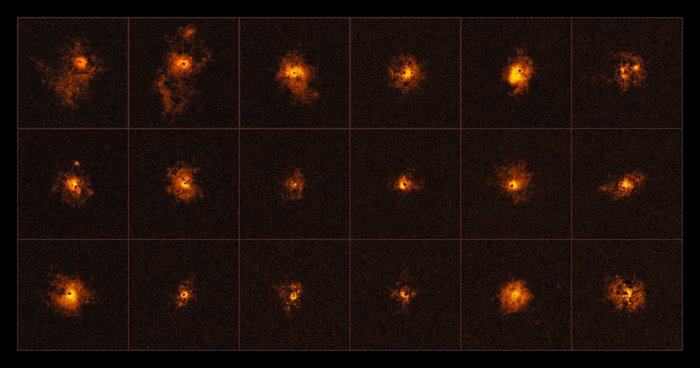
This mosaic shows 18 of the 19 quasars observed by an international team of astronomers, led by the ETH Zurich, Switzerland. Each observed quasar is surrounded by a bright gaseous halo. It is the first time that a survey of quasars shows such bright halos around all of the observed quasars. The discovery was made using the MUSE instrument at ESO’s Very Large Telescope.
This mosaic shows 18 of the 19 quasars observed by an international team of astronomers, led by the ETH Zurich, Switzerland. Each observed quasar is surrounded by a bright gaseous halo. It is the first time that a survey of quasars shows such bright halos around all of the observed quasars. The discovery was made using the MUSE instrument at ESO’s Very Large Telescope. [Larger images]

An international team of astronomers has discovered glowing gas clouds surrounding distant quasars. This new survey by the MUSE instrument on ESO’s Very Large Telescope indicates that halos around quasars are far more common than expected. The properties of the halos in this surprising find are also in striking disagreement with currently accepted theories of galaxy formation in the early Universe.

The MUSE instrument on ESO’s Very Large Telescope is able to collect three-dimensional data. Using this data cube, astronomers were able to create a 3D representation of the gas halos surrounding the distant quasars. Credit: ESO/S. Cantalupo

An international collaboration of astronomers, led by a group at the Swiss Federal Institute of Technology (ETH) in Zurich, Switzerland, has used the unrivalled observing power of MUSE on the Very Large Telescope (VLT) at ESO’s Paranal Observatory to study gas around distant active galaxies, less than two billion years after the Big Bang. These active galaxies, called quasars, contain supermassive black holes in their centres, which consume stars, gas, and other material at an extremely high rate. This, in turn, causes the galaxy centre to emit huge amounts of radiation, making quasars the most luminous and active objects in the Universe.

The study involved 19 quasars, selected from among the brightest that are observable with MUSE. Previous studies have shown that around 10% of all quasars examined were surrounded by halos, made from gas known as the intergalactic medium. These halos extend up to 300 000 light-years away from the centres of the quasars. This new study, however, has thrown up a surprise, with the detection of large halos around all 19 quasars observed  — far more than the two halos that were expected statistically. The team suspects this is due to the vast increase in the observing power of MUSE over previous similar instruments, but further observations are needed to determine whether this is the case.

“It is still too early to say if this is due to our new observational technique or if there is something peculiar about the quasars in our sample. So there is still a lot to learn; we are just at the beginning of a new era of discoveries”, says lead author Elena Borisova, from the ETH Zurich.

The original goal of the study was to analyse the gaseous components of the Universe on the largest scales; a structure sometimes referred to as the cosmic web, in which quasars form bright nodes [1]. The gaseous components of this web are normally extremely difficult to detect, so the illuminated halos of gas surrounding the quasars deliver an almost unique opportunity to study the gas within this large-scale cosmic structure.

This mosaic shows 18 of the 19 quasars observed by an international team of astronomers, led by the ETH Zurich, Switzerland. Each observed quasar is surrounded by a bright gaseous halo. It is the first time that a survey of quasars shows such bright halos around all of the observed quasars. The discovery was made using the MUSE instrument at ESO’s Very Large Telescope. Credit: ESO/Borisova et al.

The 19 newly-detected halos also revealed another surprise: they consist of relatively cold intergalactic gas — approximately 10 000 degrees Celsius. This revelation is in strong disagreement with currently accepted models of the structure and formation of galaxies, which suggest that gas in such close proximity to galaxies should have temperatures upwards of a million degrees.

It is the first time that MUSE and its unique observing capabilities have been used for a survey of this kind. The discovery shows the potential of the instrument for observing this type of object [2]. Co-author Sebastiano Cantalupo is very excited about the new instrument and the opportunities it provides:

“We have exploited the unique capabilities of MUSE in this study, which will pave the way for future surveys. Combined with a new generation of theoretical and numerical models, this approach will continue to provide a new window on cosmic structure formation and galaxy evolution.”

Notes

[1] The cosmic web is the structure of the Universe at the largest scale. It is comprised of spindly filaments of primordial material (mostly hydrogen and helium gas) and dark matter which connect galaxies and span the chasms between them. The material in this web can feed along the filaments into galaxies and drive their growth and evolution.

[2] MUSE is an integral field spectrograph and combines spectrographic and imaging capabilities. It can observe large astronomical objects in their entirety in one go, and for each pixel measure the intensity of the light as a function of its colour, or wavelength.
 

Citizen scientists find debris disk around red dwarf where planets can form

Another example of citizen scientists contributing to a published scientific finding:

Citizen Scientists Discover Potential New Exoplanet Hunting Ground

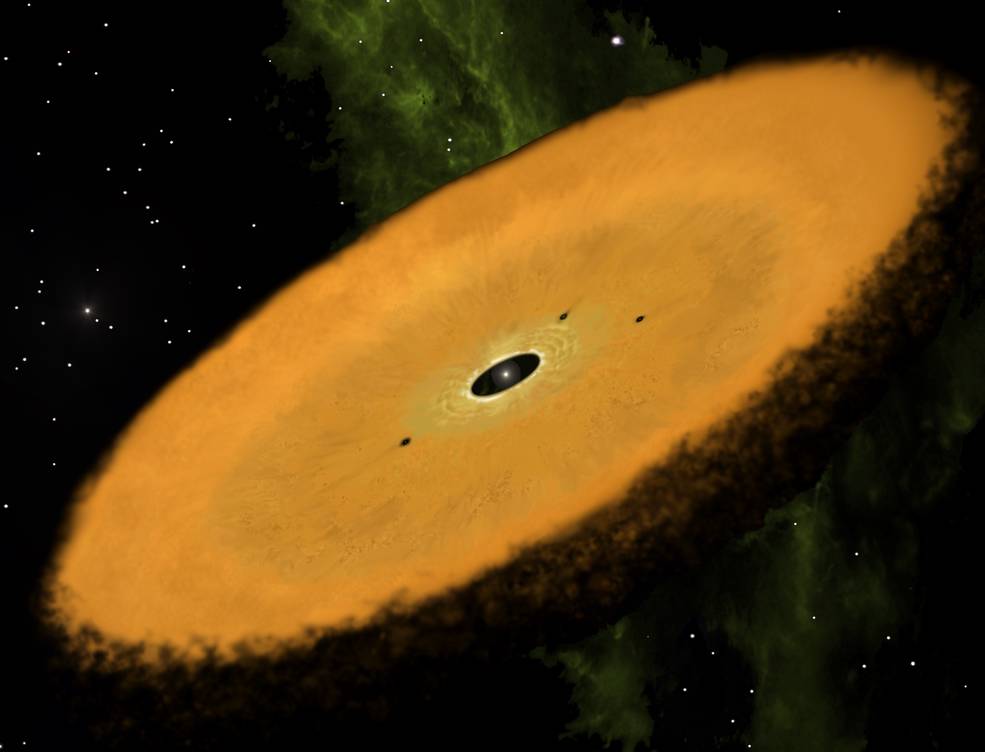
Via a NASA-led citizen science project, eight people with no formal training in astrophysics helped discover what could be a fruitful new place to search for planets outside our solar system – a large disk of gas and dust encircling a star known as a circumstellar disk.

awi0005x3s-cropped1
Artist’s concept of the newly discovered disk. Credits: Jonathan Holden

A paper, published in The Astrophysical Journal Letters and coauthored by eight citizen scientists involved in the discovery, describes a newly identified red dwarf star, AWI0005x3s, and its warm circumstellar disk, the kind associated with young planetary systems. Most of the exoplanets, which are planets outside our solar system, that have been imaged to date dwell in disks similar to the one around AWI0005x3s.

The disk and its star are located in what is dubbed the Carina association – a large, loose grouping of similar stars in the Carina Nebula approximately 212 light years from our sun. Its relative proximity to Earth will make it easier to conduct follow-on studies.

“Most disks of this kind fade away in less than 30 million years,” said Steven Silverberg, a graduate student at Oklahoma University and lead author of the paper. “This particular red dwarf is a candidate member of the Carina association, which would make it around 45 million years old. It’s the oldest red dwarf system with a disk we’ve seen in one of these associations.”

Since the launch of NASA’s Disk Detective website in January 2014, approximately 30,000 citizen scientists have performed roughly two million classifications of stellar objects, including those that led to this discovery. Through Disk Detective, citizen scientists study data from NASA’s Wide-field Infrared Survey Explorer mission (WISE), the agency’s Two-Micron All Sky Survey project, and other stellar surveys.

“Without the help of the citizen scientists examining these objects and finding the good ones, we might never have spotted this object,” said Marc Kuchner, an astrophysicist at NASA’s Goddard Space Fight Center in Greenbelt, Maryland, who leads Disk Detective. “The WISE mission alone found 747 million objects, of which we expect a few thousand to be circumstellar disks.” 

The eight citizen scientist co-authors, members of an advanced user group, volunteered to help by researching disk candidates. Their data led to the discovery of this new disk.

“I’ve loved astronomy since childhood and wanted to be part of the space program, as did every boy my age,” adds Milton Bosch, a citizen scientist co-author from California. “I feel very fortunate to be part of such a great group of dedicated people, and am thrilled to partake in this adventure of discovery and be a co-author on this paper.”

Disk Detective is a collaboration between NASA, Zooniverse, the University of Oklahoma, University of Córdoba in Argentina, National Astronomical Observatory of Japan, Space Telescope Science Institute, Harvard-Smithsonian Center for Astrophysics, Carnegie Institution of Washington, University of Hawaii and Korea Astronomy and Space Science Institute.

To learn more about opportunities for the public to participate in NASA science and technology projects, visit: www.nasa.gov/solve

ESO: Capturing the raging winds of Eta Carinae

Here is the latest ESO (European Southern Observatory) report:

Highest Resolution Image of Eta Carinae
VLT Interferometer captures raging winds in famous massive stellar system

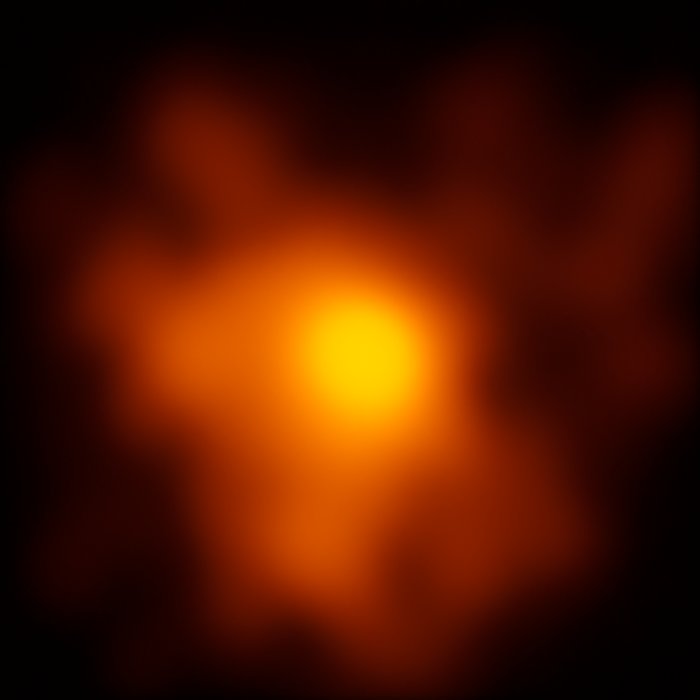
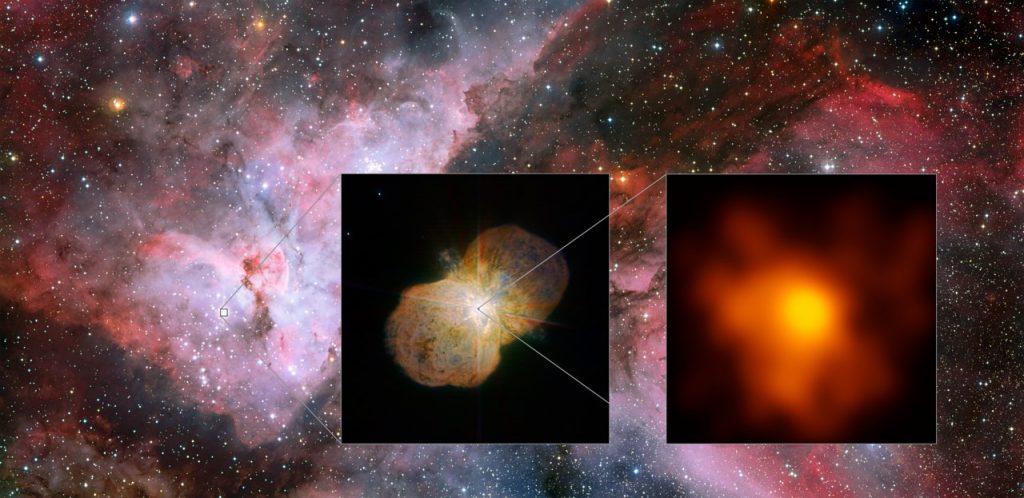
This mosaic shows the Carina Nebula (left part of the image), home of the Eta Carinae star system. This part was observed with the Wide Field Imager on the MPG/ESO 2.2-metre telescope at ESO’s La Silla Observatory. The middle part shows the direct surrounding of the star: the Homunculus Nebula, created by the ejected material from the Eta Carinae system. This image was taken with the NACO near-infrared adaptive optics instrument on ESO's Very Large Telescope. The right image shows the innermost part of the system as seen with the Very Large Telescope Interferometer (VLTI). It is the highest resolution image of Eta Carinae ever.
This mosaic shows the Carina Nebula (left part of the image), home of the Eta Carinae star system. This part was observed with the Wide Field Imager on the MPG/ESO 2.2-metre telescope at ESO’s La Silla Observatory. The middle part shows the direct surrounding of the star: the Homunculus Nebula, created by the ejected material from the Eta Carinae system. This image was taken with the NACO near-infrared adaptive optics instrument on ESO’s Very Large Telescope. The right image shows the innermost part of the system as seen with the Very Large Telescope Interferometer (VLTI). It is the highest resolution image of Eta Carinae ever. [Larger images.]
An international team of astronomers have used the Very Large Telescope Interferometer to image the Eta Carinae star system in the greatest detail ever achieved. They found new and unexpected structures within the binary system, including in the area between the two stars where extremely high velocity stellar winds are colliding. These new insights into this enigmatic star system could lead to a better understanding of the evolution of very massive stars.

This image represent the best image of the Eta Carinae star system ever made. The observations were made with the Very Large Telescope Interferometer and could lead to a better understanding of the evolution of very massive stars.
This image represent the best image of the Eta Carinae star system ever made. The observations were made with the Very Large Telescope Interferometer and could lead to a better understanding of the evolution of very massive stars. [Larger images]

Led by Gerd Weigelt from the Max Planck Institute for Radio Astronomy (MPIfR) in Bonn, a team of astronomers have used the Very Large Telescope Interferometer (VLTI) at ESO’s Paranal Observatory to take a unique image of the Eta Carinae star system in the Carina Nebula.

This animation zooms in on the massive star system Eta Carinae, located in the Carina Nebula. During the zoom the Homunculus Nebula and finally the violent surrounding of Eta Carinae becomes visible.

This colossal binary system consists of two massive stars orbiting each other and is very active, producing stellar winds which travel at velocities of up to ten million kilometres per hour [1]. The zone between the two stars where the winds from each collide is very turbulent, but until now it could not be studied.

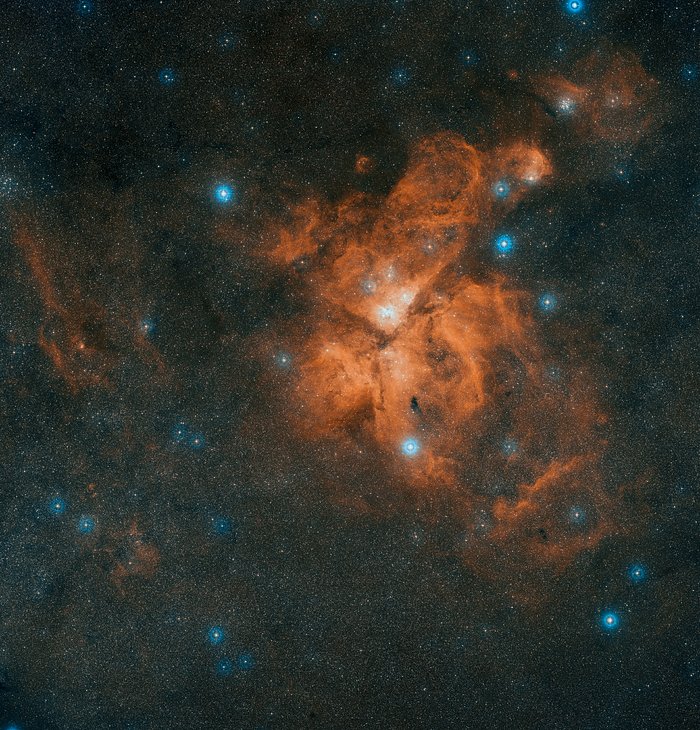
This image is a colour composite made from exposures from the Digitized Sky Survey 2 (DSS2). The field of view is approximately 4.7 x 4.9 degrees.
This image is a colour composite made from exposures from the Digitized Sky Survey 2 (DSS2). The field of view is approximately 4.7 x 4.9 degrees. [Larger images.]

The power of the Eta Carinae binary pair creates dramatic phenomena. A “Great Eruption” in the system was observed by astronomers in the 1830s. We now know that this was caused by the larger star of the pair expelling huge amounts of gas and dust in a short amount of time, which led to the distinctive lobes, known as the Homunculus Nebula, that we see in the system today. The combined effect of the two stellar winds as they smash into each other at extreme speeds is to create temperatures of millions of degrees and intense deluges of X-ray radiation.

This animation zooms from outside the Homunculus Nebula, which Eta Carinae ejected in a famous outburst in the 19th century, to the system’s two massive orbiting stars.  Credit: NASA Goddard CI Lab

The central area where the winds collide is so comparatively tiny — a thousand times smaller than the Homunculus Nebula — that telescopes in space and on the ground so far have not been able to image them in detail. The team has now utilised the powerful resolving ability of the VLTI instrument AMBER to peer into this violent realm for the first time. A clever combination — an interferometer — of three of the four Auxiliary Telescopes at the VLT lead to a tenfold increase in resolving power in comparison to a single VLT Unit Telescope. This delivered the sharpest ever image of the system and yielded unexpected results about its internal structures.

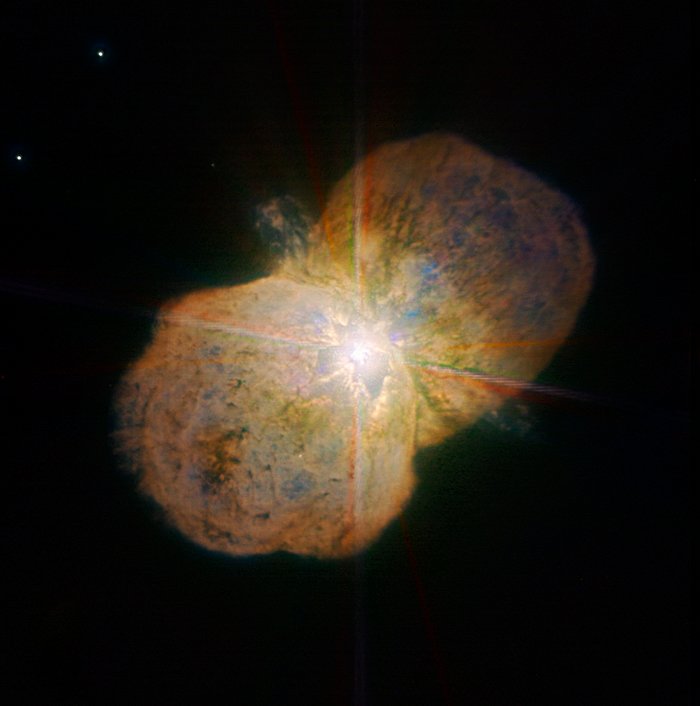
This new image of the luminous blue variable Eta Carinae was taken with the NACO near-infrared adaptive optics instrument on ESO's Very Large Telescope, yielding an incredible amount of detail. The images clearly shows a bipolar structure as well as the jets coming out from the central star. The image was obtained by the Paranal Science team and processed by Yuri Beletsky (ESO) and Hännes Heyer (ESO). It is based on data obtained through broad (J, H, and K; 90 second exposure time per filters) and narrow-bands (1.64, 2.12, and 2.17 microns; probing iron, molecular and atomic hydrogen, respectively; 4 min per filter).
This new image of the luminous blue variable Eta Carinae was taken with the NACO near-infrared adaptive optics instrument on ESO’s Very Large Telescope, yielding an incredible amount of detail. The images clearly shows a bipolar structure as well as the jets coming out from the central star. The image was obtained by the Paranal Science team and processed by Yuri Beletsky (ESO) and Hännes Heyer (ESO). It is based on data obtained through broad (J, H, and K; 90 second exposure time per filters) and narrow-bands (1.64, 2.12, and 2.17 microns; probing iron, molecular and atomic hydrogen, respectively; 4 min per filter). [Larger images.]

The new VLTI image clearly depict the structure which exists between the two Eta Carinae-stars. An unexpected fan-shaped structure was observed where the raging wind from the smaller, hotter star crashes into the denser wind from the larger of the pair.

“Our dreams came true, because we can now get extremely sharp images in the infrared. The VLTI provides us with a unique opportunity to improve our physical understanding of Eta Carinae and many other key objects”, says Gerd Weigelt.

In addition to the imaging, the spectral observations of the collision zone made it possible to measure the velocities of the intense stellar winds [2]. Using these velocities, the team of astronomers were able to produce more accurate computer models of the internal structure of this fascinating stellar system, which will help increase our understanding of how these kind of extremely high mass stars lose mass as they evolve.

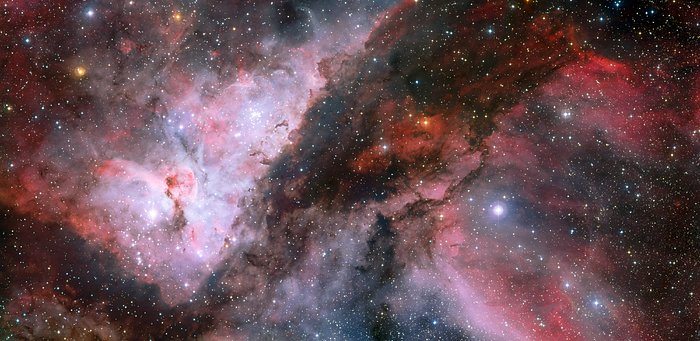
This spectacular panoramic view combines a new image of the field around the Wolf–Rayet star WR 22 in the Carina Nebula (right) with an earlier picture of the region around the unique star Eta Carinae in the heart of the nebula (left). The picture was created from images taken with the Wide Field Imager on the MPG/ESO 2.2-metre telescope at ESO’s La Silla Observatory in Chile. This image is available as a mounted image in the ESOshop. #L
This spectacular panoramic view combines a new image of the field around the Wolf–Rayet star WR 22 in the Carina Nebula (right) with an earlier picture of the region around the unique star Eta Carinae in the heart of the nebula (left). The picture was created from images taken with the Wide Field Imager on the MPG/ESO 2.2-metre telescope at ESO’s La Silla Observatory in Chile. This image is available as a mounted image in the ESOshop. [Larger image]

Team member Dieter Schertl (MPIfR) looks forward:

“The new VLTI instruments GRAVITY and MATISSE will allow us to get interferometric images with even higher precision and over a wider wavelength range. This wide wavelength range is needed to derive the physical properties of many astronomical objects.”

Notes

[1] The two stars are so massive and bright that the radiation they produce rips off their surfaces and spews them into space. This expulsion of stellar material is referred to as stellar “wind”, and it can travel at millions of kilometres per hour.

[2] Measurements were done through the Doppler effect. Astronomers use the Doppler effect (or shifts) to calculate precisely how fast stars and other astronomical objects move toward or away from Earth. The movement of an object towards or away from us causes a slight shift in its spectral lines. The velocity of the motion can be calculated from this shift.

Hubble: Observable universe holds ten times more galaxies than previously thought

The latest finding with the Hubble space telescope:

Observable Universe contains ten times more galaxies
than previously thought

Among other data, scientists used the galaxies visible in the Great Observatories Origins Deep Survey (GOODS) to recalculate the total number of galaxies in the observable Universe. The image was taken by the NASA/ESA Hubble Space Telescope and covers a portion of the southern field of GOODS. This is a large galaxy census, a deep-sky study by several observatories to trace the formation and evolution of galaxies.
Among other data, scientists used the galaxies visible in the Great Observatories Origins Deep Survey (GOODS) to recalculate the total number of galaxies in the observable Universe. The image was taken by the NASA/ESA Hubble Space Telescope and covers a portion of the southern field of GOODS. This is a large galaxy census, a deep-sky study by several observatories to trace the formation and evolution of galaxies. [Larger images]

Astronomers using data from the NASA/ESA Hubble Space Telescopes and other telescopes have performed an accurate census of the number of galaxies in the Universe. The group came to the surprising conclusion that there are at least 10 times as many galaxies in the observable Universe as previously thought. The results have clear implications for our understanding of galaxy formation, and also help solve an ancient astronomical paradox — why is the sky dark at night?

Since Edwin Hubble discovered that the Milky Way is not the only galaxy in the Universe astronomers try to find out how many of them are there. This new Hubblecast focusses on the question “How many galaxies are there?” including the new numbers achieved in 2016.

One of the most fundamental questions in astronomy is that of just how many galaxies the Universe contains. The Hubble Deep Field images, captured in the mid 1990s, gave the first real insight into this. Myriad faint galaxies were revealed, and it was estimated that the observable Universe contains about 100 billion galaxies [1]. Now, an international team, led by Christopher Conselice from the University of Nottingham, UK, have shown that this figure is at least ten times too low.

This animation demonstrates the evolution of galaxy size and number over cosmic time. It starts with the modern Universe with rather few and large galaxies — as they can be seen in our cosmic neighbourhood — and ends with a view of the early Universe with many tiny galaxies. Credit: ESA/Hubble, M. Kornmesser

Conselice and his team reached this conclusion using deep space images from Hubble, data from his team’s previous work, and other published data [2]. They painstakingly converted the images into 3D, in order to make accurate measurements of the number of galaxies at different times in the Universe’s history. In addition, they used new mathematical models which allowed them to infer the existence of galaxies which the current generation of telescopes cannot observe. This led to the surprising realisation that in order for the numbers to add up, some 90% of the galaxies in the observable Universe are actually too faint and too far away to be seen — yet.

“It boggles the mind that over 90% of the galaxies in the Universe have yet to be studied. Who knows what interesting properties we will find when we observe these galaxies with the next generation of telescopes,” explains Christopher Conselice about the far-reaching implications of the new results.

In analysing the data the team looked more than 13 billion years into the past. This showed them that galaxies are not evenly distributed throughout the Universe’s history. In fact, it appears that there were a factor of 10 more galaxies per unit volume when the Universe was only a few billion years old compared with today. Most of these galaxies were relatively small and faint, with masses similar to those of the satellite galaxies surrounding the Milky Way.

This animation demonstrates the lookback into the distant, early Universe. While the modern Universe contains in average larger galaxies, the early Universe is dominated by many tiny galaxies. Credit: ESA/Hubble, M. Kornmesser

These results are powerful evidence that a significant evolution has taken place throughout the Universe’s history, an evolution during which galaxies merged together, dramatically reducing their total number. “This gives us a verification of the so-called top-down formation of structure in the Universe,” explains Conselice.

The decreasing number of galaxies as time progresses also contributes to the solution of Olbers’ paradox — why the sky is dark at night [3]. The team came to the conclusion that there is such an abundance of galaxies that, in principle, every point in the sky contains part of a galaxy. However, most of these galaxies are invisible to the human eye and even to modern telescopes, owing to a combination of factors: redshifting of light, the Universe’s dynamic nature and the absorption of light by intergalactic dust and gas, all combine to ensure that the night sky remains mostly dark.

This animation starts with a lookback into the early Universe. The local, modern Universe with large and evolved galaxies can be seen to the left. The distant, early Universe with many tiny and primordial galaxies can be seen to the right. These galaxies grew through mergers to the galaxies we see today. The animation slowly turns by 90 degree and ends with a view similar to the Hubble Deep fields. Credit: ESA/Hubble, M. Kornmesser

Notes

[1] The limited speed of light and the age of the Universe mean that the entire Universe cannot be seen from Earth. The part visible within our cosmological horizon is called the observable Universe.

[2] The study uses data from Perez-Gonzalez et al. (2008), Kajisawa et al. (2009), Fontanta et al. (2004, 2006), Caputi et al. (2011), Pozzetti et al. (2009), Mortlock et al. (2011), Muzzin et al. (2013), Mortlock et al. (2015), Duncan et al. (2014), Grazian et al. (2015), Tomczak et al. (2014) and Song et al. (2015).

[3] The astronomer Heinrich Olbers argued that the night sky should be permanently flooded by light, because in an unchanging Universe filled with an infinite number of stars, every single part of the sky should be occupied by a bright object. However, our modern understanding of the Universe is that it is both finite and dynamic — not infinite and static.

This video pans across the southern field of the Great Observatories Origins Deep Survey (GOODS). GOODS is a large galaxy census, a deep-sky study by several observatories to trace the formation and evolution of galaxies. Credit: NASA, ESA/Hubble, Music: Johan B. Monell (www.johanmonell.com)

ESO: Ancient stars discovered at center of the Milky Way

The latest report from the European Southern Observatory (ESO):

The Milky Way’s Ancient Heart
VISTA finds remains of archaic globular star cluster

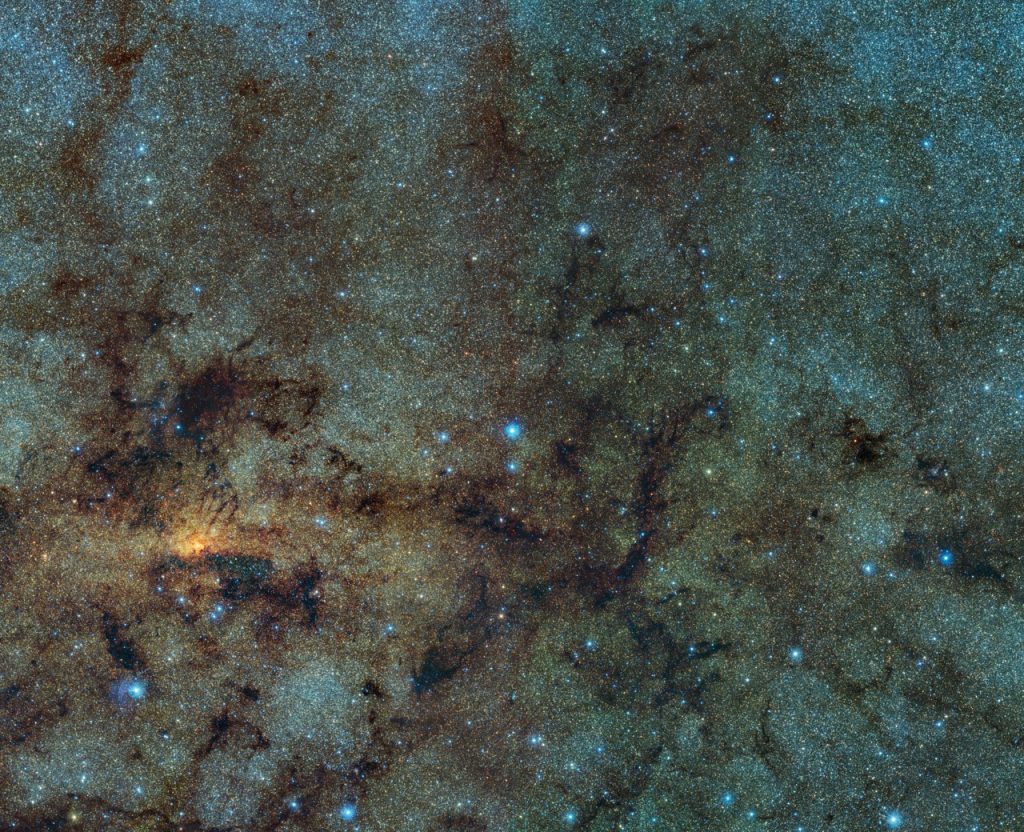
This image, captured with the VISTA infrared survey telescope, as part of the Variables in the Via Lactea (VVV) ESO public survey, shows the central part of the Milky Way. While normally hidden behind obscuring dust, the infrared capabilities of VISTA allow to study the stars close to the galactic centre. Within this field of view astronomers detected several ancient stars, of a type known as RR Lyrae. As RR Lyrae stars typically reside in ancient stellar populations over 10 billion years old, this discovery suggests that the bulging centre of the Milky Way likely grew through the merging of primordial star clusters.
This image, captured with the VISTA infrared survey telescope, as part of the Variables in the Via Lactea (VVV) ESO public survey, shows the central part of the Milky Way. While normally hidden behind obscuring dust, the infrared capabilities of VISTA allow to study the stars close to the galactic centre. Within this field of view astronomers detected several ancient stars, of a type known as RR Lyrae. As RR Lyrae stars typically reside in ancient stellar populations over 10 billion years old, this discovery suggests that the bulging centre of the Milky Way likely grew through the merging of primordial star clusters. (Larger images)

Ancient stars, of a type known as RR Lyrae, have been discovered in the centre of the Milky Way for the first time, using ESO’s infrared VISTA telescope. RR Lyrae stars typically reside in ancient stellar populations over 10 billion years old. Their discovery suggests that the bulging centre of the Milky Way likely grew through the merging of primordial star clusters. These stars may even be the remains of the most massive and oldest surviving star cluster of the entire Milky Way.

The video, based on observations made in the infrared with the VISTA infrared survey telescope shows the central region of the Milky Way galaxy. Several variable stars within the field of views are marked with circles. They can also be identified as they brighten and fade in regular intervals. At the end the video zooms on one of the newly discovered RR Lyrae stars (marked with a red circle), which are too faint to be seen clearly in the large field of view. Credit: ESO/VVV Survey/D. Minniti

A team led by Dante Minniti (Universidad Andrés Bello, Santiago, Chile) and Rodrigo Contreras Ramos (Instituto Milenio de Astrofísica, Santiago, Chile) used observations from the VISTA infrared survey telescope, as part of the Variables in the Via Lactea (VVV) ESO public survey, to carefully search the central part of the Milky Way. By observing infrared light, which is less affected by cosmic dust than visible light, and exploiting the excellent conditions at ESO’s Paranal Observatory, the team was able to get a clearer view of this region than ever before. They found a dozen ancient RR Lyrae stars at the heart of the Milky Way that were previously unknown.

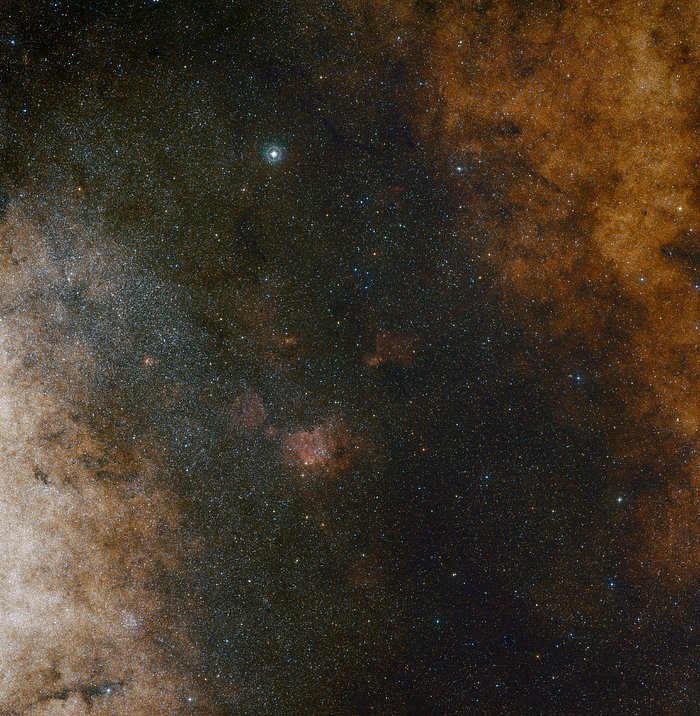
This visible light wide-field view shows the rich star clouds in the constellation of Sagittarius (the Archer) in the direction of the centre of our Milky Way galaxy. The entire image is filled with vast numbers of stars — but far more remain hidden behind clouds of dust and are only revealed in infrared images. This view was created from photographs in red and blue light and forming part of the Digitized Sky Survey 2. The field of view is approximately 3.5 degrees x 3.6 degrees.
This visible light wide-field view shows the rich star clouds in the constellation of Sagittarius (the Archer) in the direction of the centre of our Milky Way galaxy. The entire image is filled with vast numbers of stars — but far more remain hidden behind clouds of dust and are only revealed in infrared images. This view was created from photographs in red and blue light and forming part of the Digitized Sky Survey 2. The field of view is approximately 3.5 degrees x 3.6 degrees. (Larger images)

Our Milky Way has a densely populated centre — a feature common to many galaxies, but unique in that it is close enough to study in depth. This discovery of RR Lyrae stars provides compelling evidence that helps astronomers decide between two main competing theories for how nuclear bulges form [1].

This video sequence starts from a wide field view of the Milky Way and closes near the galactic centre. Here astronomers using the VISTA infrared survey telescope discovered several ancient stars, of a type known as RR Lyrae. RR Lyrae stars typically reside in ancient stellar populations over 10 billion years old. Their discovery suggests that the bulging centre of the Milky Way likely grew through the merging of primordial star clusters. Credit: ESO, Digitized Sky Survey 2, N. Risinger (skysurvey.org. Acknowledgment: Davide De Martin and S. Guisard (www.eso.org/~sguisard), Music: Johan B. Monell (www.johanmonell.com)

RR Lyrae stars are typically found in dense globular clusters. They are variable stars, and the brightness of each RR Lyrae star fluctuates regularly. By observing the length of each cycle of brightening and dimming in an RR Lyrae, and also measuring the star’s brightness, astronomers can calculate its distance [2].

Unfortunately, these excellent distance-indicator stars are frequently outshone by younger, brighter stars and in some regions they are hidden by dust. Therefore, locating RR Lyrae stars right in the extremely crowded heart of the Milky Way was not possible until the public VVV survey was carried out using infrared light. Even so, the team described the task of locating the RR Lyrae stars in amongst the crowded throng of brighter stars as “daunting”.

This video zooms across a part of the sky close to the centre of our Milky Way, which was observed with the VISTA infrared survey telescope. Within this part of the sky astronomers discovered a dozen new variable stars. Their discovery suggests that the bulging centre of the Milky Way likely grew through the merging of primordial star clusters. Credit: ESO/VVV Survey/D. Minniti. Music: 5th Dimension

Their hard work was rewarded, however, with the identification of a dozen RR Lyrae stars. Their discovery indicate that remnants of ancient globular clusters are scattered within the centre of the Milky Way’s bulge.

Rodrigo Contreras Ramos elaborates:

“This discovery of RR Lyrae Stars in the centre of the Milky Way has important implications for the formation of galactic nuclei. The evidence supports the scenario in which the nuclear bulge was originally made out of a few globular clusters that merged.”

The theory that galactic nuclear bulges form through the merging of globular clusters is contested by the competing hypothesis that these bulges are actually due to the rapid accretion of gas. The unearthing of these RR Lyrae stars — almost always found in globular clusters — is very strong evidence that part of the Milky Way’s nuclear bulge did in fact form through merging. By extension, all other similar galactic bulges may have formed the same way.

Not only are these stars powerful evidence for an important theory of galactic evolution, they are also likely to be over 10 billion years old — the dim, but dogged survivors of perhaps the oldest and most massive star cluster within the Milky Way.

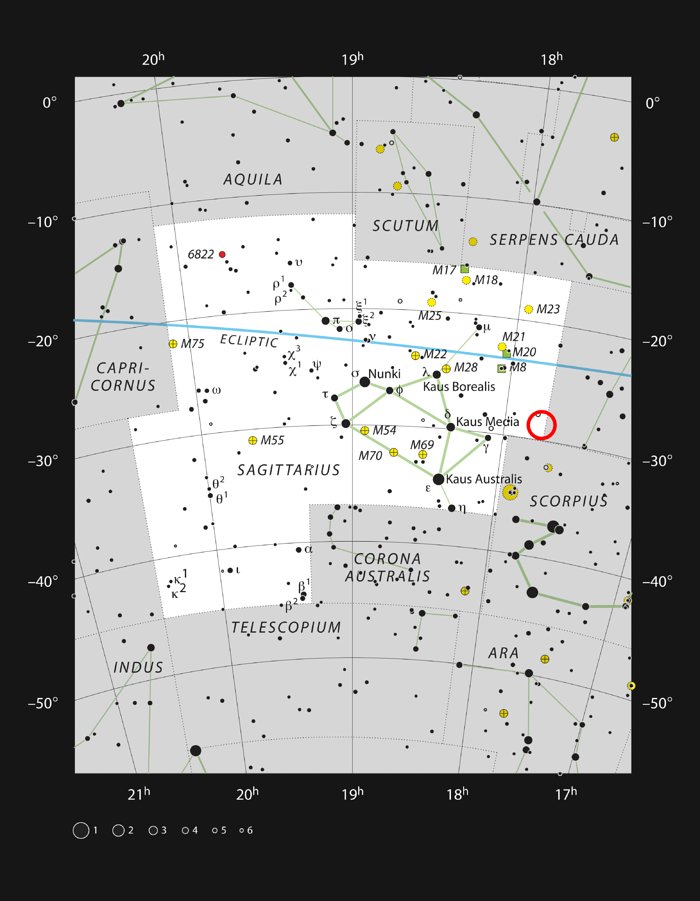
This chart shows the location of the field of view within which the RR Lyrae stars close to the galactic centre were discovered — marked with a red circle. The variable stars and the centre of the Milky Way are within the constellation of Sagittarius (The Archer). This map shows most of the stars visible to the unaided eye under good conditions.

Notes

[1] The nuclear stellar bulge is the compact component in the innermost regions of the Milky Way (and other galaxies) extending to a size of about 400 light-years.

[2] RR Lyrae stars, like some other regular variables such as Cepheids, show a simple relationship between how quickly they change in brightness and how luminous they are. Longer periods mean brighter stars. This period-luminosity relationship can be used to deduce the distance of a star from its period of variation and its apparent brightness.