The latest episode of the CBS 60 Minutes program had a fascinating report about the new ALMA radio telescope array in the Atacama Desert, which is situated on a high plateau in Northern Chile : ALMA: Peering into the universe’s past – CBS News
Category Archives: Astronomy
Debut of COSMOS with Neil deGrasse Tyson
An updating of Carl Sagan‘s famous COSMOS series begins tonight with Neil deGrasse Tyson presenting the new COSMOS: A Spacetime Odyssey.
Some reviews of the first show:
- ‘Cosmos: A Spacetime Odyssey’ Reboots Carl Sagan’s Landmark TV Series on Fox Tonight – Space.com
- ‘Cosmos’: A fond return to the vastness of space – The Washington Post
- ‘Cosmos’ then and now: The ‘personal voyage’ of Carl Sagan, the Hollywood cool of Neil deGrasse Tyson – EW.com
- Neil deGrasse Tyson Hosts ‘Cosmos: A Spacetime Odyssey’ – NYTimes.com
You can watch the Sagan version at Cosmos: A Personal Voyage – Episode 1 (Carl Sagan) – YouTube.
Sounds of the Universe on BBC’s The Sky at Night
The next episode of the program The Sky at Night on BBC Four will present the sounds of space:
- The Sky at Night, Sounds of the Universe – BBC Four – video of the show will be available after March 9.
- Audio clips: Sky at Night: The sounds of the universe – BBC News – incl. audio slideshow
- The Sky at Night, Sounds of the Universe, What does your voice sound like on Venus? – BBC Four
Find more resources concerning the conversion of space signals into audio in the Natural Space Music section at HobbySpace.

Meteor watching: Bright fireball seen over New Mexico
An entry at Latest Worldwide Meteor/Meteorite News reports on a big fireball over New Mexico. They are looking for security camera and cell phone captures of the event:
NM Large Fireball Meteor 06MAR2014 with video capture / coming soon
Breaking News -NM Large Fireball Meteor 00:29:19 am MST 06MAR2014 — video coming soon.
Report your meteor sightings please-
http://lunarmeteoritehunters.blogspot.jp/2000/11/meteor-fireball-report-form.html
Please help get the word about this event so that we might recover security camera video or cell phone captures; spread the word about this website via Facebook, Twitter, YouTube, Reddit, GLP, SOTT and your favorite forums; contact your local news outlets; thank you!
http://lunarmeteoritehunters.blogspot.com
Please help get the word about this event so that we might recover security camera video or cell phone captures; spread the word about this website via Facebook, Twitter, YouTube, Reddit, GLP, SOTT and your favorite forums; contact your local news outlets; thank you!
http://lunarmeteoritehunters.blogspot.com
Initial Meteor Sighting Reports-
On 3/6/14 1:43 27000, Thomas Ashcraft wrote:
March 06 2014 I captured a large fireball over north central New Mexico at 0729:19 UT +/- 2 seconds. (00:29:19 am MST). As bright or brighter than the full Moon. Possibly brighter. I will process it in the morning and post the movie. This one should have been captured well on Albuquerque cameras and might have been right over Albuquerque heading westerly. End point might have been western New Mexico or it might have crossed over the Arizona border. Hard to say from one camera view. Big one at least.
Thomas Ashcraft
Hubble sees asteroid breaking up
Here’s an announcement from the ESA Hubble Telescope group:
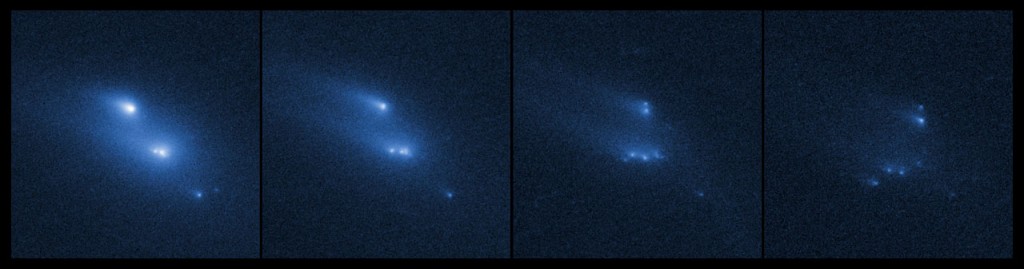
Hubble witnesses an asteroid mysteriously disintegrating
The NASA/ESA Hubble Space Telescope has photographed the never-before-seen break-up of an asteroid, which has fragmented into as many as ten smaller pieces. Although fragile comet nuclei have been seen to fall apart as they approach the Sun, nothing like the breakup of this asteroid, P/2013 R3, has ever been observed before in the asteroid belt.
“This is a rock. Seeing it fall apart before our eyes is pretty amazing,” said David Jewitt of UCLA, USA, who led the astronomical forensics investigation.
Loading player…
The crumbling asteroid, designated P/2013 R3, was first noticed as an unusual, fuzzy-looking object on 15 September 2013 by the Catalina and Pan-STARRS sky surveys. Follow-up observations on 1 October with the Keck Telescope on Mauna Kea, Hawaii, revealed three co-moving bodies embedded in a dusty envelope that is nearly the diameter of Earth.
“Keck showed us that this thing was worth looking at with Hubble,” Jewitt said. With its superior resolution, the space-based Hubble observations soon showed that there were really ten distinct objects, each with comet-like dust tails. The four largest rocky fragments are up to 200 metres in radius, about twice the length of a football pitch.
The Hubble data showed that the fragments are drifting away from each other at a leisurely 1.5 kilometres per hour — slower than the speed of a strolling human. The asteroid began coming apart early last year, but the latest images show that pieces continue to emerge.
“This is a really bizarre thing to observe — we’ve never seen anything like it before,”says co-author Jessica Agarwal of the Max Planck Institute for Solar System Research, Germany. “The break-up could have many different causes, but the Hubble observations are detailed enough that we can actually pinpoint the process responsible.”
The ongoing discovery of more fragments makes it unlikely that the asteroid is disintegrating due to a collision with another asteroid, which would be instantaneous and violent in comparison to what has been observed. Some of the debris from such a high-velocity smash-up would also be expected to travel much faster than has been observed.
It is also unlikely that the asteroid is breaking apart due to the pressure of interior ices warming and vaporising. The object is too cold for ices to significantly sublimate, and it has presumably maintained its nearly 480-million-kilometre distance from the Sun for much of the age of the Solar System.
This leaves a scenario in which the asteroid is disintegrating due to a subtle effect of sunlight that causes the rotation rate to slowly increase over time. Eventually, its component pieces gently pull apart due to centrifugal force. The possibility of disruption by this phenomenon — known as the YORP effect [1] — has been discussed by scientists for several years but, so far, never reliably observed (eso1405).
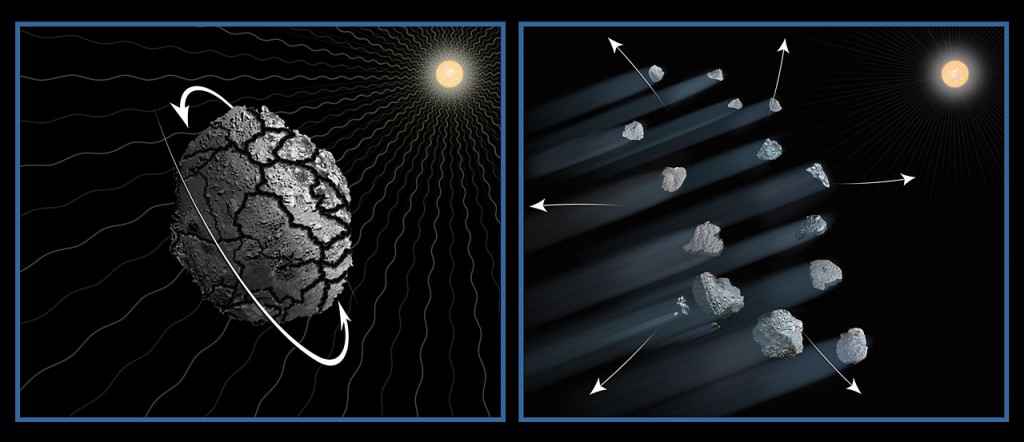
For break-up to occur, P/2013 R3 must have a weak, fractured interior, probably the result of numerous ancient and non-destructive collisions with other asteroids. Most small asteroids are thought to have been severely damaged in this way, giving them a “rubble pile” internal structure. P/2013 R3 itself is probably the product of collisional shattering of a bigger body some time in the last billion years.
“This is the latest in a line of weird asteroid discoveries, including the active asteroid P/2013 P5, which we found to be spouting six tails,” says Agarwal. “This indicates that the Sun may play a large role in disintegrating these small Solar System bodies, by putting pressure on them via sunlight.”
P/2013 R3’s remnant debris, weighing in at 200 000 tonnes, will provide a rich source of meteoroids in the future. Most will eventually plunge into the Sun, but a small fraction of the debris may one day blaze across our sky as meteors.