Category Archives: Astronomy

ESO: A study in scarlet

This week’s European Southern Observatory (ESO) scientific highlight:

A Study in Scarlet

This new image from ESO’s La Silla Observatory in Chile reveals a cloud of hydrogen called Gum 41. In the middle of this little-known nebula, brilliant hot young stars are giving off energetic radiation that causes the surrounding hydrogen to glow with a characteristic red hue.
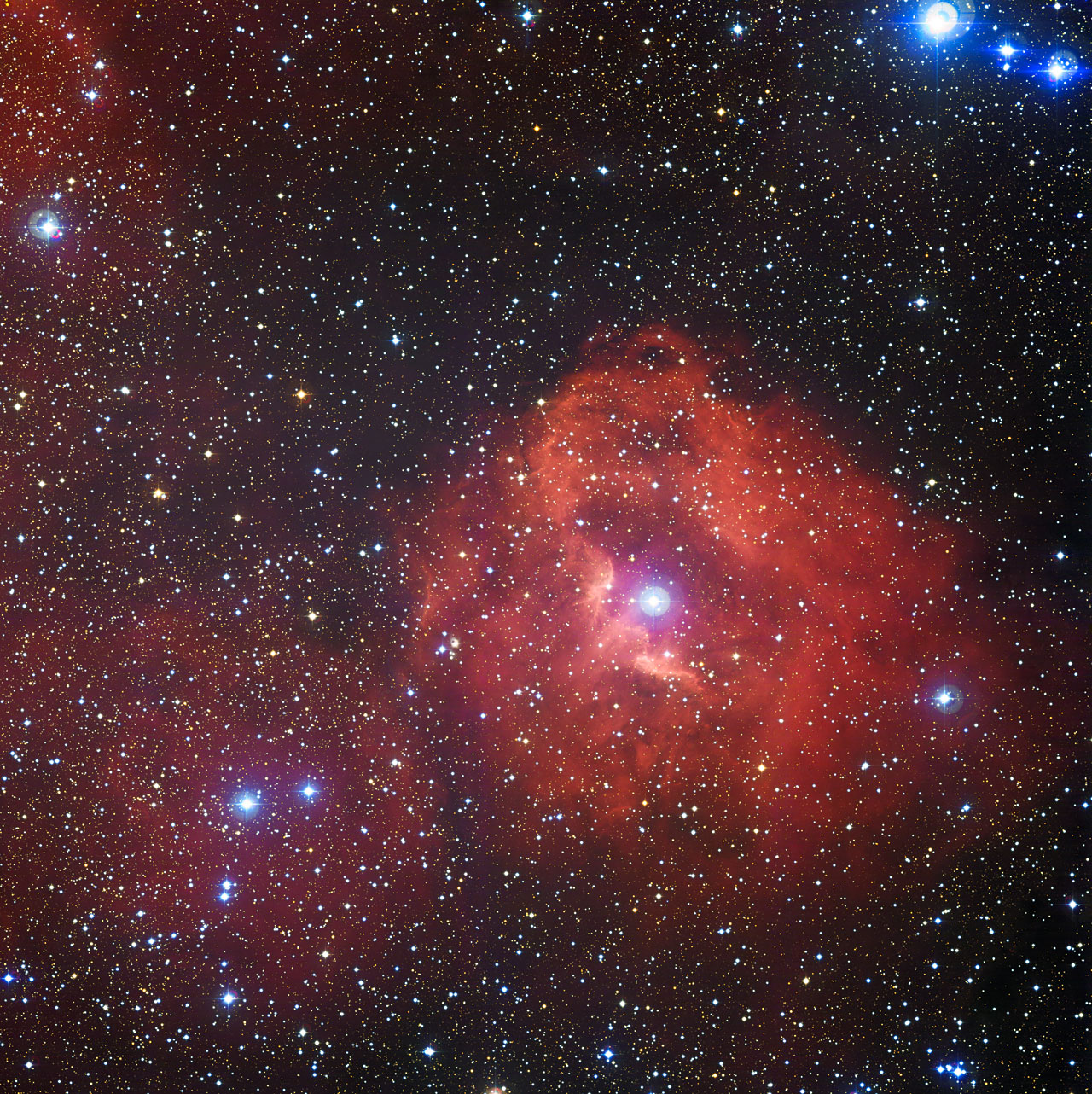
eso1413a

This area of the southern sky, in the constellation of Centaurus (The Centaur), is home to many bright nebulae, each associated with hot newborn stars that formed out of the clouds of hydrogen gas. The intense radiation from the stellar newborns excites the remaining hydrogen around them, making the gas glow in the distinctive shade of red typical of star-forming regions. Another famous example of this phenomenon is the Lagoon Nebula (eso0936), a vast cloud that glows in similar bright shades of scarlet.

The nebula in this picture is located some 7300 light-years from Earth. Australian astronomer Colin Gum discovered it on photographs taken at the Mount Stromlo Observatory near Canberra, and included it in his catalogue of 84 emission nebulae, published in 1955. Gum 41 is actually one small part of a bigger structure called the Lambda Centauri Nebula, also known by the more exotic name of the Running Chicken Nebula (another part of which was the topic of eso1135). Gum died at a tragically early age in a skiing accident in Switzerland in 1960.

In this picture of Gum 41, the clouds appear to be quite thick and bright, but this is actually misleading. If a hypothetical human space traveller could pass through this nebula, it is likely that they would not notice it as — even at close quarters — it would be too faint for the human eye to see. This helps to explain why this large object had to wait until the mid-twentieth century to be discovered — its light is spread very thinly and the red glow cannot be well seen visually.

This zoom sequence starts with a broad view of the Milky Way
and closes in on one of the more spectacular sections in the constellation
of Centaurus (The Centaur). In the final sequence we see the star formation
region known as Gum 41 in a new image from the MPG/ESO 2.2-metre telescope
at the La Silla Observatory in Chile.
Credit:ESO/N. Risinger (skysurvey.org)/Hisayoshi Kato. Music: movetwo

This new portrait of Gum 41 — likely one of the best so far of this elusive object — has been created using data from the Wide Field Imager (WFI) on the MPG/ESO 2.2-metre telescope at the La Silla Observatory in Chile. It is a combination of images taken through blue, green, and red filters, along with an image using a special filter designed to pick out the red glow from hydrogen.

More information

ESO is the foremost intergovernmental astronomy organisation in Europe and the world’s most productive ground-based astronomical observatory by far. It is supported by 15 countries: Austria, Belgium, Brazil, the Czech Republic, Denmark, France, Finland, Germany, Italy, the Netherlands, Portugal, Spain, Sweden, Switzerland and the United Kingdom. ESO carries out an ambitious programme focused on the design, construction and operation of powerful ground-based observing facilities enabling astronomers to make important scientific discoveries. ESO also plays a leading role in promoting and organising cooperation in astronomical research. ESO operates three unique world-class observing sites in Chile: La Silla, Paranal and Chajnantor. At Paranal, ESO operates the Very Large Telescope, the world’s most advanced visible-light astronomical observatory and two survey telescopes. VISTA works in the infrared and is the world’s largest survey telescope and the VLT Survey Telescope is the largest telescope designed to exclusively survey the skies in visible light. ESO is the European partner of a revolutionary astronomical telescope ALMA, the largest astronomical project in existence. ESO is currently planning the 39-metre European Extremely Large optical/near-infrared Telescope, the E-ELT, which will become “the world’s biggest eye on the sky”.

Views of the lunar eclipse

If you missed the “Blood Moon” lunar eclipse last night (see earlier post), check out the many images posted at Spaceweather.com Realtime Image Gallery.

LunarEclipse_Apr_15_2014_NASA_oA NASA image taken in San Jose, California
Image Credit: NASA Ames Research Center/Brian Day

And lots of  imagery is collected in this video:

Blood Moon eclipse tonight

Tonight there will be an eclipse visible in North America (at least where the clouds part). It will

start a few minutes before 1 a.m. EDT and slowly continue over the next two hours until it peaks (reaches totality) about 3 a.m. Tuesday. On the West Coast, it starts about 10 p.m. Monday night and reaches totality just after midnight.

A bonus: This eclipse will be a “blood moon,” in which our nearest celestial neighbor will look the color of a desert sunset. The reason? Because “even when the Earth moves directly between the moon and the sun, filtered sunlight still shines through Earth’s atmosphere, making the moon appear red.”

If you miss this one, there will be three more in the coming year and half.

Skunk Bear‘s Adam Cole welcomes the eclipse with a song:

More about the eclipse and four other sky highlights this month: 5 Sky Events This Week: Full Lunar Eclipse and Lord of the Rings – National Geographic

ESO: Chance meeting creates celestial diamond ring

An announcement from European Southern Observatory (ESO):

Chance Meeting Creates Celestial Diamond Ring

Astronomers using ESO’s Very Large Telescope in Chile have captured this eye-catching image of planetary nebula PN A66 33 — usually known as Abell 33. Created when an aging star blew off its outer layers, this beautiful blue bubble is, by chance, aligned with a foreground star, and bears an uncanny resemblance to a diamond engagement ring. This cosmic gem is unusually symmetric, appearing to be almost circular on the sky.

Most stars with masses similar to that of our Sun will end their lives as white dwarfs — small, very dense, and hot bodies that slowly cool down over billions of years. On the way to this final phase of their lives the stars throw their atmospheres out into the space and create planetary nebulae, colourful glowing clouds of gas surrounding the small, bright stellar relics.

This image, captured by ESO’s Very Large Telescope (VLT), shows the remarkably round planetary nebula Abell 33, located roughly 2500 light-years from Earth. Being perfectly round is uncommon for these objects — usually something disturbs the symmetry and causes the planetary nebula to display irregular shapes [1].

Loading player…

This zoom sequence starts with a broad view showing part of the long thin constellation of Hydra (The Female Water Snake). Towards the end a ghostly blue bubble can be seen, with a bright star on its edge, making it look like a diamond ring. This is the planetary nebula Abell 33. ESO/Digitized Sky Survey 2/M. Kornmesser. Music: movetwo


The strikingly bright star located along the rim of the nebula creates a beautiful illusion in this VLT image. This is just a chance alignment — the star, named HD 83535, lies in the foreground of the nebula, between Earth and Abell 33, in just the right place to make this view even more beautiful. Together, HD 83535 and Abell 33 create a sparkling diamond ring.

The remnant of Abell 33’s progenitor star, on its way to becoming a white dwarf, can be seen just slightly off-centre inside the nebula, visible as a tiny white pearl. It is still bright — more luminous than our own Sun — and emits enough ultraviolet radiation to make the bubble of expelled atmosphere glow [2]. Abell 33 is just one of the 86 objects included in astronomer George Abell’s 1966 Abell Catalogue of Planetary Nebulae. Abell also scoured the skies for galaxy clusters, compiling the Abell Catalogue of over 4000 of these clusters in both the northern and southern hemispheres of the sky. This image uses data from the FOcal Reducer and low dispersion Spectrograph (FORS) instrument attached to the VLT, which were acquired as part of the ESO Cosmic Gems programme [3].

Loading player…

This pan video gives a close-up look at an eye-catching new image of planetary nebula Abell 33 taken using ESO’s Very Large Telescope in Chile. Created when an aging star blew off its outer layers, this beautiful blue bubble is, by chance, aligned with a foreground star, and bears an uncanny resemblance to a diamond engagement ring. This cosmic gem is unusually symmetric, appearing to be almost perfectly circular on the sky.

Credit: ESO/Digitized Sky Survey 2. Music: movetwo

Video: What if the Moon was a Disco Ball?

A reader points me to this fun video showing variations of the answer to the important question:  What if the Moon was a Disco Ball?