Category Archives: Astronomy

An Exoplanet’s day measured for first time

An announcement from the European Southern Observatory (ESO):

Length of Exoplanet Day Measured for First Time
VLT measures the spin of Beta Pictoris b

Observations from ESO’s Very Large Telescope (VLT) have, for the first time, determined the rotation rate of an exoplanet. Beta Pictoris b has been found to have a day that lasts only eight hours. This is much quicker than any planet in the Solar System — its equator is moving at almost 100 000 kilometres per hour. This new result extends the relation between mass and rotation seen in the Solar System to exoplanets. Similar techniques will allow astronomers to map exoplanets in detail in the future with the European Extremely Large Telescope (E-ELT).
eso1414a_BetaPictorisB
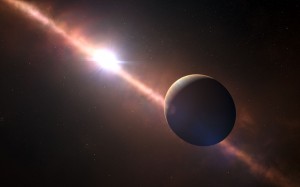
Artist’s impression of the planet Beta Pictoris b

Exoplanet Beta Pictoris b orbits the naked-eye star Beta Pictoris [1], [2], which lies about 63 light-years from Earth in the southern constellation of Pictor (The Painter’s Easel). This planet was discovered nearly six years ago and was one of the first exoplanets to be directly imaged. It orbits its host star at a distance of only eight times the Earth-Sun distance (eso1024) — making it the closest exoplanet to its star ever to be directly imaged [3].
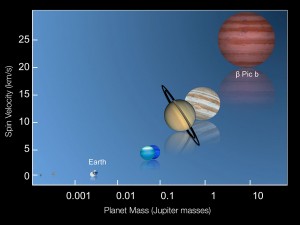
eso1414bThis graphic shows the rotation speeds of several of the planets
in the Solar System along with the recently measured spin rate
of the planet Beta Pictoris b

Using the CRIRES instrument on the VLT, a team of Dutch astronomers from Leiden University and the Netherlands Institute for Space Research (SRON) have now found that the equatorial rotation velocity of exoplanet Beta Pictoris b is almost 100 000 kilometres per hour. By comparison, Jupiter’s equator has a velocity of about 47 000 km per hour [4], while the Earth’s travels at only 1700 km per hour [5]. Beta Pictoris b is more than 16 times larger and 3000 times more massive than the Earth, yet a day on the planet only lasts 8 hours.

“It is not known why some planets spin fast and others more slowly,” says co-author Remco de Kok, “but this first measurement of an exoplanet’s rotation shows that the trend seen in the Solar System, where the more massive planets spin faster, also holds true for exoplanets. This must be some universal consequence of the way planets form.”

Beta Pictoris b is a very young planet, only about 20 million years old (compared to 4.5 billion years for the Earth) [6]. Over time, the exoplanet is expected to cool and shrink, which will make it spin even faster [7]. On the other hand, other processes might be at play that change the spin of the planet. For instance, the spin of the Earth is slowing down over time due to the tidal interactions with our Moon.

Loading player…

This sequence starts with a broad view of the southern sky and closes in
on the bright star Beta Pictoris in the constellation of Pictor(The Artist’s
Easel). This young star is surrounded by a dusty disc and also orbited
by a large planet that is the first exoplanet to have had its spin measured.
It has an equatorial rotation velocity of almost 100 000 kilometres/hour
— much faster than any of the planets in the Solar System.

The astronomers made use of a precise technique called high-dispersion spectroscopy to split light into its constituent colours — different wavelengths in the spectrum. The principle of the Doppler effect (or Doppler shift) allowed them to use the change in wavelength to detect that different parts of the planet were moving at different speeds and in opposite directions relative to the observer. By very carefully removing the effects of the much brighter parent star they were able to extract the rotation signal from the planet.

“We have measured the wavelengths of radiation emitted by the planet to a precision of one part in a hundred thousand, which makes the measurements sensitive to the Doppler effects that can reveal the velocity of emitting objects,” says lead author Ignas Snellen. “Using this technique we find that different parts of the planet’s surface are moving towards or away from us at different speeds, which can only mean that the planet is rotating around its axis“.

This technique is closely related to Doppler imaging, which has been used for several decades to map the surfaces of stars, and recently that of a brown dwarf [8] — Luhman 16B (eso1404). The fast spin of Beta Pictoris b means that in the future it will be possible to make a global map of the planet, showing possible cloud patterns and large storms.\
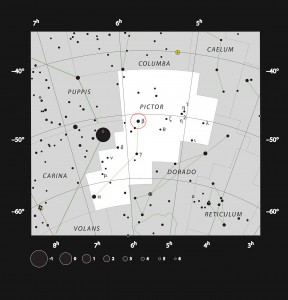
eso1408b

The position of the star Beta Pictoris is marked with a circle on this
chart of the constellation Pictor (The Painter’s Easel).  As indicated
by its name, this is the second brightest star in its constellation.
Together with most of the stars marked on this chart, it can
be seen in a dark sky with the unaided eye.

“This technique can be used on a much larger sample of exoplanets with the superb resolution and sensitivity of the E-ELT and an imaging high-dispersion spectrograph. With the planned  Mid-infrared E-ELT Imager and Spectrograph (METIS) we will be able to make global maps of exoplanets and characterise much smaller planets than Beta Pictoris b with this technique”, says METIS principal investigator and co-author of the new paper, Bernhard Brandl.
Video: Intro. astronomy class on exoplanets, solar system origin, & formation

Bruce Betts of the Planetary Society continues with his on line introductory astronomy course. In this session he talks with Debra Fischer of Yale University about exoplanets: Intro Astronomy 2014. Class 11: Exoplanets and Solar System Origin and Formation – The Planetary Society

SpaceX Dragon and Falcon 9 stage seen with telescope as they passed over Europe

On Friday at Cape Canaveral, SpaceX launched a Dragon spacecraft on a cargo delivery mission to the International Space Station.  With a modest amateur telescope, astrophotographer Thierry Legault in Paris imaged the shape of the Dragon, including its two solar panels, as it passed over Paris:

(Check out Legault’s other amazing images of spacecraft in orbit. )

Ralf Vandbergh in Belgium could also make out the shape of the Falcon 9 second stage: Dragonlaunch_20140418.jpg (1076×601)

Find more about spacecraft watching in the HobbySpace Satellite Observing section.

Kepler space telescope finds first earth-size planet in habitable zone

An announcement from the NASA Kepler mission:

NASA’s Kepler Telescope Discovers First
Earth-Size Planet in ‘Habitable Zone’

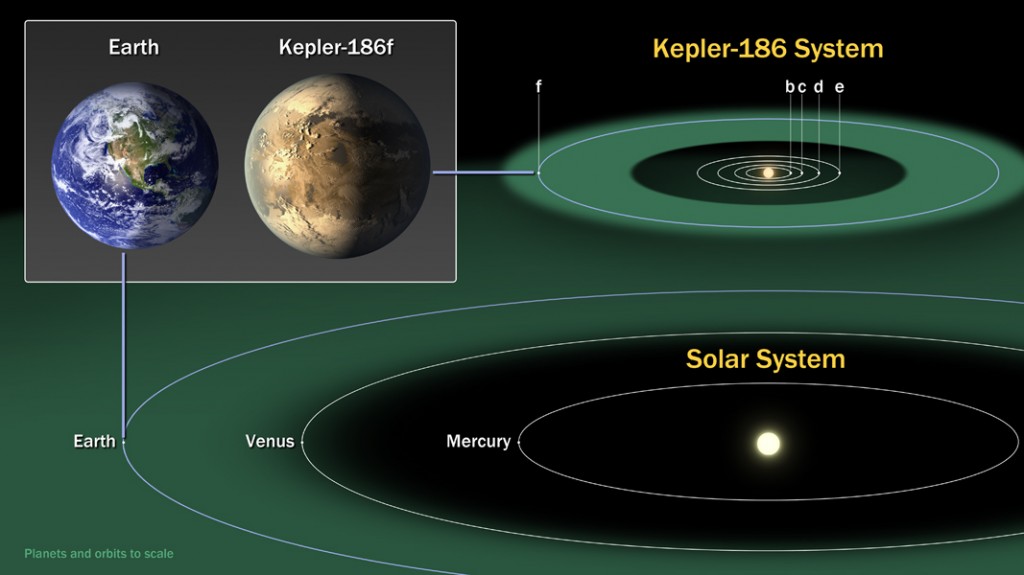
Using NASA’s Kepler Space Telescope, astronomers have discovered the first Earth-size planet orbiting a star in the “habitable zone” — the range of distance from a star where liquid water might pool on the surface of an orbiting planet. The discovery of Kepler-186f confirms that planets the size of Earth exist in the habitable zone of stars other than our sun.

PIA18000_ip

The diagram compares the planets of our inner solar system to Kepler-186,
a five-planet star system about 500 light-years from Earth in the constellation
Cygnus. Image credit: NASA Ames/SETI Institute/JPL-Caltech

› Full image and caption

While planets have previously been found in the habitable zone, they are all at least 40 percent larger in size than Earth, and understanding their makeup is challenging. Kepler-186f is more reminiscent of Earth.

“The discovery of Kepler-186f is a significant step toward finding worlds like our planet Earth,” said Paul Hertz, NASA’s Astrophysics Division director at the agency’s headquarters in Washington. “Future NASA missions, like the Transiting Exoplanet Survey Satellite and the James Webb Space Telescope, will discover the nearest rocky exoplanets and determine their composition and atmospheric conditions, continuing humankind’s quest to find truly Earth-like worlds.”

pia17999-640The artistic concept of Kepler-186f is the result of scientists and artists
collaborating to imagine the appearance of these distant worlds.
 › Full image and caption
Image credit: NASA Ames/SETI Institute/JPL-Caltech

Although the size of Kepler-186f is known, its mass and composition are not. Previous research, however, suggests that a planet the size of Kepler-186f is likely to be rocky.

“We know of just one planet where life exists — Earth. When we search for life outside our solar system, we focus on finding planets with characteristics that mimic that of Earth,” said Elisa Quintana, research scientist at the SETI Institute at NASA’s Ames Research Center in Moffett Field, Calif., and lead author of the paper published today in the journal Science. “Finding a habitable zone planet comparable to Earth in size is a major step forward.”

Kepler-186f resides in the Kepler-186 system, about 500 light-years from Earth in the constellation Cygnus. The system is also home to four companion planets, which orbit a star half the size and mass of our sun. The star is classified as an M dwarf, or red dwarf, a class of stars that makes up 70 percent of the stars in the Milky Way galaxy.

“M dwarfs are the most numerous stars,” said Quintana. “The first signs of other life in the galaxy may well come from planets orbiting an M dwarf.”

Kepler-186f orbits its star once every 130 days and receives one-third the energy from its star that Earth gets from the sun, placing it nearer the outer edge of the habitable zone. On the surface of Kepler-186f, the brightness of its star at high noon is only as bright as our sun appears to us about an hour before sunset.

“Being in the habitable zone does not mean we know this planet is habitable. The temperature on the planet is strongly dependent on what kind of atmosphere the planet has,” said Thomas Barclay, research scientist at the Bay Area Environmental Research Institute at Ames, and co-author of the paper. “Kepler-186f can be thought of as an Earth-cousin rather than an Earth-twin. It has many properties that resemble Earth.”

The four companion planets, Kepler-186b, Kepler-186c, Kepler-186d and Kepler-186e, whiz around their sun every four, seven, 13 and 22 days, respectively, making them too hot for life as we know it. These four inner planets all measure less than 1.5 times the size of Earth.

The next steps in the search for distant life include looking for true Earth-twins — Earth-size planets orbiting within the habitable zone of a sun-like star — and measuring their chemical compositions. The Kepler Space Telescope, which simultaneously and continuously measured the brightness of more than 150,000 stars, is NASA’s first mission capable of detecting Earth-size planets around stars like our sun.

Ames is responsible for Kepler’s ground system development, mission operations, and science data analysis. NASA’s Jet Propulsion Laboratory in Pasadena, Calif., managed Kepler mission development. Ball Aerospace & Technologies Corp. in Boulder, Colo., developed the Kepler flight system and supports mission operations with the Laboratory for Atmospheric and Space Physics at the University of Colorado in Boulder. The Space Telescope Science Institute in Baltimore archives, hosts and distributes Kepler science data. Kepler is NASA’s 10th Discovery Mission and was funded by the agency’s Science Mission Directorate.

The SETI Institute is a private, nonprofit organization dedicated to scientific research, education and public outreach. The mission of the SETI Institute is to explore, understand and explain the origin, nature and prevalence of life in the universe.

For more information about the Kepler mission, visit: http://www.nasa.gov/kepler

===

Here’s an animation of the Kepler 186 system:

Update May.3.14: Here is another video about Kepler 186f plus two other small planets in the habitable zones of their planets:

Hubble image captures galaxies near and far and in-between

A report from ESA/Hubble:

A cross-section of the Universe

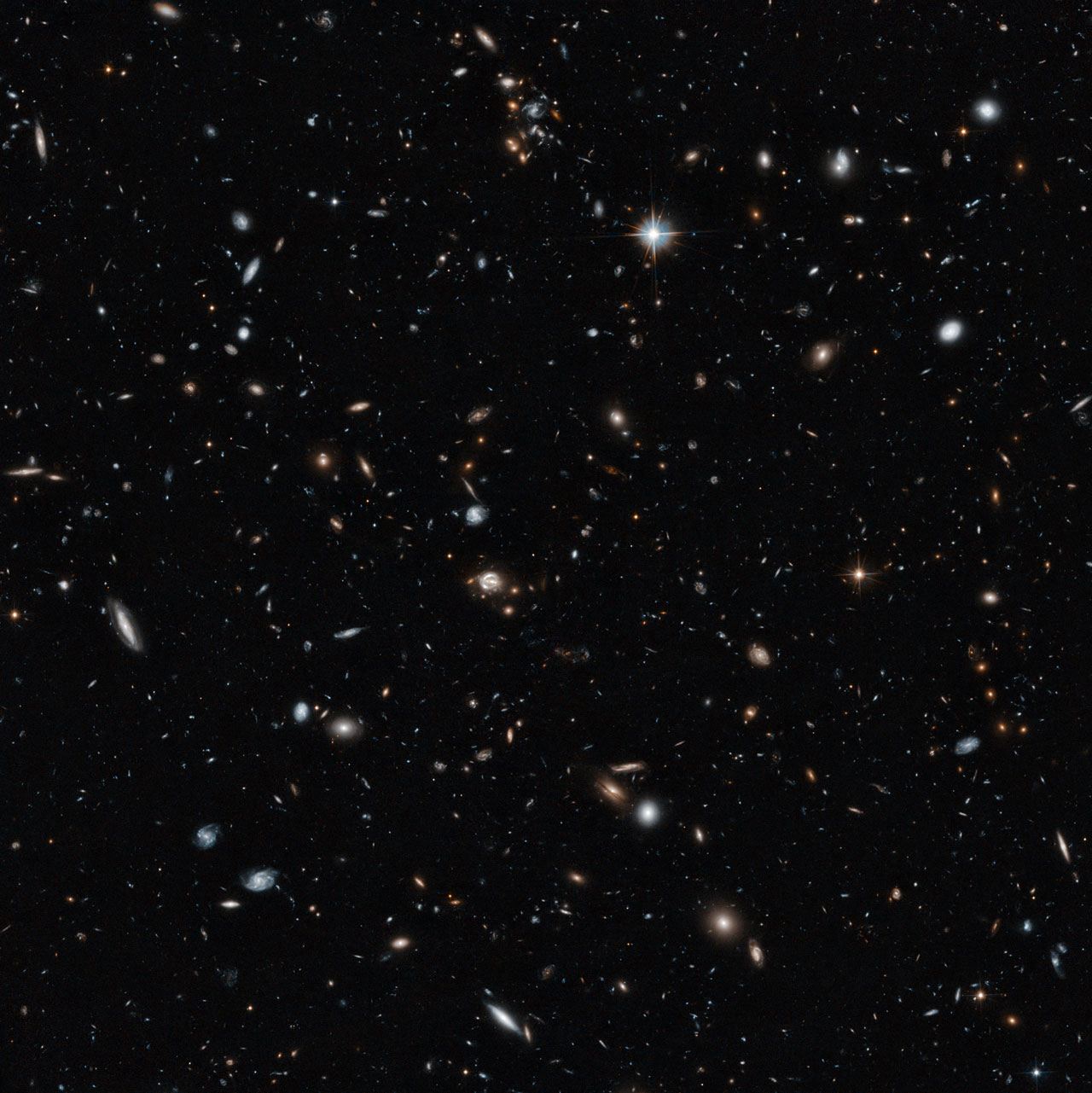
An image of a galaxy cluster taken by the NASA/ESA Hubble Space Telescope gives a remarkable cross-section of the Universe, showing objects at different distances and stages in cosmic history. They range from cosmic near neighbours to objects seen in the early years of the Universe. The 14-hour exposure shows objects around a billion times fainter than can be seen with the naked eye.

heic1408a(Larger version)

This new Hubble image showcases a remarkable variety of objects at different distances from us, extending back over halfway to the edge of the observable Universe. The galaxies in this image mostly lie about five billion light-years from Earth but the field also contains other objects, both significantly closer and far more distant.

Studies of this region of the sky have shown that many of the objects that appear to lie close together may actually be billions of light-years apart. This is because several groups of galaxies lie along our line of sight, creating something of an optical illusion. Hubble’s cross-section of the Universe is completed by distorted images of galaxies in the very distant background.

These objects are sometimes distorted due to a process called gravitational lensing, an extremely valuable technique in astronomy for studying very distant objects [1]. This lensing is caused by the bending of the space-time continuum by massive galaxies lying close to our line of sight to distant objects.

One of the lens systems visible here is called CLASS B1608+656, which appears as a small loop in the centre of the image. It features two foreground galaxies distorting and amplifying the light of a distant quasar the known as QSO-160913+653228. The light from this bright disc of matter, which is currently falling into a black hole, has taken nine billion years to reach us — two thirds of the age of the Universe.

As well as CLASS B1608+656, astronomers have identified two other gravitational lenses within this image. Two galaxies, dubbed Fred and Ginger by the researchers who studied them, contain enough mass to visibly distort the light from objects behind them. Fred, also known more prosaically as [FMK2006] ACS J160919+6532, lies near the lens galaxies in CLASS B1608+656, while Ginger ([FMK2006] ACS J160910+6532) is markedly closer to us. Despite their different distances from us, both can be seen near to CLASS B1608+656 in the central region of this Hubble image.

To capture distant and dim objects like these, Hubble required a long exposure. The image is made up of visible and infrared observations with a total exposure time of 14 hours.

Zoom in on CLASS B1608+656
This video begins with a view of the night sky before zooming in towards galaxy
cluster CLASS B1608+656. It homes in first on a view of the area around the
cluster from the Digitized Sky Survey (produced with a ground-based
telescope), before focusingon Hubble observations of the cluster.

Hubble’s very long exposure (14 hours) combined with advanced
instrumentation and a unique location above the distorting atmosphere
means that its observations are both much sharper and much brighter than
those taken from the ground-based telescope. Hubble’s image is clearly
visible as a square of brighter galaxies near the end of the zoom video.
Credit: NASA, ESA, Digitised Sky Survey 2, N. Risinger (
skysurvey.org)