Category Archives: Astronomy

Video: Earth-size planets in habitable zones of cool stars

In this SETI Institute talk, Elisa Quintana talks about Earth-Sized Planets in the Habitable Zones of Cool Stars:

Caption:

Abstract: A primary goal of the Kepler mission is to determine the frequency of Earth-sized planets in the habitable zones of other stars. M dwarfs, stars that are smaller and cooler than the Sun, comprise more than 70% of the stars in our galaxy. Finding that Earth-sized planets around M dwarfs are common, therefore, has big implications for determining the frequency of other Earths.

In April 2014 we announced the discovery of Kepler-186f, the first definitive Earth-sized planet found to orbit in the habitable zone of a star other than our Sun. We will discuss our methods of combining ground-based observations with transit modeling to confirm this system, and will present our theoretical studies on the formation and habitability of this planet. We will also present updates on several promising multi-planet systems that have Earth-sized, and possibly sub-Earth-sized, candidates in the habitable zones of cool low-mass stars in the Kepler field-of-view.

The Lithium Problem and Messier 54

A new finding from the European Southern Observatory (ESO):

This Star Cluster Is Not What It Seems

The globular star cluster Messier 54

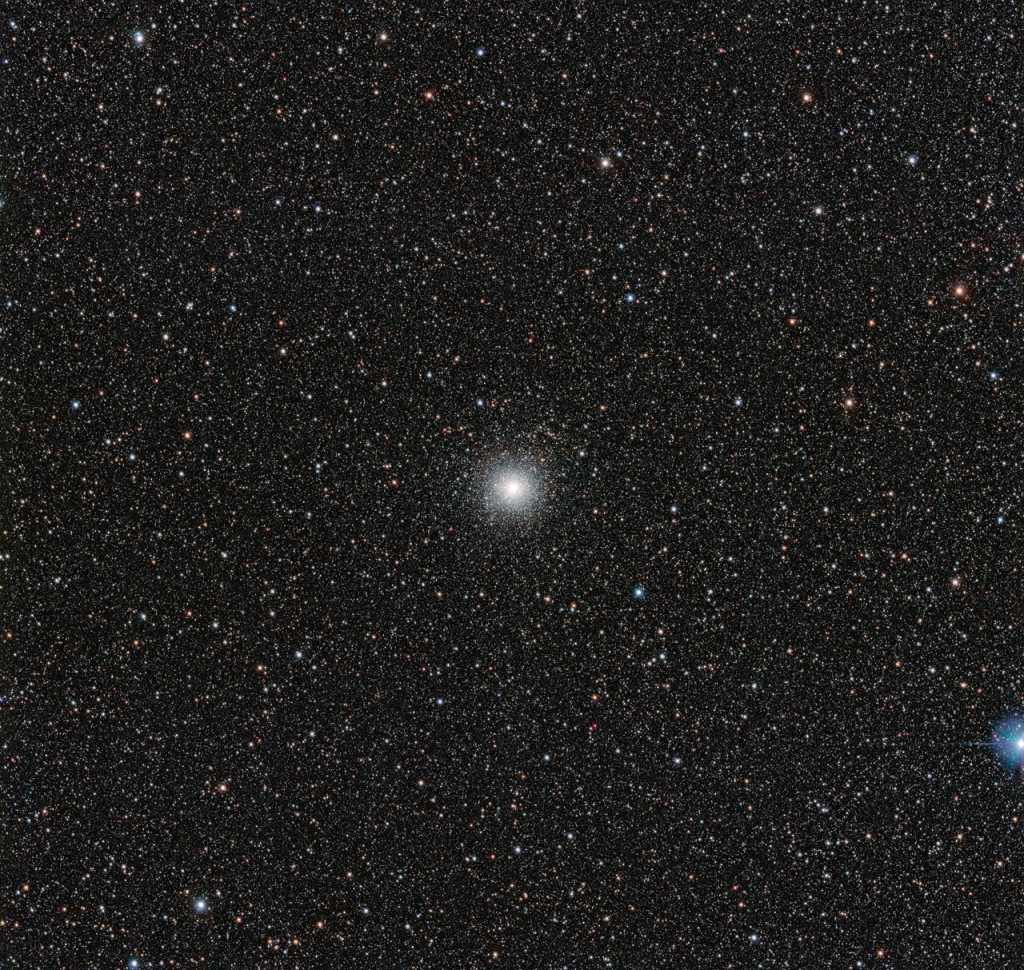
This new image from the VLT Survey Telescope at ESO’s Paranal Observatory in northern Chile shows a vast collection of stars, the globular cluster Messier 54. This cluster looks very similar to many others but it has a secret. Messier 54 doesn’t belong to the Milky Way, but is part of a small satellite galaxy, the Sagittarius Dwarf Galaxy. This unusual parentage has now allowed astronomers to use the Very Large Telescope (VLT) to test whether there are also unexpectedly low levels of the element lithium in stars outside the Milky Way.

Loading player…

This video takes you on a journey past the centre of the Milky Way
and far out the other side to the globular cluster Messier 54.
This cluster looks very similar to many others, but it has a secret.
Messier 54 doesn’t belong to the Milky Way, but actually is
part of a small satellite galaxy, the Sagittarius Dwarf Galaxy.
The final close-up view comes from the VLT Survey Telescope
at ESO’s Paranal Observatory in northern Chile.

The Milky Way galaxy is orbited by more than 150 globular star clusters, which are balls of hundreds of thousands of old stars dating back to the formation of the galaxy. One of these, along with several others in the constellation of Sagittarius (The Archer), was found in the late eighteenth century by the French comet hunter Charles Messier and given the designation Messier 54.

For more than two hundred years after its discovery Messier 54 was thought to be similar to the other Milky Way globulars. But in 1994 it was discovered that it was actually associated with a separate galaxy — the Sagittarius Dwarf Galaxy. It was found to be at a distance of around 90 000 light-years — more than three times as far from Earth as the galactic centre.

Astronomers have now observed Messier 54 using the VLT as a test case to try to solve one of the mysteries of modern astronomy — the lithium problem.

Most of the light chemical element lithium now present in the Universe was produced during the Big Bang, along with hydrogen and helium, but in much smaller quantities. Astronomers can calculate quite accurately how much lithium they expect to find in the early Universe, and from this work out how much they should see in old stars. But the numbers don’t match — there is about three times less lithium in stars than expected. This mystery remains, despite several decades of work [1].

Up to now it has only been possible to measure lithium in stars in the Milky Way. But now a team of astronomers led by Alessio Mucciarelli (University of Bologna, Italy) has used the VLT to measure how much lithium there is in a selection of stars in Messier 54. They find that the levels are close to those in the Milky Way. So, whatever it is that got rid of the lithium seems not to be specific to the Milky Way.

This new image of the cluster was created from data taken with the VLT Survey Telescope (VST) at the Paranal Observatory. As well as showing the cluster itself it reveals the extraordinarily dense forest of much closer Milky Way stars that lie in the foreground.

Notes

[1] There are several possible proposed solutions to the riddle. The first is that the calculations of the amounts of lithium produced in the Big Bang are wrong — but very recent tests suggest that this is not the case. The second is that the lithium was somehow destroyed in the earliest stars, before the formation of the Milky Way. The third is that some process in the stars has gradually destroyed lithium during their lives.

ESO: Lupus 4 cloud will one day shine with new stars

An announcement from the European Southern Observatory (ESO):

Cosmic Forecast: Dark Clouds Will Give Way to Sunshine

Lupus 4, a spider-shaped blob of gas and dust, blots out background stars like a dark cloud on a moonless night in this intriguing new image. Although gloomy for now, dense pockets of material within clouds such as Lupus 4 are where new stars form and where they will later burst into radiant life. The Wide Field Imager on the MPG/ESO 2.2-metre telescope at ESO’s La Silla Observatory in Chile captured this new picture.
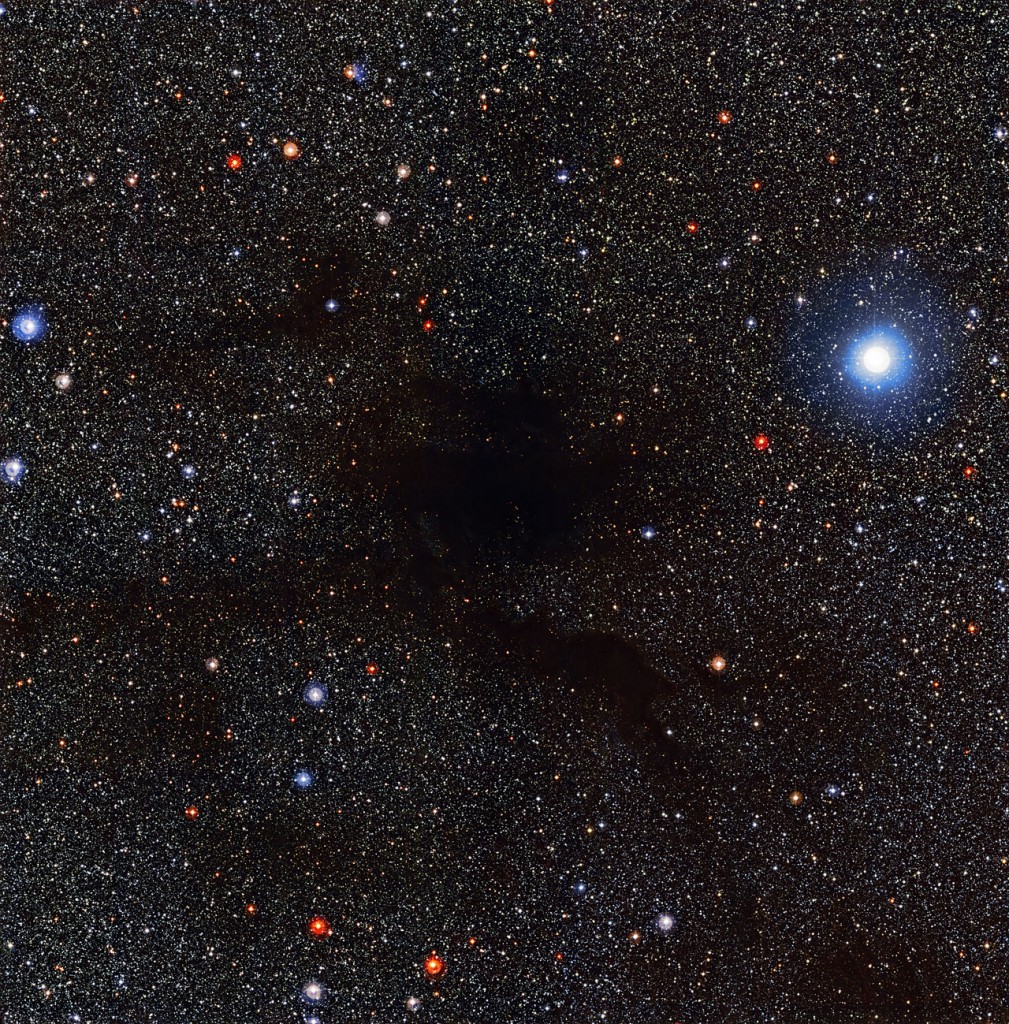
The Dark Cloud Lupus 4

The Wide Field Imager (WFI) on the MPG/ESO 2.2-metre telescope at the
La Silla Observatory in Chile captured this view of dark cloud Lupus 4
blotting out background stars. Lupus 4 is a dense pocket of gas and dust
where new stars are expected to form. The cloud is located about 400
light-years away from Earth, on the border between the constellations
of Lupus (The Wolf) and Norma (The Carpenter’s Square).

Lupus 4 is located about 400 light-years away from Earth, straddling the constellations of Lupus (The Wolf) and Norma (The Carpenter’s Square). The cloud is one of several affiliated dark clouds found in a loose star cluster called the Scorpius–Centaurus OB association. An OB association is a relatively young, yet widely dispersed grouping of stars [1]. The stars likely had a common origin in a gigantic cloud of material.

Because the association, and its Lupus clouds, form the closest such grouping to the Sun, they are a prime target for studying how stars grow up together before going their separate ways. The Sun, along with most stars in our galaxy, is thought to have started out in a similar environment.

American astronomer Edward Emerson Barnard is credited with the earliest descriptions of the Lupus dark clouds in the astronomical literature, back in 1927. Lupus 3, neighbour to Lupus 4, is the best studied, thanks to the presence of at least 40 fledgling stars formed over the last three million years, and which are on the cusp of igniting their fusion furnaces (eso1303). The main energy source in these adolescent stars, known as T Tauri stars, is the heat generated by their gravitational contraction. That is in contrast to the fusion of hydrogen and other elements which powers mature stars such as the Sun.

Zooming in on the dark cloud Lupus 4:

Loading player…

Observations of the cold darkness of Lupus 4 have turned up only a few T Tauri stars. Yet promisingly for Lupus 4 in terms of future star formation is a dense, starless core of material in the cloud. Given a few million years, that core should develop into T Tauri stars. Comparing Lupus 3 and Lupus 4 in this way suggests that the former is older than the latter, because its contents have had more time to develop into stars. How many stars might eventually start to shine within Lupus 4? It is hard to say, as mass estimates for Lupus 4 vary. Two studies agree on a figure of around 250 times the mass of the Sun, though another, using a different method, arrives at a figure of around 1600 solar masses. Either way, the cloud contains ample material to give rise to plenty of bright new stars. Rather as earthly clouds make way for sunshine, so, too, shall this cosmic dark cloud eventually dissipate and give way to brilliant starlight.

Notes
[1] The “OB” refers to the hot, bright, short-lived stars of spectral types O and B that are still shining brilliantly within the widely dispersed cluster as it travels through the Milky Way galaxy.

Links
Photos of the MPG/ESO 2.2-metre telescope
Other photos taken with the MPG/ESO 2.2-metre telescope
Photos of La Silla
StarTalk Radio with Neil deGrasse Tyson – General Astrophysics 101

The latest StarTalk Radio Show with Neil deGrasse Tyson gives a quick intro to astrophysics:  Cosmic Queries: General Astrophysics 101.