Here is NASA JPL’s monthly report on upcoming night sky highlights: What’s Up for November 2014
Here is the link to the Meteor Shower Flux Estimator (FLUXTIMATOR) mentioned in the video.
Here is NASA JPL’s monthly report on upcoming night sky highlights: What’s Up for November 2014
Here is the link to the Meteor Shower Flux Estimator (FLUXTIMATOR) mentioned in the video.
BINARY SPACE, which provides the Satellite Tracking Tool and with whom I work to make the Virtual SpaceTV 3D animated news reports, is developing a new program called the SpaceTraveller,”a solar system simulator and space mission visualizer program”. This video uses SpaceTraveller to depict the maneuvers of the Rosetta spacecraft at the comet Comet 67P/Churyumov-Gerasimenko. It also shows the lander Philae and its deployment to the comet (currently scheduled for November 12, 2014).
For further info on SpaceTraveller, contact info@binary-space.com.
An announcement from the European Southern Observatory (ESO):
Revolutionary ALMA Image Reveals Planetary Genesis
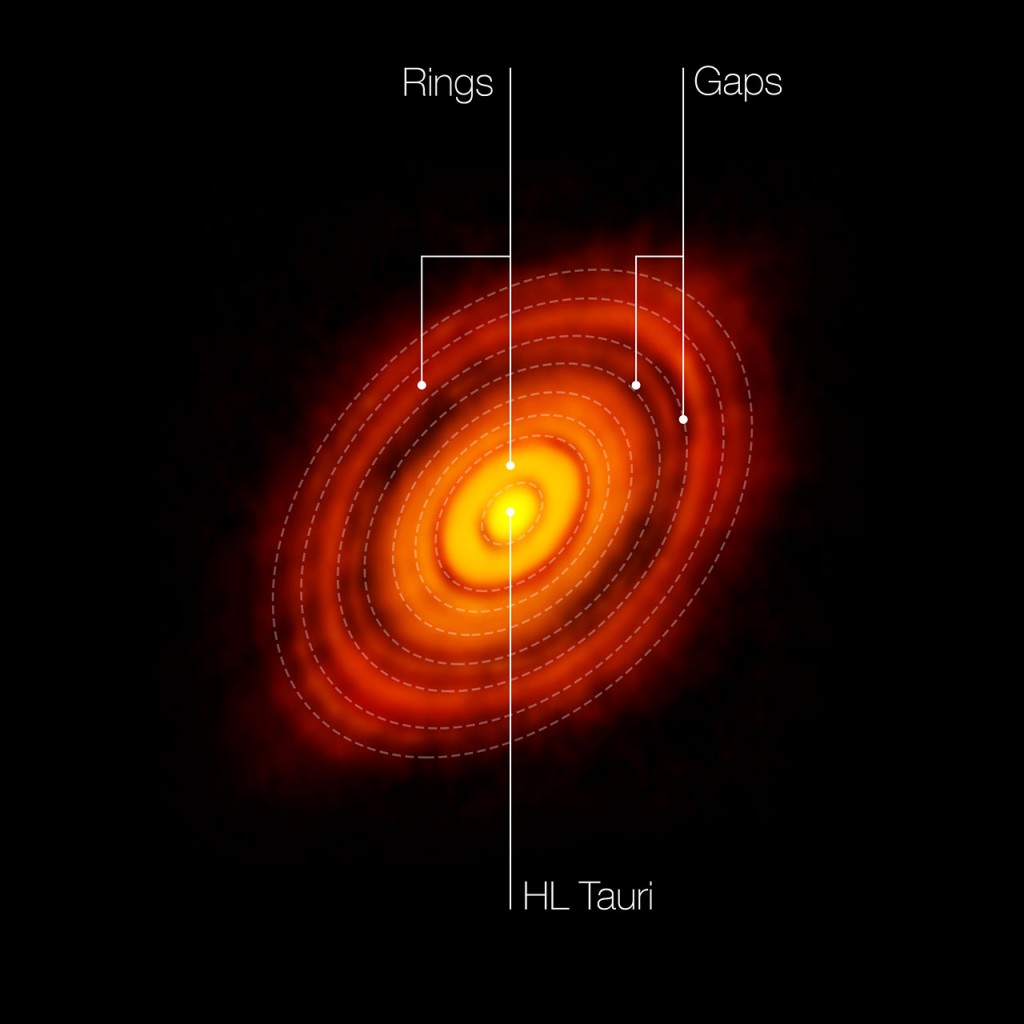
This new image from ALMA, the Atacama Large Millimeter/submillimeter Array, reveals extraordinarily fine detail that has never been seen before in the planet-forming disc around a young star. These are the first observations that have used ALMA in its near-final configuration and the sharpest pictures ever made at submillimetre wavelengths. The new results are an enormous step forward in the observation of how protoplanetary discs develop and how planets form.
For ALMA’s first observations in its new and most powerful mode, researchers pointed the antennas at HL Tauri — a young star, about 450 light-years away, which is surrounded by a dusty disc [1]. The resulting image exceeds all expectations and reveals unexpectedly fine detail in the disc of material left over from star birth. It shows a series of concentric bright rings, separated by gaps [2].
“These features are almost certainly the result of young planet-like bodies that are being formed in the disc. This is surprising since such young stars are not expected to have large planetary bodies capable of producing the structures we see in this image,” said Stuartt Corder, ALMA Deputy Director.
“When we first saw this image we were astounded at the spectacular level of detail. HL Tauri is no more than a million years old, yet already its disc appears to be full of forming planets. This one image alone will revolutionise theories of planet formation,” explained Catherine Vlahakis, ALMA Deputy Program Scientist and Lead Program Scientist for the ALMA Long Baseline Campaign.
HL Tauri’s disc appears much more developed than would be expected from the age of the system. Thus, the ALMA image also suggests that the planet-formation process may be faster than previously thought.
Such high resolution can only be achieved with the long baseline capabilities of ALMA and provides astronomers with new information that is impossible to collect with any other facility, even the NASA/ESA Hubble Space Telescope. “The logistics and infrastructure required to place antennas at such distant locations required an unprecedented coordinated effort by an expert international team of engineers and scientists,” said ALMA Director, Pierre Cox. “These long baselines fulfill one of ALMA’s major objectives and mark an impressive technological, scientific and engineering milestone.”
Young stars like HL Tauri are born in clouds of gas and fine dust, in regions which have collapsed under the effects of gravitation, forming dense hot cores that eventually ignite to become young stars. These young stars are initially cocooned in the remaining gas and dust, which eventually settles into a disc, known as a protoplanetary disc.
Through many collisions the dust particles will stick together, growing into clumps the size of sand grains and pebbles. Ultimately, asteroids, comets and even planets can form in the disc. Young planets will disrupt the disc and create rings, gaps and holes such as those seen in the structures now observed by ALMA [3].
The investigation of these protoplanetary discs is essential to our understanding of how Earth formed in the Solar System. Observing the first stages of planet formation around HL Tauri may show us how our own planetary system may have looked more than four billion years ago, when it formed.
“Most of what we know about planet formation today is based on theory. Images with this level of detail have up to now been relegated to computer simulations or artist’s impressions. This high resolution image of HL Tauri demonstrates what ALMA can achieve when it operates in its largest configuration and starts a new era in our exploration of the formation of stars and planets,” says Tim de Zeeuw, Director General of ESO.
Simon Owens writes about an interesting citizen science project at the Harvard-Smithsonian Center for Astrophysics : Why Harvard and the Smithsonian teamed up to crowdsource a century of astronomical history – Simon Owens
The goal of the project is
to transcribe logbooks for nearly half a million photographic plates of the night sky that had been taken over the course of a hundred years.
The project, called Digital Access to a Sky Century at Harvard (DASCH for short), is actually a collaboration between the Harvard College Observatory and the Smithsonian Institution, the latter of which has embarked on a much larger endeavor to crowdsource the transcription of millions of pages of archival material.
See also the Smithsonian Digital Volunteers site where the transcription projects are managed. And here is a listing of the logbooks being transcribes by the DASCH project.
The latest finding from the European Southern Observatory (ESO):
Planet-forming Lifeline Discovered in a Binary Star System
ALMA Examines Ezekiel-like “Wheel in a Wheel” of Dust and Gas
For the first time, researchers using ALMA have detected a streamer of gas flowing from a massive outer disc toward the inner reaches of a binary star system. This never-before-seen feature may be responsible for sustaining a second, smaller disc of planet-forming material that otherwise would have disappeared long ago. Half of Sun-like stars are born in binary systems, meaning that these findings will have major consequences for the hunt for exoplanets. The results are published in the journal Nature on 30 October 2014.

This artist’s impression shows the dust and gas around the double star system GG Tauri-A. Researchers using ALMA have detected gas in the region between two discs in this binary system. This may allow planets to form in the gravitationally perturbed environment of the binary. Half of Sun-like stars are born in binary systems, meaning that these findings will have major consequences for the hunt for exoplanets.
A research group led by Anne Dutrey from the Laboratory of Astrophysics of Bordeaux, France and CNRS used theAtacama Large Millimeter/submillimeter Array (ALMA) to observe the distribution of dust and gas in a multiple-star system called GG Tau-A [1]. This object is only a few million years old and lies about 450 light-years from Earth in the constellation of Taurus (The Bull).
Like a wheel in a wheel, GG Tau-A contains a large, outer disc encircling the entire system as well as an inner disc around the main central star. This second inner disc has a mass roughly equivalent to that of Jupiter. Its presence has been an intriguing mystery for astronomers since it is losing material to its central star at a rate that should have depleted it long ago.
While observing these structures with ALMA, the team made the exciting discovery of gas clumps in the region between the two discs. The new observations suggest that material is being transferred from the outer to the inner disc, creating a sustaining lifeline between the two [2].
“Material flowing through the cavity was predicted by computer simulations but has not been imaged before. Detecting these clumps indicates that material is moving between the discs, allowing one to feed off the other,” explains Dutrey. “These observations demonstrate that material from the outer disc can sustain the inner disc for a long time. This has major consequences for potential planet formation.”
Planets are born from the material left over from star birth. This is a slow process, meaning that an enduring disc is a prerequisite for planet formation. If the feeding process into the inner disc now seen with ALMA occurs in other multiple-star systems the findings introduce a vast number of new potential locations to find exoplanets in the future.
The first phase of exoplanet searches was directed at single-host stars like the Sun [3]. More recently it has been shown that a large fraction of giant planets orbit binary-star systems. Now, researchers have begun to take an even closer look and investigate the possibility of planets orbiting the individual stars of multiple-star systems. The new discovery supports the possible existence of such planets, giving exoplanet discoverers new happy hunting grounds.
Emmanuel Di Folco, co-author of the paper, concludes:
“Almost half the Sun-like stars were born in binary systems. This means that we have found a mechanism to sustain planet formation that applies to a significant number of stars in the Milky Way. Our observations are a big step forward in truly understanding planet formation.”

This wide-field view shows the sky around the young multiple star system GG Tauri, which appears very close to the centre of this picture. This view also shows a dust cloud and evidence of star formation near the top of the picture. This, like GG Tauri itself, is part of the Taurus Dark Cloud complex, one of the closest star-forming regions to Earth. Credit: ESO/Digitized Sky Survey 2. Acknowledgement: Davide De Martin