Category Archives: Astronomy

ESO: Two white dwarf stars found that will one day merge into a supernova

A new study from the European Southern Observatory (ESO) :

Stellar Partnership Doomed to End in Catastrophe
First pair of merging stars destined to become supernova found

Astronomers using ESO facilities in combination with telescopes in the Canary Islands have identified two surprisingly massive stars at the heart of the planetary nebula Henize 2-428. As they orbit each other the two stars are expected to slowly get closer and closer, and when they merge, about 700 million years from now, they will contain enough material to ignite a vast supernova explosion. The results will appear online in the journal Nature on 9 February 2015.

eso1505a_500x312

This artist’s impression shows the central part of the planetary nebula Henize 2-428. The core of this unique object consists of two white dwarf stars, each with a mass a little less than that of the Sun. They are expected to slowly draw closer to each other and merge in around 700 million years. This event will create a dazzling supernova of Type Ia and destroy both stars. Credit: ESO/L. Calçada

The team of astronomers, led by Miguel Santander-García (Observatorio Astronómico Nacional, Alcalá de Henares, Spain;Instituto de Ciencia de Materiales de Madrid (CSIC), Madrid, Spain), has discovered a close pair of white dwarf stars — tiny, extremely dense stellar remnants — that have a total mass of about 1.8 times that of the Sun. This is the most massive such pair yet found [1] and when these two stars merge in the future they will create a runaway thermonuclear explosion leading to a Type Ia supernova [2].

This artist’s impression video shows the central part of the planetary nebula Henize 2-428. The core of this unique object consists of two white dwarf stars, each with a mass a little less than that of the Sun. They are expected to slowly draw closer to each other and merge in around 700 million years. This event will create a dazzling supernova of Type Ia and destroy both stars. Credit: ESO/L. Calçada

The team who found this massive pair actually set out to try to solve a different problem. They wanted to find out how some stars produce such strangely shaped and asymmetric nebulae late in their lives. One of the objects they studied was the unusual planetary nebula [3] known as Henize 2-428.

“When we looked at this object’s central star with ESO’s Very Large Telescope, we found not just one but a pair of stars at the heart of this strangely lopsided glowing cloud,” says coauthor Henri Boffin from ESO.

This supports the theory that double central stars may explain the odd shapes of some of these nebulae, but an even more interesting result was to come.

“Further observations made with telescopes in the Canary Islands allowed us to determine the orbit of the two stars and deduce both the masses of the two stars and their separation. This was when the biggest surprise was revealed,”  reports Romano Corradi, another of the study’s authors and researcher at the Instituto de Astrofísica de Canarias (Tenerife, IAC).

They found that each of the stars has a mass slightly less than that of the Sun and that they orbit each other every four hours. They are sufficiently close to one another that, according to the Einstein’s theory of general relativity, they will grow closer and closer, spiralling in due to the emission of gravitational waves, before eventually merging into a single star within the next 700 million years.

The resulting star will be so massive that nothing can then prevent it from collapsing in on itself and subsequently exploding as a supernova. “Until now, the formation of supernovae Type Ia by the merging of two white dwarfs was purely theoretical,” explains David Jones, coauthor of the article and ESO Fellow at the time the data were obtained. “The pair of stars in Henize 2-428 is the real thing!”

“It’s an extremely enigmatic system,” concludes Santander-García. “It will have important repercussions for the study of supernovae Type Ia, which are widely used to measure astronomical distances and were key to the discovery that the expansion of the Universe is accelerating due to dark energy“.

eso1505b_500x403

This image of the unusual planetary nebula was obtained using ESO’s Very Large Telescope at the Paranal Observatory in Chile. In the heart of this colourful nebula lies a unique object consisting of two white dwarf stars, each with a mass a little less than that of the Sun. These stars are expected to slowly draw closer to each other and merge in around 700 million years. This event will create a dazzling supernova of Type Ia and destroy both stars. Credit: ESO

Hubble images rare triple moon transit of Jupiter

An ESA Hubble team released the following cool images this week:

March of the moons
Hubble captures rare triple moon transit of Jupiter

These new NASA/ESA Hubble Space Telescope images capture a rare occurrence as three of Jupiter’s largest moons parade across the giant gas planet’s banded face. Hubble took a string of images of the event which show the three satellites — Europa, Callisto and Io — in action.

Three moons and their shadows parade across Jupiter — Comparis

There are four Galilean satellites — named after the 17th century scientist Galileo Galilei who discovered them [1]. They complete orbits around Jupiter ranging from two to seventeen days in duration. The moons can commonly be seen transiting the face of Jupiter and casting shadows onto its layers of cloud. However, seeing three of them transiting the face of Jupiter at the same time is rare, occurring only once or twice a decade.

The image on the left shows the Hubble observation at the beginning of the event. On the left is the moon Callisto and on the right, Io. The shadows from Callisto, Io and Europa are strung out from left to right. Europa itself cannot be seen in the image.

The image on the right shows the end of the event, just over 40 minutes later. Europa has entered the frame at lower left with slower-moving Callisto above and to the right of it. Meanwhile Io — which orbits significantly closer to Jupiter and so moves much more quickly — is approaching the eastern limb of the planet. Whilst Callisto’s shadow seems hardly to have moved, Io’s has set over the planet’s eastern edge and Europa’s has risen further in the west. The event is also shown from start to finish in a video.

Loading player…

Time-lapse of Jupiter’s three moon transit
These new NASA/ESA Hubble Space Telescope images

capture a rare occurrence as three of Jupiter’s largest moons parade
across the giant gas planet’s banded face. Hubble took a string
of images of the event which are stitched together to show the three
satellites — Europa, Callisto and Io — in action in this time-lapse video.
Credit: NASA, ESA, Hubble Heritage Team

Missing from this sequence is the Galilean moon Ganymede which was outside Hubble’s field of view.

The moons of Jupiter have very distinctive colours. The smooth icy surface of Europa is yellow-white, the volcanic sulphur surface of Io is orange and the surface of Callisto, which is one of the oldest and most cratered surfaces known in the Solar System, is a brownish colour.

The images were taken with Hubble’s Wide Field Camera 3 in visible light on 23 January 2015. Whilst Hubble captures these moons in great clarity they can also be seen with a small telescope or even a decent pair of binoculars. Why not try it at home?

Video: “What’s Up for February 2015”

Here’s a preview of highlights in the night sky this month:


Bonus: Here is a nice view of the aurora as seen from the Int. Space Station:

Update on Kepler exoplanet finding mission

Dr. William Borucki, the force behind the Kepler exo-planet finding observatory, gave an update last night on the John Batchelor radio program: John Batchelor Hotel Mars, Wednesday, 2-4-15 – Thespaceshow’s Blog –

David Livingston, who co-hosts the weekly Hotel Mars segment on the John Batchelor show, gave this summary of the show:

John Batchelor and I welcomed Dr. William (Bill) Borucki back to the show to discuss the recently announced discovery of the small five planet system 11.2 billion years old, Kepler-444. This is approximately 2.5 times older than the Earth. We discussed the exoplanet search, rocky planets and their early formation, the surprises contained within the discovery of Kepler-444, and life detection in the habitable zone. As it turns out, the five small planets orbit their sun in 10 days so they are far too hot for life. However, Dr. Borucki did at one point during our discussion estimate the number of planetary candidates that were possible in the habitable zone. One can see Kepler-444 with binoculars so I asked our guest where to look to find it. He also said it was a triple star system! Among the surprises included the discover of dust and metal that early and the discovery that stars formed so very early at all.

LEGO Hubble Telescope model misses selection for commercial production

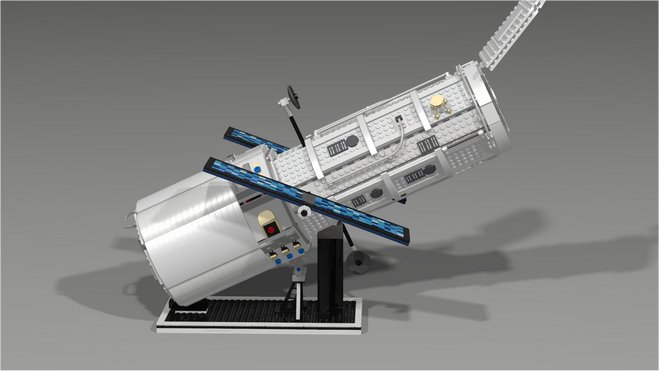
Last summer I wrote about a LEGO scratch model of the Hubble Telescope, which could become an official production model by LEGO if it was popular enough. (See The Hubble observatory in LEGO.)  LEGO allows LEGO modelers to post about their creations on the LEGO Ideas site. Visitors can vote on the models they like best. Those models that exceed 10,000 votes will be considered for commercial production.

Gabriel Russo posted his impressive Hubble Telescope model at the LEGO Ideas site last year:

HubbleTelescopeLego-GRusso

It received the 10000 votes but Robert Pearlman reports that it was nevertheless not selected by LEGO : LEGO passes on fan-voted Hubble Space Telescope model – collectSPACE

LEGO on Wednesday (Feb. 4) revealed the outcome of its most recent review of fan-suggested model kits submitted through its LEGO Ideas website. The Danish toy company passed on making the Hubble telescope, selecting a Pixar animator’s WALL-E robot and a “Doctor Who” set instead.

“We reviewed eight amazing projects that reached 10,000 supporters between June and September,” Signe Lonholdt with the LEGO Ideas team said in a video announcing the results of the evaluation. “Reaching 10,000 supporters is a tremendous accomplishment, but the journey [for the sets] is far from over.”

Here were two previous posts about the HST model: