** An interview with the Boston Dynamics founder and CEO Marc Raibert:
** Boston Dynamics: “SpotMini Autonomous Navigation”:
SpotMini autonomously navigates a specified route through an office and lab facility. Before the test, the robot is manually driven through the space so it can build a map of the space using visual data from cameras mounted on the front, back and sides of the robot. During the autonomous run, SpotMini uses data from the cameras to localize itself in the map and to detect and avoid obstacles. Once the operator presses ‘GO’ at the beginning of the video, the robot is on its own. Total walk time for this route is just over 6 minutes. (The QR codes visible in the video are used to measure performance, not for navigation.)
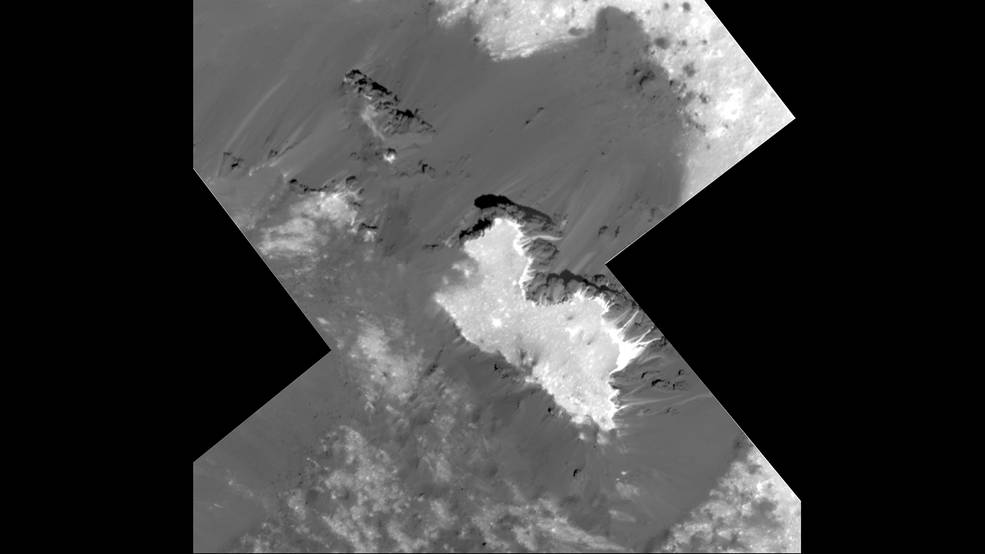
This mosaic of a prominent mound located on the western side of Cerealia Facula was obtained by NASA’s Dawn spacecraft on June 22, 2018 from an altitude of about 21 miles (34 kilometers). Credits: NASA/JPL-Caltech/UCLA/MPS/DLR/IDA. Full image and caption
NASA’s Dawn spacecraft reached its lowest-ever and final orbit around dwarf planet Ceres on June 6 and has been returning thousands of stunning images and other data.
The flight team maneuvered the spacecraft into an orbit that dives 22 miles (35 kilometers) above the surface of Ceres and viewed Occator Crater, site of the famous bright deposits, and other intriguing regions. In more than three years of orbiting Ceres, Dawn’s lowest altitude before this month was 240 miles (385 kilometers), so the data from this current orbit bring the dwarf planet into much sharper focus.
These low orbits have revealed unprecedented details of the relationships between bright and dark materials in the region of Vinalia Faculae. Dawn’s visible and infrared mapping spectrometer had previously found the bright deposits to be made of sodium carbonate, a material commonly found in evaporite deposits on Earth. Last week Dawn fired its ion engine, possibly for the final time, to fly nearer Cerealia Facula, the large deposit of sodium carbonate in the center of Occator Crater.
“Acquiring these spectacular pictures has been one of the greatest challenges in Dawn’s extraordinary extraterrestrial expedition, and the results are better than we had ever hoped,” said Dawn’s chief engineer and project manager, Marc Rayman, of NASA’s Jet Propulsion Laboratory, Pasadena, California. “Dawn is like a master artist, adding rich details to the otherworldly beauty in its intimate portrait of Ceres.”
The wealth of information contained in these images, and more that are planned in the coming weeks, will help address key, open questions about the origin of the faculae, the largest deposits of carbonates observed thus far outside Earth, and possibly Mars. In particular, scientists have been wondering how that material was exposed, either from a shallow, sub-surface reservoir of mineral-laden water, or from a deeper source of brines (liquid water enriched in salts) percolating upward through fractures.
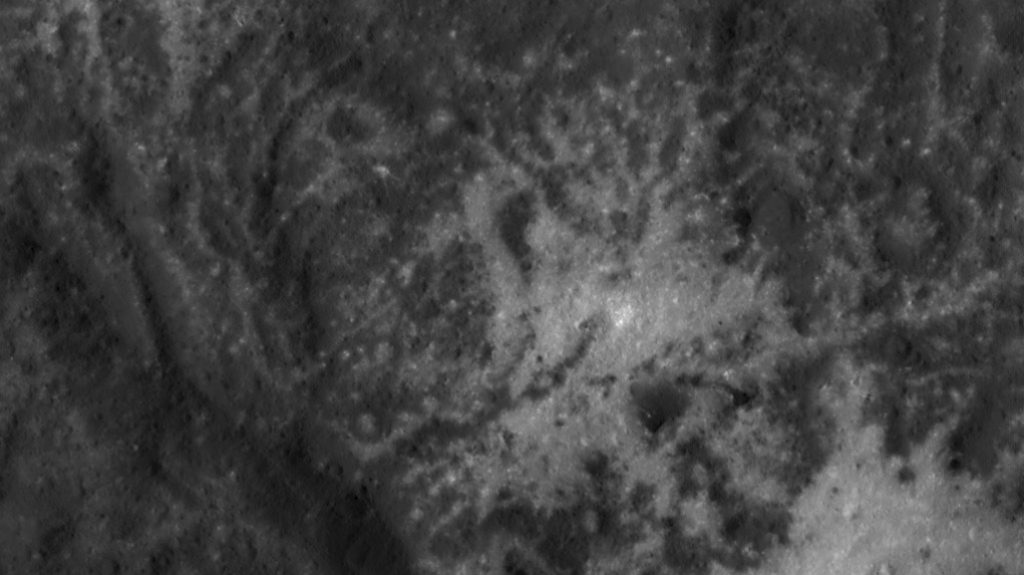
This close-up image of the Vinalia Faculae in Occator Crater was obtained by NASA’s Dawn spacecraft on June 14, 2018 from an altitude of about 24 miles (39 kilometers). Credits: NASA/JPL-Caltech/UCLA/MPS/DLR/IDA Full image and caption
And the low-altitude observations obtained with Dawn’s other instruments, a gamma ray and neutron detector and a visible and infrared mapping spectrometer, will reveal the composition of Ceres at finer scale, shedding new light on the origin of the materials found across Ceres’ surface. New gravity measurements also may reveal details of the subsurface.
“The first views of Ceres obtained by Dawn beckoned us with a single, blinding bright spot,” said Carol Raymond of JPL, Dawn’s principal investigator. “Unraveling the nature and history of this fascinating dwarf planet during the course of Dawn’s extended stay at Ceres has been thrilling, and it is especially fitting that Dawn’s last act will provide rich new data sets to test those theories.”
Read more details about Dawn’s recent orbits in Rayman’s Dawn Journal.
The Dawn mission is managed by JPL for NASA’s Science Mission Directorate in Washington. Dawn is a project of the directorate’s Discovery Program, managed by NASA’s Marshall Space Flight Center in Huntsville, Alabama. JPL is responsible for overall Dawn mission science. Orbital ATK Inc., in Dulles, Virginia, designed and built the spacecraft. The German Aerospace Center, Max Planck Institute for Solar System Research, Italian Space Agency and Italian National Astrophysical Institute are international partners on the mission team.
The planet-wide dust cloud on Mars continues and may last another month or two. Opportunity rover remains in a deep freeze mode while the sun is blocked from powering its solar panels but Curiosity‘s nuclear power planet keeps it running regardless of the weather. Here is an update on the storm from NASA JPL:
X-Arc team illustration. X-Arc is a top 10 finalist in the 3D-Printed Habitat Challenge Phase: 3 Level 1 competition.
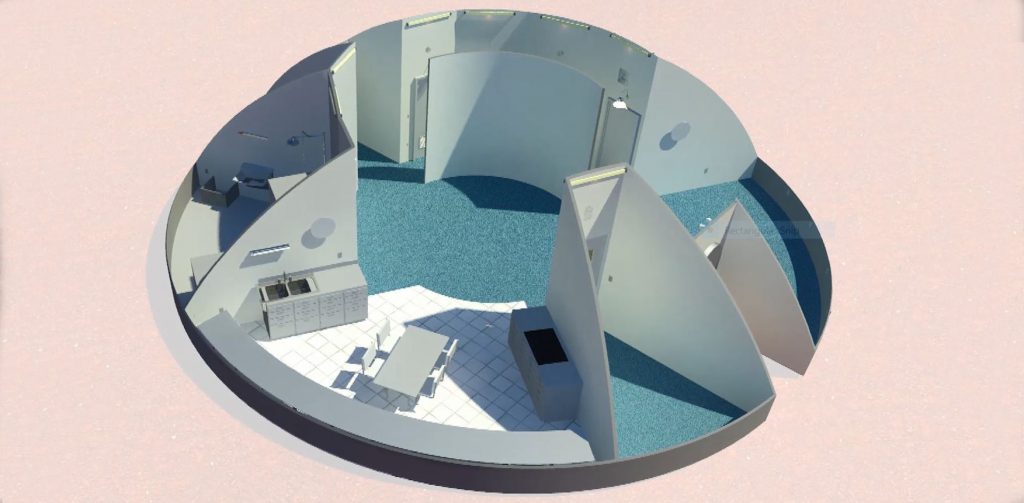
NASA’s 3D-Printed Habitat Challenge is challenging teams of citizen inventors to push the state of the art of additive construction to design and build sustainable shelters for humans to live on Mars. Previous levels of the challenge have resulted in advanced habitat concepts, material compositions and printing technologies. The current stage (Phase 3: Level 1) of the multi-level contest challenges participants to prepare digital representations of physical and functional characteristics of a house on Mars using Building Information Modeling (BIM) software tools.
Image provided by ALPHA Team, which is a top 10 finalist in the 3D-Printed Habitat Challenge Phase: 3 Level 1 competition.
The habitat must comprise 1,000 square feet of living space to support four astronauts for one year and include plans for systems such as life support, mechanical and electrical, spacesuit and rover hatches, and plumbing.
Image provided by Colorado School of Mines, which is a top 10 finalist in the 3D-Printed Habitat Challenge Phase: 3 Level 1 competition.
“This stage of the competition asks the participants to design habitats that will combine shelter with critical survival systems,” said Monsi Roman, program manager for the Centennial Challenges Program. “We are asking them to look beyond the physical structure into the needs of our future explorers.”
Image provided by Hassell & EOC, which is a top 10 finalist in the 3D-Printed Habitat Challenge Phase: 3 Level 1 competition.
Eighteen teams submitted their designs on May 16, and judges have selected the top 10 teams that will continue to compete for $100,000 in prize money that will be awarded to the top five teams in July. The teams will be evaluated by a panel of subject matter experts from NASA and industry.
Image provided by Kahn-Yates, which is a top 10 finalist in the 3D-Printed Habitat Challenge Phase: 3 Level 1 competition.
The teams, listed in alphabetical order, are:
ALPHA Team – Marina Del Rey, California
Colorado School of Mines – Golden, Colorado
Hassell & EOC – San Francisco
Kahn-Yates – Jackson, Mississippi
Mars Incubator – New Haven, Connecticut
AI. SpaceFactory – New York
Northwestern University – Evanston, Illinois
SEArch+/Apis Cor – New York
Team Zopherus – Rogers, Arkansas
X-Arc – San Antonio
“There is a great breadth in use of technology and 3D-modeling skills among the judges that range from Building Information Modeling software developers to the most sophisticated applications of virtual design and construction,” said Pete Carrato, lead judge and corporate manager of Building Information Modeling at challenge sponsor Bechtel. “Each team’s submission is a view into the future of developing surface-based facilities on Mars.”
Image provided by Mars Incubator, which is a top 10 finalist in the 3D-Printed Habitat Challenge Phase: 3 Level 1 competition.
The goal of the 3D-Printed Habitat Challenge is to foster the development of technologies to manufacture a habitat using local indigenous materials with, or without, recyclable materials. The vision is that autonomous machines will someday be deployed in deep space destinations, including Mars, to construct shelters for human habitation. On Earth, these same capabilities could be used to produce affordable housing wherever it is needed or where access to conventional building materials and skills are limited.
Image provided by AI. SpaceFactory, which is a top 10 finalist in the 3D-Printed Habitat Challenge Phase: 3 Level 1 competition.
The challenge, which began in 2014, is structured in phases:
Phase 1, the Design Competition, required teams to submit architectural renderings and was completed in 2015. ($50,000 prize purse)
Phase 2, the Structural Member Competition, focused on material technologies, requiring teams to create structural components. It was completed in 2017. ($1.1 million prize purse)
Phase 3 (current), the On-Site Habitat Competition, challenges competitors to fabricate sub-scale habitats, and has five levels of competition – three construction levels and two virtual levels. For the virtual levels, teams must use BIM software to design a habitat that combines allowances for both the structure and systems it must contain. The construction levels challenge the teams to 3D-print elements of the habitat, culminating with a one-third-scale printed habitat for the final level. ($2 million prize purse)
Image provided by Northwestern University, which is a top 10 finalist in the 3D-Printed Habitat Challenge Phase: 3 Level 1 competition.