A sampling of recent articles, videos, and images from space-related science news items (find previous roundups here):
Astronomy
** Enigmatic radio burst illuminates a galaxy’s tranquil halo | ESO
Astronomers using ESO’s Very Large Telescope have for the first time observed that a fast radio burst passed through a galactic halo. Lasting less than a millisecond, this enigmatic blast of cosmic radio waves came through almost undisturbed, suggesting that the halo has surprisingly low density and weak magnetic field. This new technique could be used to explore the elusive halos of other galaxies.
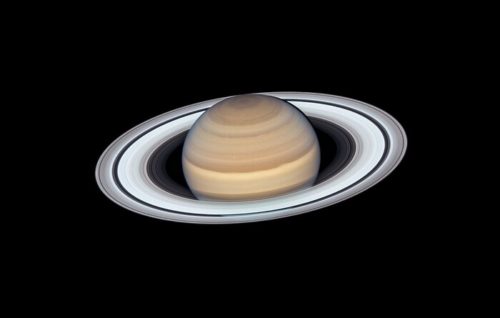
** Hubble Reveals Latest Portrait of Saturn | ESA/Hubble
The NASA/ESA Hubble Space Telescope’s Wide Field Camera 3 observed Saturn on 20 June 2019 as the planet made its closest approach to Earth this year, at approximately 1.36 billion kilometres away.
Since the Hubble Space Telescope was launched, its goal has been to study not only distant astronomical objects, but also the planets within our Solar System. Hubble’s high-resolution images of our planetary neighbours can only be surpassed by pictures taken from spacecraft that actually visit these bodies. However, Hubble has one advantage over space probes; it can look at these objects periodically and observe them over much longer periods than any passing probe could.
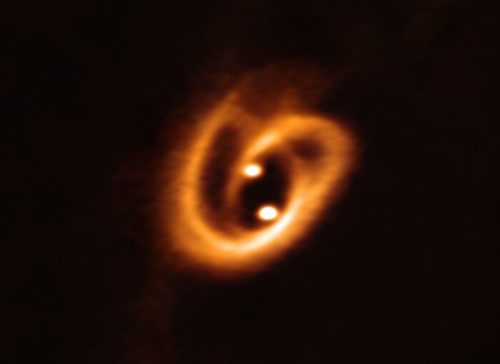
Astronomers using ALMA have obtained an extremely high-resolution image showing two disks in which young stars are growing, fed by a complex pretzel-shaped network of filaments of gas and dust. Observing this remarkable phenomenon sheds new light on the earliest phases of the lives of stars and helps astronomers determine the conditions in which binary stars are born.
The two baby stars were found in the [BHB2007] 11 system – the youngest member of a small stellar cluster in the Barnard 59 dark nebula, which is part of the clouds of interstellar dust called the Pipe nebula. Previous observations of this binary system showed the outer structure. Now, thanks to the high resolution of the Atacama Large Millimeter/submillimeter Array (ALMA) and an international team of astronomers led by scientists from the Max Planck Institute for Extraterrestrial Physics (MPE) in Germany, we can see the inner structure of this object.
Cosmology
** If the universe is only 14 billion years old, how can it be 92 billion light years wide? – The light of the most distant stars and galaxies comes from a time not long after the Big Bang. So why didn’t that light pass us back then when we were all “close” together? Here is the explanation:
The size and age of the universe seem to not agree with one another. Astronomers have determined that the universe is nearly 14 billion years old and yet its diameter is 92 billion light years across. How can both of those numbers possibly be true? In this video, Fermilab’s Dr. Don Lincoln tells you how.
Exoplanets
** Hubble Finds Water Vapor on Habitable-Zone Exoplanet for the First Time | ESA/Hubble
With data from the NASA/ESA Hubble Space Telescope, water vapour has been detected in the atmosphere of a super-Earth within the habitable zone by University College London (UCL) researchers in a world first. K2-18b, which is eight times the mass of Earth, is now the only planet orbiting a star outside the Solar System, or exoplanet, known to have both water and temperatures that could support life.
The discovery, published today in Nature Astronomy, is the first successful atmospheric detection of an exoplanet orbiting in its star’s habitable zone, at a distance where water can exist in liquid form.
Asteroids & Comets
** Europe and US teaming up for asteroid deflection – ESA – NASA will launch the DART (Double Asteroid Redirection Test) spacecraft in late 2021 to the near-Earth binary asteroid Didymos where it will smack into the smaller of the two objects in Sept. 2022. The goal is to test whether an asteroid on track to impact earth could be diverted from its path. DART will be accompanied by the Italian CubeSat LICIACube (Light Italian CubeSat for Imaging of Asteroids), which will record the impact event .
Another European contribution is the Hera spacecraft, which will launch in 2024. The Hera spacecraft
will perform a close-up survey of the post-impact asteroid, acquiring measurements such as the asteroid’s mass and detailed crater shape. Hera will also deploy a pair of CubeSats for close-up asteroid surveys and the very first radar probe of an asteroid.
The results returned by Hera would allow researchers to better model the efficiency of the collision, to turn this grand-scale experiment into a technique which could be repeated as needed in the event of a real threat.
The combined DART and HERA projects fall under the Asteroid Impact & Deflection Assessment (AIDA) mission.
Astrophysicist and Queen guitarist Brian May describes the HERA mission.
** Visitor from Interstellar Space – SETI Institute.
Planetary Astronomer Michael Busch and Senior Astronomer Seth Shostak discuss a recent visit from Comet Borisov, C/2019 Q4.
Mars
** NASA’s InSight ‘Hears’ Peculiar Sounds on Mars
NASA’s InSight lander placed a seismometer on the Martian surface to study marsquakes. While it’s found many, it has also detected other kinds of seismic signals, including some produced by the spacecraft itself. That includes wind gusts, InSight’s robotic arm moving around and “dinks and donks,” friction caused by parts inside the seismometer moving against each other as the temperature changes. Put on your headphones and you can hear sonifications of this seismic “noise” recorded on March 6, 2019, the 98th Martian day, or sol, of the mission. Around 2 p.m. local Mars time, the spacecraft’s arm was moving and snapping pictures with its cameras, surveying InSight’s “workspace.” This audio would be too faint for the human ear to heart it on Mars. It’s been sped up by 10 times and processed so you can hear the kinds of signals InSight sends back for its scientists to study.
** NASA InSight’s Robotic Arm Helps Out its Mole on Mars
NASA’s InSight lander on Mars is trying to use its robotic arm to get the mission’s heat flow probe, or mole, digging again. InSight team engineer Ashitey Trebbi-Ollennu, based at NASA’s Jet Propulsion Laboratory in Pasadena, California, explains what has been attempted and the game plan for the coming weeks. The next tactic they’ll try will be “pinning” the mole against the hole it’s in. The German Aerospace Center (DLR) built the mole. It is designed to dig under the Martian surface to measure heat flowing out of the planet. Scientists want this data to learn how Mars and other rocky planets form.
** A recent Curiosity update from Leonard David: Curiosity Mars Rover: “Dumping Dirt on its Back”
NASA’s Curiosity Mars rover has just initiated Sol 2543 duties.
Reports Roger Wiens, Geochemist at Los Alamos National Laboratory in New Mexico: “Curiosity has been at this same location for all of August and September, which included a number of days of waiting for Mars to pass behind the Sun (‘conjunction’), drilling two holes, and processing the samples.”

** A selection of Bob Zimmerman‘s analyses of interesting features on the surface of Mars:
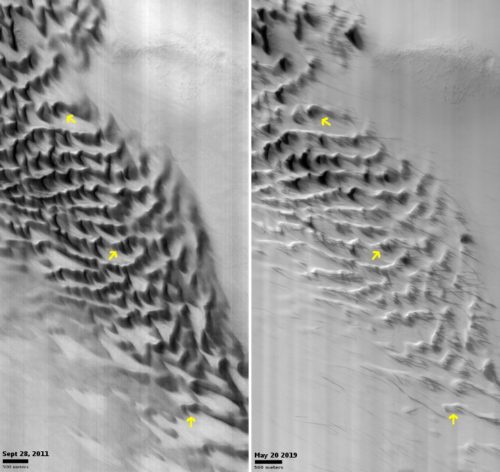
- The slowly changing dunes of Mars
- Martian impact into lava crust?
- Curiosity to use first of nine “wet chemistry cups”
- Tongue-shaped glaciers on Mars
- Cave pits in the Martian northern lowlands
- Taking a look back at a Martian pit
Webcasts:
** How Do Astronomers Define Latitude & Longitude on Other Planets – Scott Manley:
t took centuries for the people on Earth to decide on a common meridian to measure longitude from, but other planets also need everyone to agree about the origins of their mapping systems. In the case of the terrestrial planets a single bright spot was chosen in the early stages of exploration, and as maps improved the exact location is defined with increasing accuracy. For tidally locked moons the meridian is defined based on orientation relative to the parent body, but even then there’s a lot of room for improvement as data improves. Finally some bodies are just not suited to spherical coordinated, because they’re not particularly spherical.
** All your astronomy questions answered | Space Interview – TMRO.tv
Jared and Tony Darnell from Deep Astronomy lost track of time answering a bunch of community questions ranging from why James Webb Space Telescope is being intentionally launched out of focus, what’s the *next* telescope after JWST gets launched (FINALLY) to why Uranus and Neptune deserve their own dedicated space missions.
====
Fire in the Sky:
Cosmic Collisions, Killer Asteroids, and
the Race to Defend Earth