A sampling of recent articles, press releases, etc. related to student and amateur CubeSat / SmallSat projects and programs (find previous smallsat roundups here):
“Concrete and asphalt tend to retain the heat of the sun and heat the place. We want to know exactly why, where, and when the cities are heating up,” De La Vega stated.
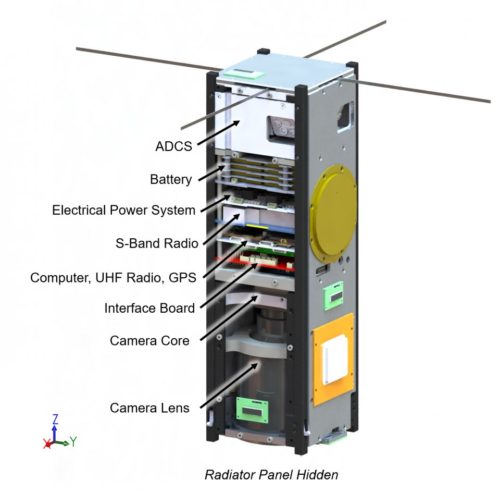
Once the satellite gets deployed by astronauts onboard the International Space Station in January, the team will be testing, calibrating, and hopefully, receiving data from the satellite for further research.
[SOCRATES} is the first-ever made by the university in a joint venture featuring university professors and students from a variety of space-related fields and engineering. The project is under NASA’s Undergraduate Student Instrument Project, which was started three years ago to give students opportunities to build and launch satellites into space.
More than 30 students from the university were interested in the program, led by Kyle Houser, the chief engineer and Burgett, the project manager. The SOCRATES was developed in the university’s Small Satellite Project Lab, founded by Demoz Gebre and physics professor Lindsay Glesener for a small satellite study.
The SOCRATES is fitted with state-of-the-art X-ray detection sensors to provide navigation when GPS is inaccessible. The satellite will also be able to capture information on electronic acceleration from solar flares to aid in the study of the solar phenomenon. The SOCRATES will be released to orbit the Earth in January 2020 from the International Space Station, where it is held at the moment.
Here is the latest episode in NASA’s Space to Ground weekly report on activities related to the International Space Station:
** AskNASA┃ What is the International Space Station?
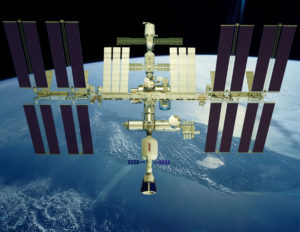
NASA’s Jacob Keaton answers questions about the International Space Station. He highlights building this home off Earth and what astronauts do while aboard. Research and other lessons learned from the space station will help us send humans to the Moon under the Artemis program and prepare for Mars.
Astronauts Andrew Morgan of NASA and Luca Parmitano of the European Space Agency (ESA) will venture outside the International Space Station starting at ~7:05 a.m. EST to continue repairing the Alpha Magnetic Spectrometer (AMS) instrument. This is the second in a series of repair spacewalks – the most complex of this kind since the servicing of the Hubble Space Telescope. AMS is attached to the outside of the space station, where it has been operating since 2011. It is a particle physics experiment working to help us understand dark matter and the origins of the universe.
** Science Launching On SpaceX CRS 19
The 19th SpaceX Commercial Resupply Services (CRS-19) contract mission for NASA carries a variety of cutting-edge scientific experiments to the International Space Station. Learn more about some of the scientific investigations riding on Dragon to the orbiting laboratory on CRS-19: https://go.nasa.gov/2qZGYBd Learn more about the research being conducted on Station: https://www.nasa.gov/iss-science Follow Twitter updates on the science conducted aboard the space station: https://twitter.com/iss_research
A sampling of links to recent space policy, politics, and government (US and international) related space news and resource items that I found of interest (find previous space policy roundups here):
Erin Miller, Director of Business Development at The National Cybersecurity Center in Colorado Springs, explains what the Space Information Sharing and Analysis Center (ISAC) is and why we need it. As Erin explains, a 1998 presidential directive requires the development of ISACs to protect our critical infrastructures from threats and vulnerabilities. There are about 25 different ISACs to support major industry sectors such as financial services, information technology, natural gas and others. As space transcends virtually all these sectors it was only natural that there be a Space ISAC. In this episode of Constellations, Erin will also discuss new developments and strategies to combat increasing cybersecurity and other threats to our space assets.
Richard Duke from the Surrey Space Center joins me to talk about their RemoveDEBRIS mission, which launched last year and carried out 4 different tests focused on space debris removal and management.
** The Space Show – Tue, 11/19/2019 – Christopher Richins discussed “RBC Signals satellite ground stations, business growth and expansion, new government customers. Lunar and Mars communications to Earth and more”.
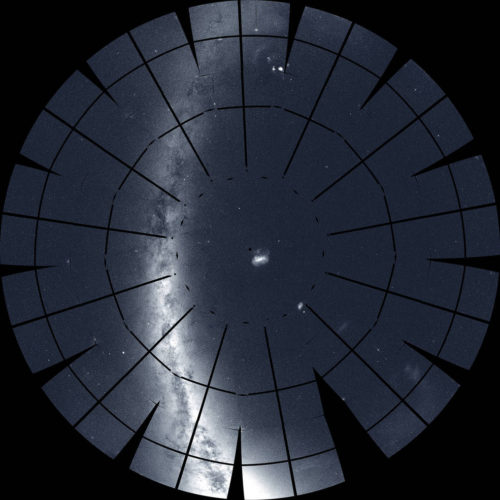
“This mosaic of the southern sky was assembled from 208 images taken by NASA’s Transiting Exoplanet Survey Satellite (TESS) during its first year of science operations, completed in July 2019. The mission divided the southern sky into 13 sectors, each of which was imaged for nearly a month by the spacecraft’s four cameras. Among the many notable celestial objects visible is the glowing band (left) of the Milky Way, our home galaxy seen edgewise, the Orion Nebula (top), a nursery for newborn stars, and the Large Magellanic Cloud (center), a nearby galaxy located about 163,000 light-years away. The prominent dark lines are gaps between the detectors in TESS’s camera system. Credits: NASA/MIT/TESS and Ethan Kruse (USRA)” via Carnival of Space and Universe Today
A sampling of recent articles, videos, and images dealing with space transport (find previous roundups here):
[ Update 4: A statement from SpaceX indicates that they were pushing the pressure extremely high as a test of the tank design since they had decided it would never fly.
Will be interesting to see if they repair it or build a whole new propulsion module. Regardless, no Mk.1 test flight this year for sure. A flight of the Mk.2 in Florida may now happen before a demo Starship flight in Texas.
Update: NASA posted a video of the recent SpaceX Crew Dragon static abort firing test:
#ICYMI 🐉 Last week, @SpaceX completed a series of static fire engine tests of the #CrewDragon spacecraft.
The tests will help validate the launch escape system for the in-flight abort demonstration planned as part of @NASA‘s Commercial Crew Program.
** China launched a two Kuaizhou-1A rockets in less than a week. The latest one carried
two multimedia satellites into space on Sunday after the successful launch of a remote sensing satellite on Wednesday, according to China Aerospace Science and Technology Corporation (CASC). The two satellites have already entered the pre-set orbit by the time of release. The rocket, carrying the satellites named KL-α-A, KL-α-B, blasted off from northwestern China’s Jiuquan Satellite Launch Center at 18:00 p.m. BJT. The two satellites atop were developed by the Innovation Academy for Microsatellites of Chinese Academy of Sciences to conduct Ka-band communication technology test for German customers.
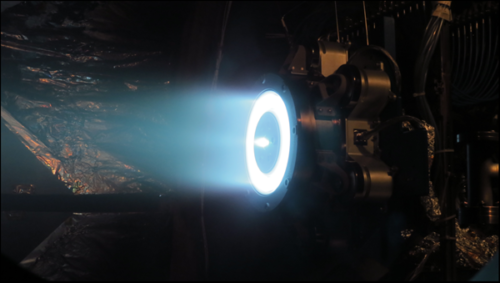
Aerojet Rocketdyne and NASA recently demonstrated an Advanced Electric Propulsion System (AEPS) thruster at full power for the first time, achieving an important program milestone.
Aerojet Rocketdyne-developed AEPS thrusters are slated to be used on the Power and Propulsion Element of NASA’s Gateway, the agency’s orbiting lunar outpost for robotic and human exploration operations in deep space.
The state-of-the-art AEPS Hall thruster operated at 12.5 kilowatts (kW) as part of its final conditioning sequence during testing at the Jet Propulsion Laboratory in Pasadena, California. The thruster demonstrated stable operation at power levels ranging from 4.2 kW to 12.5 kW. Full electric propulsion thruster string integration will take place early next year.
‘Aerojet Rocketdyne’s Advanced Electric Propulsion System thruster demonstrates full power operation at the Jet Propulsion Laboratory in Pasadena, California.”
Our first rocket #Terran1 will be a 2-stage #3DPrinted expendable vehicle capable of lifting 1250kg payloads to LEO for $10 million per launch. Oh, and we’ll make it flight ready from raw materials in 60 days. pic.twitter.com/ZBjnNgK4PV
Orbex, a U.K.-based company that hopes to start launching rockets from Scotland in the coming years, has revealed images of the facility where it will build its upcoming Prime launch vehicle.
Located in the town of Forres near Inverness in Scotland, the company’s facility will be used to construct each 17-meter long Prime rocket, designed to loft small satellites into polar orbit from the early 2020s.
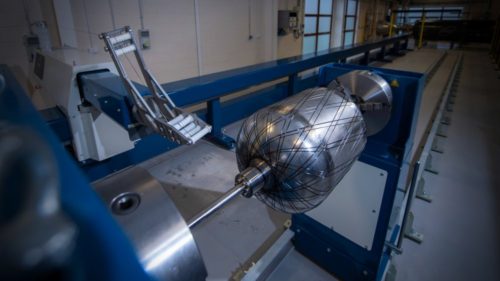
Inside, the company says it has included a number of features to produce a lighter and more environmentally-friendly rocket. This includes, with regards to the former, a large carbon-fiber winding machine to build the exterior structure of the two-stage rocket, which the company says is among the largest in Europe.
“Orbex has installed one of the largest high-speed automated carbon fibre winding machines in Europe in its Scottish factory, as well as a full size ‘autoclave’. This equipment allows engineers to have complete control over the design and pace of manufacture of all carbon fibre tanks, including the main stage tanks, which can be wound in a matter of hours. Orbex fuel tanks use specialized materials, including graphene, and specially developed processing techniques to ensure linerless compatibility with liquid oxygen.” – Orbex
** An update on Sierra Nevada’s Dream Chaser cargo vehicle development:
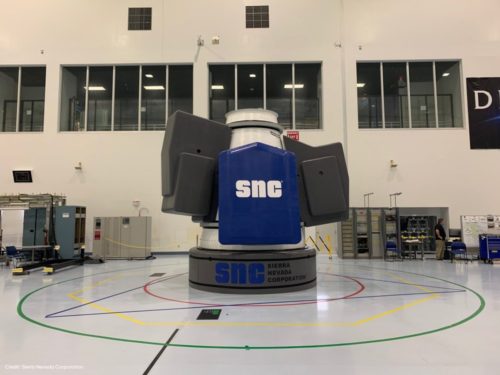
At the Kennedy Space Center’s Space Station Processing Facility, Sierra Nevada Corporation unveiled the name for Dream Chaser’s cargo module element as well as provided an update on the status of the cargo craft as it prepares for its first flight in 2021.
Also discussed at the event were potential other applications for Dream Chaser, including but not limited to a Gateway logistics cargo vehicle, a standalone space station, and a crew transportation vehicle.
Today’s update came as Sierra Nevada continues to prepare its cargo version of Dream Chaser for its first voyage to the International Space Station in “Fall 2021,” according to Steve Lindsey – Vice President, Space Exploration Systems Space Systems for Sierra Nevada Corporation.
A test version of Dream Chaser’s “Shooting Star” cargo module on display at KSC this week. The blue panel is where a solar panel can be located. The gray structures on the sides represent where cargo modules can be attached.
Here is a video of a Sierra Nevada briefing held back in October 15th on the occasion of the arrival of the primary structure of the first Dream Chaser at a SNC facility in Colorado where they will assemble the vehicle: Dream Chaser Primary Structure Arrives in Colorado – SNC
** The Space Show – Mon, 11/18/2019 – Joe Carroll discussed “tethers, artificial gravity, humans and long duration spaceflight, living in space, on the Moon and Mars plus much more”.
Jonathan Yaney and his colleagues at SpinLaunch, a startup based in Long Beach, California, believe they’ve found the answer. Their nearly fuel-free system, known as a mass accelerator, will use a giant vacuum-sealed centrifuge to spin a payload to more than 4,000 mph. Once released, the payload will go screaming through the atmosphere, coasting nearly 30 vertical miles before propelling itself the rest of the way to orbit by means of a small rocket. The company already has a working prototype; Yaney calls it “science fiction stuff.”
Eventually, Yaney claims, SpinLaunch will be able to fling several 200-pound payloads into space every day, at a cost of less than half a million dollars each— five or 10 times cheaper than the competition. Human passengers are out of the question; the accelerator would turn their bodies to mush. Even satellites must be specially hardened to survive the ride. But that’s a small concession, Yaney argues, when you’re talking about putting together, say, a constellation of internet satellites in a matter of days rather than months.
OHB is best known for building Europe’s Galileo navigation satellites, but the company also supplies many of the structures and tanks for the Ariane 5 and upcoming Ariane 6 rockets.
This year OHB revealed plans to develop its own rocket, targeting the small satellite market around the range Rocket Lab’s Electron addresses today.
OHB hopes to have a small launcher capable of sending 200 kilograms to low Earth orbit conduct a first flight by the end of 2021, Fuchs said in an interview at Space Tech Expo Europe here. The German prime contractor established an entity called Rocket Factory Augsburg to spearhead the small launcher program.
Falcon 9’s first stage lands on the Of Course I Still Love You droneship and returns to port, completing this booster’s fourth launch and landing pic.twitter.com/D923OCxXjm
*** The legs were soon removed and the booster laid on its transporter:
Y’all knew it was comin. Here’s my time lapse from today’s port activities. The first few seconds show the final leg coming off, and the rest is Falcon 9 B1048.4 being laid down on the transporter. It’s nuts seeing something that big being moved around like that. #Starlinkpic.twitter.com/Vk9HDGrAyE
An anthropomorphization sometimes used to describe the venting launch vehicles often exhibit while during and after fueling, Starship Mk1’s so-called ‘breaths’ occurred around 5:59 pm CST (23:59 UTC). Those first vents came after roughly an hour or two spent performing several different pressurization cycles, observable due to the fact that Starship’s stainless steel tanks visibly smoothed out as pressure increased.
Due to the typical distances Starship is viewed from and the nature of the mirror-finished stainless steel SpaceX has chosen to build the next-generation launch vehicle out of, the exterior of Starship prototypes can produce a reflection that looks bumpy and disjointed. This has lead many a layperson to incorrectly assume that SpaceX’s Starship prototypes are thus shoddily built. In reality, viewed from afar, the tiniest hint of surface heterogeneity on a mirror can dramatically change what is reflected on its surface.
Even at the thinness of Starship Mk1’s liquid oxygen and methane tanks, stainless steel is still extremely strong, but pressurizing the vehicle’s tanks can clearly counteract a significant portion of the slight imperfections in their curvature.
**** Additional views of Starship Mk1 activities at Boca Chica from the past few days
Following Monday’s initial testing, engineers entered Starship Mk1 for checks ahead of the cryoproofing test objectives potentially later this week. Long video (down to 12 mins thanks to timelapse, lots of viewpoints, with special guests: Starship Internal Ladder and Concrete Smoother guy. Learn about Starship Mk1: UPDATES: https://forum.nasaspaceflight.com/ind… ARTICLES: https://www.nasaspaceflight.com/?s=St… Video and photos from Mary (@bocachicagal) for NSF.
Starship Mk1’s first cryo loading tests are just around the corner as workers prepare the test vehicle by flushing out the lines and pressurizing the commodity tanks. Venting IS normal (or “norminal” as SpaceX would say. 🙂 Learn about Starship Mk1: UPDATES: https://forum.nasaspaceflight.com/ind… ARTICLES: https://www.nasaspaceflight.com/?s=St… Lots of videos (some time-lapse) and Photos by Mary (@bocachicagal) for NASASpaceFlight.com.
**** And view of the Starship Mk2 in Cocoa Beach, Florida
The upper bulkhead for Starship MK2 has officially been lifted. The Cocoa yard seems to have taken a different approach than they did in Boca Chica for the design. #MK2#SpaceXpic.twitter.com/L77Lb24qyl