1. Monday, Jan. 6, 2020; 7 pm PST (9 pm CST, 10 pm EST): No special programming today.
2. Tuesday, Jan. 7, 2020; 7-8:30 pm PST (9-10:30 pm CST, 10-11:30 pm EST): We welcome Dr. Malcolm Davis from Australia’s to address national security space concerns for Australia and the region
3. Wednesday, Jan. 8, 2020: Pre-recorded Hotel Mars Program with John Batchelor. See Upcoming Show on The Space Show website for details. NO SHOW FOR NEW YEARS DAY.
4. Thursday, Jan. 9, 2020; 7-8:30 pm PST (9-10:30 pm CST, 10-11:30 pm EST): No special program today.
5. Friday, Jan. 10, 2020; 9:30-11 am PST (11:30 am-1 pm CST; 12:30-2 pm EST): We welcome back Dr. Bob Krone regarding space education.
6. Sunday, Jan. 12, 2020; 12-1:30 pm PST (3-4:30 pm EST, 2-3:30 pm CST): We welcome back Jim Muncy on commercial, NewSpace and general space policy news and updates.
** Sun, 12/29/2019 – Thomas A. Olson discussed “NewSpace, Commercial Space & the space industry 2019 review with a look at 2020 for the full space industry”.
A sampling of links to recent space policy, politics, and government (US and international) related space news and resource items that I found of interest (find previous space policy roundups here):
In the final TMRO Space News of 2019 Manju talks about the formation of the United States Space Force, and Jared covers Christina Koch’s record-setting day in space, along with your weekly traffic report.
In the middle of the New Mexico desert lies Spaceport America, a glittering, alien structure advertised as the very first purpose-built commercial spaceport. It’s home to Virgin Galactic, a space startup that promises to send tourists into orbit as early as next year. But even if that milestone happens, it will follow years of delays, setbacks, and even tragedy. Local residents in the nearby town of Truth or Consequences were told to expect big things when New Mexico joined the private space economy, but many now wonder if the dream of a space industry will ever materialize.
Happy new year in space! Editorial Director Jason Davis, Chief Advocate Casey Dreier and Solar System Specialist Emily Lakdawalla join Mat Kaplan for a review of 2019’s biggest news from the final frontier. Our experts then turn to the promise of 2020 for Mars exploration, humans in space and much more. The theme continues as Planetary Society Chief Scientist Bruce Betts adds his highlights in a special What’s Up segment. Got a great joke that combines space and the new year? You might win this week’s contest!
** Is Betelgeuse about to go supernova? Recent dimming of the red super giant star got people discussing the possibility, but it’s unlikely to happen anytime soon (on a human timescale). Here are a couple of discussions of Betelgeuse by Scott Manley and Fraser Cain:
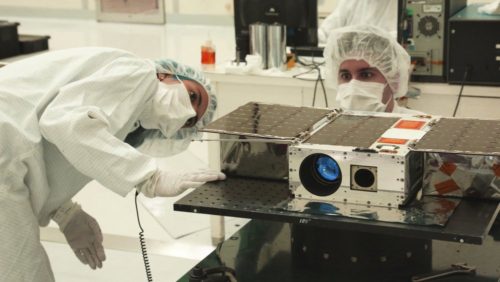
ASTERIA observed a handful of nearby stars and successfully demonstrated that it could achieve precision measurements of the stars’ brightness. With that data, scientists look for dips in a star’s light that would indicate an orbiting planet passing between the satellite and the star. (This planet-hunting technique is called the transit method.) Mission data is still being analyzed to confirm whether ASTERIA spotted any distant worlds.
Since completing its primary mission objectives in early February 2018, ASTERIA has continued operating through three mission extensions. During that time, it has been used as an in-space platform to test various capabilities to make CubeSats more autonomous, some of which are based on artificial intelligence programs. ASTERIA also made opportunistic observations of the Earth, a comet, other spacecraft in geo-synchronous orbit and stars that might host transiting exoplanets.
“Left to right: Electrical Test Engineer Esha Murty and Integration and Test Lead Cody Colley prepare the ASTERIA spacecraft for mass-properties measurements in April 2017 prior to spacecraft delivery ahead of launch. ASTERIA was deployed from the International Space Station in November 2017. Credit: NASA/JPL-Caltech” > Larger view
PICTURE-C’s coronagraph creates artificial eclipses to dim or eliminate starlight without dimming the planets that the stars illuminate. It is designed to capture faint asteroid belt like objects very close to the central star.
While a coronagraph is necessary for direct imaging of exoplanets, our 6,000 pound device also includes deformable mirrors to correct the shape of the the telescope mirrors that get distorted due to changes in gravity, temperature fluctuations and other manufacturing imperfections.
Finally, the entire device has to be held steady in space for relatively long periods of time. A specially NASA-designed gondola called Wallops Arc Second Pointer (WASP) carried PICTURE-C and got us part way. An internal image stabilization system designed by my colleagues provided the “steady hand” necessary.
Sun
** Sunspots return. After an unusually long period of about six months with few or zero spots, several appeared on the face of the Sun in December. They also displayed the change in magnetic polarization that indicates they belong to the next phase of the solar cycle. The Next Solar Cycle is Coming – SpaceWeather.com
The pace of new-cycle sunspots is definitely intensifying. 2020 is only three days old, and already there is a Solar Cycle 25 ‘spot on the sun: AR2755. The sunspot is inset in this magnetic map from NASA’s Solar Dynamics Observatory:
We know that AR755 belongs to the next solar cycle because of its magnetic polarity. It’s reversed. According to Hale’s Law, sunspot polarities flip-flop from one solar cycle to the next. During old Solar Cycle 24, we grew accustomed to sunspots in the sun’s southern hemisphere having a -/+ pattern. AR2755 is the reverse: +/-, marking it as a member of new Solar Cycle 25.
This is the 3rd consecutive month that Solar Cycle 25 sunspots have appeared: Nov. 2019, Dec. 2019, and now Jan. 2020. The quickening pace of new cycle sunspots does not mean that Solar Minimum is finished. On the contrary, low sunspot counts will likely continue for many months and maybe even years. However, it is a clear sign that Solar Cycle 25 is coming to life. The doldrums won’t last forever.
The Sun is now in what appears to be the longest stretch ever recorded, since the 11-year solar sunspot cycle reactivated in the 1700s after the last grand minimum, of sunspot inactivity. This record-setting dearth of practically no sunspots has now stretched to six months in a row.
Moon
** China’s Chang’e 4 lander and rover mission continues 1 year after landing on the far side of the Moon on January 3rd, 2019.
[The] grants support very advanced amateur astronomers around the world in their efforts to find, track, and characterize near Earth asteroids.
The world’s professional sky surveys alone cannot handle the burden of defending the Earth from potentially dangerous asteroids. Our Shoemaker grant winners contribute in particular to two areas of planetary defense:
Characterization: Some winners focus on asteroid characterization to determine asteroid properties. They typically carry out photometry (brightness) studies to determine properties like spin rate and whether what looks like one asteroid is actually two asteroids—a binary pair. This type of information will be crucial when an asteroid deflection is required, and in the meantime, for understanding the near-Earth asteroid population in general.
Tracking: Other winners focus on astrometric (sky position) tracking observations that are necessary for calculating orbits, which tells us whether an asteroid will hit Earth. Without these follow-up observations of newly discovered asteroids, the asteroids can even be lost.
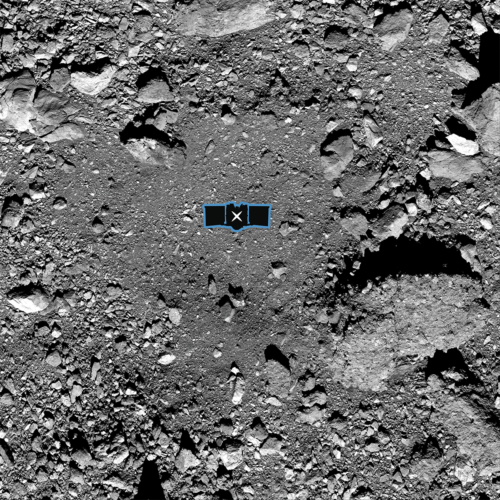
“The sample site Nightingale, OSIRIS-REx’s primary sample collection site on asteroid Bennu. The image is overlaid with a graphic of the OSIRIS-REx spacecraft to illustrate the scale of the site. Credit: NASA/Goddard/University of Arizona”
On Dec. 17, 2019, engineers took NASA’s next Mars rover for its first spin. The test took place in the Spacecraft Assembly Facility clean room at NASA’s Jet Propulsion Laboratory in Pasadena, California. This was the first drive test for the new rover, which will move to Cape Canaveral, Florida, in the beginning of next year to prepare for its launch to Mars in the summer. Engineers are checking that all the systems are working together properly, the rover can operate under its own weight, and the rover can demonstrate many of its autonomous navigation functions. The launch window for Mars 2020 opens on July 17, 2020. The rover will land at Mars’ Jezero Crater on Feb. 18, 2021.
Scheduled to launch in July or August 2020, the Mars 2020 rover will land in Jezero Crater on Feb. 18, 2021. There it will search for signs of past microbial life, characterize Mars’ climate and geology, collect samples for future return to Earth and pave the way for human exploration of the Red Planet.
Both to ensure that as few Earthly microbes as possible hitch a ride to Mars and to keep out particles that could interfere with the rover’s operations, High Bay 1 comes with strict cleanliness standards: Anyone entering the clean room, whether a technician or a journalist, must wear a “bunny suit,” booties, a hair cover, a face mask and latex gloves. Because notepads and writing implements could shed dust and other particles, specially-approved paper and pens were provided to visiting media members on request.
In the coming weeks, engineers and technicians will pack the 2020 rover into a specially-designed container. After it arrives at the Cape, Mars 2020 will undergo final processing and testing before launch.
** Updates on Curiosity’s roving from Leonard David:
Curiosity Right B Navigation Camera photo taken on Sol 2634, January 3, 2020. Credit: NASA/JPL-Caltech
** Are We About to Find Life on Mars? – SETI Institute
Over the past six months, numerous articles have reported weird anomalies in the atmosphere of Mars, from an outburst of methane in June 2019 to patterns in oxygen concentrations that cannot be explained by any known atmospheric or surface processes on the Red Planet. Perhaps more intriguing is the Viking Lander (Viking LR) experiment. In 1976, each of the two Viking landers performed experiments on Martian soil samples. The samples tested positive for metabolism, and researchers recently claimed that like on Earth, this is a sign for the presence of a Martian life. Finally, an Ohio scientist claims to have found photographic proof of “insect and reptile-like” life on Mars. This controversial result has been discussed at length in the media, even though most scientists rejected it.
What does this mean? Are we on the verge of announcing the most profound story since humans first wondered about the existence of life elsewhere? Or are these coincidences that can be explained by geological processes, failed experiments or pareidolia?
We invited two SETI Institute scientists who are experts on Mars to discuss these exciting and out of this world results. Biologist Kathryn Bywaters who has studied life in some of the most extreme environments on Earth and planetary scientist Pascal Lee who focuses on water on Mars and human exploration of the Red Planet. Both scientists will tell us if indeed we are about to discover life on Mars and the consequences of this significant discovery.
A sampling of recent articles, videos, and images dealing with space transport (find previous roundups here):
[ Update Jan.4.2019 #2: SpaceX confirms the static test went well and they are on track for Monday’s launch:
Falcon 9 first stage booster supporting this mission previously launched a Starlink mission, the Iridium-8 mission, and the Telstar 18 VANTAGE mission pic.twitter.com/QdailzdG4o
F9/Starlink: Hot fire complete at LC-40 at 12pm EST; appeared normal; will now stand by for an update from SpaceX regarding planned Monday morning Starlink launch pic.twitter.com/ctjKZ527f1
** Everyday Astronaut Tim Dodd selects his “Best Spaceflight & Space Science Events of the Year“:
Welcome to the 2019 Astro Awards!!! A time where we reflect on all the exciting things that happened throughout the year in spaceflight and space discoveries. Now of course, these are nothing official… for now… , just a time to look back on the awesome science, discoveries, engineering and achievements made in the past year. We took polls here on YouTube, Twitter and Reddit for your favorite missions and now we get to soak them all in! We do put these in an order and I put the most weight on how you voted in the polls, BUT at the end of the day, I get final say on what goes where because I said so 😉
Check out the Firefly Alpha engine bay! There are 4 Reaver engines on the first stage which generate 165,500 lbf of thrust, allowing Alpha to deliver 1,000 kg of payload to low LEO and 630 kg to 500 km SSO. #Firefly#MakingSpaceForEveryone#FullAttack! pic.twitter.com/QbR8ykWxTT
After falling short of plans to begin launches in 2019, Virgin Orbit now expects to perform its first orbital launch attempt in early 2020, a key year for the burgeoning small launch vehicle industry.
In a Dec. 19 statement, Virgin Orbit says it is now in position to perform an “imminent orbital demo flight” some time in early 2020 as it completes rehearsals of launch preparations at the Mojave Air and Space Port in California.
With our flying launch site all buttoned up and a factory full of flight hardware for half a dozen rockets, the Virgin Orbit team is ready to hit the ground running in 2020. https://t.co/WhMfAjrSB5pic.twitter.com/PHm7BRGTfK
**** A Falcon 9 launch is scheduled for Monday, Jan. 6th with the Starlink-2 batch of 60 operational broadband Internet satellites. Liftoff is set for 9:19 pm EST (0219 GMT Tuesday) from Cape Canaveral. Likely that the on-pad test firing will be with the satellites on the rocket and the rocket will stay on the pad rather than roll back to the hanger. This will be another step in speeding up launch rates.
** Time-lapse satellite imagery showing construction underway at SpaceX’s facilities in Florida and Texas and Blue Origin’s facilities in Florida:
An excellent collection of timelapse satellite views of the new Blue Origin and SpaceX facilities for their next-generation rockets, New Glenn, Starship and Super Heavy Collated by Harry Stranger (@HarryStrangerPG) for NSF. Contains modified Copernicus Sentinel data processed by Sentinel Hub. The satellite provider is Copernicus via ESA and the satellites are Sentinel-2A & Sentinel-2B.
*** Starship
**** Views of Boca Chica
[ Update: This video was uploaded soon after this item was posted:
At SpaceX’s Boca Chica site, the impressive new dome (bulkhead) for Starship SN1 was lifted towards the windbreak, while work continues around the site and the Mk1 remains departed the area. Footage and photos from Mary (@bocachicagal) for NSF. Edited by Jack Beyer (@thejackbeyer)
****** SpaceX Boca Chica – Preparing the Starship SN1 Launch Site – NASASpaceflight.com
While work continues on multiple Starship bulkheads (domes), preparations around the launch site have picked up again ahead of SN1’s arrival. Footage and photos from Mary (@bocachicagal) for NSF. Video is muted when wind noise becomes too annoying.
Remembering Starship Mk1 at Boca Chica. Was to fly 20km, but popped her bulkhead during a pressurization test. Some believe the design of Mk1 (and Mk2) was already deemed as below requirements so the pressurization test was pushed to extremes to gain some data before scrapping the vehicle. The refined design of Starship SN1 (Mk3) is now being constructed. Timelapse of footage from Mary (@bocahicagal) for NSF with a few clips from SpaceX’s presentation event, edited by Jay DeShetler.
A sampling of recent articles, press releases, etc. related to student and amateur CubeSat / SmallSat projects and programs (find previous smallsat roundups here):
** “Kesari” CubeSat built by Indian students in six months. After launch to orbit on an Indian rocket, the team at the NRI Institute of Technology (NRIIT) at Agiripalli in Krishna district will upload their country’s national anthem to the demonstration spacecraft: Satellite built by students to beam anthem from space – The Hindu
“The satellite will start functioning once put in orbit. Antennas fixed to ‘Kesari’ will beam the anthem in Morse code as high-frequency radio waves. The anthem can be heard by ham radio operators and on walkie talkies across the world,” Mr. Salvendar told The Hindu on Friday.
Mr. Manoj Kumar said that ‘Kesari’ will have a lifespan of more than six months if equipped with solar panels. He thanked faculty Sk. Abdul Rehaman and the institute management for encouraging them in designing the mini satellite.
NRIIT Placement Cell director N.V. Surendra Babu said that Mr. Salvendar and his team designed the 450-gram satellite in just 45 days. The students said they drew inspiration from Sputnik-1 designed by Russian scientists.
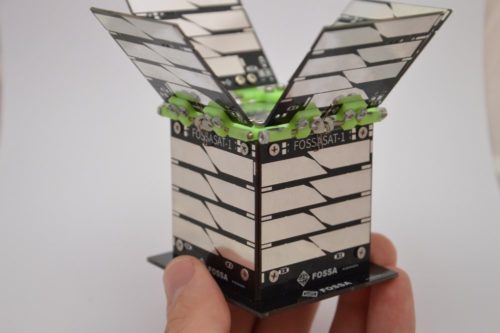
** PocketQubes will enable satellite projects for educational and non-profit organizations at even lower costs than CubeSats.
FossaSat is a pocketqube satellite which is being developed using free and open source ethics, more detailed information about the hardware and software involved in this project can be found here.
It will create the world’s first free and open source IoT network. The satellite will test the new LoRa spread spectrum modulation, allowing unprecedented link budgets with <5$ receivers, democratizing telecommunications to millions of students and individuals worldwide.
Based on the 5x5x5cm PocketQube standard, it will truly reduce the barrier to entry for launching a satellite with launch and development costs under 30000 EUR.
FOSSASAT-1 is built to the PocketQube standard with a size of 5 × 5 × 5 centimeters. Image credits: Fossa Systems
Initial results are generally positive:
Although not a full mission success due to our deployable antennas not deploying and our link budget aprox. 25db inferior to planned. We have learnt invaluable data in this first mission for our upcoming missions (report coming). OBC & EPS working nominally for nearly 1 month! pic.twitter.com/IxfB7dUosD