The weather on Neptune-sized HAT-P-11b exoplanet + Weathermap of exoplanet WASP-43b

John Batchelor and David Livingston spoke yesterday with  Dr. Heather Knutson about Exoplanet HAT-P-11b: The John Batchelor Show Hotel Mars, Wednesday, 10-8-14 – Thespaceshow’s Blog

The exoplanet has been found to have

clear skies and water vapor in its atmosphere. Dr. Knutson explained how clear skies and atmospheric water vapor [were] confirmed, what it means for this specific Neptune size exoplanet and what it means for our planet searches in general.  We talked about it having a hot atmosphere, a core but not a solid surface.  The exoplanet is not habitable.  HAT-P-11b is 120 light years from Earth.  Dr. Knutson also explained why so many exoplanets have a cloudy atmosphere and why that limits our research into the exoplanet.

Listen to the show:

====

And here is an announcement today from the ESA Hubble Telescope group about measurements of the atmosphere of another exoplanet:

Hubble reveals most detailed exoplanet weather map ever

A team of scientists using the NASA/ESA Hubble Space Telescope have made the most detailed map ever of the temperature of an exoplanet’s atmosphere, and traced the amount of water it contains. The planet targeted for both of the investigations was the hot-Jupiter exoplanet WASP-43b.

WASP-43b is a planet the size of Jupiter but with double the mass and an orbit much closer to its parent star than any planet in the Solar System. It has one of the shortest years ever measured for an exoplanet of its size — lasting just 19 hours.

A team of astronomers working on two companion studies have now created detailed weather maps of WASP-43b. One study mapped the temperature at different layers in the planet’s atmosphere, and the other traced the amount and distribution of water vapour within it — detail is shown in the video created by the team.

“Our observations are the first of their kind in terms of providing a two-dimensional map of the planet’s thermal structure,” said Kevin Stevenson from University of Chicago, USA, lead author of the thermal map study. “These maps can be used to constrain circulation models that predict how heat is transported from an exoplanet’s hot day side to its cool night side.”

The planet has different sides for day and night because it is tidally locked, meaning that it keeps one hemisphere facing the star, just as the Moon keeps one face toward Earth. The Hubble observations show that the exoplanet has winds that howl at thespeed of sound from a day side that is hot enough to melt iron — soaring above 1500 degrees Celsius — to the pitch-black night side that sees temperatures plunge to a comparatively cool 500 degrees Celsius.

To study the atmosphere of WASP-43b the team combined two previous methods of analysing exoplanets for the first time.

By looking at how the parent star’s light filtered through the planet’s atmosphere — a technique called transmission spectroscopy — they determined the water abundance of the atmosphere on the boundary between the day and night hemispheres.

In order to make the map more detailed the team also measured the water abundances and temperatures at different longitudes. To do this they took advantage of the precision and stability of Hubble’s instruments to subtract more than 99.95% of the light from the parent star, allowing them to study the light coming from the planet itself — a technique called emission spectroscopy. By doing this at different points of the planet’s orbit around the parent star they could map the atmosphere across its longitude.
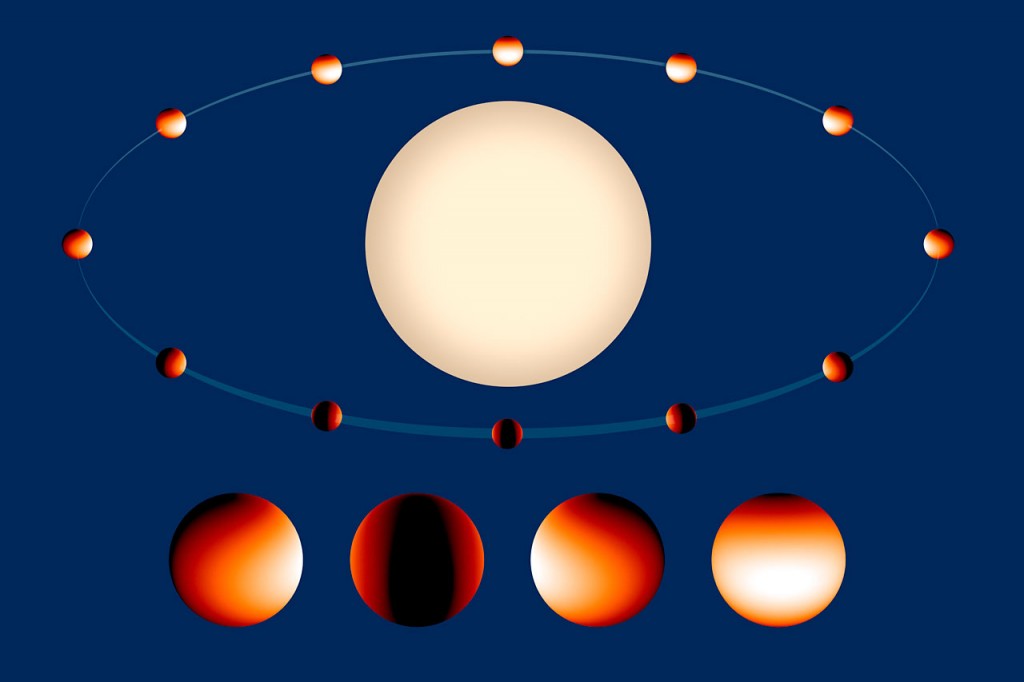
Exoplanet WASP-43b orbits its parent star

In this artist’s illustration the Jupiter-sized planet WASP-43b orbits its parent star in one of the closest orbits ever measured for an exoplanet of its size — with a year lasting just 19 hours.

The planet is tidally locked, meaning it keeps one hemisphere facing the star, just as the Moon keeps one face toward Earth.

The colour scale on the planet represents the temperature across its atmosphere. This is based on data from a recent study that mapped the temperature of WASP-43b in more detail than has been done for any other exoplanet.

“We have been able to observe three complete rotations — three years for this distant planet — during a span of just four days,” explained Jacob Bean from the University of Chicago, USA, leader of the research project. “This was essential in allowing us to create the first full temperature map for an exoplanet and to probe its atmosphere to find out which elements it held and where.”

Finding the proportions of the different elements in planetary atmospheres provides vital clues to understanding how planets formed.

“Because there’s no planet with these tortured conditions in the Solar System, characterising the atmosphere of such a bizarre world provides a unique laboratory with which to acquire a better understanding of planet formation and planetary physics,” said Nikku Madhusudhan of Cambridge University, UK, co-author of both studies. “In this case the discovery fits well with pre-existing models of how such planets behave.”

The team found that WASP-43b reflected very little of its host star’s light. An atmosphere like that on Earth, with clouds that reflect most of the sunlight, is not present on WASP-43b, but the team did find water vapour in the planet’s atmosphere.

“The planet is so hot that all the water in its atmosphere is vapourised, rather than condensed into the icy clouds we find on Jupiter,” said team member Laura Kreidberg of the University of Chicago, lead author of the study mapping water on the planet. Kreidberg describes both results in her online video.

Water is thought to play an important role in the formation of giant planets. Astronomers theorise that comet-like bodies bombard young planets, delivering most of the water and other molecules that we observe. However, the water abundances in the giant planets of the Solar System are poorly known because water is locked away as ice, deep in their atmospheres which makes it difficult to identify.

“Space probes have not been able to penetrate deep enough into Jupiter’s atmosphere to obtain a clear measurement of its water abundance. But this giant planet is different,” added Derek Homeier of the École Normale Supérieure de Lyon, France, co-author of the studies. “WASP-43b’s water is in the form of a vapour that can be much more easily traced. So we could not only find it, we were able to directly measure how much there is and test for variations along the planet’s longitude.”

In WASP-43b the team found the same amount of water as we would expect for an object with the same chemical composition as the Sun.

“This tells us something fundamental about how the planet formed,” added Kreidberg.“Next, we aim to make water-abundance measurements for different planets to explore their chemical abundances and learn more about how planets of different sizes and types come to form around our own Sun and the stars beyond it.” [1]

The results are presented in two new papers, one on the thermal mapping of the planet’s atmosphere — published online in Science Express on 9 October — and the other on mapping the water content of the atmosphere — published in The Astrophysical Journal Letters on 12 September 2014.

Sci-Tech: Report on an extended study of Rossi LENR reactor confirms high energy output

An extended study of a Rossi type reactor device (see posts here and here) has been carried out by a team of Italian and Swedish researchers. The results again shows high energy output for which a nuclear reaction is the only explanation.

Mats Lewan, who has written extensively about the Rossi story for the technical magazine Ny Teknik, writes about the new paper: New scientific report on the E-Cat shows excess heat and nuclear process – An Impossible Invention

In order to avoid doubts that were presented with regard to their earlier report, several things have been changed: The measurement was performed during 32 days in a neutral laboratory in Switzerland, electric measurement on the input power has been improved, a 23-hour test of the reactor without charge was done in order to calibrate the measurement set-up, and chemical analysis of the fuel before and after the run has been performed with five different methods.

He includes some comments from one of the authors, Professor Bo Höistad of Uppsala University:

Mats: What have you done differently this time, based on the experiences from your last measurement and report?

Höistad: An accurate measurement, particularly the control of energy balance without fuel in the reactor, and a isotopic analysis of the fuel.

Mats: What reactions do you expect on the report?

Höistad: Hopefully that the interest in the possibility of achieving LENR reactors get a decent boost, and that critical overtones in the debate are downplayed in favor of scientific discussions.

Mats: What do you personally feel facing the inexplicable observations you have made?

Höistad: As pointed out in our paper, we face a phenomenon without explanation. However, we can not categorically reject the clear experimental results just because a credible theory is currently lacking. We need to relate to the actual experimental results and continue the investigations to gain more knowledge about the LENR phenomenon.

The paper has been submitted to Physics Review D and was available on the preprint site arXiv.org but was removed, no doubt because of the usual controversy that surrounds any cold fusion type paper. The report, however, is available on line:

Observation of abundant heat production from a reactor device and of isotopic changes in the fuel (pdf)
Giuseppe Levi – Bologna University, Bologna, Italy
Evelyn Foschi – Bologna, Italy
Bo Höistad, Roland Pettersson and Lars Tegnér  – Uppsala University, Uppsala, Sweden
Hanno Essén – Royal Institute of Technology, Stockholm, Sweden

Abstract:

New results are presented from an extended experimental investigation of anomalous heat production in a special type of reactor tube operating at high temperatures. The reactor, named E-Cat, is charged with a small amount of hydrogen-loaded nickel powder plus some additives, mainly Lithium. The reaction is primarily initiated by heat from resistor coils around the reactor tube. Measurements of the radiated power from the reactor were performed with high-resolution thermal imaging cameras. The measurements of electrical power input were performed with a large bandwidth three-phase power analyzer.

Data were collected during 32 days of running in March 2014. The reactor operating point was set to about 1260 ºC in the first half of the run, and at about 1400 °C in the second half. The measured energy balance between input and output heat yielded a COP factor of about 3.2 and 3.6 for the 1260 ºC and 1400 ºC runs, respectively. The total net energy obtained during the 32 days run was about 1.5 MWh. This amount of energy is far more than can be obtained from any known chemical sources in the small reactor volume.

A sample of the fuel was carefully examined with respect to its isotopic composition before the run and after the run, using several standard methods: XPS, EDS, SIMS, ICP-MS and ICP-AES. The isotope composition in Lithium and Nickel was found to agree with the natural composition before the run, while after the run it was found to have changed substantially. Nuclear reactions are therefore indicated to be present in the run process, which however is hard to reconcile with the fact that no radioactivity was detected outside the reactor during the run.

Update: The CEO of Elforsk, the organization that runs the electric power plants in Sweden, responds to the report and announces the formation of a program to study the phenomenon. Here’s an English translation of his statement: CEO Elforsk Magnus Olofsson – LENR Forum. (Elforsk has been monitoring the work of the Italian-Swedish group for some time now.)

Update 2: Here’s an interview with prominent investor Tom Darden who is CEO of Cherokee Investment Partners, which in turn owns the company Industrial Heat that acquired the rights to Rossi’s eCat technology (see post here) :  Raleigh investor Darden still bullish on controversial nuclear technology – Triangle Business Journal

Misc: ISEE-3 Reboot Project review + Leland Melvin and Spaceship Earth Grants + Mars One sim shows big challenges

Here’s a set of links that have been sitting in my queue.

—

Here is an article that tells the story of the ISEE-3 Reboot Project‘s successful effort to contact and gain control of the International Sun-Earth Explorer 3 unmanned probe (ISEE-3), which was launched by NASA in 1978 and subsequently redirected to follow a comet : Space: the financial frontier – how citizen scientists took control of a spaceship – TheConversation.com.

The project, which was funded via crowd-sourcing, was reported on here several times. Unfortunately, the propulsion system could not be restarted and so they could not place the ISEE-3 probe into an orbit that would keep it close to earth and let it resume its solar science measurements. Nevertheless, the project demonstrated a great deal: a private group can raise funding for such a project, can gain access to elaborated ground control systems, and can contact and control a sophisticated scientific spacecraft. This may inspire many more such projects.

===

Former NASA astronaut Leland Melvin spoke to David Livingston on The Spac eShow about the Spaceship Earth Grants (SEG), on which Leland is the president: Leland Melvin, Friday, 10-3-14 – Thespaceshow’s Blog

Mr. Melvin started out by telling us about SEG which he said was formed to do good in the world.  He talked about their contest for raising money to send people to space so that they will experience an orbital shift in perception (The Overview Effect) and upon return, do work and good with this new perspective of Earth.  They want this new perspective shared with others for the benefit of all.  He talked about the application for the contest and the fee structure which you will find fully explained on their website so see the above URL. 

Leland explained that this was a crowd funding program though not like others that use specific crowd funding program such as Kickstarter or Indiegogo.  We also learned from a listener question that the contest winners will choose their own carrier for going to space and will need to comply with the rules & conditions set by that particular carrier.  Later, he mentioned that they would have a spaceflight training academy but details would not be announced until later in October. 

 ===

A simulation of a Mars One type of settlement found several serious problems that will need to be solved before such an endeavor can be viable : MIT Analysis Paints Bleak Outcome for Mars One Concept – SpacePolicyOnline.com.

Houston Grand Opera commissions opera based on the Columbia space shuttle tragedy

The Houston Grand Opera received a A $750,000 grant from the Andrew W. Mellon Foundation that will help commission five new musical works, including a chamber opera based on the Columbia space shuttle tragedy: $750,000 grant will help Houston Grand Opera produce 5 new works – Rant & Rave

“O Columbia,” based on the space shuttle calamity, will premiere in autumn 2015. Created by composer Gregory Spears and librettist Royce Vavrek, the chamber opera will look at the tragedy from multiple perspectives, including those of the control room at Johnson Space Center; a family waiting at Cape Canaveral in Florida; the Columbia crew; and Houston-area residents who witnessed the shuttle’s end.

Former Space Shuttle program manager Wayne Hale was initially “appalled” at the idea but was won over after he visited the HGO group a couple of times and heard what they were creating:  O Columbia -Wayne Hale’s Blog

It was not merely good, it was great.

It put space exploration in a historical context. It used the point of view of a young person aspiring to be an astronaut. There was nothing neither maudlin nor titillating. At one point there were tears among the audience. It was powerful.

After the reading we were asked for comments; the astronauts spoke first, then we all had the chance; praise for the approach, minor corrections to the script, overall an emotional release.

The music is in composition, much later the sets and costumes will be constructed, rehearsals will begin. The curtain should go up in October 2015. Just like all space projects, the schedule will take some time.

I think it will be great.
You should mark your calendar and go.

Stories of asteroid adventures by Richard Penn

Richard Penn points me to his “hard” science fiction book series under the title of the Asteroid Belt Police:

* The Dark Colony – Volume 1

The adventures of a young policewoman begin at a space station at the asteroid Terpsichore in the year 2060, and follow her and her team as they track down a secret colony where women and children are kept as slaves. This is “hard” science fiction, with no magic forces or time-warps, where space travel is hard and takes many months. Colonists invent and build their own equipment from local materials. While truly isolated, they are part of a movement aiming to create thousands of independent communities throughout the Belt.

* Freedom at Feronia – Volume 2

Lisa and her team of asteroid police have captured a nuclear rocket, and rescued a dozen kidnapped children. They aim to return the children to Mars, but first they need to build a ship. The rebel colony of Feronia is on the way, taken over by Christian fundamentalists. Can they return it to civilization, and what kind of government will lead to a long-term peace? This is hard science-fiction, with no laser swords or time-warps, where space travel is difficult and takes many months, and the people who live in space must use engineering innovation to build what they need from local materials.


Everyone can participate in space