The latest news item from ESO (European Southern Observatory):
New Exoplanet-hunting Telescopes on Paranal
The Next-Generation Transit Survey (NGTS) has achieved first light at ESO’s Paranal Observatory in northern Chile. This project will search for transiting exoplanets — planets that pass in front of their parent star and hence produce a slight dimming of the star’s light that can be detected by sensitive instruments. The telescopes will focus on discovering Neptune-sized and smaller planets, with diameters between two and eight times that of Earth.
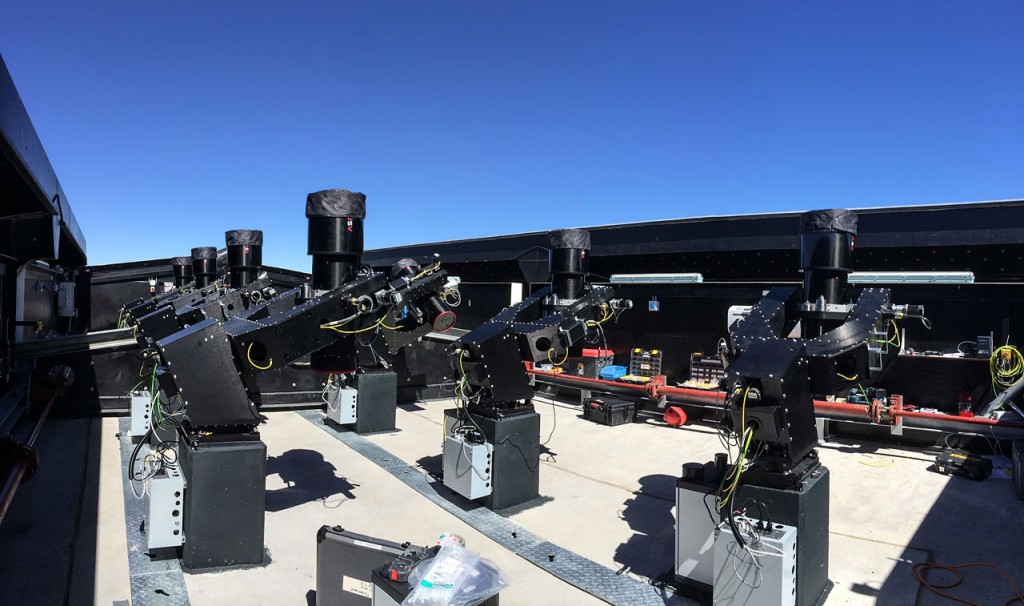
The Next-Generation Transit Survey (NGTS) is located at ESO’s Paranal Observatory in northern Chile. This project will search for transiting exoplanets — planets that pass in front of their parent star and hence produce a slight dimming of the star’s light that can be detected by sensitive instruments. The telescopes will focus on discovering Neptune-sized and smaller planets, with diameters between two and eight times that of Earth.
Most of the 20-centimetre telescopes that form the survey system are shown in this picture taken during testing. Credit: ESO/R. West
The Next-Generation Transit Survey (NGTS) is a wide-field observing system made up of an array of twelve telescopes, each with an aperture of 20 centimetres [1]. This new facility, built by a UK, Swiss and German consortium, is located at ESO’s Paranal Observatory in northern Chile and benefits from the superb observing conditions and excellent support facilities available at this site.
“We needed a site where there were many clear nights and the air was clear and dry so that we could make very accurate measurements as often as possible — Paranal was the best choice by far,” says Don Pollacco of the University of Warwick in the UK and one of the NGTS project leads.
NGTS is designed to operate in a robotic mode and it will continuously monitor the brightness of hundreds of thousands of comparatively bright stars in the southern skies. It is searching for transiting exoplanets and will reach a level of accuracy in measuring the brightness of stars — one part in a thousand — that has never before been attained with a ground-based wide-field survey instrument [2].
This great accuracy of brightness measurement, across a wide field, is technically demanding, but all the key technologies needed for NGTS were demonstrated using a smaller prototype system, which operated on La Palma in the Canary Islands during 2009 and 2010. NGTS also builds on the success of the SuperWASP experiment, which up to now leads in the detection of large gaseous planets.
The discoveries of NGTS will be studied further using other larger telescopes, including the ESO Very Large Telescope. One goal is to find small planets that are bright enough for the planetary mass to be measured. This will allow planetary densities to be deduced, which in turn provides clues about the composition of the planets. It may also be possible to probe the atmospheres of the exoplanets whilst they are in transit. During the transit some of the star’s light passes through the planet’s atmosphere, if it has one, and leaves a tiny, but detectable, signature. So far only a few such very delicate observations have been made, but NGTS should provide many more potential targets.
This is the first telescope project hosted, but not operated, by ESO on Paranal. Several telescope projects operating under similar arrangements are already at work at the older La Silla Observatory. The NGTS data will flow into the ESO archivesystem and will be available to astronomers worldwide for decades to come.
Peter Wheatley, one of the NGTS project leads from the University of Warwick, concludes: “We are excited to begin our search for small planets around nearby stars. The NGTS discoveries, and follow-up observations by telescopes on the ground and in space, will be important steps in our quest to study the atmospheres and composition of small planets such as the Earth.”
The NGTS Consortium is composed of the University of Warwick, UK; the Queen’s University of Belfast, UK; the University of Leicester, UK; the University of Cambridge, UK; Geneva University, Switzerland and DLR Berlin, Germany.
 Mars from a young perspective
 , makes it sound like a fun read: