1. Tuesday, Mar. 8, 2022; 7 pm PST (9 pm CST, 10 pm EST): We welcome back Joe Carroll to discuss his guest post on the David Brin blog. See our blog for his post which forms the discussion for tonight.
2. Hotel Mars – Wednesday, Mar. 9, 2022; 1:00 pm PST (3:00 pm CST, 4:00 pm EST): Douglas Messier returns to discuss SpaceX prioritizing for cyber defense and related news.
3. Friday, Mar.11, 2022; 9:30-11 am PST (11:30 am-1 pm CST, 12:30-2 pm EST): We welcome Nathan Hirsch and Jonathan Zarate to discuss the USC Liquid Propulsion Lab (LPL), its history, past and current projects, and plans.
4. Sunday, Mar.13, 2022; 12-1:30 pm PST (2-3:30 pm CST, 3-4:30 pm EST): This program is under construction at this time due to Space Show book writing schedules. Check the Upcoming Show Menu on our website for updates later in the week.
** Friday, March.4.2022 – Marc Bell, CEO of Terran Orbital gave a “brief cubesat history, LEO, MEO & GEO satellites, lunar satellites, DOD and intelligence agency customers and products, funding, public stock issues, and more“.
** Tuesday, March.1.2022 – Michael Listner discussed “India, international space cooperation, norms, lawfare, Russia and Ukraine, congress passing a budget authorization, Artemis Accords, the ISS future, militarization of space, Eric Berger, NewSpace economic slowdown, FlightAware, stalled space legislation, commercial satellites & Ukraine, NEEP, FAA & SpaceX, FCC litigation with VIASAT and more“.
Here is the latest episode in NASA’s Space to Ground weekly report on activities related to the International Space Station:
** Expedition 66 Space Station Crew Answers Ohio Student Questions – March 2, 2022 – NASA Video
Aboard the International Space Station, NASA Expedition 66 Flight Engineers Raja Chari and Tom Marshburn of NASA answered pre-recorded questions about life and work on the orbital laboratory during an in-flight event March 2 with the Glenn Research Center in Cleveland, Ohio. Chari and Marshburn are in the midst of a planned six-month mission living and working aboard the microgravity laboratory to advance scientific knowledge and demonstrate new technologies for future human and robotic exploration missions as part of NASA’s Moon and Mars exploration approach, including lunar missions through NASA’s Artemis program.
** NLRA 2022-6: In-space Production Applications: Advanced Materials and Manufacturing – ISS National Lab – YouTube
On February 28, 2022, the ISS National Lab held a webinar to provide further background on NLRA 2022-6 and to answer any questions.
** Episode 58 – Geopolitics, Cooperation and the ISS – Space Thoughts
Europe’s Columbus laboratory is a hive of activity in this 360° timelapse as ESA astronaut Matthias Maurer works on an experiment called Fluidics and his @NASA colleague Raja Chari carries out activity in the Veggie plant habitat. Developed by French space agency @CNES and co-funded by @Airbus, the Fluidics experiment investigates how liquids behave in space. It was first run by ESA astronaut Thomas Pesquet in 2017 during his Proxima mission. Made up of six small, transparent spheres housed in the black centrifuge seen here, the experiment studies two phenomena. The first is ‘sloshing’ or how liquids move in enclosed spaces. The second is wave turbulence. Understanding the underlying physics of how liquids move in space will help improve the fuel economy of spacecraft and our knowledge of Earth’s oceans. By observing how surface forces behave in reduced gravity and singling out interactions, scientists aim to improve climate models for forecasting sea states and better understand wave formation on Earth. Fluidics is just one of many European and international science experiments Matthias is supporting throughout his six-month Cosmic Kiss mission.
** Media Briefing: NASA, Axiom, & SpaceX Officials Discuss 1st Private Astronaut Space Station Mission – Axiom Space
Axiom Space will host a virtual press conference at 11 a.m. EST Monday, Feb. 28, to preview the launch of Ax-1, the first all-private astronaut mission to the International Space Station (ISS). The launch is targeted for Wednesday, March 30 at 2:46 p.m. EDT from Launch Complex 39A (LC-39A) at NASA’s Kennedy Space Center in Florida.
During the 10-day mission, which includes eight days aboard the space station, the four-person multi-national crew will complete more than 25 research experiments developed for microgravity in collaboration with leading health and science organizations across the globe. Axiom Space, a leader in human spaceflight and space infrastructure, is committed to the commercialization of low Earth orbit.
Briefing participants are: • Michael Suffredini, President and CEO, Axiom
• Michael López-Alegría, Ax-1 Crew Commander, Axiom
• Christian Maender, Director, In-Space Research and Manufacturing, Axiom
• Kathy Lueders, Associate Administrator, Space Operations, NASA
• Robyn Gatens, Director, International Space Station, NASA
• Phil McAllister, Director, Commercial Spaceflight Division, NASA
• Benjamin Reed, Sr. Director, Human Spaceflight Programs, SpaceX
Ax-1’s crew includes Michael López-Alegría, Axiom vice president and former NASA astronaut, as commander; American entrepreneur and non-profit activist investor Larry Connor as pilot; investor and philanthropist Mark Pathy of Canada as mission specialist; and impact investor and philanthropist Eytan Stibbe of Israel as mission specialist. Axiom Space has contracted SpaceX to launch the Ax-1 crew to the International Space Station aboard a Falcon 9 rocket and Dragon spacecraft. Ax-1 is the first of several planned Axiom missions to the space station, each a critical step toward Axiom Station, the first private space station. This new method of access to low-Earth orbit is progress toward a next generation platform, which will serve as a center for scientists, innovators, and entrepreneurs to pursue revolutionary breakthroughs in the unique environment of microgravity.
Currently, live views from the ISS are streaming from an external camera mounted on the ISS module called Node 2. Node 2 is located on the forward part of the ISS. The camera is looking forward at an angle so that the International Docking Adapter 2 (IDA2) is visible. If the Node 2 camera is not available due to operational considerations for a longer period of time, a continuous loop of recorded HDEV imagery will be displayed. The loop will have “Previously Recorded” on the image to distinguish it from the live stream from the Node 2 camera. After HDEV stopped sending any data on July 18, 2019, it was declared, on August 22, 2019, to have reached its end of life. Thank You to all who shared in experiencing and using the HDEV views of Earth from the ISS to make HDEV so much more than a Technology Demonstration Payload!
** What’s Up: March 2022 Skywatching Tips from NASA – NASA JPL
What are some skywatching highlights in March 2022? Look for Saturn to join Venus and Mars in the morning sky around mid-month. In the evenings, find the Y-shaped constellation Taurus, the bull, high in the southwest. The Hyades star cluster forms the bull’s face. Then take a tour of four easy-to-find stars that have known planets of their own orbiting them.
0:00 Intro
0:11 Morning planets
0:37 Hyades star cluster
2:11 Easy to find exoplanets
3:30 Moon phases
Additional information about topics covered in this episode of What’s Up, along with still images from the video, and the video transcript, are available at https://solarsystem.nasa.gov/skywatch….
In March, the stars of spring lie eastward: Look for the constellations Gemini and Cancer to spot interesting celestial features like star clusters M35 and the Beehive Cluster, and NGC 3923, an oblong elliptical galaxy with an interesting ripple pattern. Keep watching for space-based views of the galaxies.
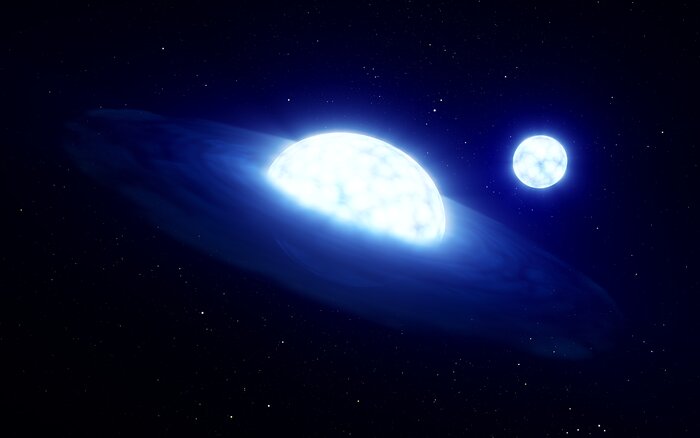
New research using data from ESO’s Very Large Telescope and Very Large Telescope Interferometer has revealed that HR 6819, previously believed to be a triple system with a black hole, is in fact a system of two stars with no black hole. The scientists, a KU Leuven-ESO team, believe they have observed this binary system in a brief moment after one of the stars sucked the atmosphere off its companion, a phenomenon often referred to as “stellar vampirism”. This artist’s impression shows what the system might look like; it’s composed of an oblate star with a disc around it (a Be “vampire” star; foreground) and B-type star that has been stripped of its atmosphere (background).
In 2020 a team led by European Southern Observatory (ESO) astronomers reported the closest black hole to Earth, located just 1000 light-years away in the HR 6819 system. But the results of their study were contested by other researchers, including by an international team based at KU Leuven, Belgium. In a paper published today, these two teams have united to report that there is in fact no black hole in HR 6819, which is instead a “vampire” two-star system in a rare and short-lived stage of its evolution.
The original study on HR 6819 received significant attention from both the press and scientists. Thomas Rivinius, a Chile-based ESO astronomer and lead author on that paper, was not surprised by the astronomy community’s reception to their discovery of the black hole.
“Not only is it normal, but it should be that results are scrutinised,” he says, “and a result that makes the headlines even more so.”
Rivinius and his colleagues were convinced that the best explanation for the data they had, obtained with the MPG/ESO 2.2-metre telescope, was that HR 6819 was a triple system, with one star orbiting a black hole every 40 days and a second star in a much wider orbit. But a study led by Julia Bodensteiner, then a PhD student at KU Leuven, Belgium, proposed a different explanation for the same data: HR 6819 could also be a system with only two stars on a 40-day orbit and no black hole at all. This alternative scenario would require one of the stars to be “stripped”, meaning that, at an earlier time, it had lost a large fraction of its mass to the other star.
“We had reached the limit of the existing data, so we had to turn to a different observational strategy to decide between the two scenarios proposed by the two teams,”
says KU Leuven researcher Abigail Frost, who led the new study published today in Astronomy & Astrophysics.
To solve the mystery, the two teams worked together to obtain new, sharper data of HR 6819 using ESO’s Very Large Telescope (VLT) and Very Large Telescope Interferometer (VLTI).
“The VLTI was the only facility that would give us the decisive data we needed to distinguish between the two explanations,“
says Dietrich Baade, author on both the original HR 6819 study and the new Astronomy & Astrophysics paper. Since it made no sense to ask for the same observation twice, the two teams joined forces, which allowed them to pool their resources and knowledge to find the true nature of this system.
“The scenarios we were looking for were rather clear, very different and easily distinguishable with the right instrument,” says Rivinius. “We agreed that there were two sources of light in the system, so the question was whether they orbit each other closely, as in the stripped-star scenario, or are far apart from each other, as in the black hole scenario.”
To distinguish between the two proposals, the astronomers used both the VLTI’s GRAVITY instrument and the Multi Unit Spectroscopic Explorer (MUSE) instrument on ESO’s VLT.
“MUSE confirmed that there was no bright companion in a wider orbit, while GRAVITY’s high spatial resolution was able to resolve two bright sources separated by only one-third of the distance between the Earth and the Sun,” says Frost. “These data proved to be the final piece of the puzzle, and allowed us to conclude that HR 6819 is a binary system with no black hole.”
“Our best interpretation so far is that we caught this binary system in a moment shortly after one of the stars had sucked the atmosphere off its companion star. This is a common phenomenon in close binary systems, sometimes referred to as “stellar vampirism” in the press,” explains Bodensteiner, now a fellow at ESO in Germany and an author on the new study. “While the donor star was stripped of some of its material, the recipient star began to spin more rapidly.”
“Catching such a post-interaction phase is extremely difficult as it is so short,” adds Frost. “This makes our findings for HR 6819 very exciting, as it presents a perfect candidate to study how this vampirism affects the evolution of massive stars, and in turn the formation of their associated phenomena including gravitational waves and violent supernova explosions.”
The newly formed Leuven-ESO joint team now plans to monitor HR 6819 more closely using the VLTI’s GRAVITY instrument. The researchers will conduct a joint study of the system over time, to better understand its evolution, constrain its properties, and use that knowledge to learn more about other binary systems.
As for the search for black holes, the team remains optimistic.
“But order-of-magnitude estimates suggest there are tens to hundreds of millions of black holes in the Milky Way alone,”
Baade adds.
It is just a matter of time until astronomers discover them.
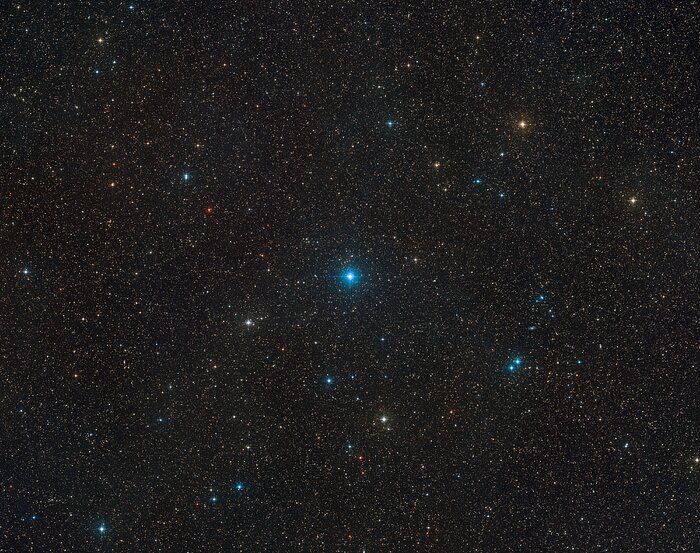
This wide-field view shows the region of the sky, in the constellation of Telescopium, where HR 6819 can be found. This view was created from images forming part of the Digitized Sky Survey 2. The two stars in HR 6819 can be viewed from the southern hemisphere on a dark, clear night without binoculars or a telescope.
1. Tuesday, Mar. 1, 2022; 7 pm PST (9 pm CST, 10 pm EST): We welcome back Michael Listner, Atty. for policy, legal, Ukraine and all sorts of new space news and information.
3. Friday, Mar.4, 2022; 9:30-11 am PST (11:30 am-1 pm CST, 12:30-2 pm EST): Marc Bell, CEO of Terran Orbital, will talk about small satellites, space industry, etc.
4. Sunday, Mar.6, 2022; 12-1:30 pm PST (2-3:30 pm CST, 3-4:30 pm EST): James A. M. Muncy will discuss “commercial space and policy updates, Ukrainian impact on NewSpace“.
multiple topics with multiple callers. Space settlement, the gravity RX, human reproduction in space and the situation in Ukraine dominated the topics and calls for today.
Dylan’s recent ride to space with Blue Origin, inflation and space economics, NewSpace economy and investment risks vs. rewards, Voyager Space Holding activities, SpaceX, the ISS and private space stations plus lots more.
** Tuesday, Feb.22.2022 – Dr. Angie Bukley and Karen Jones of The Aerospace Corp discussed the “value of space, LEO assets, satellite data for monitoring climate change and the space environmental impact on climate on a global basis, green rocket fuels, environmental justice, SPS and more“.