A sampling of links to recent space policy, politics, and government (US and international) related space news and resource items that I found of interest:
NASA announces the first partnership of its kind with MAXAR Technologies to power the future lunar orbiting station. For more information visit NASA.gov/moontomars
** The Space Show – Tue, 05/21/2019 – Dr. Philip Metzger discussed “starting space industrialization, establishing Cislunar transportation, lunar development, asteroid development, thinking big, Mars and more”.
The former Oklahoma congressman and Navy aviator stepped into the leadership role barely a year ago. Now he wants to see humans back on the Moon by 2024 as a vital stepping stone to Mars. Join us for a wide-ranging conversation about this ambitious plan and much more. Planetary Society Chief Scientist Bruce Betts continues the countdown to launch of LightSail 2 before he takes us across the heavens in What’s Up.
*** SpaceX set to launch Falcon 9 with 60 Starlink satellites. Following a stand-down of about a week since the initial launch attempts, liftoff of the Starlink mission is now set for a 90 minute window that opens at 10:30 pm EDT this evening (0230 GMT onMay 24). The SpaceX webcast should go live about 15 minutes before liftoff time.
On April 21, 2019, we, the USC Rocket Propulsion Lab, launched our latest space-shot rocket, Traveler IV, out of Spaceport America. Traveler IV reached an apogee of 339,800 ft with a confidence of 90% of having crossed the internationally-recognized border between Earth’s atmosphere and space known as the Kármán line. By flying higher than the Kármán line, Traveler IV has broken the world record for the highest altitude ever reached by a vehicle entirely designed and built by a collegiate rocketry team. USCRPL thanks the alumni, faculty, department staff, parents, the university, and all others who have supported the lab’s fourteen-year-long dream.
Even greater things lie ahead. Read the full data analysis and check out more information in the following links:
Join us as we host hundreds of the world’s ambitious collegiate rocketeers at the third annual Spaceport America Cup June 18-22, 2019. The event brought to you by the Experimental Sounding Rocket Association and the Spaceport America Crew, is the world’s largest intercollegiate rocket engineering conference and competition.
The Spaceport America Cup will kick off on June 18th with the Spaceport America Cup Conference at the Las Cruces Convention Center in Las Cruces, NM. Spectators are invited to see the rockets displayed and interact with the rocket teams. The event is FREE.
June 19th will be flight preparation day where teams will have the entire day to assemble their rockets in the field and test components while being judged. (OPEN TO THE PUBLIC) Gates open: 11 am
Teams will be launching and recovering rockets June 20-22 at the Spaceport America Vertical Launch Area. (OPEN TO THE PUBLIC) Gates open: 8 am- 4 pm. If you are planning to attend as a spectator, you must purchase a spectator pass.
We’re proud to announce that we completed perhaps the most challenging, most important, and most successful test in the history of our LauncherOne program: Last week, we lit up our Mojave site with our final full duration, full scale, full thrust – hell, full everything – test firing of LauncherOne’s main stage. That’s more than three minutes of controlled rocket thrust, using all of the same equipment we’ll use on our actual flights to orbit later this year. Here’s one fun way to think about it: the data proved that if this stage wasn’t physically bolted down, it had the oomph to make the journey into space.
** India launches RISAT 2B radar Earth observation satellite with PSLV (Polar Space Launch Vehicle):
Designed for a five-year mission, RISAT 2B carries an X-band radar imaging instrument capable of resolving structures and features on Earth’s surface, regardless of daylight or weather conditions. Earth-looking optical telescopes are inhibited by cloudy weather, and only produce usable imagery during daytime.
The satellite was developed by ISRO — the Indian space agency — and carries a dish-shaped radar antenna that was folded up to fit inside the rocket’s payload compartment. Now that the satellite is in space, its radial band antenna will be unfurled to its full diameter of 11.8 feet (3.6 meters).
“This has been a much-awaited satellite with complex new technologies, X-band synthetic aperture radar, and one of the most cutting edge technologies in the world — one that is world-class — the 3.6-meter radial band antenna,” said P. Kunhikrishnan, director of ISRO’s UR Rao Satellite Center in Bangalore.
** China Long March 4C rocket launch of a remote sensing satellite fails due to a problem in the third stage of the 3-stage vehicle:
The latest BeiDou Navigation Satellite System (BDS) launch took place from the Xichang Satellite Launch Center at 11:48 p.m. on May 17. Launched on a Long March-3C carrier rocket, it is the fourth BDS-2 backup satellite and the 45th satellite in the BDS network. It can provide users with more reliable services and enhance the stability of the satellite constellation.
** Chinese commercial company LandSpace tests LOX/Methane engine:
Hydros thruster: Hydros uses electrolysis to split water into hydrogen and oxygen gas, which can then be burned as rocket propellants. The concept meshes well with the idea of extracting water ice from the moon or near-Earth asteroids for spacecraft refueling. Three Hydros-M flight units already have been delivered to Millennium Space Systems, and Hoyt said a Hydros-C module is due for launch on the PTD-1 CubeSat mission in December.
Despite that warning, launch vehicle startups remain focused on unique engine designs. At last count, there were 129 rocket startups, Rich Pournelle, NanoRacks senior vice president for business development, said at the April conference.
How many will survive? Eric Salwan, Firefly Aerospace commercial business development director, suggested the market could support three, four or five.
In support of the mission, SpaceX will need to completely integrate Falcon Heavy and prepare the rocket for a routine static fire test approximately one week prior to launch, sometime in mid-June. STP-2 will be critical to both SpaceX and the USAF for a number of reasons, ranging from rocket reusability to the future of US military launch procurement.
NASA has announced a series of awards as part of its 2024 Moon return ambitions, providing up to $45.5M for 11 companies to study lunar landers, spacecraft, and in-space refueling technologies.
Among those selected for studies are SpaceX, Blue Origin, Masten Space, and the Sierra Nevada Corporation, alongside usual suspects like Boeing and Lockheed Martin. The chances of NASA actually achieving a crewed return to the surface of the Moon by 2024 are admittedly minuscule. However, with the space agency’s relatively quick three-month turnaround from accepting proposals to awarding studies, those chances of success will at least be able to continue skirting the realm of impossibility for now. In fact, SpaceX believes its Moon lander could be ready for a lunar debut as early as 2023.
*** Watch the lifting of a Falcon Heavy to vertical on Pad 39A in this video (at 1:04): Construction of SpaceX’s largest spaceship ever could be taking place in Cocoa –
SpaceX CEO Elon Musk says that there is now a chance that a vacuum-optimized version of the Raptor engine will be ready for near-term Starship launches, indicating that development has either been re-prioritized or is going more smoothly than expected.
This is a significant shift away from a strategy discussed by Musk just four months ago, in which a single variant of Raptor was to be used on Starship and Super Heavy to shorten the next-gen rocket’s path to orbit. For unknown reasons, that approach may have already been replaced with a new alternative that would lead to a Starship with six Raptors instead of seven and a 50-50 split between vacuum and sea level-optimized engines.
SpaceX CEO Elon Musk has confirmed that the company’s second orbital Starship prototype is already in the early stages of integration at a parallel Florida facility, piggybacking on ongoing work in South Texas.
SpaceX’s plans to simultaneously build Starship prototypes in Texas and Florida have been public for some time. However, photos taken by forum members of NASASpaceflight.com offer the first direct confirmation that hardware is already being assembled in Florida. Likely unique in the annals of full-scale heavy-lift rocket development, SpaceX’s strategy of building largely identical prototypes in separate locations – and with separate teams – could be an ingenious method of speeding up development.
A comment from Elon on the two projects:
SpaceX is doing simultaneous competing builds of Starship in Boca Chica Texas & Cape Canaveral Florida
As SpaceX continues to make steady progress on multiple Starship test vehicles at their Boca Chica launch facility, the company’s CEO Elon Musk has confirmed that they are also constructing a Starship vehicle in Florida. The Florida-based Starship is expected to launch from one of SpaceX’s Cape Canaveral based facilities, as opposed to the company’s launch site in Boca Chica, Texas. NASASpaceflight.com understands that one facility under serious consideration is historic Launch Complex 39A at Kennedy Space Center.
SpaceX hopes to use the Starship spacecraft to return humans to the moon and colonize Mars. While plans for the vehicle are rapidly evolving, at present multiple sources have indicated that the company is hoping to perform orbital test flights of the Starship prototypes.
What level of testing remains an open question, as Elon Musk noted on Twitter that using SSTO (Single Stage To Orbit) test launches – where just the Starship launches without the Super Heavy booster – wouldn’t allow the vehicle to be reusable.
A half-century after it was released, “2001: A Space Odyssey” is still supplying light amid the darkness. It’s considered not just a great film but an important and influential work of modern art. An astonishing marriage of sound and image, man and machine, there’s nothing simple or obvious — nothing monolithic — about it.
With no help from cinematic CGI, its vision of the 21st century and beyond seems uncannily prescient and profound. Before we’d even landed on the moon, “2001” showed us how privately operated spacecraft would one day take us there.
Life’s biggest mystery — our place in the universe — would be an empty question were it not for director Stanley Kubrick and author Arthur C. Clarke’s vision of what comes next. There is no “Star Wars” without the Star Gate, no “Close Encounters” or “Contact” without the monolith. HAL was a perfect preview/early warning of Siri and Alexa and our AI-dominated near future.
In Part One we look at the film’s origins in 1960s New York when Kubrick and Clarke first met. We visit Kubrick’s former penthouse apartment, where the two believed they saw a UFO, and then recall their trip to the 1964 World’s Fair. We explore the unorthodox production and try to discover how “2001” went from opening night bomb to counterculture icon. We’ll hear from effects wizard Doug Trumbull, actor Keir Dullea, film critic Carrie Rickey, “2001” scholars Michael Benson (“The Making of Stanley Kubrick’s ‘2001: A Space Odyssey’“) and Jarice Hanson, as well as superfan Tom Hanks, who has seen the movie more than 200 times.
[]
====
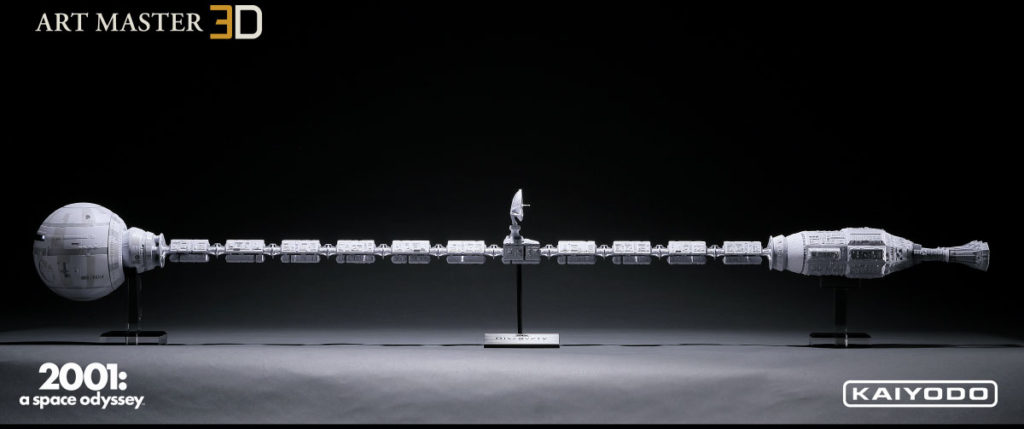
Here is a terrific scale model replica of the Discovery One spaceship in the movie:
Largest Scale Discovery One Prop Replica On Sale Now HobbyLink Japan, in partnership with GomoraKick (Kaiyodo International), presents a limited-edition 1.6-meter scale replica of ‘Discovery One’ prop featured in film “2001: A Space Odyssey”
Sano, Tochigi, JAPAN: Today, HobbyLink Japan Ltd., an internet retail business specializing in sales of hobby products and collectibles to customers worldwide, announced the exclusive US distribution rights for a limited-edition 1/10 scale 3D-CAD replica of the original ‘Discovery One’ spaceship prop made famous in Stanley Kubrick’s acclaimed 1968 sci-fi classic ‘2001: A Space Odyssey’.
The company, a leader in its niche for nearly 25 years, now expands its portfolio with HLJ Select, a new brand for premium merchandise, to better serve the acquired preferences of memorabilia collectors globally. In collaboration with GomoraKick (Kaiyodo International), HobbyLink Japan Ltd. proudly offers the ‘Discovery One’ spacecraft prop replica exclusively to the United States market:
Most precise, largest scale (1/10) replica of the original movie prop, measuring 160cm (approx. 5 feet 3 inches) in length
● Each single piece is created through Hollywood-class 3D-CAD printing paired with meticulous handcrafting by world-renowned Japanese modelers
● Individually-sculpted, unique spine module containers and side panels
● Superior detail in the piping, heat dissipation fins, and fuel tanks of nuclear engines
● Perfectly recreated antenna array based on original movie images
● Cockpit illumination via 4 remote-controlled LED lights
● Luxury acrylic display stand and photo-etched acrylic name plate included
Front view of the Discovery One model. Credits: HobbyLink Japan
About HobbyLink Japan Ltd.:HobbyLink Japan Ltd. is an internet retail business based in Sano, Tochigi Prefecture, Japan. Founded in 1995, the company started out offering Japanese model kits to international customers out of a small apartment in Tokyo, Japan. Today, HobbyLink Japan Ltd. operates a custom-built office and state-of-the-art warehouse in scenic Sano, Tochigi Prefecture, Japan, and offers over 120,000 hobby products including anime & action figures, model kits, Gundam products, hobby publications, and other collectibles at domestic prices, shipping to over 220 countries worldwide. In addition to retail sales (B2C), the company provides wholesale (B2B), third-party logistics and e-commerce services (3PL/3PEC). With a culturally diverse team of over 75 Japanese and international employees, HobbyLink Japan Ltd. was awarded the ‘Gold Trusted Service Award’ for ‘Outstanding Customer Service’ in 2018 by Feefo. Learn more at https://hlj.com/corporate-profile.
The first science results from the unprecedented Chang’e-4 lunar far side mission are in. The mission’s Yutu-2 rover, deployed from the lander shortly after the Chang’e-4 landing on 3 January, has, with the help of the Queqiao relay satellite, returned data which suggests it has discovered material derived from the Moon’s mantle, according to research published today in Nature. The possibility of accessing mantle rocks exposed within an enormous impact basin was a major reason for attempting the challenging farside landing.
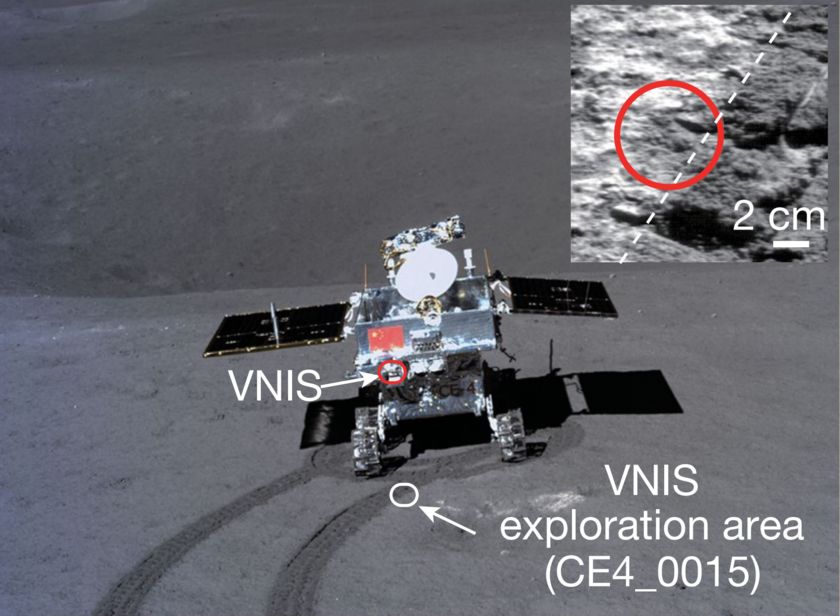
The Visible and Near Infrared Spectrometer (VNIS) aboard Yutu-2 made the first in situ observations—detecting scattered or reflected light from surface materials—on the lunar far side. These spectra have been interpreted by the paper’s authors to represent the presence of olivine and low-calcium pyroxene, materials that may originate from the Moon’s mantle.
VNIS payload and observation footprint – Yutu-2’s Visible and Yutu-2 rover’s Near Infrared Spectrometer (VNIS) measures an area a few centimeters across. Credits: Chunlai Li et al via Planetary Society
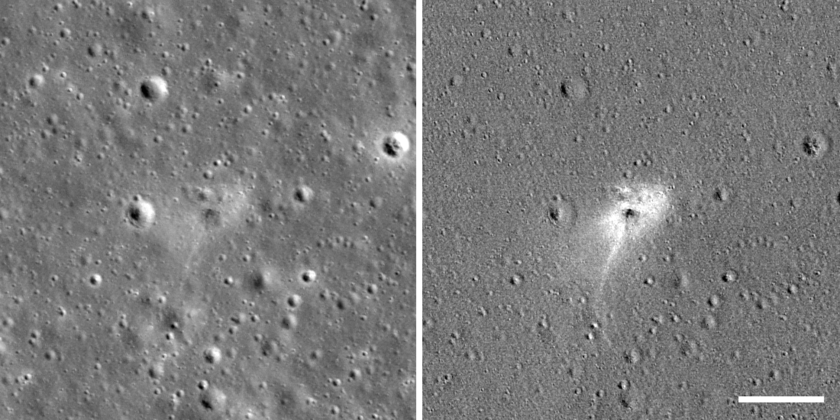
Lunar surface before/after Beresheet impact. Planetary Society: “Left: Beresheet impact site as seen by Lunar Reconnaissance Orbiter on 22 April 2019. Right: An image processed to highlight changes near the landing site among photos taken before and after the landing, revealing a white impact halo. Other craters are visible in the right image because there is a slight change in lighting conditions among the before and after images. Scale bar is 100 meters. North is up. Both panels are 490 meters wide.”
How will Greek honey and olive oil behave under microgravity conditions? What about ouzo and grape juice molasses? Will bubbles grow bigger and last longer? ACS Athens students sealed their experiment within the capsule carried by the groundbreaking Blue Origin’s New Shepard reusable rocket where it will tested at an altitude of 100 km.
ACS Athens High School students are conducting one complex STEAM (Science, Technology, Engineering, the Arts, and Mathematics) experiment, investigating how honey behaves at an altitude of 100 km. ACS Athens is one of the three non-US-based K-12 schools to have ever sent an experiment with Blue Origin
spACS 1 scientific goal is to investigate the viscosity of honey under microgravity conditions, a Physics-based experiment on fluidity.
spACS 2, which won the first place in the Hellenic Physical Society’s 1st aerospace contest (November 2018), combines Physics, Chemistry, and Biology to investigate the behavior of foams and emulsions under microgravity conditions focusing on Greek traditional products (olive oil, ouzo, petimezi).
NASA’s OSIRIS-REx spacecraft is continuing to chug along at asteroid Bennu. It’s currently sweeping arcs between the asteroid’s north and south poles, gathering scientific data that will also be used to select 12 possible sites for sample collection. The OSIRIS-REx team has also been releasing stunning new images from the mission’s prior phase.
The photograph, uncaptioned, is titled “Terminus of Pitted Materials Emanating from Oudemans Crater.” Oudemans Crater is about 55 miles across and is located near the head of Marineris Valles to the east of the giant volcanic region dubbed the Tharsis Bulge. The meteorite that caused this crater is estimated to have been a little less than 3 miles in diameter. It is believed by some scientists that the impact heated up subsurface carbon dioxide permafrost which then explosively flooded down the Valles Marineris into the Northern Plains of Mars, pushing a lot of pulverized debris in front of it.
** NASA’s Curiosity Finds Climate Clues on a Martian Mountain – A brief update on Curiosity’s travels:
After spending the better part of a year exploring Mars’ Vera Rubin Ridge, NASA’s Curiosity Mars rover has moved to a new part of Mount Sharp. Project Scientist Ashwin Vasavada gives a tour of the rover’s new home in the “clay unit,” as well as other areas scientists are excited to visit. Find out what they could tell us about watery ancient Mars versus the dry Red Planet we see today.
** Charon, Pluto’s Companion: What We Learned from New Horizons – Dr. Ross Beyer (SETI Institute) gave this recent public lecture in the Silicon Valley Astronomy Series:
Pluto’s large moon Charon turned out to be far more interesting than astronomers expected. Pluto was the star of the New Horizons show, but the features on Charon’s surface tell a fascinating tale of how icy worlds could form far from the gravitational influences of the giant planets. There is evidence of a world-wide sub-surface ocean early on, and of global expansion as that ocean froze solid. Dr. Beyer is your expert (and humorous) guide through this story of formation and change in the frozen reaches of the outer Solar System.
**Dr. Linda Spilker spoke about the latest findings from the Cassini Mission data, “new information on Saturn’s ring system, Titan, Enceladus, liquid methane oceans, life, NASA missions and more” – The Space Show – Friday, 05/17/2019
A sampling of links to recent space policy, politics, and government (US and international) related space news and resource items that I found of interest:
** The Emerging Space Environment, Hearing of the Senate Subcommittee on Aviation and Space, May 14, 2019
** Amending the Budget to Support Humans on the Moon in 2024 – This Week @NASA – May 17, 2019
** Will $1.6 billion Let NASA’s New Artemis Program Become Reality? – Scott Manley
** Sun, 05/19/2019 – Emily Carney talked about Space Hipsters, which she co-founded, “and lots more regarding space programs, education, outreach, policy, and getting young women interested in space”.




 and about “the Gateway, lunar return, Mars, policy, China, Pell Grant funding and more”.