The robot explorer’s sampling mechanism works by firing a metal bullet into the asteroid once the probe’s sampler horn, which extends from one side of the spacecraft, contacts the surface. The projectile is designed to blast away rock and dust on the asteroid’s surface, then direct the material through the sampler horn into a collection chamber inside the Hayabusa 2 spacecraft.
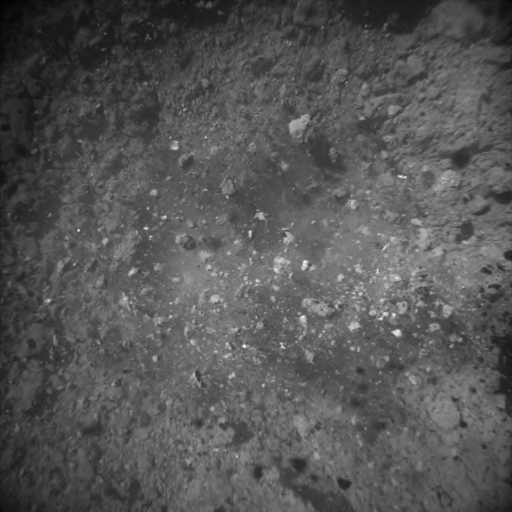
This image shows debris thrown up from the surface of Ryugu by the bullet.
Image of surface immediately after touchdown. Taken with the Optical Navigation Camera – Wide angle (ONC-W1). Credits: Hayabusa-2 project.
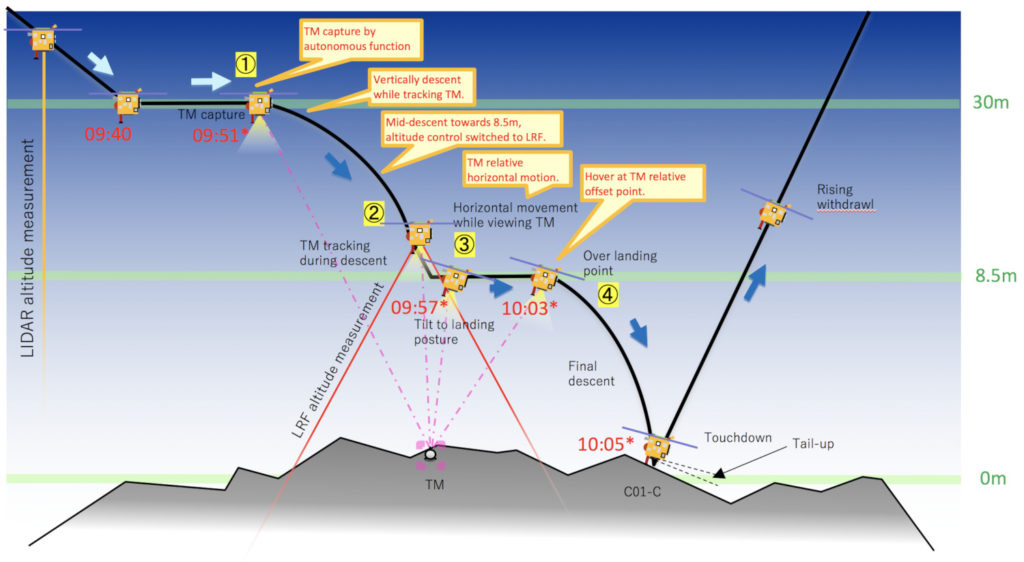
A diagram of the touch-and-go surface sampling operation:
Citizen scientists assemble! NASA’s OSIRIS-REx mission to the asteroid Bennu needs extra pairs of eyes to help choose its sample collection site on the asteroid – and to look for anything else that might be scientifically interesting.
“This image shows a view of asteroid Bennu’s surface in a region near the equator. It was taken by the PolyCam camera on NASA’s OSIRIS-REx spacecraft on March 21 from a distance of 2.2 miles (3.5 km). The field of view is 158.5 ft (48.3 m). For scale, the light-colored rock in the upper left corner of the image is 24 ft (7.4 m) wide. Credits: NASA/Goddard/University of Arizona”
The OSIRIS-REx spacecraft has been at Bennu since Dec. 3, 2018, mapping the asteroid in detail, while the mission team searches for a sample collection site that is safe, conducive to sample collection and worthy of closer study. One of the biggest challenges of this effort, which the team discovered after arriving at the asteroid five months ago, is that Bennu has an extremely rocky surface and each boulder presents a danger to the spacecraft’s safety. To expedite the sample selection process, the team is asking citizen scientist volunteers to develop a hazard map by counting boulders.
“For the safety of the spacecraft, the mission team needs a comprehensive catalog of all the boulders near the potential sample collection sites, and I invite members of the public to assist the OSIRIS-REx mission team in accomplishing this essential task,” said Dante Lauretta, OSIRIS-REx principal investigator at the University of Arizona, Tucson.
For this effort, NASA is partnering with CosmoQuest, a project run out of the Planetary Science Institute that supports citizen science initiatives. Volunteers will perform the same tasks that planetary scientists do – measuring Bennu’s boulders and mapping its rocks and craters – through the use of a simple web interface. They will also mark other scientifically interesting features on the asteroid for further investigation.
The boulder mapping work involves a high degree of precision, but it is not difficult. The CosmoQuest mapping app requires a computer with a larger screen and a mouse or trackpad capable of making precise marks. To help volunteers get started, the CosmoQuest team provides an interactive tutorial, as well as additional user assistance through a Discord community and livestreaming sessions on Twitch.
** SpaceX Cargo Dragon to deliver wide range of science and technology experiments to the ISS. Liftoff of mission CRS-18 is currently set for July 21st at 7:35 pm EDT (2335 GMT)
These two visible sunspots for the next solar cycle are very significant. They indicate that we will have an upcoming solar maximum, and are not heading into a grand minimum, when no sunspots are visible for decades.
Their appearance however does not mean that solar minimum is over. On the contrary, the solar cycles typically overlap by one or two years, with new sunspots for the next solar cycle appearing even as the Sun ramps down to minimum and remains relatively inactive for many months.
I cannot deny that I will be disappointed if a grand minimum does not occur. Such an event would have been a wonderful opportunity for solar scientists to get answers to their many questions about the Sun’s solar cycles that today remain unanswered and will likely not be answerable while the Sun follows its behavior of the last three hundred years.
This Sunday, a Falcon 9 rocket will launch a SpaceX Dragon capsule that will rendezvous with the International Space Station. Part of this mission will include RFTSat, developed by a team of Northwest Nazarene University (Boise, Idaho) led by Prof. Joshua Griffin and a team of Georgia Tech Researchers in ECE.
This CubeSat experiment will have a unique RF energy-harvesting radio designed and built by the Georgia Tech Propagation Group. PhD student researcher Cheng Qi has built a one-of-a-kind microwave backscatter reader and tag-sensor combo that will drive the mission science package.
The low-powered reader designed by our team deploys a sensor that unfurls a distance away from the spacecraft. The reader then energizes and receives backscatter information from the device using a 5.8 GHz transmission. The launch info can be tracked here. Interesting articles on the launch can be found here and here.
The project was funded by NASA, but could not have been completed without private matching funds from the Space Solar Power Institute. Complete with generator, retrodirective antenna, and rectenna harvester, the radio package qualifies as the first microwave space-based solar power satellite ever tested — despite the somewhat limited 1m range. You have to start somewhere!
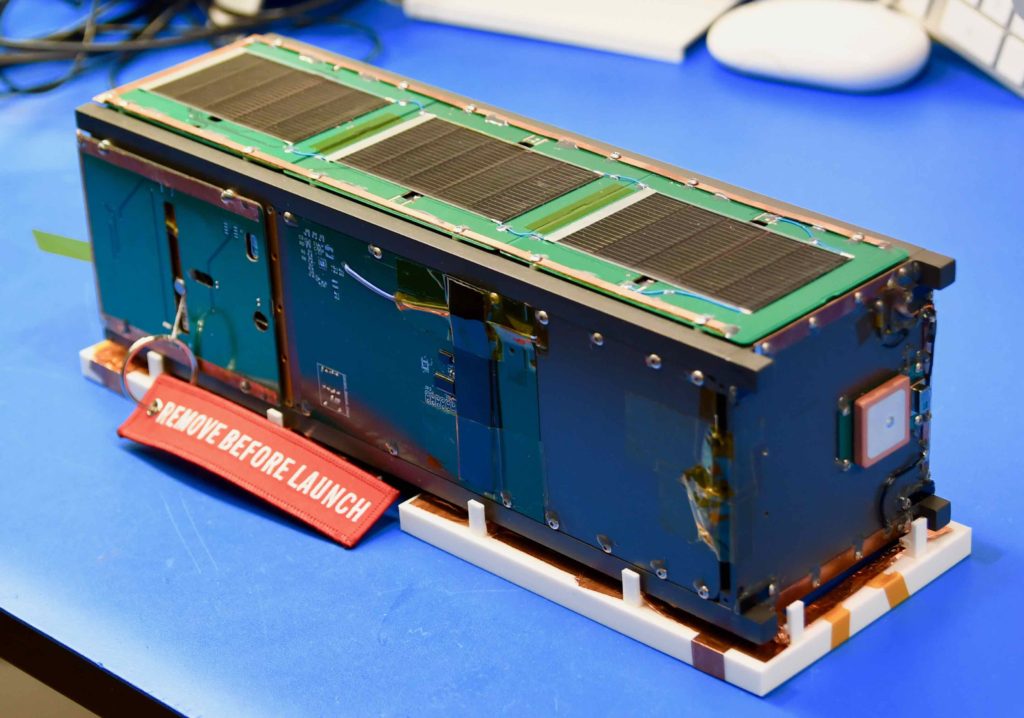
RFTSat (Radio Frequency Tag Satellite) CubeSat built by teams at Northwest Nazarene University and Georgia Tech. It will demonstrate RF energy harvesting and backscatter communication.
A sampling of links to recent space policy, politics, and government (US and international) related space news and resource items that I found of interest:




 , and