A sampling of recent articles, videos, and images related to human expansion into the solar system (see also previous space settlement postings):
** A settlement on Mars has always been the primary goal for SpaceX. The accelerating development of the Starship space transport system means that such a settlement is becoming more feasible and nearer in time. In fact, if the Starship space transport system achieves Elon Musk’s expectation of a $10-20/kg operating cost to reach low earth orbit, then all sorts of space concepts previously considered distant future sci-fi become feasible.
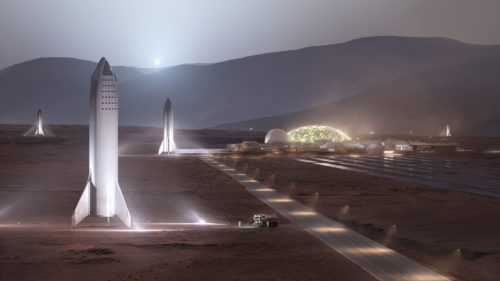
Elon recently posted at on Twitter a series of comments about Starship capabilities and how it would enable Mars settlement:
- In response to a remark about $20/kg flight costs with the Starship, Elon said, “The economics have to be something like that to build a self-sustaining city on Mars“
- “A thousand ships will be needed to create a sustainable Mars city“
- “Payload to orbit per year of Starship fleet is most mind-blowing metric, as it’s designed to fly 3X per day, which is ~1000X per year“
- “If we build as many Starships as Falcons, so ~100 vehicles & each does 100 tons to orbit, that’s a capacity of 10 million tons of payload to orbit per year“
- “Current global payload to orbit capacity is about 500 tons per year, of which Falcon is about half“
- “So it will take about 20 years to transfer a million tons to Mars Base Alpha, which is hopefully enough to make it sustainable“
- In response to a comment about whether the Starship is needed so one can “escape if the earth is getting close to its end”, Elon said, “No, in the beginning, assuming you even make it there alive, Mars will be far more dangerous & difficult than Earth & take decades of hard labor to make self-sufficient. That’s the sales pitch. Want to go?”
- And in response to the comment, “It’s not about escaping, it’s about survival of the species if one planet is wiped out”, Elon said, “Exactly! It’s also a far more exciting & inspiring future if consciousness is out there among the stars, than forever confined to Earth until some eventual extinction event, however far in the future that may be (hopefully, very far)“
** SpaceX appears especially interested in the Arcadia Planitia region as a potential site for a space settlement: SpaceX completes 1st round of Starship’s Mars landing site images | Behind The Black
Based on all this research and the image locations being chosen by SpaceX, we therefore might someday hear a pilot of Starship take a breath and then announce to the world, “Arcadia Base here, the Starship has landed.”

** Providing spin gravity with Starships on the way to Mars.
See the video caption for more details, discussion, and corrections.
** There were several presentations of in-space habitat designs at the recent SSI 50: The Space Settlement Enterprise conference in Seattle. Most of the panel presentations are available via the SSI 50 Space Settlement conference videos.
Here are David Livingston’s subsequent interviews with three of those habitat designers:
**** The Space Show – Mon, 10/28/2019 – Anthony Longman discussed “his expandable rotating shielded space habitats”.
Longman works at Sky Frame Research, which collaborates with Prof. Robert Skelton at Texas A&M Aerospace Engineering Dept. They have used two NASA NIAC grants (Tensegrity Approaches to In-Space Construction | NASA) to pursue a habitat design that can start small and then grow over time: Building A Habitat For Sustainable Life In Space – Texas A&M Today
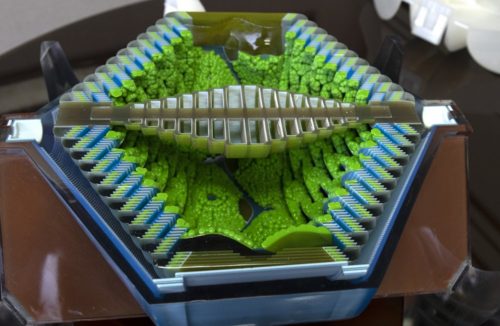
He proposes to start the habitat at the size of 20 meters radius, enough to sustain about 20 people, with the final structure being built over time out to 225 meters, housing 8,000 people with 300 square meters of agricultural space per person.
The initial habitat would be small and built from materials launched from Earth. Because material resources are costly in space, Skelton suggests using tensegrity systems for the design of the growth adaptable space structure. These minimal mass structures make the habitat easy to change in shape, and it’s very strong and lightweight. Subsequent growth stages of the habitat would rely on tensegrity robots mining materials from the moon and asteroids.
With the overall shape of the habitat designed in concentric cylinders, the outer shell would be a thick-wall of regolith for radiation protection that would rotate slowly to enhance stability. Regolith is a layer of loose, heterogeneous superficial deposits covering solid rock found on Earth, the moon and asteroids. The habitat inside would spin at a faster rate to provide artificial gravity (due to the centrifugal forces) for the inhabitants inside. The habitat would provide all levels of gravity from 0 G to 1 G where the lower g-level space is reserved for agriculture and the people occupy higher g-levels up to 1 G.
**** The Space Show – Thu, 10/24/2019 – Suzana Bianco discussed “Space architecture and her concept designs for free space habitats and stations”. See the slides from her SSI conference presentation: New Venice – set 2019 (pdf).
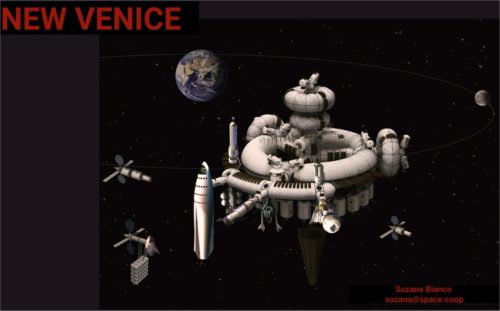
See also this essay by Bianco: How I designed a space outpost – Space Decentral – Medium.
**** The Space Show – Mon, 10/07/2019 – John Blincow gave a “complete and thorough introduction to The Gateway Foundation Project including the Von Braun station, space hotels, commercial operations, orbital manufacturing and assembly and more”.
The Gateway Foundation’s Youtube channel also has several videos describing the Von Braun station. For example,
** Bigelow Aerospace opened up B330 and B2100 expandable habitat prototypes to the press on Sept.12th:
** Improved spacesuits are needed are needed for modern space endeavors. ILC Dover, which designed and built Apollo spacesuits, has developed a line of Commercial Spacesuits that includes the “Astro™, the EVA (Extravehicular Activity) spacesuit, and Sol™, the LEA (Launch, Entry and Abort) spacesuit”.
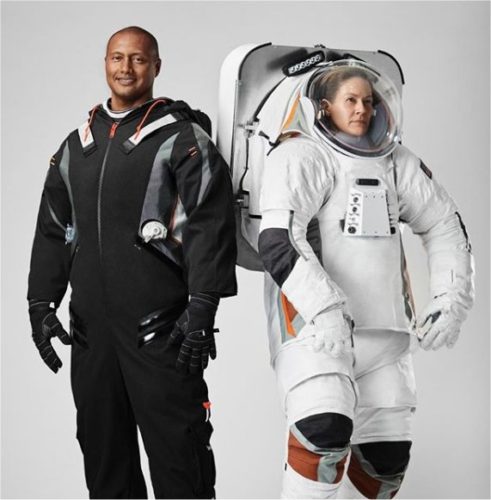
Both Astro™ EVA and Sol™ LEA will be vital in moving forward with commercial space travel. Combining astronaut needs with an emphasis on safety, ILC Dover has created the next generation spacesuits.
Astro™ EVA and Sol™ LEA spacesuits are designed with an astronaut’s mission in mind. Astro™ EVA is equipped with the newly patented Hybrid Upper Torso to accommodate all astronauts. The Hybrid Upper Torso can be resized without tools, thereby minimizing EVA spacesuit inventory. In addition, the engineers placed the mobility joints where it matters, optimizing mobility without compromising weight. Sol™ LEA is a lightweight highly mobile all soft spacesuit providing astronauts a comfortable safe ride to and from space.
- Introducing the First Line of Adaptive Commercial Spacesuits – ILC Dover
- This Next-Gen Spacesuit Could Protect Astronauts on the Moon and Mars | Space.com
** NASA recently debuted suits in development for the Artemis lunar missions: A New Spacesuit for Artemis Generation Astronauts | NASA
== Amazon Ad ==


 ‘, talks about lessons from AeroCube-10, TeamXc at JPL and the use of CubeSats for outreach and education. Do you think CubeSats are the future of space exploration or are they better suited to education/student purposes?