Video: Cosmonauts throw student CubeSats into orbit during ISS spacewalk

On Wednesday, Russian flight engineers Oleg Artemyev and Sergey Prokopyev made a spacewalk outside the International Space Station.  Their initial tasks included hurling four student-built smallsats into orbit: Spacewalkers toss nanosatellites into orbit, hook up bird migration monitor – Spaceflight Now

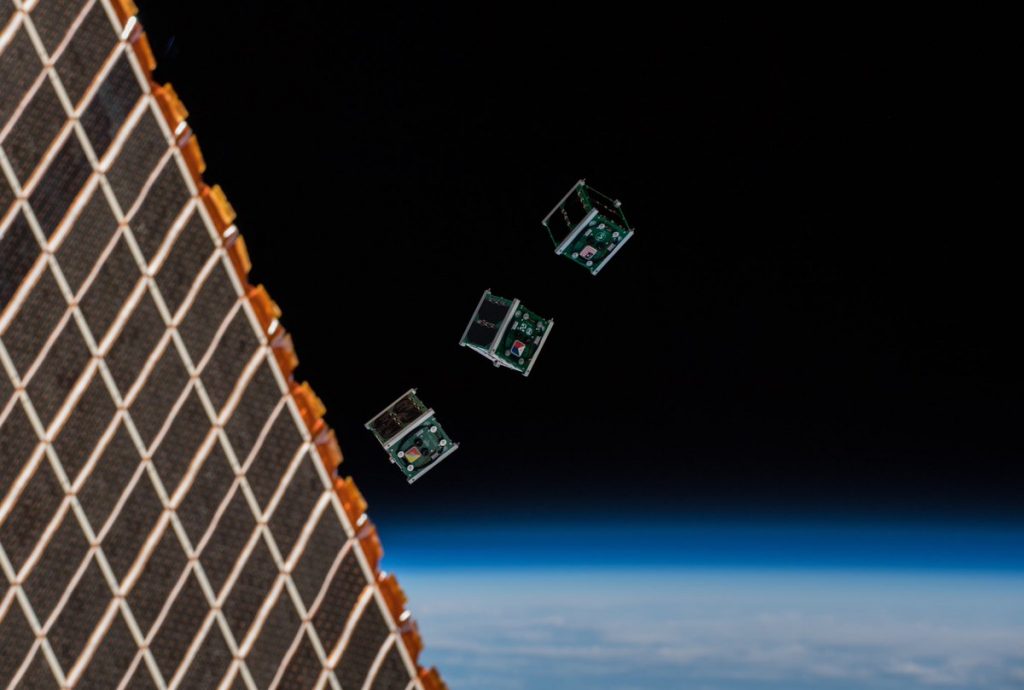
The spacewalkers’ first task was the deployment — by hand — of four CubeSats built by Russian students.

The cosmonauts carried with them two Tanyusha satellites, each about the size of a small toaster oven, built by students at Southwestern State University with demo payloads to study spacecraft autonomy technology and to measure the vacuum of space. Another pair of SiriusSat CubeSats, assembled by Russian schoolchildren and equipped with particle detectors, was also with the cosmonauts.

Prokopyev tossed the four nanosatellites into space by hand just outside the Pirs airlock, using a manual release method used on previous Russian spacewalks.

Here is a video of the hand-tossed orbital deployments plus views of the tiny satellites drifting away from the station:

Most of the rest of the nearly 8 hour long EVA involved installation of an antenna and related equipment for a German project to track animals wearing GPS transmitters:

Then the duo turned their attention to the installation of antennas and cables for a German-developed instrument package to track global animal movements. The equipment was placed outside the station’s Zvezda service module in a multi-step procedure that took a couple of hours longer than originally planned.

Called Icarus, the project aims to reveal changes in migratory routes, animal connections and other animal behavior. The antenna for Icarus was carried aloft in February, and a computer launched on a Russian Progress mission last year to help process the signals coming from tracking units tagged to animals on Earth.

“Icarus is a global collaboration of research scientists that are interested in life on the globe, and once we put together all the information on mobile animals, then we have a different and new understanding of life on Earth,” said Martin Wikelski, lead scientist on the Icarus project, director of the Max Planck Institute of Ornithology, and professor the University of Konstanz in Germany.

The Icarus project will start by tracking small animals, such as birds, bats and flying foxes, according to DLR, the German Aerospace Center. Tags fixed to the animals will transmit information on their migratory behavior — such as their GPS coordinates, acceleration and environmental data — up to a receiver on the space station.

See also

====


Video: Japan’s BIRDS project deploys satellites from ISS for countries new to space

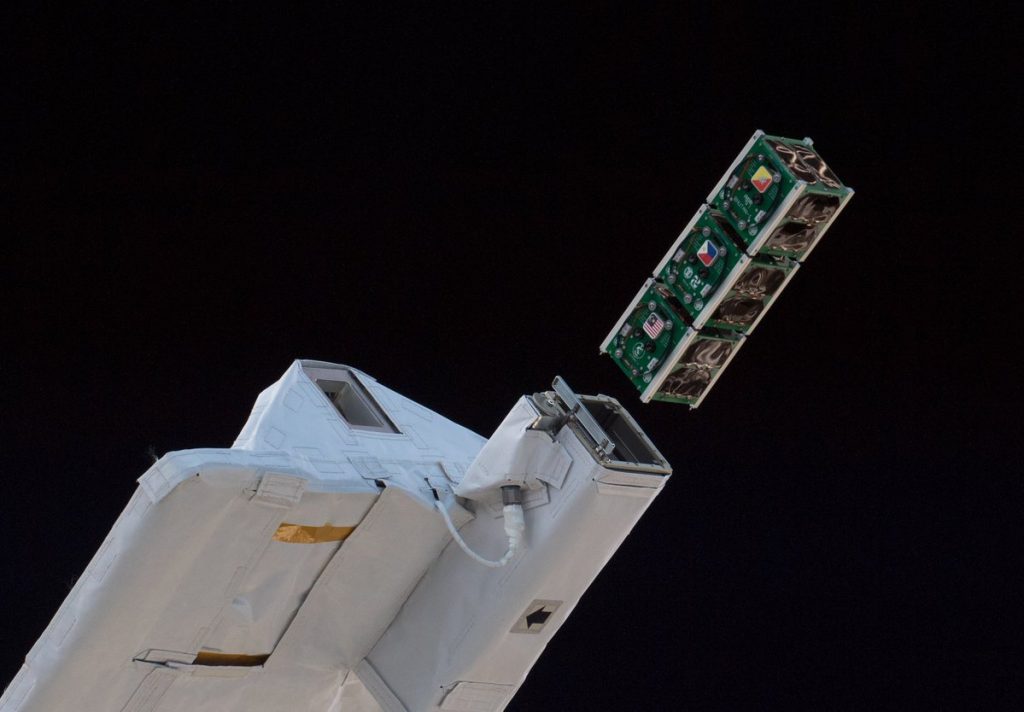
The Japan space agency’s BIRDS project has launched university student-built CubeSats from the Kibo module on the International Space Station for several countries that have never before put spacecraft into orbit. The project is managed by the Kyushu Institute of Technology (Kyutech) and is known officially as the Joint Global Multi-Nation Birds Satellite project.

A view of the BIRDS-2 deployment as seen by German astronaut Alexander Gerst.

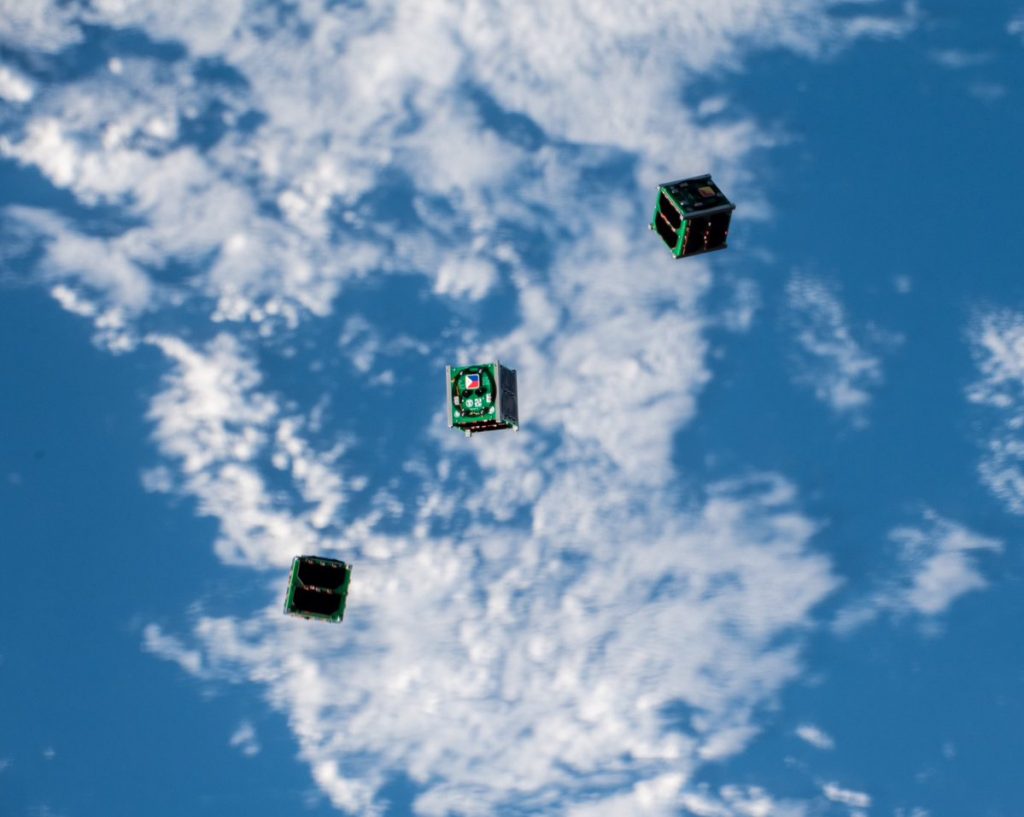
Birds-1 deployed scientific and technology demonstration CubeSats from Ghana, Mongolia, Nigeria, Bangladesh and Japan while BIRDS-2 deployed CubeSats for Bhutan, Malaysia, and the Philippines.

This video, narrated mostly in Japanese but with English subtitles, describes the Birds project and shows the two deployment events. An animation between 11:10 – 14:30 gives a clear depiction of how the ISS satellite deployment system works.

Birds-1:

Birds-2

Another image of the BIRDS-2 deployment from Alexander Gerst on Twitter.

A JAXA project apparently separate from BIRDS also deployed spacecraft for three countries that are newbies to orbital hardware:

The three BIRDS-2 cubesats head into orbit. Alexander Gerst on Twitter

Resources:

====


Carnival of Space #574 – Urban Astronomer

Urban Astronomer hosts the latest Carnival of Space.

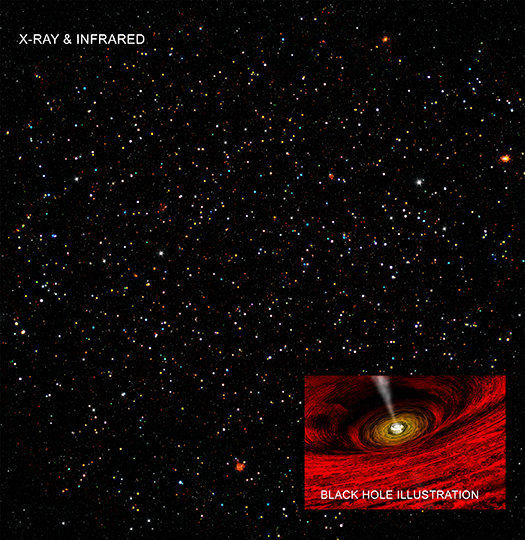
This image shows data from a massive observing campaign that includes NASA’s Chandra X-ray Observatory. These Chandra data have provided strong evidence for the existence of so-called intermediate-mass black holes (IMBHs). Combined with a separate study also using Chandra data, these results may allow astronomers to better understand how the very largest black holes in the early Universe formed, as described in our latest press release. Credit: X-ray: NASA/CXC/ICE/M.Mezcua et al.;
Infrared: NASA/JPL-Caltech; Illustration: NASA/CXC/A.Hobart

Videos: SpaceX presents the Crew Dragon and the first astronauts to ride it

The astronauts who will fly on the first Boeing and SpaceX commercial crew missions to the International Space Station were introduced by NASA to the public earlier this month (see posting here). On Monday, SpaceX held a press event at the company’s HQ in Hawthorne, California where the astronauts who will fly on the Crew Dragon were presented and the Dragon and other hardware items were shown off as well. Here are some videos about the event:

https://youtu.be/LcuFCLjuuqk

https://youtu.be/x7h7wtTkLLQ

Here aer a couple of reports on the event

The Everyday Astronaut Tim Dodd attended the event as well: A rare look inside SpaceX Headquarters and Crew Dragon. – Everyday Astronaut.

He examined the SpaceX flight suit up close: Up close and personal with SpaceX’s space suit – Everyday Astronaut

Dodd recently got to try on the flight suit that Boeing astronauts will wear during their missions to the ISS:

====


Video: TMRO Orbit 11.31 – “The Space Shuttle you never knew about”

The latest episode of TMRO.tv‘s Space weekly live show is now available in the archive: The Space Shuttle you never knew about – Orbit 11.31 – TMRO

We are joined by Chuck Ryan who built the shuttle simulator ‘Resolution’ to talk about his adventures in NASA and beyond.

Program segments:

Launch Minute
Falcon 9 Launches Merah Putih/Telkom 4

Space News:
Star-making fuel
NASA Awards Multiple Research and Development Contracts
Ultrahot Jupiters are more like stars than we thought

Interview with Chuck Ryan

Community Comments

====