1. Monday, March 12, 218: 2-3:30 pm PDT; 4-5:30 pm CDT; 6-6:30 pm EDT We welcome back Dr. Jeff Bell to the program for a multi-topic discussion.
2. Tuesday, March 13, 2018: 7-8:30 pm PDT; 9-10:30 pm CDT; 10-11:30 pm EDT: We welcome back Dr. Robert Zubrin to the program.
3. Wednesday, March 14, 2018: Hotel Mars. See Upcoming Show Menu and the website newsletter for details. Hotel Mars is pre-recorded by John Batchelor. It is archived on The Space Show site after John posts it on his website.
4. Friday, March 16, 2018; 9:30 am -11 am PDT, (12:30 -2 pm EDT; 11:30 am -1 pm CDT): We welcome back Dr. Erik Seedhouse to discuss his new book regarding British astronaut Tim Peake.
5. Sunday, March 18, 2018: 12-1:30 pm PDT; 2-3:30 pm CDT; 3-4:30 pm EDT. OPEN LINES. All space, STEM, STEAM, & science topics welcome. First time callers are welcome.
Elon Musk on Saturday released a short video of the Falcon Heavy launch made by Jonathan Nolan, the co-creator of HBO series Westworld. It includes brief footage of the central core nearly crashing into the droneship landing pad at high speed. Elon Musk on Twitter:
“Why Falcon Heavy & Starman? Life cannot just be about solving one sad problem after another. There need to be things that inspire you, that make you glad to wake up in the morning and be part of humanity. That is why we did it. We did for you.”
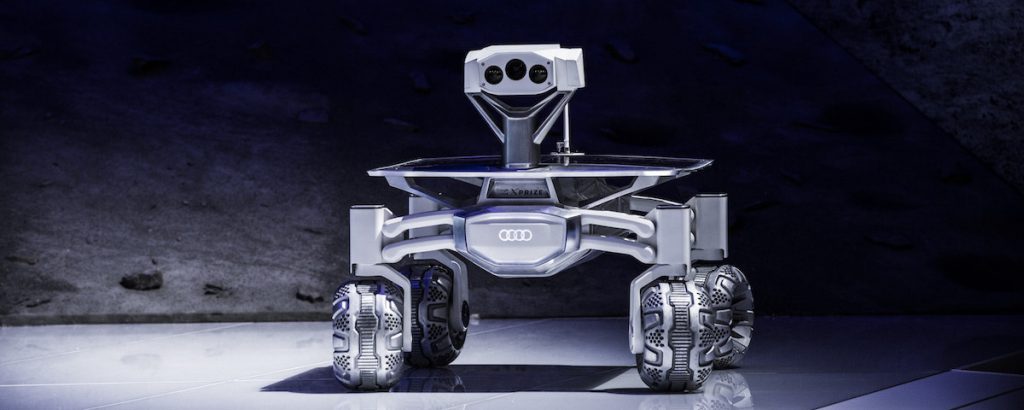
Jonny Smith of the Fully Charged Show on line program visited the Part Time Scientists group in Berlin, which is partnering with Audi and Vodafone on a private mission to the Moon. In this video, Smith gets to drive the Audi Lunar Quattro, “a remote controlled solar powered electric moon buggy”.
PT Scientists began as a team competing for the Google Lunar XPRIZE, which ended without any winners, However, like several other GLXP teams, a commercial company emerged from the effort and will continue to pursue lunar ventures.
“Equipped with a four-wheel electrical drive chain, tilt-able solar panels, rechargeable batteries and science-grade high definition cameras, the Audi lunar quattro rovers will deploy and operate a series of scientific and technological payloads on the Moon.”
Arp 256 is a stunning system of two spiral galaxies, about 350 million light-years away, in an early stage of merging. The image, taken with the NASA/ESA Hubble Space Telescope, displays two galaxies with strongly distorted shapes and an astonishing number of blue knots of star formation that look like exploding fireworks. The star formation was triggered by the close interaction between the two galaxies. This image was taken by Hubble’s Advanced Camera for Surveys (ACS) and the Wide Field Camera 3 (WFC3). It is a new version of an image already released in 2008 that was part a large collection of 59 images of merging galaxies taken for Hubble’s 18th anniversary. [Larger images.]
Galaxies are not static islands of stars — they are dynamic and ever-changing, constantly on the move through the darkness of the Universe. Sometimes, as seen in this spectacular Hubble image of Arp 256, galaxies can collide in a crash of cosmic proportions.
350 million light-years away in the constellation of Cetus (the Sea Monster), a pair of barred spiral galaxies have just begun a magnificent merger. This image suspends them in a single moment, freezing the chaotic spray of gas, dust and stars kicked up by the gravitational forces pulling the two galaxies together.
This video pans over NASA/ESA Hubble Space Telescope observations of the system Arp 256, about 350 million light-years from Earth. The system consists of two spiral galaxies in an early stage of a merger. Though the two galaxies are still separated by a large distance, their shapes are already impressively disrupted by the gravitational forces.
Both galaxies show bright blue patches, which highlight regions of star formation. These regions also contain hot newborn stars. Like their distorted appearance, the bursts in star formation are also triggered by the gravitational interaction between the two galaxies. Credit: ESA/Hubble, NASA Music: Astral Electronic
Though their nuclei are still separated by a large distance, the shapes of the galaxies in Arp 256 are impressively distorted. The galaxy in the upper part of the image contains very pronounced tidal tails — long, extended ribbons of gas, dust and stars.
The galaxies are ablaze with dazzling regions of star formation: the bright blue fireworks are stellar nurseries, churning out hot infant stars. These vigorous bursts of new life are triggered by the massive gravitational interactions, which stir up interstellar gas and dust out of which stars are born.
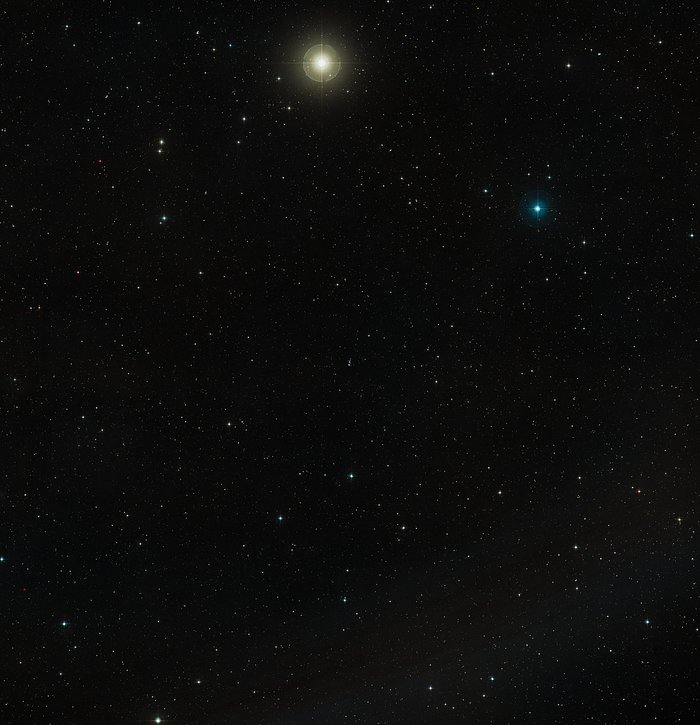
This video zooms in on the two interacting spiral galaxies of the ARP 256 system, about 350 million light-years away. It starts with a view of the night sky, focused on the constellation of Cetus (the Sea Monster), as seen from the ground. It then zooms through observations from the Digitized Sky Survey 2, and ends with a view of Arp 256 obtained with the NASA/ESA Hubble Space Telescope. Credit: ESA/Hubble, NASA, Digitized Sky Survey 2, Risinger. Music: Astral Electronic
Arp 256 was first catalogued by Halton Arp in 1966, as one of 338 galaxies presented in the aptly-named Atlas of Peculiar Galaxies. The goal of the catalogue was to image examples of the weird and wonderful structures found among nearby galaxies, to provide snapshots of different stages of galactic evolution. These peculiar galaxies are like a natural experiment played out on a cosmic scale and by cataloguing them, astronomers can better understand the physical processes that warp spiral and elliptical galaxies into new shapes.
Many galaxies in this catalogue are dwarf galaxies with indistinct structures, or active galaxies generating powerful jets — but a large number of the galaxies are interacting, such as Messier 51, the Antennae Galaxies, and Arp 256. Such interactions often form streamer-like tidal tails as seen in Arp 256, as well as bridges of gas, dust and stars between the galaxies.
Long ago, when our expanding Universe was much smaller, interactions and mergers were more common; in fact, they are thought to drive galactic evolution to this day. The galaxies in the Arp 256 system will continue their gravitational dance over the next millions of years, at first flirtatious, and then intimate, before finally morphing into a single galaxy.
This ground-based image shows the two spiral galaxies of the Arp 256 system and their surroundings. Credit: NASA, ESA, Digitized Sky Survey 2; Acknowledgement: Davide De Martin