1. SPECIAL TIME: Monday, March 19, 2018: 7-8:03 pm PDT; 9-10:30 pm CDT; 10-11:30 pm EDT We welcome back Bob Zimmerman for multiple timely space news reporting. Also, Happy Birthday to Moonwards Kim.
3. Wednesday, March 21, 2018: Hotel Mars. See Upcoming Show Menu and the website newsletter for details. Hotel Mars is pre-recorded by John Batchelor. It is archived on The Space Show site after John posts it on his website.
5. Sunday, March 25, 2018: 12-1:30 pm PDT; 2-3:30 pm CDT; 3-4:30 pm EDT. OPEN LINES. All space, STEM, STEAM, & science topics welcome. First time callers are welcome.
Participate in NASA’s GLOBE Clouds program and have a great excuse to go outside on spring days and gaze at the clouds. Researchers working with the Clouds and the Earth’s Radiant Energy System (CERES) recently installed on the International Space Station need to calibrate what the sensors observe with what the clouds look like from the ground. You can help out as a citizen scientist by downloading the GLOBE Clouds app for your smartphone and whenever you are outside use it to capture pictures of the clouds currently in view. The program invites participants to enter up to 10 cloud observations per day from March 15, 2018 to April 15, 2018.
It’s almost spring, the time of year when the looming change in seasons could lead to some pretty fascinating cloud activity in the sky. NASA and the GLOBE Program are asking for your help by taking part in a citizen science cloud observation challenge.
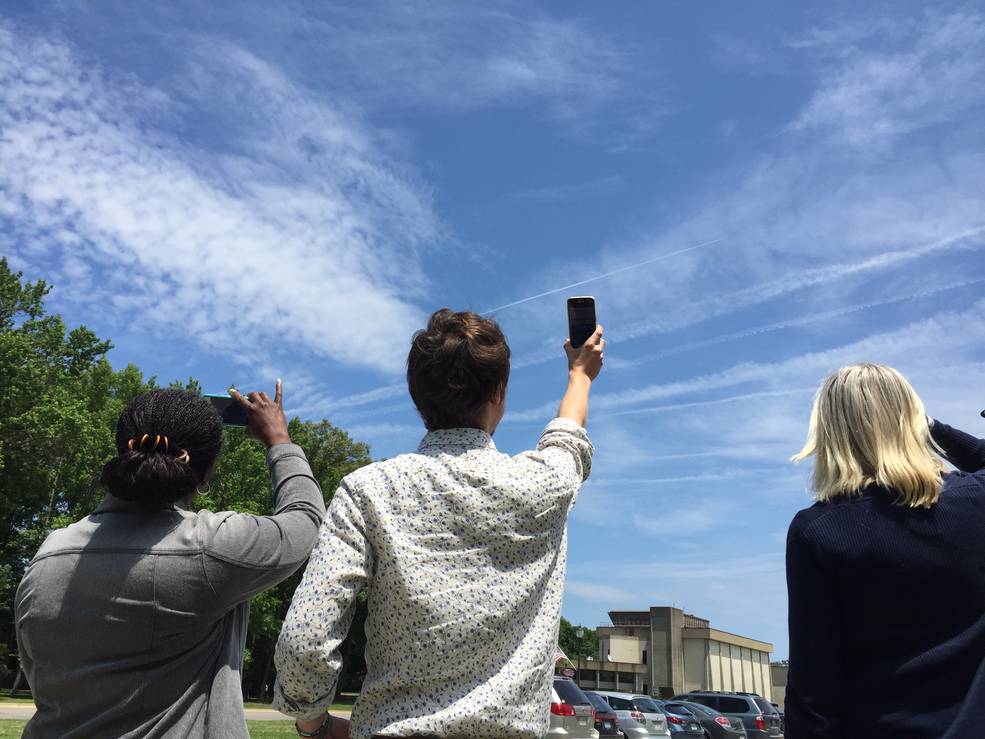
During the GLOBE cloud observation challenge, citizen scientists of all ages can make up to 10 cloud observations per day using the GLOBE Observer app or one of the other data entry options (for trained GLOBE members). Credits: NASA/Jessica Taylor
From March 15 through April 15, citizen scientists of all ages can make up to 10 cloud observations per day using the GLOBE Observer app or one of the other data entry options (for trained GLOBE members). Challenge participants with the most observations will be congratulated by a NASA scientist in a video posted on the GLOBE Program’s website and on social media.
“The GLOBE Program is offering this challenge to show people how important it is to NASA to have citizen scientist observations; observations from the ground up,” said Marilé Colón Robles, lead for the GLOBE Clouds team at NASA’s Langley Research Center in Hampton, Virginia. “We’re going from winter to spring, so the types of storms will change, which will also change the types of clouds.”
Researchers use, and value, this citizen science cloud data because it helps to validate data from Earth-observing instruments. Scientists at Langley work with a suite of six instruments known as the Clouds and the Earth’s Radiant Energy System (CERES).
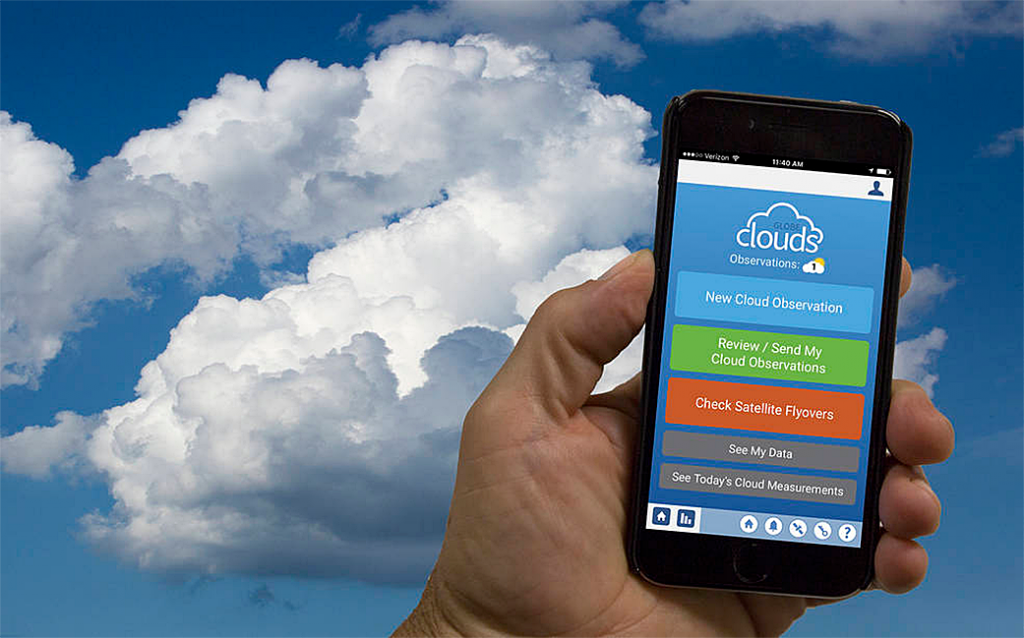
The GLOBE Observer app.
Even though CERES’ instruments use advanced technology, it is not always easy for researchers to positively identify all types of clouds in their images. For example, it can be difficult to differentiate thin, wispy cirrus clouds from snow since both are cold and bright; even more so when cirrus clouds are above a surface with patchy snow or snow cover. One solution to this problem is to look at satellite images from a particular area and compare them to data submitted by citizen scientists on the ground.
“Looking at what an observer recorded as clouds and looking at their surface observations really helps us better understand the images that were matched from the satellite,” said Colón Robles.
Citizen science observations are especially needed now because scientists are starting to verify data from a new CERES instrument. CERES FM6 launched to orbit Nov. 18, 2017 and began taking measurements Jan. 5.
You don’t have to be a cloud-gazing pro to participate. For those who want to be part of the challenge but don’t have a lot of experience identifying clouds, Colón Robles offers the following advice: “Just go outside.” The more clouds you observe, she said, the more comfortable you’ll be collecting data.
Find tips for making good cloud observations here.
NASA sponsors the GLOBE Program. The GLOBE Program is an international science and education program that provides students and the public with the opportunity to participate in data collection and the scientific process. NASA GLOBE Observer is a free smartphone app that lets anybody make citizen science observations from the palm of their hand.
Pink Floyd notwithstanding, there is no “Dark side of the Moon” any more than there is a dark side of the earth. The Moon rotates just like earth does, continually changing which half of the sphere is in sunlight and which half in darkness. Our celestial companion keeps one face turned towards us as it orbits around the earth, which means it takes a month rather than 24 hours to make its full 360 degree rotation. Here is a compilation of images from the Lunar Reconnaissance Orbiter (LRO) showing how the Moon would appear if you could sit fixed on a line between the Moon and the sun for a month: APOD: 2018 March 18 – Rotating Moon from LRO
Explanation: No one, presently, sees the Moon rotate like this. That’s because the Earth’s moon is tidally locked to the Earth, showing us only one side. Given modern digital technology, however, combined with many detailed images returned by the Lunar Reconnaissance Orbiter (LRO), a high resolution virtual Moon rotation movie has been composed. The above time-lapse video starts with the standard Earth view of the Moon. Quickly, though, Mare Orientale, a large crater with a dark center that is difficult to see from the Earth, rotates into view just below the equator. From an entire lunar month condensed into 24 seconds, the video clearly shows that the Earth side of the Moon contains an abundance of dark lunar maria, while the lunar far side is dominated by bright lunar highlands. Currently, over 20 new missions to the Moon are under active development from four different countries, most of which have expected launch dates either this year or next.
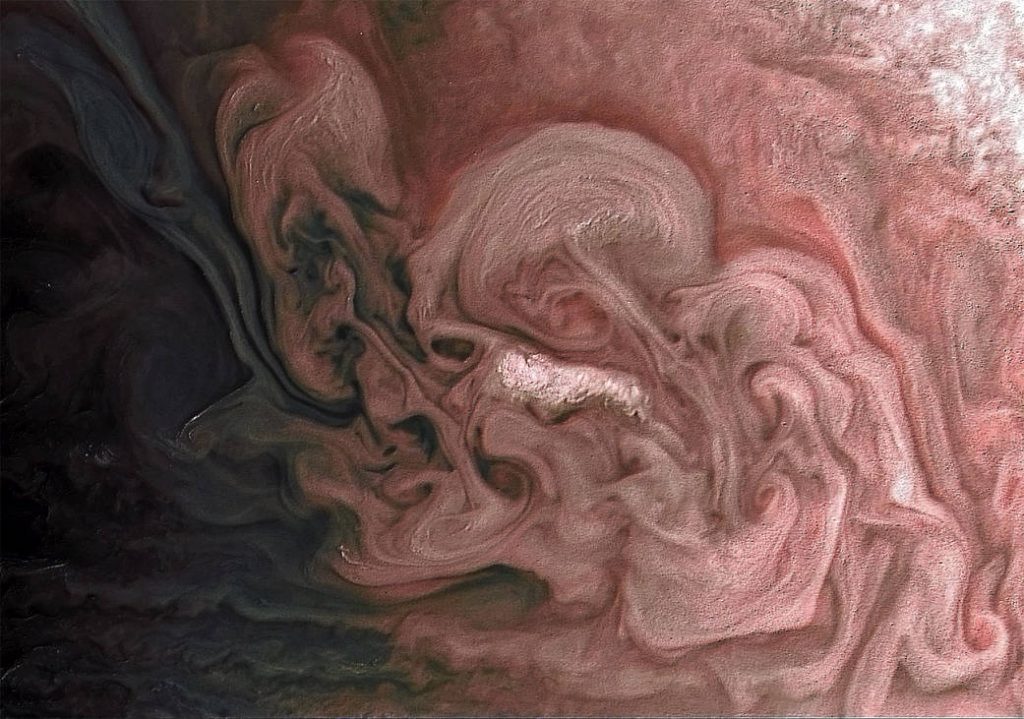
This image captures a close-up view of a storm with bright cloud tops in the northern hemisphere of Jupiter.
NASA’s Juno spacecraft took this color-enhanced image on Feb. 7 at 5:38 a.m. PST (8:38 a.m. EST) during its 11th close flyby of the gas giant planet. At the time, the spacecraft was 7,578 miles (12,195 kilometers) from the tops of Jupiter’s clouds at 49.2 degrees north latitude.
Citizen scientist Matt Brealey processed the image using data from the JunoCam imager. Citizen scientist Gustavo B C then adjusted colors and embossed Matt Brealey’s processing of this storm.
JunoCam’s raw images are available for the public to peruse and process into image products at: www.missionjuno.swri.edu/junocam