ESO: Nearest temperate world found orbiting quiet star

The latest report from ESO (European Southern Observatory):

Closest Temperate World Orbiting Quiet Star Discovered
ESO’s HARPS instrument finds Earth-mass exoplanet around Ross 128 
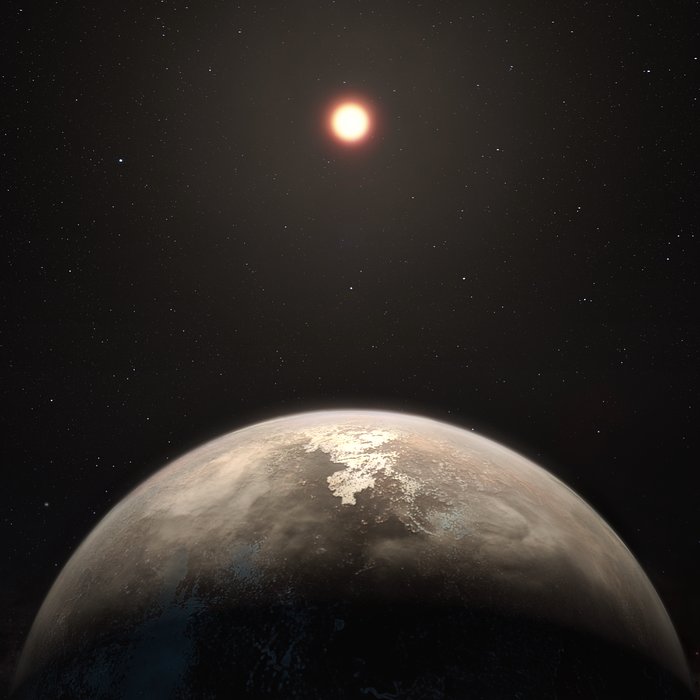
This artist’s impression shows the temperate planet Ross 128 b, with its red dwarf parent star in the background. This planet, which lies only 11 light-years from Earth, was found by a team using ESO’s unique planet-hunting HARPS instrument. The new world is now the second-closest temperate planet to be detected after Proxima b. It is also the closest planet to be discovered orbiting an inactive red dwarf star, which may increase the likelihood that this planet could potentially sustain life. Ross 128 b will be a prime target for ESO’s Extremely Large Telescope, which will be able to search for biomarkers in the planet’s atmosphere. [Larger image.]
A temperate Earth-sized planet has been discovered only 11 light-years from the Solar System by a team using ESO’s unique planet-hunting HARPS instrument. The new world has the designation Ross 128 b and is now the second-closest temperate planet to be detected after Proxima b. It is also the closest planet to be discovered orbiting an inactive red dwarf star, which may increase the likelihood that this planet could potentially sustain life. Ross 128 b will be a prime target for ESO’s Extremely Large Telescope, which will be able to search for biomarkers in the planet’s atmosphere.

A team working with ESO’s High Accuracy Radial velocity Planet Searcher (HARPS) at the La Silla Observatory in Chile has found that the red dwarf star Ross 128 is orbited by a low-mass exoplanet every 9.9 days. This Earth-sized world is expected to be temperate, with a surface temperature that may also be close to that of the Earth. Ross 128 is the “quietest” nearby star to host such a temperate exoplanet.

“This discovery is based on more than a decade of HARPS intensive monitoring together with state-of-the-art data reduction and analysis techniques. Only HARPS has demonstrated such a precision and it remains the best planet hunter of its kind, 15 years after it began operations,”

explains Nicola Astudillo-Defru (Geneva Observatory – University of Geneva, Switzerland), who co-authored the discovery paper.
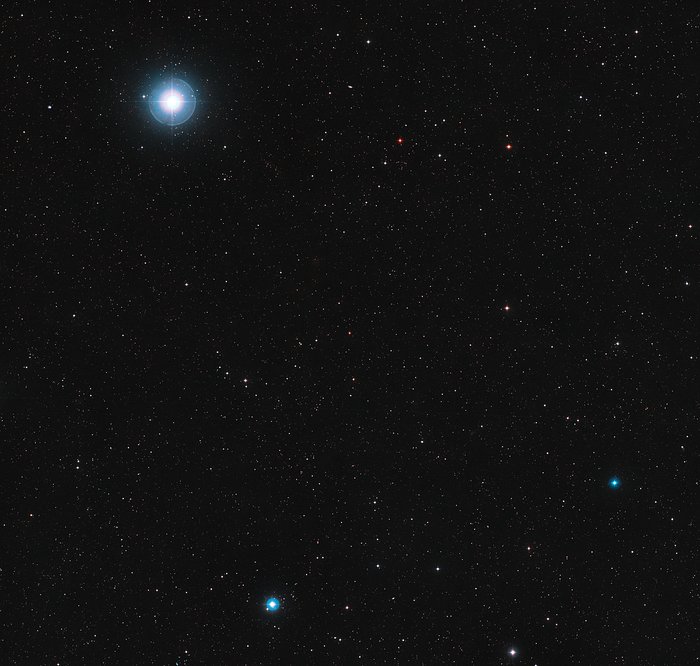
This image shows the sky around the red dwarf star Ross 128 in the constellation of Virgo (The Virgin). It was created from images forming part of the Digitized Sky Survey 2. Ross 128 appears at the centre of the picture. Close inspection reveals that Ross 128 has a strange multiple appearance as this image was created from photographs taken over a more than forty year period, and the star, which is only 11 light-years from Earth, moved across the sky significantly during this time. Ross 128 is a “quiet” red dwarf star and is orbited by Ross 128 b, an exoplanet with a similar mass and temperature to the Earth. [Larger images.]

Red dwarfs are some of the coolest, faintest — and most common — stars in the Universe. This makes them very good targets in the search for exoplanets and so they are increasingly being studied. In fact, lead author Xavier Bonfils (Institut de Planétologie et d’Astrophysique de Grenoble – Université Grenoble-Alpes/CNRS, Grenoble, France), named their HARPS programme The shortcut to happiness, as it is easier to detect small cool siblings of Earth around these stars, than around stars more similar to the Sun [1].

Many red dwarf stars, including Proxima Centauri, are subject to flares that occasionally bathe their orbiting planets in deadly ultraviolet and X-ray radiation. However, it seems that Ross 128 is a much quieter star, and so its planets may be the closest known comfortable abode for possible life.

Although it is currently 11 light-years from Earth, Ross 128 is moving towards us and is expected to become our nearest stellar neighbour in just 79 000 years — a blink of the eye in cosmic terms. Ross 128 b will by then take the crown from Proxima b and become the closest exoplanet to Earth!

With the data from HARPS, the team found that Ross 128 b orbits 20 times closer than the Earth orbits the Sun. Despite this proximity, Ross 128 b receives only 1.38 times more irradiation than the Earth. As a result, Ross 128 b’s equilibrium temperature is estimated to lie between -60 and 20°C, thanks to the cool and faint nature of its small red dwarf host star, which has just over half the surface temperature of the Sun. While the scientists involved in this discovery consider Ross 128b to be a temperate planet, uncertainty remains as to whether the planet lies inside, outside, or on the cusp of the habitable zone, where liquid water may exist on a planet’s surface [2].

Astronomers are now detecting more and more temperate exoplanets, and the next stage will be to study their atmospheres, composition and chemistry in more detail. Vitally, the detection of biomarkers such as oxygen in the very closest exoplanet atmospheres will be a huge next step, which ESO’s Extremely Large Telescope (ELT) is in prime position to take [3].

“New facilities at ESO will first play a critical role in building the census of Earth-mass planets amenable to characterisation. In particular, NIRPS, the infrared arm of HARPS, will boost our efficiency in observing red dwarfs, which emit most of their radiation in the infrared. And then, the ELT will provide the opportunity to observe and characterise a large fraction of these planets,” concludes Xavier Bonfils.

Notes

[1] A planet orbiting close to a low-mass red dwarf star has a larger gravitational effect on the star than a similar planet orbiting further out from a more massive star like the Sun. As a result, this “reflex motion” velocity is much easier to spot. However, the fact that red dwarfs are fainter makes it harder to collect enough signal for the very precise measurements that are needed.

[2] The habitable zone is defined by the range of orbits around a star in which a planet can possess the appropriate temperature for liquid water to exist on the planet’s surface.

[3] This is only possible for the very few exoplanets that are close enough to the Earth to be angularly resolved from their stars.
The Space Show this week – Nov.13.2017

The guests and topics of discussion on The Space Show this week:

1. Monday, Nov. 13, 2017: 2-3:30 pm PST (4-5:30 pm M CST, 5-6:30 pm EST): We welcome back Dr. Paul Spudis to discuss all things lunar and space policy.

2. Tuesday, Nov. 14 2017: 7-8:30 pm PST, 10-11:30 pm EST, 9-10:30 pm CST: Special Open Lines Show for those who want to be a guest on The Space Show, ask to be on and want to share information with us. This is your night to be on The Space Show so give us a call. Normal Open Lines callers and email are also welcome..

3. Wednesday, Nov. 15, 2017: Hotel Mars. See Upcoming Show Menu and the website newsletter for details. Hotel Mars is pre-recorded by John Batchelor. It is archived on The Space Show site after John posts it on his website.

4. Friday, Nov. 17, 2017; 9:30 am -11 am PST, (12:30 -2 pm EST; 11:30 am -1 pm CST): We welcome Robert Hargraves to the show to discuss Thorium, Thorium reactors and more.

5. Sunday, Nov. 19, 2017: 12-1:30 pm PST; 2-4:30 pm EST; 2-3:30 pm CST. This is our regular Open Lines program. First time callers are welcome as are all space, STEM, STEAM topics. Emails are welcome too but phone calls get first billing.

See also:
* The Space Show on Vimeo – webinar videos
* The Space Show’s Blog – summaries of interviews.
* The Space Show Classroom Blog – tutorial programs

The Space Show is a project of the One Giant Leap Foundation.

The Space Show - David Livingston
David Livingston

Video: An astronomer learned “to hear the stars” after losing her eyesight

An interesting story of an astronomer finding a way to continue her research after losing her eyesight: Wanda Diaz Merced: How a blind astronomer found a way to hear the stars | TED Talk

From the caption:

Wanda Diaz Merced studies the light emitted by gamma-ray bursts, the most energetic events in the universe. When she lost her sight and was left without a way to do her science, she had a revelatory insight: the light curves she could no longer see could be translated into sound. Through sonification, she regained mastery over her work, and now she’s advocating for a more inclusive scientific community. “Science is for everyone,” she says. “It has to be available to everyone, because we are all natural explorers.”

====

Misc: An Artist Astronaut + Next phase of NASA’s 3-D Printed Habitat Challenge + An assembler of ingredients for life

Some miscellaneous items of interest:

** This Performance Artist Is Also a Candidate for Space Travel – Creators –  Sarah Jane Pell is a “Artist Astronaut” who believes that

 … the artistic and astronautics components of her work have equal weight. In other words, the art isn’t supplementary. “Calling art supplementary is like calling it decoration,” Pell tells Creators.

“The capacity of an artist is deeper, more complex and culturally significant: stemming from a philosophy of aesthetics and poetics from the sublime to the beautiful and grotesque and everything in between. It is an act, action and activism, a way of being in the world that translates curiosities, insights and provocations about our being in time. It can be invention, experimentation, improvisation, expression, and calculated methodical gesture and mark. Art may manifest in music, movement, the material arts and letters. Art knows no bounds, and therein lays the capacity for new discovery.”

** NASA Opens $2 Million Third Phase of 3D-Printed Habitat Competition | NASA – NASA invites participates to enter the 3-D Printed Habitat Challenge competition:

Future missions to the Moon, Mars and beyond will require innovative options to shelter our explorers, and we won’t be able to carry all of the materials with us from Earth. NASA’s 3D-Printed Habitat Challenge, a Centennial Challenges competition, seeks ways to create or develop the technologies needed to create such habitats on-site, and challenges citizen inventors to lead the way. Today, NASA and challenge partner Bradley University of Peoria, Illinois, announce the opening of Phase 3 of the competition for team registration.

“The ideas and technologies this competition has already produced are encouraging, and we are excited to see what this next phase will bring,” said Monsi Roman, program manager of NASA’s Centennial Challenges. “The solutions we seek from our competitions are revolutionary, which by nature makes them extremely difficult. But this only fuels our teams to work harder to innovate and solve.”

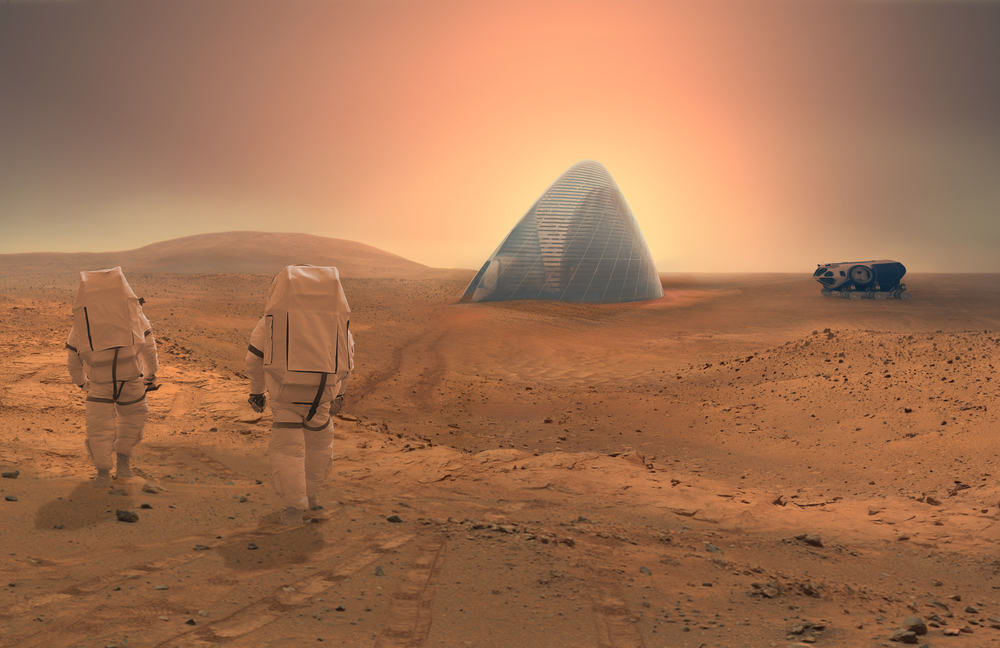
The Ice House

The goal of the 3D-Printed Habitat Challenge is to foster the development of new technologies necessary to additively manufacture a habitat using local indigenous materials with, or without, recyclable materials. The vision is that autonomous machines will someday be deployed to the Moon, Mars or beyond to construct shelters for human habitation. On Earth, these same capabilities could be used to produce affordable housing wherever it is needed or where access to conventional building materials and skills are limited.

Bradley University President Gary Roberts said the school is honored to be the challenge partner once again. “Bradley prides itself on experiential learning and student engagement,” Roberts said. “This challenge isn’t something our students can learn about in a textbook or in a classroom. This is a forward-thinking concept coming to life, and they have a chance to see it firsthand. They will meet the people making it happen and learn about the ideas that are fueling innovation. This could change the way they imagine the future and push their creative limits.”

The 3D-Printed Habitat Challenge is divided into phases. The Phase 1: Design Competition called on participants to develop state-of-the-art architectural concepts and was completed in 2015. The Phase 2: Structural Member Competition focused on manufacturing structural components and was completed in August 2017.

The now-open Phase 3: On-Site Habitat Competition challenges competitors to fabricate sub-scale habitats using indigenous materials with or without mission-generated recyclables, and offers a $2 million total prize purse. Phase 3 has five levels of competition. Interested teams may register through Feb. 15, 2018. Full details, schedule and rules can be found here.

** Scientists find potential ‘missing link’ in chemistry that led to life on earth | EurekAlert! – An interesting finding that could illuminate a key step in bringing together the ingredients that led to the formation of life on earth:

Origins-of-life researchers have hypothesized that a chemical reaction called phosphorylation may have been crucial for the assembly of three key ingredients in early life forms: short strands of nucleotides to store genetic information, short chains of amino acids (peptides) to do the main work of cells, and lipids to form encapsulating structures such as cell walls. Yet, no one has ever found a phosphorylating agent that was plausibly present on early Earth and could have produced these three classes of molecules side-by-side under the same realistic conditions.

TSRI chemists have now identified just such a compound: diamidophosphate (DAP).

====

Carnival of Space #533 – NextBigFuture.com

NextBigFuture.com hosts the latest Carnival of Space.