Here is this week’s Space to Ground report from NASA on activities related to the International Space Station
Astronauts carried out another spacewalk today-
Outside the International Space Station, Expedition 50 Commander Shane Kimbrough of NASA and Flight Engineer Thomas Pesquet of the European Space Agency conducted a spacewalk in U.S. spacesuits to upgrade the system for the 1A power channel of the orbital laboratory’s starboard 4 (S4) truss solar arrays. Moving adapter plates and batteries, Kimbrough completed the work to hook up electrical connections for the last three of six new lithium-ion batteries recently delivered to the station, and to move the last of the old nickel-hydrogen batteries that will be stored on the station. It was the second spacewalk in a week for Kimbrough and the fourth of his career, and the first for Pesquet in the refurbishment of two of the station’s eight power channels. On Jan. 6, Kimbrough and Flight Engineer Peggy Whitson of NASA conducted similar work for the 3A power channel of the station’s S4 solar arrays.
On Jan. 14, 2005, ESA’s Huygens probe made its descent to the surface of Saturn’s hazy moon, Titan. Carried to Saturn by NASA’s Cassini spacecraft, Huygens made the most distant landing ever on another world, and the only landing on a body in the outer solar system. This video uses actual images taken by the probe during its two-and-a-half hour fall under its parachutes.
Huygens was a signature achievement of the international Cassini-Huygens mission, which will conclude on Sept. 15, 2017, when Cassini plunges into Saturn’s atmosphere.
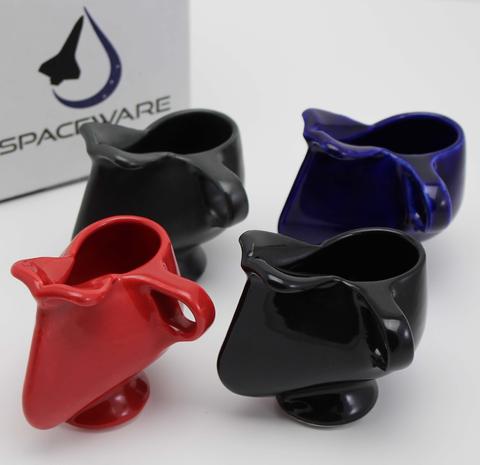
These porcelain cups are made from 3D printed molds:
A one of a kind porcelain Space Cup that comes in a variety of colors. It’s food safe, durable, and true to the original space design minus a small base for operating in earthly gravity. The functional design is derived from fluid physics, yielding a unique, even artistic piece.
Note: These cups require some hand preparation and finishing so expect some slight variations in appearance.
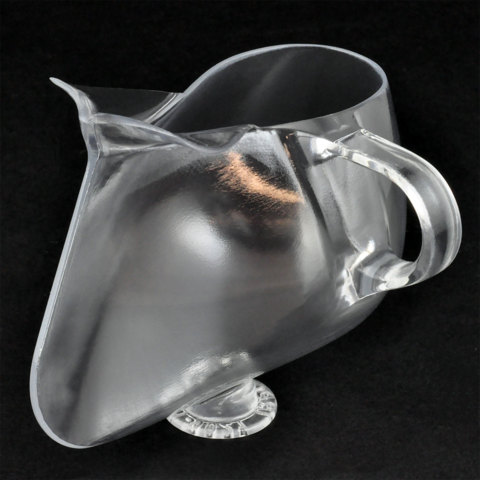
A real Flight Certified Space Coffee Cup. What does that mean? Well, it means that his is the original shape, material, and specifications that have been approved by NASA for flight aboard the International Space Station.
Keep in mind that this is not for everyday use and most definitely not dishwasher safe. Think of this as a bit of art, science, and space history all in one. The cup is 3D printed using the SLA process (UV light + a bath of special resin). So when you break it down it’s space, 3D printing, coffee, and fluid mechanics. Enjoy.
ESO has signed an agreement with the Breakthrough Initiatives to adapt the Very Large Telescope instrumentation in Chile to conduct a search for planets in the nearby star system Alpha Centauri. Such planets could be the targets for an eventual launch of miniature space probes by the Breakthrough Starshot initiative.
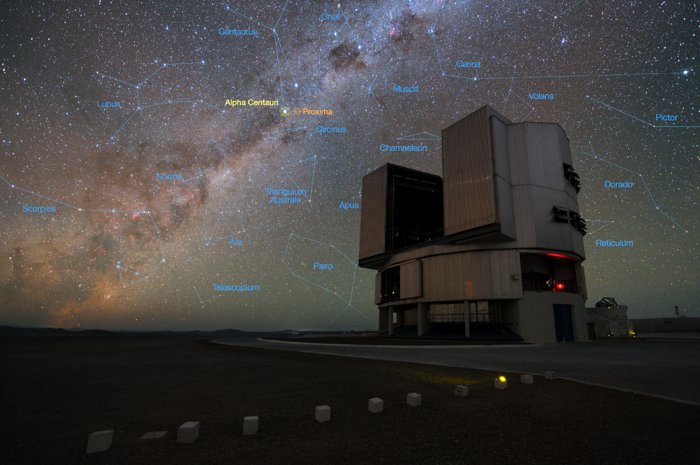
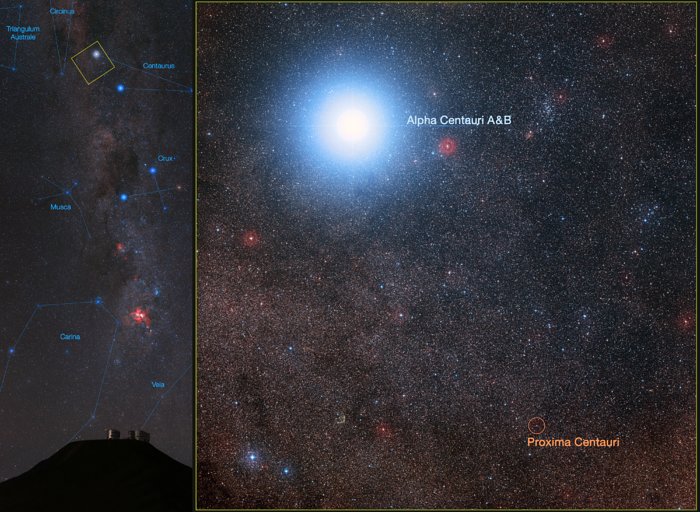
The foreground of this image shows ESO’s Very Large Telescope (VLT) at the Paranal Observatory in Chile. The rich stellar backdrop to the picture includes the bright star Alpha Centauri, the closest stellar system to Earth. In late 2016 ESO signed an agreement with the Breakthrough Initiatives to adapt the VLT instrumentation to conduct a search for planets in the Alpha Centauri system. Such planets could be the targets for an eventual launch of miniature space probes by the Breakthrough Starshot Initiative. [Larger images.]ESO, represented by the Director General, Tim de Zeeuw, has signed an agreement with the Breakthrough Initiatives, represented by Pete Worden, Chairman of the Breakthrough Prize Foundation and Executive Director of the Breakthrough Initiatives. The agreement provides funds for the VISIR (VLT Imager and Spectrometer for mid-Infrared) instrument, mounted at ESO’s Very Large Telescope (VLT) to be modified in order to greatly enhance its ability to search for potentially habitable planets around Alpha Centauri, the closest stellar system to the Earth. The agreement also provides for telescope time to allow a careful search programme to be conducted in 2019.
ESO has signed an agreement with the Breakthrough Initiatives to adapt the Very Large Telescope instrumentation in Chile to conduct a search for planets in the nearby star system Alpha Centauri. Such planets could be the targets for an eventual launch of miniature space probes by the Breakthrough Starshot Initiative. The video is available in 4K UHD. This ESOcast Light takes a quick look at the main facts and why this is an important step for the future.
The discovery in 2016 of a planet, Proxima b, around Proxima Centauri, the third and faintest star of the Alpha Centauri system, adds even further impetus to this search.
Knowing where the nearest exoplanets are is of paramount interest for Breakthrough Starshot, the research and engineering programme launched in April 2016, which aims to demonstrate proof of concept for ultra-fast light-driven “nanocraft”, laying the foundation for the first launch to Alpha Centauri within a generation.
This image shows the closest stellar system to the Sun, the bright double star Alpha Centauri AB and its distant and faint companion Proxima Centauri. In late 2016 ESO signed an agreement with the Breakthrough Initiatives to adapt the VLT instrumentation to conduct a search for planets in the Alpha Centauri system. Such planets could be the targets for an eventual launch of miniature space probes by the Breakthrough Starshot Initiative. [Larger images.]Detecting a habitable planet is an enormous challenge due to the brightness of the planetary system’s host star, which tends to overwhelm the relatively dim planets. One way to make this easier is to observe in the mid-infrared wavelength range, where the thermal glow from an orbiting planet greatly reduces the brightness gap between it and its host star. But even in the mid-infrared, the star remains millions of times brighter than the planets to be detected, which calls for a dedicated technique to reduce the blinding stellar light.
The existing mid-infrared instrument VISIR on the VLT will provide such performance if it were enhanced to greatly improve the image quality using adaptive optics, and adapted to employ a technique called coronagraphy to reduce the stellar light and thereby reveal the possible signal of potential terrestrial planets. Breakthrough Initiatives will pay for a large fraction of the necessary technologies and development costs for such an experiment, and ESO will provide the required observing capabilities and time.
The new hardware includes an instrument module contracted to Kampf Telescope Optics (KTO), Munich, which will host the wavefront sensor, and a novel detector calibration device. In addition, there are plans for a new coronagraph to be developed jointly by University of Liège (Belgium) and Uppsala University (Sweden).
Detecting and studying potentially habitable planets orbiting other stars will be one of the main scientific goals of the upcoming European Extremely Large Telescope (E-ELT). Although the increased size of the E-ELT will be essential to obtaining an image of a planet at larger distances in the Milky Way, the light collecting power of the VLT is just sufficient to image a planet around the nearest star, Alpha Centauri.
The developments for VISIR will also be beneficial for the future METIS instrument, to be mounted on the E-ELT, as the knowledge gained and proof of concept will be directly transferable. The huge size of the E-ELT should allow METIS to detect and study exoplanets the size of Mars orbiting Alpha Centauri, if they exist, as well as other potentially habitable planets around other nearby stars.