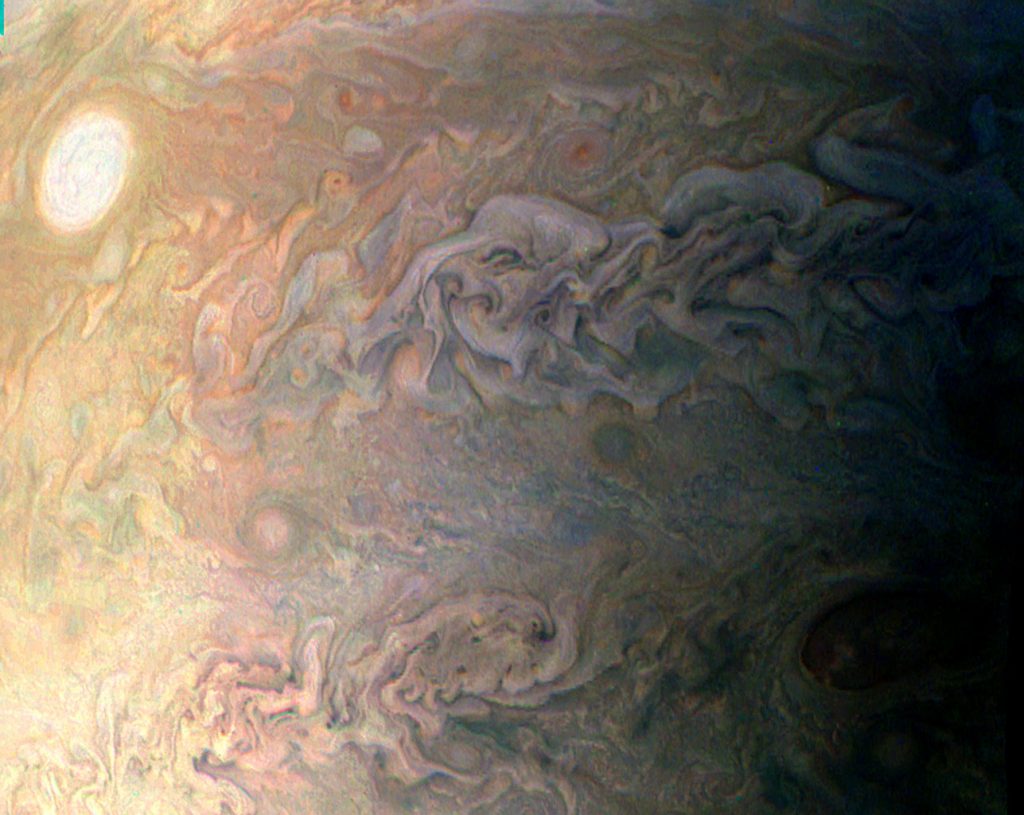
This amateur-processed image was taken on Dec. 11, 2016, at 9:27 a.m. PST (12:27 p.m. EST), as NASA’s Juno spacecraft performed its third close flyby of Jupiter. At the time the image was taken, the spacecraft was about 15,200 miles (24,400 kilometers) from the gas giant planet. The citizen scientist (Eric Jorgensen) cropped the JunoCam image and enhanced the color to draw attention to Jupiter’s swirling clouds southeast of the “pearl.” The “pearl” is one of eight massive rotating storms at 40 degrees south latitude on Jupiter, known colloquially as the “string of pearls.” The processing of this image highlights the turbulence of the clouds in the south temperate belt of the planet. [Other image sizes]Where should NASA’s Juno spacecraft aim its camera during its next close pass of Jupiter on Feb. 2? You can now play a part in the decision. For the first time, members of the public can vote to participate in selecting all pictures to be taken of Jupiter during a Juno flyby. Voting begins Thursday, Jan. 19 at 11 a.m. PST (2 p.m. EST) and concludes on Jan. 23 at 9 a.m. PST (noon EST).
“We are looking forward to people visiting our website and becoming part of the JunoCam imaging team,” said Candy Hansen, Juno co-investigator from the Planetary Science Institute, Tucson, Arizona. “It’s up to the public to determine the best locations in Jupiter’s atmosphere for JunoCam to capture during this flyby.”
JunoCam will begin taking pictures as the spacecraft approaches Jupiter’s north pole. Two hours later, the imaging will conclude as the spacecraft completes its close flyby, departing from below the gas giant’s south pole. Juno is currently on its fourth orbit around Jupiter. It takes 53 days for Juno to complete one orbit.
“The pictures JunoCam can take depict a narrow swath of territory the spacecraft flies over, so the points of interest imaged can provide a great amount of detail,” said Hansen. “They play a vital role in helping the Juno science team establish what is going on in Jupiter’s atmosphere at any moment. We are looking forward to seeing what people from outside the science team think is important.”
There will be a new voting page for each upcoming flyby of the mission. On each of the pages, several points of interest will be highlighted that are known to come within the JunoCam field of view during the next close approach. Each participant will get a limited number of votes per orbit to devote to the points of interest he or she wants imaged. After the flyby is complete, the raw images will be posted to the JunoCam website, where the public can perform its own processing.
“It is great to be able to share excitement and science from the Juno mission with the public in this way,” said Scott Bolton, Juno principal investigator from the Southwest Research Institute in San Antonio. “Amateur scientists, artists, students and whole classrooms are providing the world with their unique perspectives of Jupiter. I am really pleased that this website is having such a big impact and allowing so many people to join the Juno science team. The public involvement is really affecting how we look at the most massive planetary inhabitant in our solar system.”
During the Feb. 2 flyby, Juno will make its closest approach to Jupiter at 4:58 a.m. PST (7:58 a.m. EST), when the spacecraft is about 2,700 miles (4,300 kilometers) above the planet’s swirling clouds.
JunoCam is a color, visible-light camera designed to capture remarkable pictures of Jupiter’s poles and cloud tops. As Juno’s eyes, it will provide a wide view of Jupiter over the course of the mission, helping to provide context for the spacecraft’s other instruments. JunoCam was included on the spacecraft primarily for public engagement purposes, although its images also are helpful to the science team.
NASA’s Jet Propulsion Laboratory, Pasadena, California, manages the Juno mission for the principal investigator, Scott Bolton, of Southwest Research Institute in San Antonio. The Juno mission is part of the New Frontiers Program managed by NASA’s Marshall Space Flight Center in Huntsville, Alabama, for NASA’s Science Mission Directorate. Lockheed Martin Space Systems, Denver, built the spacecraft. JPL is a division of Caltech in Pasadena, California.
More information on the Juno mission is available at:
Here is this week’s episode of NASA’s Space to Ground report on activities related to the International Space Station:
In this video, ISS chief scientist Dr. Julie Robinson talks about the science research on the station, including an example where a project contributed to better understanding of an osteoporosis drug now in use:
Miles O’Brien, science and technology reporter for the PBS NewsHour, made the following profile of the commercial fusion power company Tri Alpha Energy, which I have mentioned here a few times over the years.
There is also this BBC video report from last summer: BBC – Horizons – A Slice of the Sun. See also the videos there on other commercial fusion power projects.
This Friday marks the inaugural launch of The New York Science Fiction Film Festival, a new cinematic event debuting January 20-22, 2017 with a highly acclaimed lineup of science fiction, horror, supernatural and fantasy films and virtual reality entertainment. Valuing the importance of filmmakers from all walks of life, the festival presents to audiences modern masterpieces where storytelling transcends expectations and possibilities are endless.
Highlights include the USA premiere of Marcos Machado’s UFO’s in Zacapa (Ovnis en Zacapa) (2016), the NYC premiere of Marco Checa Garcia’s 2BR02B: To Be or Naught to Be (2016) and the East Coast premiere of Ian Truitner’s Teleios (2016). Among its many gems, the festival is also proud to screen Hiroshi Katagiri’s Gehenna: Where Death Lives (2016) starring Doug Jones (Hellboy) and Lance Henriksen (Alien), Lukas Hassel’s Into the Dark (2014) starring Lee Tergesen (The Strain) and a prominent virtual reality block featuring Ben Leonberg’s Dead Head (2016) and Ryan Hartsell’s I’ll Make You Bleed (2016) set to the music of the band These Machines are Winning.
The festival will run on January 20, 2017 at Instituto Cervantes (211 E 49th St, New York, NY 10017), January 21, 2017 at Producers Club (358 W 44th Street, New York, NY 10036) and The Roxy Hotel Cinema (2 Avenue of the Americas, New York, NY 10013) and January 22, 2017 at Anthology Film Archives (32 Second Avenue [at 2nd Street], New York, NY 10003).
Lots of space themed entries in the schedule. For example,
TITAN
Dir: Álvaro Gonzalez
12 minutes
Spain, 2015
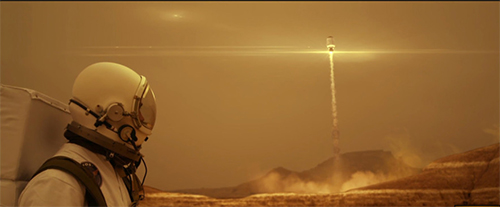
Titan, Saturn’s largest moon, is the main stage of the Mission Cronos. Orpheus, one of the astronauts who have descended to its surface, is searching for organic life forms. This is his story.
The Last Journey of Paul WR
Dir: Romain Quirot
17 minutes
France, 2015
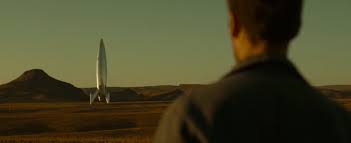
The red moon threatens the existence of our planet. Mankind only hope lies upon the shoulders of the enigmatic Paul WR, the most talented astronaut of his generation. Mysteriously, a few hours before the mission launch, Paul has disappeared.
TELEIOS
Directed by Ian Truitner
USA, 1 hr 22 minutes
2016
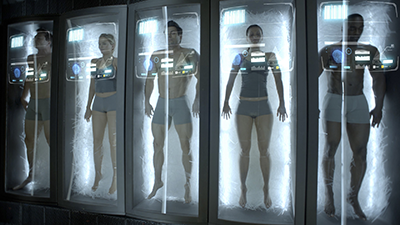
Five genetically engineered “perfect” humans are sent on a rescue mission to Titan, where only one man has survived a ruined expedition to retrieve a vital cargo. Under the stress of isolation in outer space, the five perfect humans begin to exhibit formerly-concealed character flaws that threaten to tear the mission (and their chances for survival) apart.
New images taken with the Atacama Large Millimeter/submillimeter Array (ALMA) in Chile have revealed otherwise invisible details of our Sun, including a new view of the dark, contorted centre of a sunspot that is nearly twice the diameter of the Earth. The images are the first ever made of the Sun with a facility where ESO is a partner. The results are an important expansion of the range of observations that can be used to probe the physics of our nearest star. The ALMA antennas had been carefully designed so they could image the Sun without being damaged by the intense heat of the focused light.
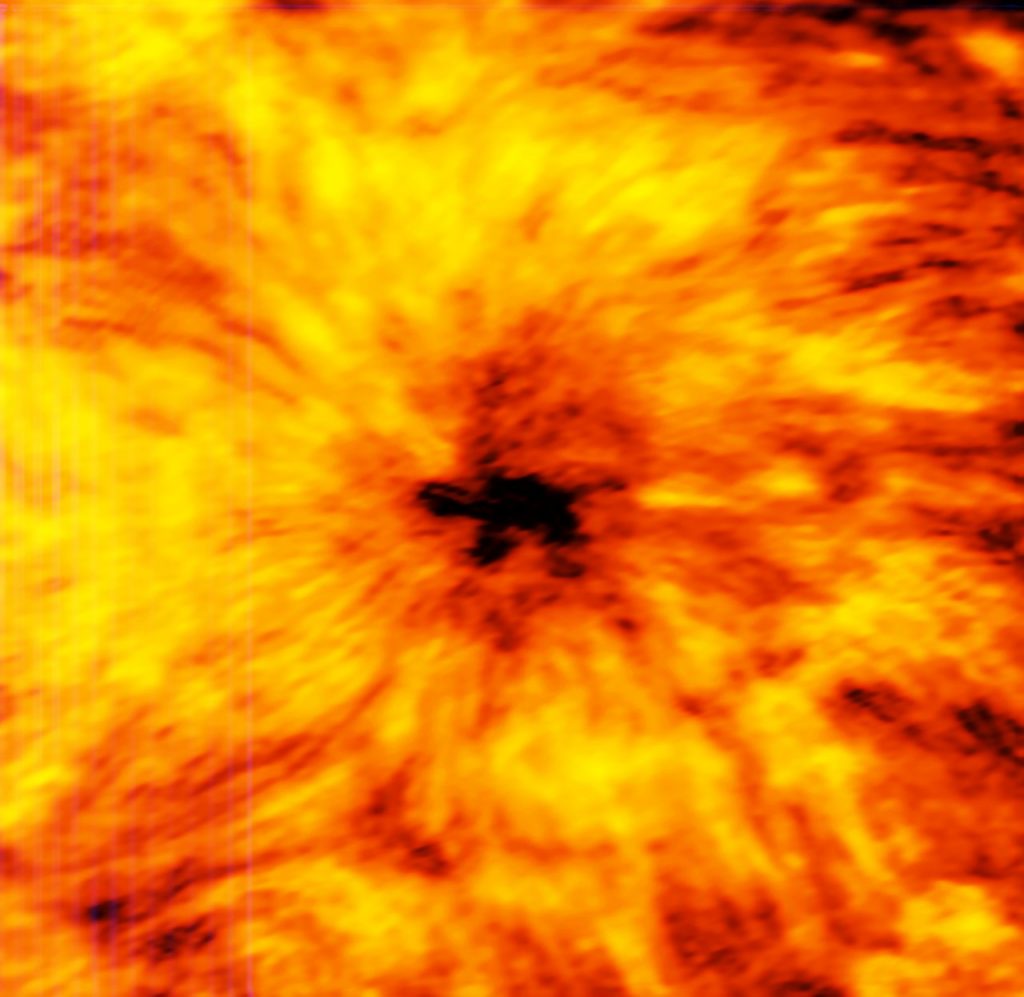
This ALMA image of an enormous sunspot was taken at a wavelength of 1.25 millimetres. Sunspots are transient features that occur in regions where the Sun’s magnetic field is extremely concentrated and powerful. They have lower temperatures than their surrounding regions, which is why they appear relatively dark. These observations are the first ever made of the Sun with a facility where ESO is a partner. They are an important expansion of the range of observations that can be used to probe the mysterious physics of our nearest star. [Larger images]Astronomers have harnessed ALMA‘s capabilities to image the millimetre-wavelength light emitted by the Sun’s chromosphere — the region that lies just above the photosphere, which forms the visible surface of the Sun. The solar campaign team, an international group of astronomers with members from Europe, North America and East Asia [1], produced the images as a demonstration of ALMA’s ability to study solar activity at longer wavelengths of light than are typically available to solar observatories on Earth.
The ALMA telescope has been used to study the Sun for the first time. It is also the first time that an ESO facility has been used to study our nearest star. This ESOcast Light takes a quick look at the main facts and why this is an important step for the future of solar observing.
Astronomers have studied the Sun and probed its dynamic surface and energetic atmosphere in many ways through the centuries. But, to achieve a fuller understanding, astronomers need to study it across the entire electromagnetic spectrum, including the millimetre and submillimetre portion that ALMA can observe.
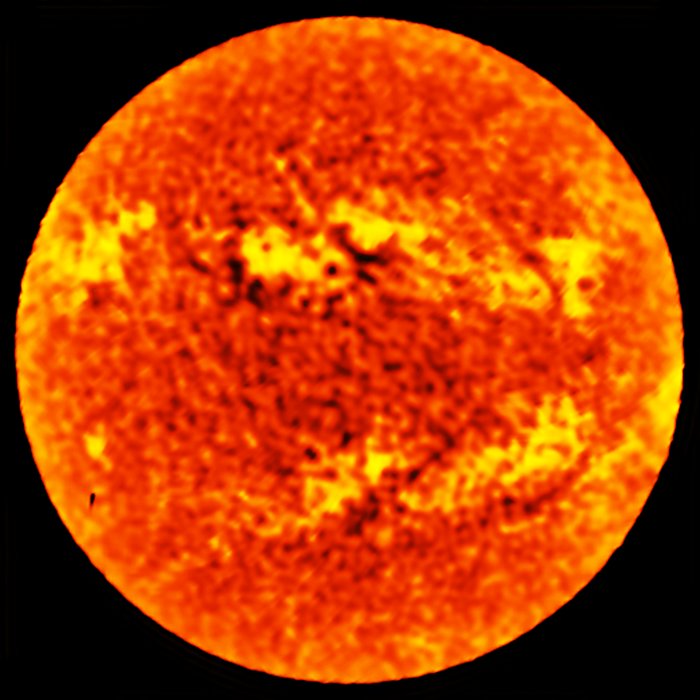
A map of the whole disc of the Sun was also made with a single ALMA antenna, using a technique called fast-scanning, at a wavelength of 1.25 millimetres. The accuracy and speed of observing with a single ALMA antenna make it possible to produce a map of the entire solar disc in just a few minutes. These maps show the distribution of temperatures in the chromosphere over the whole disc at low spatial resolution and therefore complement the detailed interferometric images of individual regions of interest. [Larger image.]Since the Sun is many billions of times brighter than the faint objects ALMA typically observes, the ALMA antennas were specially designed to allow them to image the Sun in exquisite detail using the technique of radio interferometry — and avoid damage from the intense heat of the focussed sunlight [2]. The result of this work is a series of images that demonstrate ALMA’s unique vision and ability to study our Sun.The data from the solar observing campaign are being released this week to the worldwide astronomical community for further study and analysis.
This comparison video starts with a view of the solar disc at ultraviolet wavelengths from the NASA Solar Dynamics Observatory. The final view of the disc comes from recent observations by ALMA at millimetre wavelengths. Credit: NASA-SDO, ALMA (ESO/NAOJ/NRAO)
The team observed an enormous sunspot at wavelengths of 1.25 millimetres and 3 millimetres using two of ALMA’s receiver bands. The images reveal differences in temperature between parts of the Sun’s chromosphere [3]. Understanding the heating and dynamics of the chromosphere are key areas of research that will be addressed in the future using ALMA.
Sunspots are transient features that occur in regions where the Sun’s magnetic field is extremely concentrated and powerful. They are lower in temperature than the surrounding regions, which is why they appear relatively dark.
This video shows a major sunspot on the surface of the Sun. The initial view is in visible light, from NASA’s Solar Dynamics Observatory and the final view is from ALMA, at millimetre wavelengths. Credit: NASA-SDO, ALMA (ESO/NAOJ/NRAO)
The difference in appearance between the two images is due to the different wavelengths of emitted light being observed. Observations at shorter wavelengths are able to probe deeper into the Sun, meaning the 1.25 millimetre images show a layer of the chromosphere that is deeper, and therefore closer to the photosphere, than those made at a wavelength of 3 millimetres.
ALMA is the first facility where ESO is a partner that allows astronomers to study the nearest star, our own Sun. All other existing and past ESO facilities need to be protected from the intense solar radiation to avoid damage. The new ALMA capabilities will expand the ESO community to include solar astronomers.
Notes
[1] The ALMA Solar Campaign team includes: Shin’ichiro Asayama, East Asia ALMA Support Center, Tokyo, Japan; Miroslav Barta, Astronomical Institute of the Czech Academy of Sciences, Ondrejov, Czech Republic; Tim Bastian, National Radio Astronomy Observatory, USA; Roman Brajsa, Hvar Observatory, Faculty of Geodesy, University of Zagreb, Croatia; Bin Chen, New Jersey Institute of Technology, USA; Bart De Pontieu, LMSAL, USA; Gregory Fleishman, New Jersey Institute of Technology, USA; Dale Gary, New Jersey Institute of Technology, USA; Antonio Hales, Joint ALMA Observatory, Chile; Akihiko Hirota, Joint ALMA Observatory, Chile; Hugh Hudson, School of Physics and Astronomy, University of Glasgow, UK; Richard Hills, Cavendish Laboratory, Cambridge, UK; Kazumasa Iwai, National Institute of Information and Communications Technology, Japan; Sujin Kim, Korea Astronomy and Space Science Institute, Daejeon, Republic of Korea; Neil Philips, Joint ALMA Observatory, Chile; Tsuyoshi Sawada, Joint ALMA Observatory, Chile; Masumi Shimojo (interferometry lead), NAOJ, Tokyo, Japan; Giorgio Siringo, Joint ALMA Observatory, Chile; Ivica Skokic, Astronomical Institute of the Czech Academy of Sciences, Ondrejov, Czech Republic; Sven Wedemeyer, Institute of Theoretical Astrophysics, University of Oslo, Norway; Stephen White (single dish lead), AFRL, USA; Pavel Yagoubov, ESO, Garching, Germany and Yihua Yan, NAO, Chinese Academy of Sciences, Beijing, China.
[2] Indeed, this lesson has been learned the hard way: the Swedish–ESO Submillimetre Telescope (SEST) had a fire in its secondary mirror assembly after the telescope was accidentally pointed at the Sun.
[3] A map of the whole disc of the Sun was also made with a single ALMA antenna, using a technique called fast-scanning, at a wavelength of 1.25 millimetres. The accuracy and speed of observing with a single ALMA antenna makes it possible to produce a map of the entire solar disc in just a few minutes. These maps show the distribution of temperatures in the chromosphere over the whole disc at low spatial resolution and therefore complement the detailed interferometric images of individual regions of interest.