ESO: Observational evidence of first generation of stars in the early universe

Here’s a new ESO report:

Best Observational Evidence of First Generation Stars in the Universe

Astronomers using ESO’s Very Large Telescope have discovered by far the brightest galaxy yet found in the early Universe and found strong evidence that examples of the first generation of stars lurk within it. These massive, brilliant, and previously purely theoretical objects were the creators of the first heavy elements in history — the elements necessary to forge the stars around us today, the planets that orbit them, and life as we know it. The newly found galaxy, labelled CR7, is three times brighter than the brightest distant galaxy known up to now.
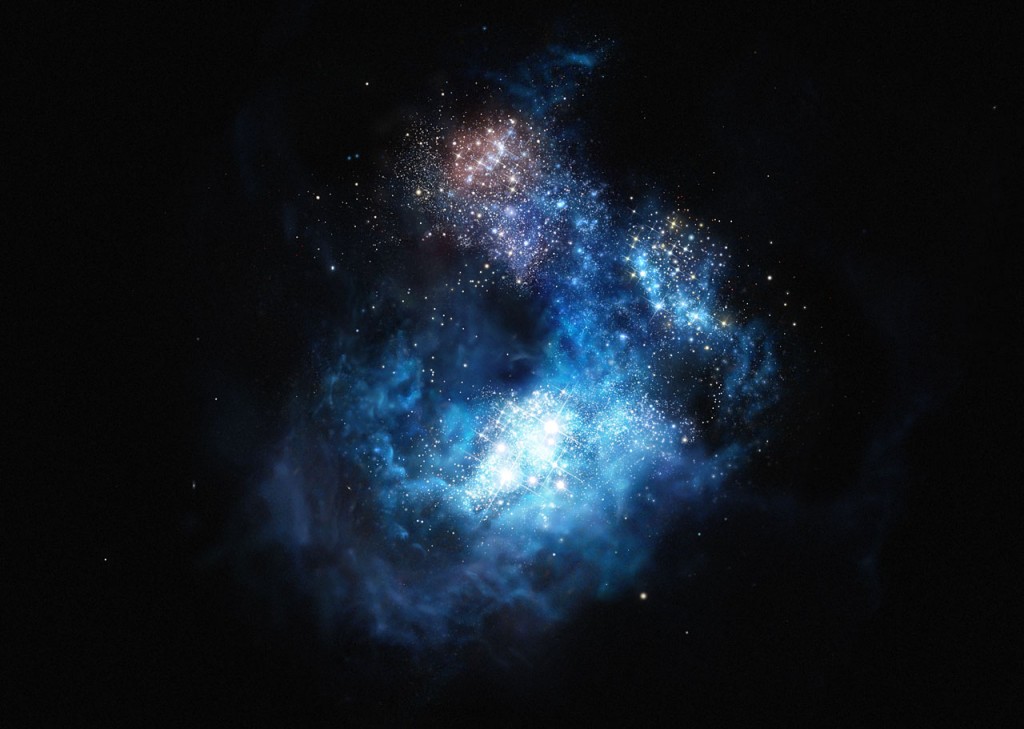
This artist’s impression shows CR7 a very distant galaxy discovered using ESO’s Very Large Telescope. It is by far the brightest galaxy yet found in the early Universe and there is strong evidence that examples of the first generation of stars lurk within it. These massive, brilliant, and previously purely theoretical objects were the creators of the first heavy elements in history — the elements necessary to forge the stars around us today, the planets that orbit them, and life as we know it. This newly found galaxy is three times brighter than the brightest distant galaxy known up to now.

Astronomers have long theorised the existence of a first generation of stars — known as Population III stars — that were born out of the primordial material from the Big Bang [1]. All the heavier chemical elements — such as oxygen, nitrogen, carbon and iron, which are essential to life — were forged in the bellies of stars. This means that the first stars must have formed out of the only elements to exist prior to stars: hydrogen, helium and trace amounts of lithium.

These Population III stars would have been enormous — several hundred or even a thousand times more massive than the Sun — blazing hot, and transient — exploding as supernovae after only about two million years. But until now the search for physical proof of their existence had been inconclusive [2].

A team led by David Sobral, from the Institute of Astrophysics and Space Sciences, the Faculty of Sciences of the University of Lisbon in Portugal, and Leiden Observatory in the Netherlands, has now used ESO’s Very Large Telescope (VLT) to peer back into the ancient Universe, to a period known as reionisation, approximately 800 million years after the Big Bang. Instead of conducting a narrow and deep study of a small area of the sky, they broadened their scope to produce the widest survey of very distant galaxies ever attempted.

Their expansive study was made using the VLT with help from the W. M. Keck Observatory and the Subaru Telescope as well as the NASA/ESA Hubble Space Telescope. The team discovered — and confirmed — a number of surprisingly bright very young galaxies. One of these, labelled CR7 [3], was an exceptionally rare object, by far the brightest galaxy ever observed at this stage in the Universe [4]. With the discovery of CR7 and other bright galaxies, the study was already a success, but further inspection provided additional exciting news.

The X-shooter and SINFONI instruments on the VLT found strong ionised helium emission in CR7 but — crucially and surprisingly — no sign of any heavier elements in a bright pocket in the galaxy. This meant the team had discovered the first good evidence for clusters of Population III stars that had ionised gas within a galaxy in the early Universe [5].

The discovery challenged our expectations from the start,” said David Sobral, “as we didn’t expect to find such a bright galaxy. Then, by unveiling the nature of CR7 piece by piece, we understood that not only had we found by far the most luminous distant galaxy, but also started to realise that it had every single characteristic expected of Population III stars. Those stars were the ones that formed the first heavy atoms that ultimately allowed us to be here. It doesn’t really get any more exciting than this.”

Within CR7, bluer and somewhat redder clusters of stars were found, indicating that the formation of Population III stars had occurred in waves — as had been predicted. What the team directly observed was the last wave of Population III stars, suggesting that such stars should be easier to find than previously thought: they reside amongst regular stars, in brighter galaxies, not just in the earliest, smallest, and dimmest galaxies, which are so faint as to be extremely difficult to study.

Jorryt Matthee, second author of the paper, concluded: “I have always wondered where we come from. Even as a child I wanted to know where the elements come from: the calcium in my bones, the carbon in my muscles, the iron in my blood. I found out that these were first formed at the very beginning of the Universe, by the first generation of stars. With this discovery, remarkably, we are starting to actually see such objects for the first time.”

Further observations with the VLT, ALMA, and the NASA/ESA Hubble Space Telescope are planned to confirm beyond doubt that what has been observed are Population III stars, and to search for and identify further examples.

Notes

[1] The name Population III arose because astronomers had already classed the stars of the Milky Way as Population I (stars like the Sun, rich in heavier elements and forming the disc) and Population II (older stars, with a low heavy-element content, and found in the Milky Way bulge and halo, and globular star clusters).

[2] Finding these stars is very difficult: they would have been extremely short-lived, and would have shone at a time when the Universe was largely opaque to their light. Previous findings include: Nagao, et al., 2008, where no ionised helium was detected; De Breuck et al., 2000, where ionised helium was detected, but alongside carbon and oxygen, as well as clear signatures of an active galactic nucleus; and Cassata et al., 2013, where ionised helium was detected, but of a very lowequivalent width, or weak intensity, and alongside carbon and oxygen.

[3] CR7’s nickname is an abbreviation of COSMOS Redshift 7, a measure of its place in terms of cosmic time. The higher the redshift, the more distant the galaxy and the further back in the history of the Universe it is seen. A1689-zD1, one of the oldest galaxies ever observed, for example, has a redshift of 7.5.

CR7 is located in the COSMOS field, an intensely studied patch of sky in the constellation of Sextans (The Sextant).

The nickname was inspired by the great Portuguese footballer, Cristiano Ronaldo, who is known as CR7.

[4] CR7 is three times brighter in terms of ultraviolet light emission than the previous titleholder, Himiko, which was thought to be one of a kind at this very early time. Dusty galaxies, at later stages in the history of the Universe, may radiate far more total energy than CR7 in the form of infrared radiation from warm dust. The energy coming from CR7 is mostly ultraviolet/visible light.

[5] The team considered two alternate theories: that the source of the light was either from an AGN or Wolf–Rayet stars. The lack of heavy elements, and other evidence strongly refutes both these theories. The team also considered that the source may be a direct-collapse black hole, which are themselves exceptional exotic and purely theoretical objects. The lack of a broad emission line and the fact that the hydrogen and helium luminosities were much greater than what has been predicted for such a black hole indicate that this, too, is unlikely. A lack of X-ray emissions would further refute this possibility, but additional observations are needed.

Video: Young delight in flight

I bet this young lady would enjoy a trip to space when she turns 18:

https://vimeo.com/130828401

Via Watch This 4-Year-Old’s Glee During Her First Plane Ride – PopularMechanics.com.

New Horizons Pluto mission: New video + Course correction

A video from the New Horizons mission to Pluto:

And here is a press release:

One Month from Pluto:
New Horizons on Track, All Clear, and Ready for Action

Now within one month of the historic Pluto flyby, NASA’s New Horizons team has executed a small but important course correction for the spacecraft, completed updated analyses of possible hazards in the Pluto system, and is picking up the pace of science-data collection.

Homing in on Pluto

A 45-second thruster burst on June 14 refined New Horizons’ trajectory toward Pluto, targeting the optimal aim point for the spacecraft’s flight through the Pluto system.

This was only the second targeting maneuver of New Horizons’ approach to Pluto; Sunday’s burst adjusted the spacecraft’s velocity by just 52 centimeters per second, aiming it toward the desired close-approach target point approximately 7,750 miles above Pluto’s surface.

The maneuver was based on the latest radio tracking data on the spacecraft and range-to-Pluto measurements made by optical-navigation imaging of the Pluto system taken by New Horizons in recent weeks.

Using commands transmitted to the spacecraft on June 12-13, the thrusters began firing at 12:05 a.m. EDT and stopped 45 seconds later. Telemetry indicating the spacecraft was healthy and that the maneuver was performed accurately reached the New Horizons Mission Operations Center at the Johns Hopkins University Applied Physics Laboratory in Laurel, Maryland, through NASA’s Deep Space Network at 6:23 a.m. EDT. With the spacecraft about 2.95 billion miles from home, the radio transmissions from its communications system need nearly 4.5 hours to reach Earth.

Mark Holdridge, New Horizons encounter mission manager at APL, said that without the maneuver, the spacecraft was on a line to arrive about 470 miles (755 kilometers) away from the aim point at Pluto, some 84 seconds earlier than desired. The New Horizons team will continue to analyze spacecraft navigation and tracking data with an eye on June 24, which would be the next opportunity for them to adjust course.

New Horizons is now less than 22 million miles from the Pluto system, or less than 100 times as far from Pluto as the moon is from Earth. The spacecraft is healthy and all systems are operating normally. Approach science operations resume today.

Latest Hazard Search Complete; All Still Clear

Planning for a daring close approach that will take its spacecraft inside the orbits of all five of Pluto’s known moons, the New Horizons team has completed its analysis of the second and third sets of hazard-search observations of the Pluto system.

The data were taken May 29-30 and June 5, using the telescopic Long-Range Reconnaissance Imager (LORRI) camera on New Horizons. For these observations, LORRI is commanded to take hundreds of long-exposure (10-second) images, which are combined to enable a highly sensitive search for faint satellites, rings or dust-sheets in the system.

All elements of the process went well, including the observations, the downlink of the images, the resulting data reductions, and the search for new moons or rings that might present hazards to the fast-moving New Horizons spacecraft when it flies through the Pluto system on July 14.

The latest hazard observations easily detected Pluto and all five known moons, but no rings, new moons, or hazards of any kind were found. The New Horizons hazard detection team determined that satellites as faint as about four times dimmer than Pluto’s faintest known moon, Styx, would have been seen if they existed beyond the orbit of Pluto’s largest and closest moon, Charon. Limits on possible rings are unchanged since the first hazard observations in May: any undiscovered rings must be very faint or narrow – less than 1,000 miles wide or reflecting less than one 5-millionth of the incoming sunlight.

The next New Horizons hazard search will start June 15, and the team will report on the results on approximately June 25, after completing a detailed analysis of the new and still more sensitive data.

What’s Next?

In the last week of June, the Pluto approach enters its third and final far encounter science phase — called Approach Phase 3, which runs until seven days before Pluto close approach.

“AP3” highlights include taking additional images of the Pluto system for final navigation purposes; mapping Pluto and Charon in increasing detail and watching for variability in color, surface composition and atmospheric patterns as the small planets rotate; and searching for new moon and rings with even greater sensitivity. New Horizons will also continue sampling of the interplanetary environment – measuring both solar wind and high-energy particles, as well as dust-particle concentrations – approaching Pluto and its moons.

“Every day we break a new distance record to Pluto, and every day our data get better,” says mission Principal Investigator Alan Stern, of the Southwest Research Institute, Boulder, Colorado. “Nothing like this kind of frontier, outer solar system exploration has happened since Voyager 2 was at Neptune way back in 1989. It’s exciting–come and watch as New Horizons turns points of light into a newly explored planetary system and its moons!”

The Johns Hopkins University Applied Physics Laboratory in Laurel, Maryland, designed, built, and operates the New Horizons spacecraft, and manages the mission for NASA’s Science Mission Directorate. The Southwest Research Institute, based in San Antonio, leads the science team, payload operations and encounter science planning. New Horizons is part of the New Frontiers Program managed by NASA’s Marshall Space Flight Center in Huntsville, Alabama.

To view images from New Horizons and learn more about the mission visit: www.nasa.gov/newhorizons

Follow the New Horizons mission on social media, and use the hashtag #PlutoFlyby to join the conversation. The mission’s official NASA Twitter account is @NASANewHorizons. Live updates will be available on Facebook at: https://www.facebook.com/new.horizons1

Sci-Tech: SpaceX sponsoring Hyperloop pod competition on test track

Elon Musk is not planning to to develop his Hyperloop mass transit idea with a company of his own. Instead, he is encouraging others to develop it. Today SpaceX announced that a short test track will be built near the company’s headquarters in Hawthorne, California, which will be used for

an open competition, geared towards university students and independent engineering teams, to design and build the best Hyperloop pod. To support this competition, SpaceX will construct a one-mile [1.61 km] test track adjacent to our Hawthorne, California headquarters. Teams will be able to test their human-scale pods during a competition weekend at the track, currently targeted for June 2016. The knowledge gained here will continue to be open-sourced.

The details of the competition are described in SpaceX Hyperloop Pod Competition (pdf).

The Space Show this week – June.15.15

The guests and topics of discussion on The Space Show this week:

1. Monday, June 15, 2015: 2-3:30 PM PDT (5-6:30 PM EDT; 4-5:30 PM CDT): We welcome back RANDA & ROD MILLIRON OF INTERBITAL SYSTEMS. See www.interorbital.com.

2. Tuesday, June 16, 2015:,7-8:30 PM PDT (10-11:30 PM EST, 9-10:30 PM CDT): We welcome back ROBERT (BOB) ZIMMERMAN, author, space journalist and more. For more information, visit his website, www.behindtheblack.com.

3. Friday, June 19, 2015; 9:30 -11 AM PDT (12:30-2 PM EDT; 11:30-1 PM CDT):We welcome back DR. BRUCE CORDELL for Maslow Windows updates and more.

4. Sunday, June 21, 2015: 12-1:30 PM PDT (3-4:30 PM EDT, 2-3:30 PM CDT): No show due to Dad’s Day. Happy Father’s Day to all Space Show fathers.

See also:
/– The Space Show on Vimeo – webinar videos
/– The Space Show’s Blog – summaries of interviews.
/– The Space Show Classroom Blog – tutorial programs

The Space Show is a project of the One Giant Leap Foundation.