Uwingu launches its first call for student grant applications

An announcement from Uwingu:

Uwingu Launches Its First Call for Grant Applications
Resulting Grants Will Fund Planetary Science Graduate Student Travel
to Report Research Results at Scientific Meetings During
This Time of Budget Cuts

Space startup Uwingu announced today that it is soliciting applications from planetary science graduate students to support their travel to report research results at scientific meetings in 2014 and early 2015. Applications are due by 30 April 2014 at 11:59 PM PST.

Uwingu expects to make 10-15 awards of travel grants from this solicitation by early June. Any graduate student completing their PhD in 2014 who is studying planetary science and/or exoplanets are eligible. Recipients must use the funds to present their research at a research conference occurring by 30 April 2015. Selections will be made based on material provided by applicants in the form at: http://tinyurl.com/Uwingu-TravelAwards.

Uwingu is a for profit, public engagement space company based in Boulder, CO, led by senior planetary scientists and astronomers (see http://www.uwingu.com/about-us/who-we-are/). Uwingu’s mission is to connect the public to space exploration in new ways and to create a grant fund to support a wide range of space efforts by individual space researchers, educators, and organizations.

Uwingu’s Mars Map Crater Naming Project at www.uwingu.com, which is funding these student grants, allows anyone with a connection to the Internet to help name approximately 590,000 unnamed, scientifically cataloged craters on Mars. The project aims to ultimately raise up to $10M for Uwingu’s grant fund.
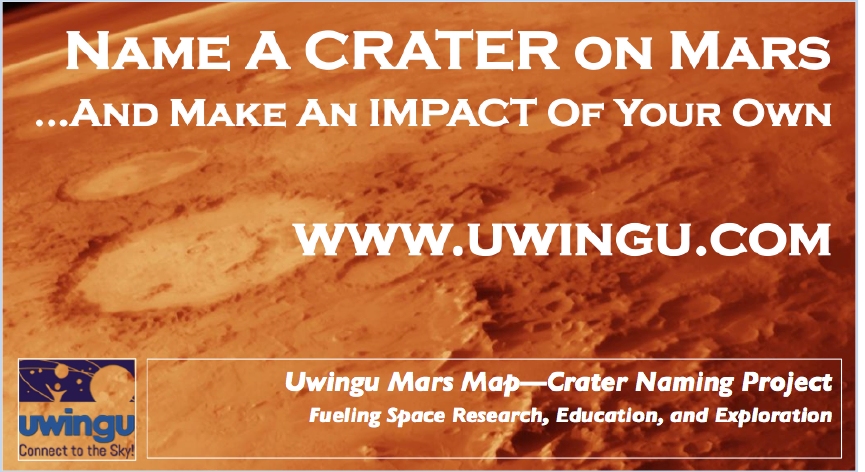
NameACraterOnMars_banner

Uwingu’s Mars map grandfathers in all the already named craters on Mars, opening the remainder up for naming by people around the globe. Prices for naming craters depend on the size of the crater, and begin at $5 dollars. Uwingu makes a shareable Internet link and a naming certificate available to each crater namer for each newly named crater. This public engagement project will culminate with the flight of Uwingufs Mars Map to Mars in 2018 aboard the Mars One 2018 robotic lander, currently in definition phase at aerospace giant Lockheed-Martin

Dr. Alan Stern, Uwingu’s CEO added, “We are excited to begin making grants to students and to supporting their research, and look forward to selecting the best applications we receive for funding. We expect to make more and more grant solicitations as revenues from our Mars Map Crater Naming Project continue to grow.”

Space policy roundup – April.7.14 [Update]

Today’s selection of space policy/politics related links: 

[ Update:

Update 2:

]

===

I recently came across this interesting 1985 article describing a discussion of Shuttle launch costs during a Congressional hearing: L5 News: Shuttle Pricing and Space Development.

Commercial launch was in its infancy at the time and the new industry had to deal with the fact that NASA wanted  the Space  Shuttle to provide launch services for commercial satellites. The commercial guys did not have the clout to stop this government competition (after the Challenger disaster, commercial satellite launch was taken away from NASA) but they pushed for NASA to at least charge enough to cover the cost of a Shuttle mission.

In 1985 and in 2014, NASA implements a favored government agency technique when asked for the cost of its services: obfuscation. The most basic, straight-forward estimate of the cost of a launch is simply the annual cost of the launch program divided by the number of launches annually, plus some increment from an estimate of the amortization of the development costs. NASA always rejects this basic accounting method and insists that launch cost requires very complicated calculations  by teams of accountants and analysts who must determine what internal services, materials, etc are included. What eventually emerges from the agency is their famously fantastical marginal cost numbers that ignore program and development costs and instead only include estimates of materials, fuels, services, etc consumed during a launch.

As Rick Boozer notes in today’s Space Review article, NASA is giving an absurd $500M marginal cost number for a SLS launch.  The SLS program will cost tens of billions in development and require an annual cost in the $3B +range. NASA will be lucky to average one SLS flight per year. So even if development costs are ignored, an SLS flight will cost $3B+.

Congressional hearings on NASA are always dominated by Congresspersons representing states and districts with NASA centers. Thus, today as in 1985, actual launch costs are ignored and NASA’s marginal cost fantasies are still treated seriously. Unfortunately, they are seldom called on this by the press or the space policy establishment.

The total money spent on the Space Shuttle program was $209 B (in 2010 dollars) and thus the average cost of the 134 flights was $1.6B. NASA, of course, still claims a Shuttle flight cost below $500M.

(It’s not just NASA that obfuscates to its advantage. The GAO recently gave up trying to determine what an EELV launch costs the US Air Force. )

===

Here’s a video of a recent panel discussion event at the Marshall Institute in Washington D.C. with the theme : Moon’s Challenges and Opportunities for Human Space Exploration –

On Tuesday March 25, 2014, the Marshall Institute and the Space Enterprise Council brought together a panel of experts to discuss the pressing scientific, technological and economic issues involved in human settlement on the Moon.

The panel speakers are:

* Dr. Paul D. Spudis, Planetary Geology and Remote Sensing, Lunar and Planetary Institute.

* Mike Gold, Director of D.C. Operations & Business Growth, Bigelow Aerospace, LLC

* Dr. Haym Benaroya, Distinguished Professor of Mechanical and Aerospace Engineering, Rutgers University

Additional details at http://marshall.org/events/human-settlement-in-space-the-moons-challenges-and-opportunities/

The Space Show this week

The guests and topics for The Space Show this week:

1. Monday, April 7, 2014, 2-3:30 PM PDT(5-6:30 PM EDT, 4-5:30 PM CDT): We welcome back RANDA & ROD MILLIRON of Interorbital Systems to discuss their recent successful test launch.

2. Tuesday, April 8, 2014:, 7-8:30 PM PDT (10-11:30 PM EDT, 9-10:30 PM CDT): We welcome back ROBERT (BOB) ZIMMERMAN for space news updates and more.

3. Friday, April 11, 2014, 9:30-11 AM PDT (12:30-2 PM EDT; 11:30 AM-1 PM CDT): We welcome back DR. CLAY MOLTZ to discuss his new book Crowded Orbits: Conflict & Cooperation in Space .

4. Sunday, April 13, 2014, 12-1:30 PM PDT (3-4:30 PM EDT, 2-3:30 PM CDT). OPEN LINES. First time callers welcome. All STEM and space topics welcome.

See also:
/– The Space Show on Vimeo – webinar videos
/– The Space Show’s Blog – summaries of interviews.
/– The Space Show Classroom Blog – tutorial programs

The Space Show is a project of the One Giant Leap Foundation.

Science misc: Moon mantle puzzles, Space colonizing diversity, Sky falls more often, Deflating the inflation model

A selection of science related links of intrest that I’ve come across recently:

The Moon’s structure and composition are not as well understood as one might think : The Moon’s Mantle Muddle: Maybe we’ve been looking for the wrong minerals, or maybe our models are wrong – Daily Planet/Air & Space Magazine

===

How many people do you need in your exoplanet colonization caravan to insure a healthy diversity of genes? How Many People Does It Take to Colonize Another Star System? – Popular Mechanics

===

A nuclear detection sensor system detects more asteroids hitting the earth than thought: Blast Sensors Detect More Asteroid Strikes Than Expected – NBC News.com

===

Theoretical physicist Sir Roger Penrose is skeptical that the recent measurements of variations in the cosmic radiation background necessarily validate the Inflation Model as the explanation of the early universe: Sir Roger Penrose: Cosmic Inflation Is ‘Fantasy’ – Science Friday

Spacevidcast: The battle between Roscosmos and NASA

The latest live Spacevidcast show is now in the archives: The battle between Roscosmos and NASA – Spacevidcast –

From the caption:

Spacevidcast is changing names! We are becoming TMRO. Details in this episode.

Our new sub-reddit is now available here:http://www.reddit.com/r/tmro

Help keep Spacevidcast going! We are a crowd funded show supported by our community of TMRO! If you like this episode, consider contributing $1.00 for additional episodes! Details athttp://www.patreon.com/spacevidcast — And for those of you who helped us get to our 2nd Patreon goal, THANK YOU! A detailed list of the equipment we’re looking at is right here:http://www.bhphotovideo.com/bnh/contr…

Want to check out the universe with a 20 Gigapixel image? Head over here: http://www.spitzer.caltech.edu/glimps… and browse away!

In this episode we talk about NASA and how it is cutting communications with Roscosmos… Except for ISS.