Looking in on the Zooniverse citizen science space projects

A scan of of what’s happening with the space related citizen science projects at Zooniverse:

Update May.9.13: Here is a report by Katy Maloney about a recent Zooniverse workshop held n Chicago at the Adler Planetarium :
Search for Space Warps in new citizen science project

A new citizen science project from Zooniverse is titled Space Warps.

This project is a gravitational lens discovery engine. Large astronomical surveys can use Space Warps to find gravitational lenses in their data through the collaborative efforts of citizen scientists.

Here is an animation of the gravitational lenses effect:

http://youtu.be/6hxFV-LvlrU

More information about the project is described here: New Project: Join the Search for ‘Space Warps’ – Zooniverse

Gravitational lenses – or ‘space warps’ – are created when massive galaxies cause light to bend around them such that they act rather like giant lenses in space. By looking through data that has never been seen by human eyes, our new Space Warps project is asking citizen scientists to help discover some of these incredibly rare objects. We need your help to spot these chance-alignments of galaxies in a huge survey of the night sky. To take part visit www.spacewarps.org.

Gravitational lenses help us to answer all kinds of questions about galaxies, including how many very low mass stars such as brown dwarfs – which aren’t bright enough to detect directly in many observations – are lurking in distant galaxies. The Zooniverse has always been about connecting people with the biggest questions and now, with Space Warps, we’re taking our first trip to the early Universe. We’re excited to let people be the first to see some of the rarest astronomical objects of all!

The Space Warps project is a lens discovery engine. Joining the search is easy: when you visit the website you are given examples of what space warps look like and are shown how to mark potential candidates on each image. The first set of images to be inspected in this project is from the CFHT (Canada-France-Hawaii Telescope) legacy survey.

[See above video.]

Computer algorithms have already scanned the images, but there are likely to be many more space warps that the algorithms have missed. We think that only with human help will we find them all. Realistic simulated lenses are dropped into some images to help you learn how to spot them, and reassure you that you’re on the right track. Previous studies have shown that the human brain is better at identifying complex lenses than computers are, and we know at the Zooniverse that members of the public can be at least as good at spotting astronomical objects as experts! We’re going to use the data from citizen scientists to continuously train computers to become better space warp spotters.

This is a really exciting project and you can read more on the Space Warps blog. As with our other projects it can also be found on Twitter (@SpaceWarps), on Facebook and you can discuss any interesting objects you find on Space Warps Talk. We’re really excited about this project and think you’ll be able to make some amazing discoveries through it.


SGAC opens “Find an Asteroid” competition

The SGAC (Space Generation Advisory Council) has opened a Find an Asteroid project:

SGAC gives you the opportunity to take part in an Asteroid Search Campaign. Partnering with the International Astronomical Search Collaboration, and supported by the Minor Planet Center, SGAC has slots available for 10 -15 teams to participate. Team up with your SGAC friends and start hunting!

Registration is now open.

Form a team with 3 – 5 SGAC members and apply by June 1, 2013.
The search campaign will take place 14 August – 18 September, 2013.

More here: SGAC’s “Find An Asteroid” campaign — be part of the UKSEDS team! – UKSEDS


Alternative fuel to hydrazine to be tested with NASA’s GPIM spacecraft

A US Air Force sponsored program has developed a non-toxic alternative propellant to the commonly used, but highly toxic and flammable, monopropellant hydrazine: New research key to revolutionary ‘green’ spacecraft propellant – US Air Force

The new fuel, labeled AF-M315E,  is an “energetic ionic liquid, or EIL”. It was developed by Dr. Tom Hawkins of the Air Force Research Lab with funding from the Integrated High Payoff Rocket Propulsion Technology (IHPRPT) Program.  AF-M315E  offers nearly twice the energy density of hydrazine, has very low vapor flammability and is non-toxic.

The fuel will be tested in space by NASA in 2015 using an engine developed for the fuel by Aerojet in the project called the  Green Propellant Infusion Mission (GPIM)

The Green Propellant Infusion Mission (GPIM) project will demonstrate the practical capabilities of AF-M315E, a high-performance green alternative to hydrazine. This innovative, low-toxicity propellant is expected to improve overall vehicle performance. It boasts a higher density than hydrazine, meaning more of it can be stored in containers of the same volume; it delivers a higher specific impulse, or thrust delivered per given quantity of fuel; and it has a lower freezing point, requiring less spacecraft power to maintain its temperature.


Mars One receives 78,000 applications in 2 weeks for Mars settlement

The Mars One organization released this announcement on Tuesday:

78,000 sign up for one-way mission to Mars
Amersfoort, 7th May 2013 –  Just two weeks into the nineteen week application period, more than seventy-eight thousand people have applied to the Mars One astronaut selection program in the hope of becoming a Mars settler in 2023.

Mars One has received applications from over 120 countries. Most applications come from USA (17324), followed by China (10241), United Kingdom (3581), Russia, Mexico, Brazil, Canada, Colombia, Argentina and India.

Bas Lansdorp, Mars One Co-Founder and CEO said: “With seventy-eight thousand applications in two weeks, this is turning out to be the most desired job in history. These numbers put us right on track for our goal of half a million applicants.”

“Mars One is a mission representing all humanity and its true spirit will be justified only if people from the entire world are represented. I’m proud that this is exactly what we see happening,” he said.

As part of the application every applicant is required to explain his/her motivation behind their decision go to Mars in an one minute video. Many applicants are choosing to publish this video on the Mars One website. These are openly accessible on applicants.mars-one.com.

“Applicants we have received come from a very wide range of personalities, professions and ages. This is significant because what we are looking for is not restricted to a particular background. From Round 1 we will take forward the most committed, creative, resilient and motivated applicants,” said Dr. Norbert Kraft, Mars One Chief Medical Officer.

Mars One will continue to receive online applications until August 31st 2013. From all the applicants in Round 1, regional reviewers will select around 50-100 candidates for Round 2 in each of the 300 geographic regions in the world that Mars One has identified.

Four rounds make the selection process, which will come to an end in 2015; Mars One will then employ 28-40 candidates, who will train for around 7 years. Finally an audience vote will elect one of groups in training to be the envoys of humanity to Mars.

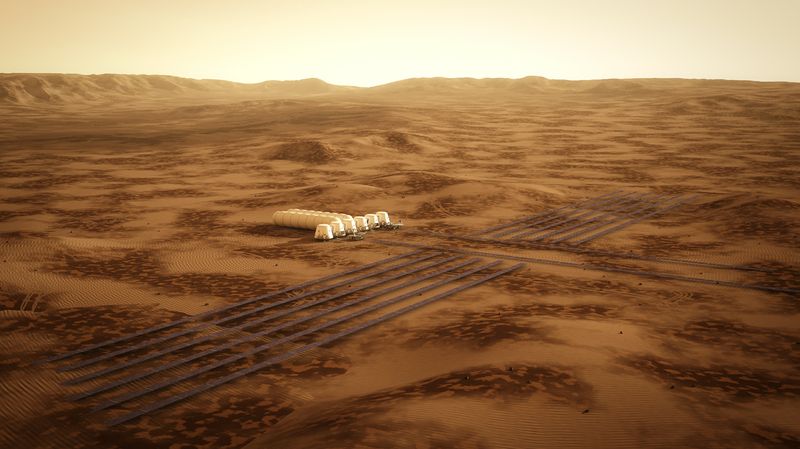
MarsOne_Base

About Mars One:
The Mars One Foundation is a not-for-profit organisation that will send humans to Mars in 2023 to establish the first permanent settlement outside Earth. Before the first settlers land on Mars a self-sustaining habitat will be set up with help of rovers and more settlers will follow every two years. We have designed a realistic plan by using only existing technology available through the private space industry. The first footprint on Mars will fascinate and inspire generations; it is this public interest that will help finance this human mission to Mars. Mars One is supported by space exploration experts from all over the world.