Category Archives: Science and Technology

Sci-Tech: Focus fusion project update from LPPFusion, Inc.

LPPFusion, Inc., formerly Lawrenceville Plasma Physics, Inc, offers some updates on recent developments in their focus fusion program:

* Tungsten Cathode Nears Completion after Long Delays

The long-awaited tungsten cathode is finally nearing completion in a Chinese factory.  According to the latest reports by California-based Tungsten Heavy Powder(THP), which is performing the work in China, machining will be complete within a few weeks and delivery to LPPFusion should occur by mid-February. The 99.95% pure tungsten piece has been in the machining process for nearly two months. Because pure tungsten is as brittle as ceramic and liable to cracking, the part must be removed from machining frequently and heat-treated to relieve internal stress.

samllerelectrode-270x318[1]

Given the extreme difficult of making the tungsten cathode, why does LPPFusion not go directly to the final beryllium electrodes? The answer is that tungsten, with its extreme resistance to heat, is the lowest risk material for the next step of our experiment. We need to eliminate evaporation of the electrode and the resulting impurities to get a jump in the density of our plasmoid, and in the resulting fusion energy output or yield. We have firm experimental evidence that tungsten does not erode under the condition FF-1 is currently running. While we have developed and published well-founded theories of how pre-ionization can stop erosion of much less heat-resistant materials like beryllium, we still need to test those theories experimentally. That we can do safely with tungsten, with risking damage to the electrodes or disappointing fusion results. In this way we will confirm or refine the theories and technique, paving the way for the beryllium electrodes.

Those beryllium electrodes will be ready when we need them. We expect to order them in January, with delivery in the first half of 2015.

* LPPF Releases Processed Data to Researchers and the Public

LPPFusion, Inc. has made available on our website the data in ourProcessed Data Base to all researchers, both professional and amateur. This data provides the key observations for each shot from the start of operation of Focus Fusion-1 in 2009 through the end of 2013 for four instruments: the Main Rogowski coil (MRC), High Voltage Probe (HVP), the Near Time of Flight (NTF) and Far Time of Flight (FTF) detectors. This gives data on the current and voltage produced during a shot and the neutrons and x-rays emitted.  We are making this data publically available in the expectation that other researchers will be able to use the data to provide new insights into the functioning of the Dense Plasma Focus device and advance the field generally.

* Physics of Plasmas Publishes LPPFusion’s Runaway Electron Theory

Physics of Plasmas, the leading journal in the field of plasma physics, has published LPPFusion’s new paper on “Runaway electrons as a source of impurity and reduced fusion yield in the dense plasma focus”. The paper, by Chief Scientist Eric J. Lerner and Chief Research Officer Hamid R. Yousefi, was published online October 22, 2014 less than a month after it was submitted for peer-review. Physics of Plasmas had published a previous LPPFusion paper on record-breaking ion energies in 2012.

The new paper describes the evidence that runaway electrons are a key cause of vaporization of electrodes in the dense plasma focus device, an idea first reported on LPPFusion’s website in April of this year. Runaway electrons occur when very strong electric fields, such as in lightning bolts, accelerate electrons moving through a mainly neutral gas. If the field is strong enough the electrons gain more energy between each collision with an atom than they lose in the collision, thus speeding up to high energy.
Sci-Tech: Tesla Motors to offer range boost to Roadster [Update]

Elon Musk says that Tesla Motors will offer an upgrade to the Roadster, which is no longer in production, that will increase the range from around 240 miles (~385 km) to nearly 400 miles (~640 km) – Elon Musk on Twitter:

Roadster upgrade will enable non-stop travel from LA to SF — almost 400 mile range. Details tmrw. Merry Christmas!”

That’s close to the max range of most gasoline powered cars. There is still the big challenge to lower the very high cost of the battery packs but Tesla is clearly making good progress in EV technology.

Earlier in the week, Tesla also demonstrated a fast battery swap system for the Model S:

Update: Elon added this to his tweet above – Elon Musk on Twitter:

Should mention that a battery pack upgrade is not coming soon for the Model S, but it obviously *will* happen long-term.

Update 2: Here are the details : Roadster 3.0 – Blog/Tesla Motors –

Battery technology has continued a steady improvement in recent years, as has our experience in optimizing total vehicle efficiency through Model S development. We have long been excited to apply our learning back to our first vehicle, and are thrilled to do just that with the prototype Roadster 3.0 package. It consists of three main improvement areas.

1. Batteries
The original Roadster battery was the very first lithium ion battery put into production in any vehicle. It was state of the art in 2008, but cell technology has improved substantially since then. We have identified a new cell that has 31% more energy than the original Roadster cell. Using this new cell we have created a battery pack that delivers roughly 70kWh in the same package as the original battery.

2. Aerodynamics
The original Roadster had a drag coefficient (Cd) of 0.36. Using modern computational methods we expect to make a 15% improvement, dropping the total Cd down to 0.31 with a retrofit aero kit.

3. Rolling Resistance
The original Roadster tires have a rolling resistance coefficient (Crr) of 11.0 kg/ton. New tires that we will use on the Roadster 3.0 have a Crr of roughly 8.9 kg/ton, about a 20% improvement. We are also making improvements in the wheel bearings and residual brake drag that further reduce overall rolling resistance of the car.

Summary
Combining all of these improvements we can achieve a predicted 40-50% improvement on range between the original Roadster and Roadster 3.0. There is a set of speeds and driving conditions where we can confidently drive the Roadster 3.0 over 400 miles. We will be demonstrating this in the real world during a non-stop drive from San Francisco to Los Angeles in the early weeks of 2015.

Appointments for upgrading Roadsters will be taken this spring once the new battery pack finishes safety validation. We are confident that this will not be the last update the Roadster will receive in the many years to come.

Sci-Tech: Hyperloop fast transit system – latest update

Elon Musk introduced his Hyperloop super-fast mass transit concept in August of 2013. He has too much on his plate (i.e. SpaceX, Tesla Motors, and Solar City) to pursue the idea himself and instead has encouraged others to try to make it happen.

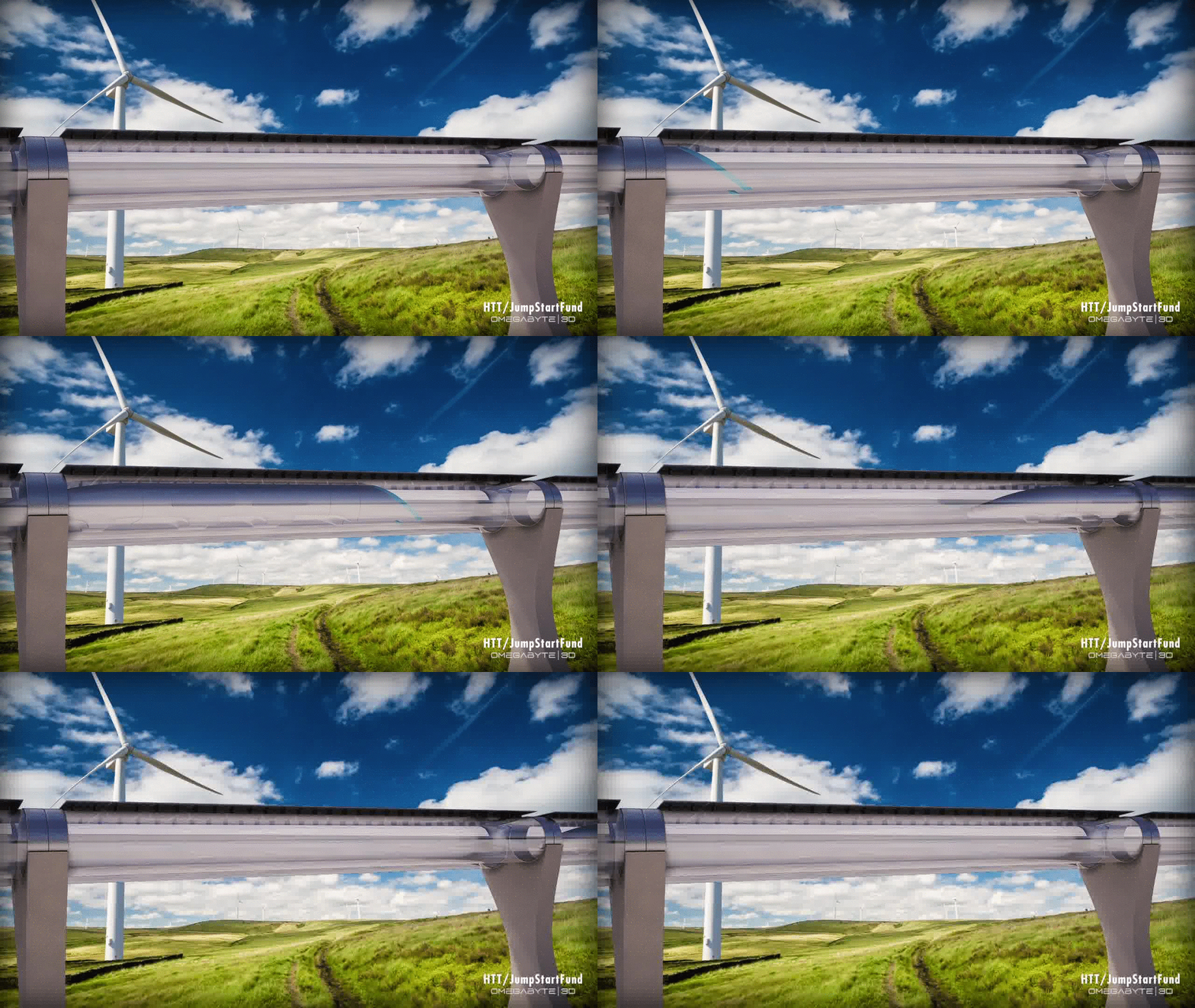
In September of 2013 came word that a Hyperloop company had been formed to try to develop a hyperloop system. The company is a virtual one based at the JumpStartFund with over 100 engineers who work part time on developing real-world build-able design. Here are a couple of reports on their progress so far:

Frame7 08 (Lavc53.28.0)

A student team at UCLA has contributed a lot of work on the concept as well. The 25 students work at SUPRASTUDIO under Prof. Craig Hodgetts. Here’s a video about their work:

And here’s an article about their project: Hyperloop: UCLA graduate students explore feasibility of high-speed tube transportation system – Daily Breeze.

Most of the 25 students are from China, where large urban populations make the Hyperloop and other high-speed rail attractive alternatives to cars and planes. Only two Americans are enrolled in the program.

featureimg_502_547f55db3782d_Untitled-1_610x392[1]

Interstellar: Space box office hit + Kip Thorne and others on the science of the film

The movie Interstellar has made over $550M since its release in November. This is a good sign that proves to Hollywood studios that the success of Gravity was not a fluke. There is clearly a sizable global audience for well-made, intelligent space movies.

The plot devices used to provide scientifically plausible ways to carry out interstellar flight continue to inspire lots of discussions and arguments.

Noted Caltech physicist and cosmologist Kip Thorne was a key adviser on the script and has even written a book titled, The Science of Interstellar.

He recently spoke on the Planetary Society‘s weekly radio program about the movie: Kip Thorne and the Science of Interstellar – The Planetary Society –

The Kavli Foundation hosted an on line Q&A about the movie with three astrophysicists:

From the caption:

Astrophysicists (and Curious Stardust bloggers) Mandeep Gill, Eric Miller and Hardip Sanghera answer YOUR questions about worm holes, black holes and distant galaxies.


===

Sci-Tech: Mach’s principle, James Woodward, and propellantless propulsion

Last January at the NASA Innovative Advanced Concepts Symposium, Gary Hudson, head of the  Space Studies Institute, outlined the experimental investigation that  James Woodward at California State University Fullerton has been doing for many years into the question of whether Mach’s principle leads to propellantless propulsion. (See Gary’s talk in this NIAC 2014 video.)

Recently Charles Platt posted an interesting update on Woodward’s work :  Strange thrust: the unproven science that could propel our children into space – Boing Boing.

The Space Studies institute has been providing some funding for Woodward via SSI’s Exotic Propulsion Initiative. There is a donation button there if you would like to help the project.