Category Archives: Asteroids & Comets

New dwarf planet visitor from the Oort Cloud

Ira Flatow interviews astronomer Chad Trujillo about a new dwarf planet that he and his team discovered in the outer reaches of our solar system: Dwarf Planet Found at the Edge of the Solar System – Science Friday

More about the discovery:

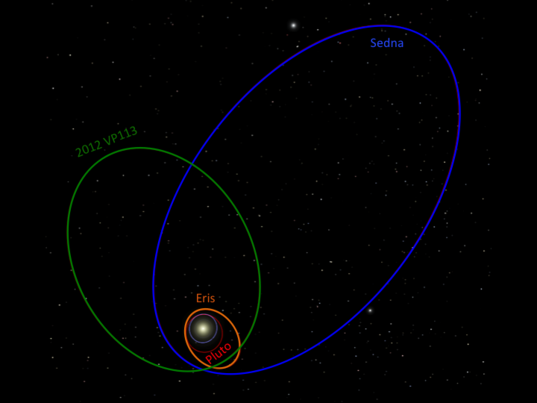
The orbits of Pluto, Eris, Sedna, and 2012 VP113Unmannedspaceflight.com user Lucas, via Planetary Society
This diagram shows the relative sizes of the
orbits of Pluto and the dwarf planets
Eris, Sedna, and 2012 VP113

ESO detects ring around asteroid Chariklo

A surprising find by the European Southern Observatory (ESO):

First Ring System Around Asteroid

Observations at many sites in South America, including ESO’s La Silla Observatory, have made the surprise discovery that the remote asteroid Chariklo is surrounded by two dense and narrow rings. This is the smallest object by far found to have rings and only the fifth body in the Solar System — after the much larger planets Jupiter, Saturn, Uranus and Neptune — to have this feature. The origin of these rings remains a mystery, but they may be the result of a collision that created a disc of debris. The new results are published online in the journal Nature on 26 March 2014.

The rings of Saturn are one of the most spectacular sights in the sky, and less prominent rings have also been found around the other giant planets. Despite many careful searches, no rings had been found around smaller objects orbiting the Sun in the Solar System. Now observations of the distant minor planet [1] (10199) Chariklo [2] as it passed in front of a star have shown that this object too is surrounded by two fine rings.

Loading player…

We weren’t looking for a ring and didn’t think small bodies like Chariklo had them at all, so the discovery — and the amazing amount of detail we saw in the system — came as a complete surprise!” says Felipe Braga-Ribas (Observatório Nacional/MCTI, Rio de Janeiro, Brazil) who planned the observation campaign and is lead author on the new paper.

Chariklo is the largest member of a class known as the Centaurs [3] and it orbits between Saturn and Uranus in the outer Solar System. Predictions had shown that it would pass in front of the star UCAC4 248-108672 on 3 June 2013, as seen from South America [4]. Astronomers using telescopes at seven different locations, including the 1.54-metre Danish and TRAPPIST telescopes at ESO’s La Silla Observatory in Chile [5], were able to watch the star apparently vanish for a few seconds as its light was blocked by Chariklo — an occultation [6].

But they found much more than they were expecting. A few seconds before, and again a few seconds after the main occultation there were two further very short dips in the star’s apparent brightness [7]. Something around Chariklo was blocking the light! By comparing what was seen from different sites the team could reconstruct not only the shape and size of the object itself but also the shape, width, orientation and other properties of the newly discovered rings.

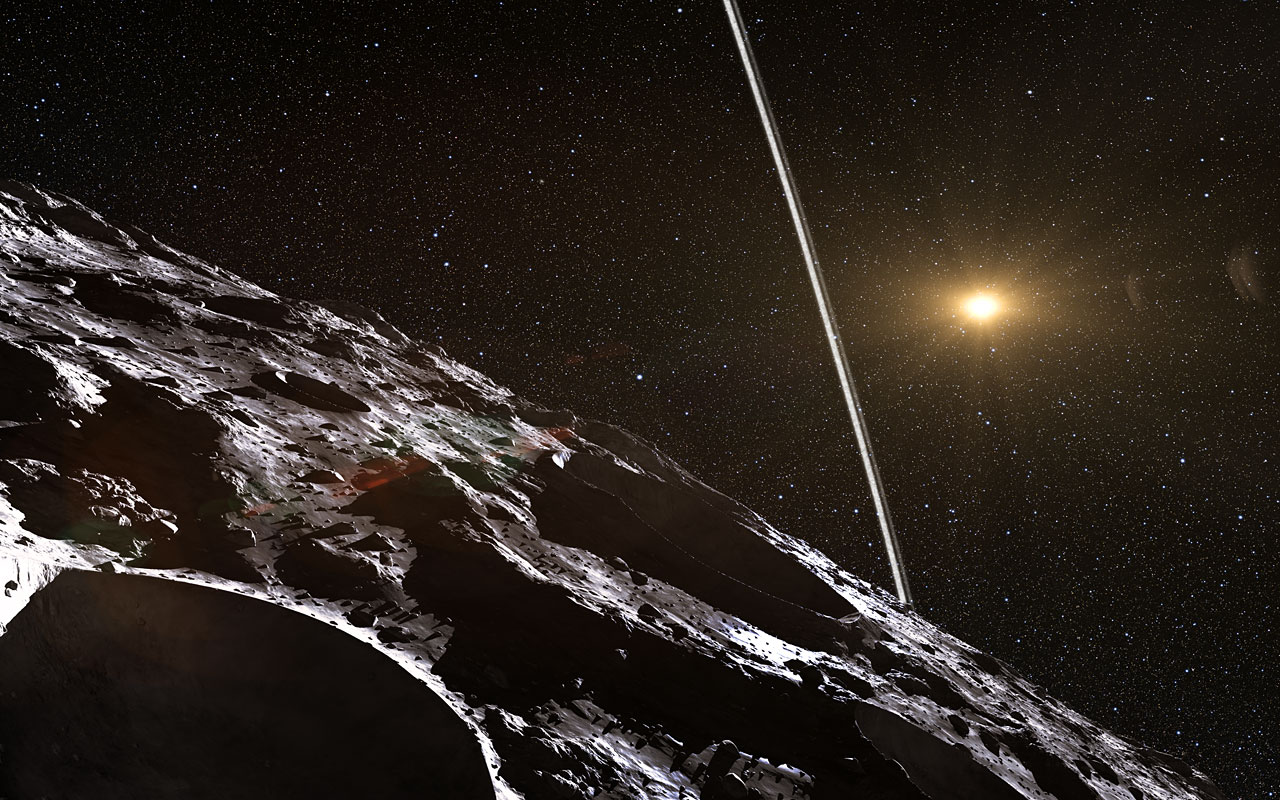
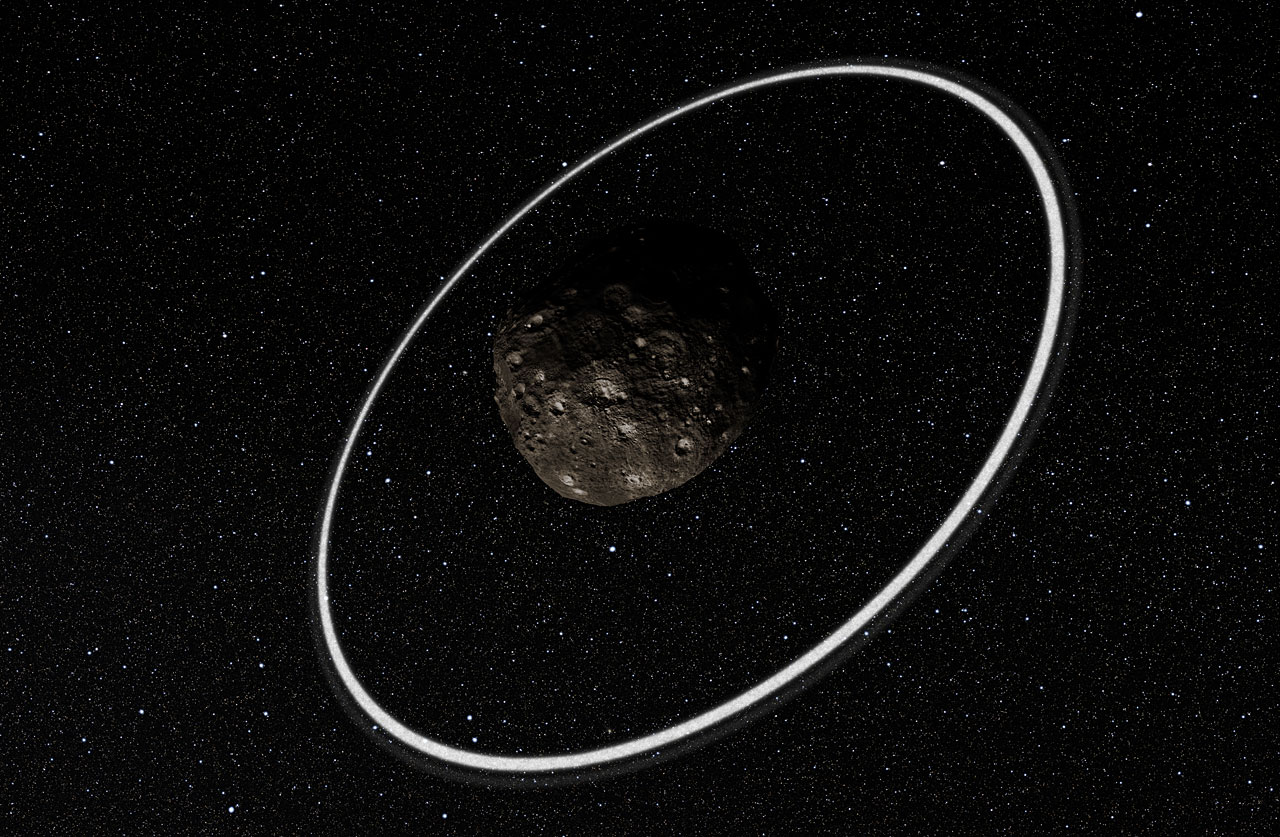
Artist’s impression close-up of the rings around Chariklo
Artist’s sketch of ring around minor planet Chariklo.
Click to Enlarge

The team found that the ring system consists of two sharply confined rings only seven and three kilometres wide, separated by a clear gap of nine kilometres — around a small 250-kilometre diameter object orbiting beyond Saturn.

For me, it was quite amazing to realise that we were able not only to detect a ring system, but also pinpoint that it consists of two clearly distinct rings,” adds Uffe Gråe Jørgensen (Niels Bohr Institute, University of Copenhagen, Denmark), one of the team. “I try to imagine how it would be to stand on the surface of this icy object — small enough that a fast sports car could reach escape velocity and drive off into space — and stare up at a 20-kilometre wide ring system 1000 times closer than the Moon.” [8]

Although many questions remain unanswered, astronomers think that this sort of ring is likely to be formed from debris left over after a collision. It must be confined into the two narrow rings by the presence of small putative satellites.

So, as well as the rings, it’s likely that Chariklo has at least one small moon still waiting to be discovered,” adds Felipe Braga Ribas.

The rings may prove to be a phenomenon that might in turn later lead to the formation of a small moon. Such a sequence of events, on a much larger scale, may explain the birth of our own Moon in the early days of the Solar System, as well as the origin of many other satellites around planets and asteroids.

The leaders of this project are provisionally calling the rings by the nicknames Oiapoque and Chuí, two rivers near the northern and southern extremes of Brazil [9].

FISO: Defending the earth from asteroids – Bill Ailor of Aerospace Corp.

The latest presentation to the Future In-Space Operations (FISO) study group is now posted in the FISO Working Group Presentations Archive. Both slides and videos (zip) and audio (mp3) are available for the talk, Defending the Earth From Asteroids: Meeting the Challenges of Planetary Defense, by Bill Ailor of Aerospace Corp, March 12, 2014.

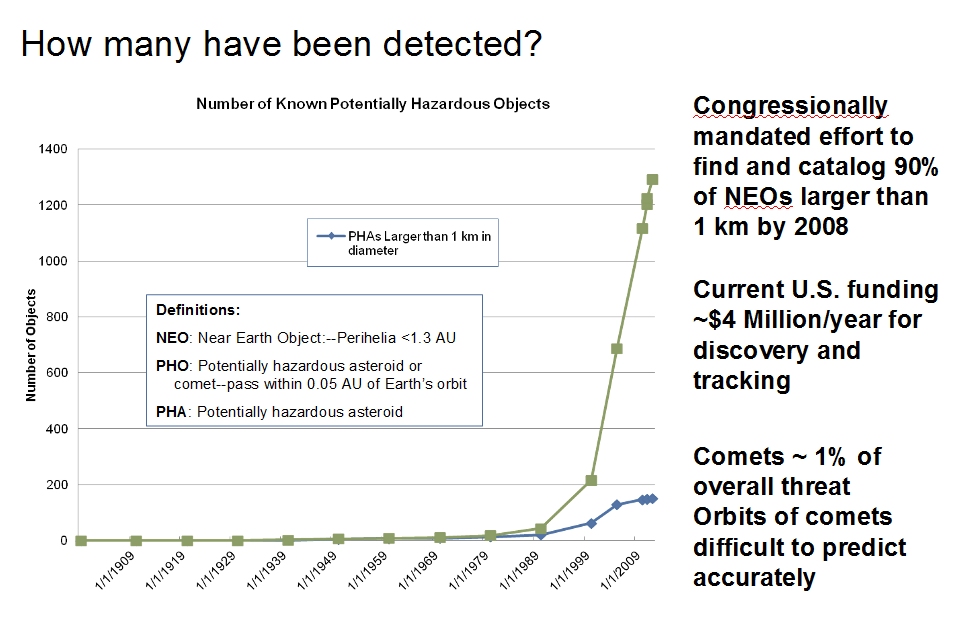
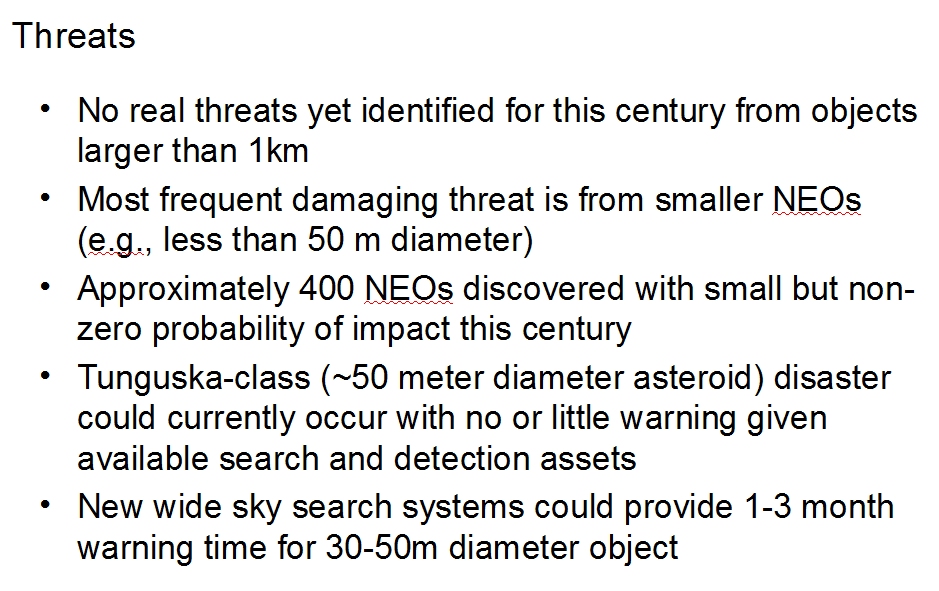
Ailor reviews what’s known about the asteroids and near earth objects, their threats to earth, how a NEO threat could be diverted, and legal/policy issues.

A sample of his slides:

SizesTable

HowManyDetected

Threats

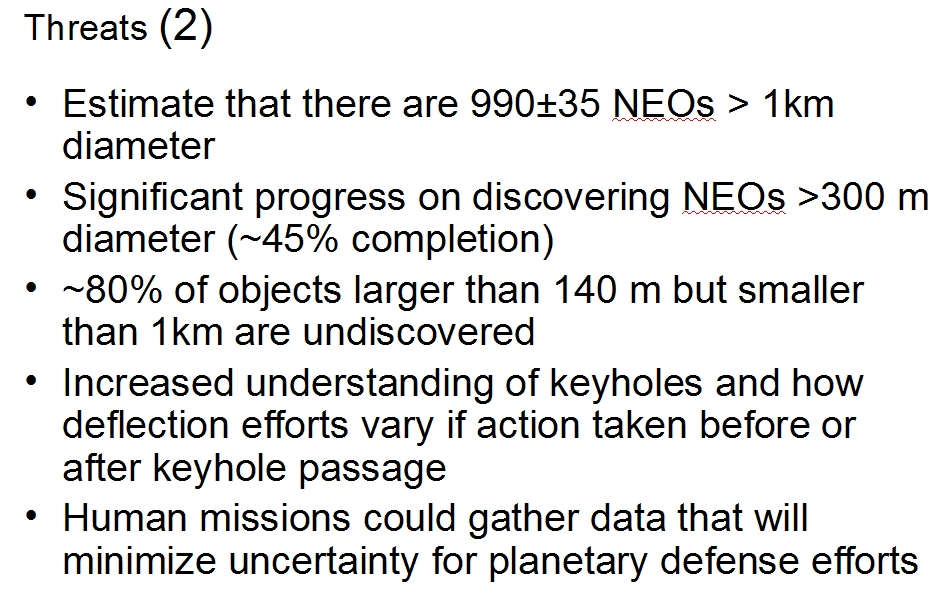
Threats2


Summary


NASA’s Asteroid Grand Challenge Contest

A message from Planetary Resources:

Be an Asteroid Hunter in NASA’s
First Asteroid Grand Challenge Contest Series

NASA’s Asteroid Data Hunter contest series will offer $35,000 in awards over the next six months to citizen scientists who develop improved algorithms that can be used to identify asteroids.

This contest series is being conducted in partnership with Planetary Resources Inc. of Bellevue, Wash. The first contest in the series will kick off on March 17. Prior to the kick off, competitors can create an account on the contest series website and learn more about the rules and different phases of the contest series by going to: http://bit.ly/AsteroidHunters

Managed by the NASA Tournament Lab, the entire contest series runs through August and is the first contest series contributing to the agency’s Asteroid Grand Challenge.

“For the past three years, NASA has been learning and advancing the ability to leverage distributed algorithm and coding skills through the NASA Tournament Lab to solve tough problems,” said Jason Crusan, NASA Tournament Lab director. “We are now applying our experience with algorithm contests to helping protect the planet from asteroid threats through image analysis.”

The Asteroid Data Hunter contest series challenges participants to develop significantly improved algorithms to identify asteroids in images captured by ground-based telescopes. The winning solution must increase the detection sensitivity, minimize the number of false positives, ignore imperfections in the data, and run effectively on all computer systems.

“Protecting the planet from the threat of asteroid impact means first knowing where they are,” said Jenn Gustetic, Prizes and Challenges Program executive. “By opening up the search for asteroids, we are harnessing the potential of innovators and makers and citizen scientists everywhere to help solve this global challenge.”

Gustetic and Jason Kessler, Grand Challenges Program executive, will host a panel March 10 at the South by Southwest Festival in Austin, Texas titled “Are We Smarter than the Dinosaurs?” to talk about how open innovation can meaningfully engage people in discussions on and research into space exploration and help us solve problems of global importance. They will provide an outline of the Asteroid Data Hunter contest series and other efforts to detect asteroid threats, as well as ideas for mitigating these threats.

“Current asteroid detection initiatives are only tracking one percent of the estimated objects that orbit the Sun. We are excited to partner with NASA in this contest to help increase the quantity and knowledge about asteroids that are potential threats, human destinations, or resource rich.” said Chris Lewicki, President and Chief Engineer of the asteroid mining company Planetary Resources, Inc. “Applying distributed algorithm and coding skills to the extensive NASA-funded Catalina Sky Survey data set will yield important insights into the state of the art in detecting asteroids.”

Through NASA’s asteroid initiative, the agency seeks to enhance its ongoing work in the identification and characterization of near-Earth objects for further scientific investigation. This work includes locating potentially hazardous asteroids and identifying those viable for redirection to a stable lunar orbit for future exploration by astronauts. The Asteroid Grand Challenge, one part of the asteroid initiative, expands the agency’s efforts beyond traditional boundaries and encourages partnerships and collaboration with a variety of organizations.

The algorithm contests are managed and executed by NASA’s Center of Excellence for Collaborative Innovation (CoECI). CoECI was established at the request of the White House Office of Science and Technology Policy to advance NASA open innovation efforts and extend that expertise to other federal agencies. CoECI uses the NASA Tournament Lab (NTL) for its advanced algorithmic and software development contests. Through its contract with Harvard Business School in association with Harvard’s Institute of Quantitative Social Science, NTL uses the topcoder platform to enable a community of more than 600,000 designers, developers and data scientists to create the most innovative, efficient and optimized solutions for specific, real-world challenges faced by NASA.

For more information on NASA’s Center of Excellence for Collaborative Innovation, visit: http://www.nasa.gov/coeci

For more information on Planetary Resources, Inc., visit: http://www.planetaryresources.com

For more information on NASA’s asteroid initiative, visit: http://www.nasa.gov/asteroidinitiative
Meteor watching: Bright fireball seen over New Mexico

An entry at Latest Worldwide Meteor/Meteorite News reports on a big fireball over New Mexico. They are looking for security camera and cell phone captures of the event:

NM Large Fireball Meteor 06MAR2014 with video capture / coming soon

Breaking News -NM Large Fireball Meteor 00:29:19 am MST 06MAR2014 — video coming soon.

Report your meteor sightings please-

http://lunarmeteoritehunters.blogspot.jp/2000/11/meteor-fireball-report-form.html
Please help get the word about this event so that we might recover security camera video or cell phone captures; spread the word about this website via Facebook, Twitter, YouTube, Reddit, GLP, SOTT and your favorite forums; contact your local news outlets; thank you!
http://lunarmeteoritehunters.blogspot.com

Initial Meteor Sighting Reports-
On 3/6/14 1:43 27000, Thomas Ashcraft wrote:
March 06 2014 I captured a large fireball over north central New Mexico at 0729:19 UT +/- 2 seconds. (00:29:19 am MST). As bright or brighter than the full Moon. Possibly brighter. I will process it in the morning and post the movie. This one should have been captured well on Albuquerque cameras and might have been right over Albuquerque heading westerlyEnd point might have been western New Mexico or it might have crossed over the Arizona border. Hard to say from one camera view. Big one at least.

Thomas Ashcraft