Category Archives: History

The Space Show: Marc Fusco & Space Age politics + John Batchelor Show: Jeff Foust & Chelyabinsk

Marc Fusco talked on The Space Show on Sunday about “Space history and presidential politics with JFK, Presidents Johnson & Nixon”: Marc Fusco, Sunday, 4-28-13 – Thespaceshow’s Blog.

===

Jeff Foust of The Space Review   (+ spacetoday.net, Space Politics, and NewSpace Journal) spoke on the John Batchelor Show last Tuesday 04/23/13 about the Chelyabinsk fireball event.

Russian amateur group may have found lost Soviet Mars lander

A group of Russian space enthusiasts may have spotted an image of a Soviet Mars lander that transmitted for a few seconds after landing on the Red Planet in 1971 before going permanently silent:

AMS-02 and Shuttle Endeavour

Chris Bergin gives lots of details about the Alpha Magnetic Spectrometer (AMS-02) experiment, particularly regarding how it finally got to the ISS on Shuttle Endeavour: Endeavour’s ongoing legacy: AMS-02 proving its value | NASASpaceFlight.com

See also the earlier posts herehere and here on the results presented yesterday.


NASA offers space program artifacts to schools and museums

An announcement from NASA about historical space items available for schools and museums:

NASA Announces 17th Screening of Space Program Artifacts

WASHINGTON — NASA is inviting eligible educational institutions, museums and other organizations to screen and request historical space artifacts.

The artifacts represent significant human spaceflight technologies, processes and the accomplishments of NASA’s many programs. NASA and the General Services Administration worked together to ensure broad access to space artifacts and to provide a web-based electronic artifacts viewing capability. This is the 17th time since 2009 NASA has made this opportunity available.

The web-based artifacts module is located at: http://gsaxcess.gov/NASAWel.htm

Eligible participants may view the artifacts and request specific items at the website through May 6. Only schools and museums are eligible to receive artifacts. They must register online using an assigned Department of Education number or through the state agency responsible for surplus property.

The artifacts are free of charge. Eligible organizations must cover shipping costs and any special handling fees. Shipping fees on smaller items will be relatively inexpensive, while larger items may involve extensive disassembly, preparation, shipping and reassembly costs. NASA will work closely with eligible organizations, on a case-by-case basis, to address any unique special handling costs.

Special items, such as space shuttle thermal protective tiles and packages of three packets of astronaut food, also are offered on a first-come, first-served basis. Instructions for requesting artifacts and special items are linked on the website home page.

To date, more than 7,700 artifacts from programs, including the Mercury, Gemini, Apollo, space shuttle and the Hubble Space Telescope, have been given to eligible museums, schools, universities, libraries and planetariums in all 50 U.S. states. Artifacts are on display for 42 days. NASA organizations must register their requests within the first 21 days. All other eligible organizations may register their requests after the first 21 days. After the viewing period ends, organizations will be notified about the status of their requests.

For more about NASA and agency programs, visit http://www.nasa.gov
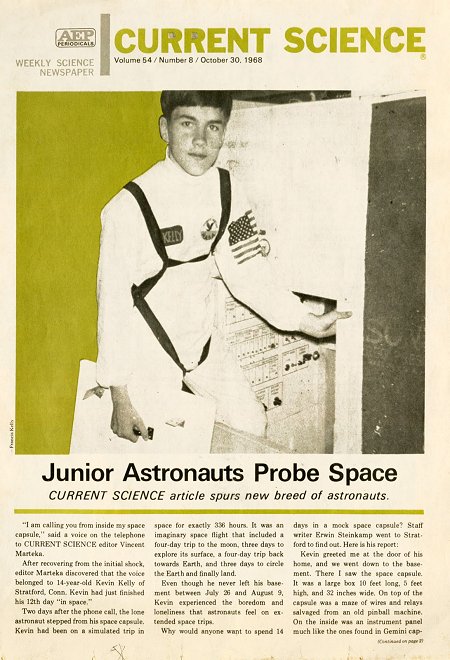
Space mission simulations by students in the Space Age days

John Sisson has an interesting post about space mission simulations carried out by young people during the late 1960s: Books and Ephemera: Kevin Kelly, forgotten space celebrity (1968) – Dreams of Space

One of the most famous junior testing astronauts was a 14 year old boy named Kevin Kelly. He and groups of dedicated  youth tested the limits of survival in a space capsule and led the way to our landing on the Moon.  This October 30, 1968 story in Current Science the outlines these heroic efforts. Unfortunately this coverage was limited to a newspaper distributed in classrooms so few recognize this hero today.

1968CurrentScienceOct30-boy-01_450x660

Kevin spent a grueling 336 hours in a test capsule in order to prove that the human body was capable of a flight to the Moon. By locating the expensive test apparatus in the basement of a suburban house they were able to avoid harmful media exposure during the testing.

The Current Science article went on to describe other projects by student teams who simulated multi-day Gemini and Apollo missions.

As described in the HobbySpace Space Simulation section, there are still some schools and organizations who carry out elaborate space simulations with students such as the Columbia Aeronautics and Space Association (CASA)  at Hickman High School in Columbia, Missouri.