Category Archives: Rockets

Space transport roundup – Mar.24.2019

[ Update Mar.25.2019: Next launch attempt on Tuesday UTC time:

Update: Electron launch scrubbed for at least one day:

]

** Rocket Lab Electron launch set for no earlier than 22:30 UTC Sunday 24 March (6:30 pm EDT Sunday, 11:30 am Monday 25 March NZDT) –  Launch Complex 1 | Rocket Lab

The mission is the Radio Frequency Risk Reduction Deployment Demonstration (R3D2) launch for DARPA.

The mission will lift-off from Launch Complex 1 carrying a prototype reflect array antenna designed to improve radio communications in small spacecraft.

Follow @RocketLab on Twitter for regular updates.

See also DeepSpace: Rocket Lab ready for first commercial launch of 2019, an innovative DARPA spacecraft – Teslarati.

** AVIO Vega rocket launches PRIMA EO satellite for Italy:

On its third launch of the year, Arianespace has successfully orbited the PRISMA Earth observation satellite on behalf of the ASI Italian space agency, within the scope of a contract with OHB Italia. This was the first Vega launch in 2019, and the 14th successful launch in a row for this light launcher since its introduction at the Guiana Space Center (CSG) in 2012. The launch took place on Thursday, March 21 at 10:50 pm local time in French Guiana.

** Sierra Nevada Dream Chaser cargo spaceplane passes a major review: SNC’s Dream Chaser® Spacecraft Passes Another NASA Milestone

Sierra Nevada Corporation’s (SNC) Dream Chaser spacecraft passed NASA’s Integrated Review Milestone 5 (IR5), a key status check on SNC’s performance of a variety of ground and flight operations.

IR5 demonstrates that the Dream Chaser team is on track to operate the space vehicle in advance of the first mission to the International Space Station under the Commercial Resupply Services Contract 2 (CRS-2). 

** Germany’s DLR space agency studies in-air capture of booster instead of using propellant for landing:

For several years, the German Aerospace Center (Deutsches Zentrum für Luft- und Raumfahrt; DLR) has been focusing its research activities on developing concepts for making future European launch vehicles as reusable as possible. The aim is to reduce the cost of satellite launches while also improving the environmental compatibility of rockets. This work is being carried out in conjunction with numerous international partners. A key technology for this is the efficient retrieval of rocket stages after launch, so that they can later be re-used for further launches. One option for retrieving them is catching a rocket stage while it is still in the air. DLR is proposing a remarkably innovative procedure for this purpose, which will be further developed and tested together with six international partners as part of the EU’s FALCon (Formation flight for in-Air Launcher 1st stage Capturing demonstration) project; this will run for a period of three years from March 2019. The aim is to develop a technical concept for a ‘rocket catcher’ that is as detailed as possible, and to conduct tests using small demonstrators to test autonomous in-flight capture and towing.

“In the patented in-air capture process, a winged rocket stage is automatically captured by a transport aircraft while still in flight over the sea, and then towed back to the vicinity of its landing site,” explains FALCon Project Leader Martin Sippel of the DLR Institute of Space Systems in Bremen. “The stage is released there and lands independently, rather like a glider.” This allows the dimensions and starting weight of reusable launch vehicles to be reduced, which, when coupled with reusability, means lower costs. This technology has already been the subject of investigation in numerous simulations and in DLR’s first flight experiments with uncrewed light aircraft.

** Blue Origin studies converting New Glenn upper stages to habitats after achieving orbit: Blue Origin studying repurposing of New Glenn upper stages – SpaceNews.com

Blue Origin has studied repurposing upper stages of its future New Glenn launch vehicle to serve as habitats or for other applications as part of a series of NASA-funded commercialization studies.

Brett Alexander, vice president of government sales and strategy at Blue Origin, said the company looked at ways it could make use of the second stage of New Glenn rather than simply deorbiting the stage at the end of each launch, but emphasized the company currently had no firm plans to reuse those stages at this time.

NanoRacks is leading the STARPOST team that is also investigating the conversion of upper stages into habitats.

In November 2017, NanoRacks, along with SSL, a Maxar Technologies Company, Altius Space, and Space Adventures, proved to NASA that it is technically feasible to repurpose a spent second stage of a rocket while in space. This concept is known as a “Wet Lab,” and was originally a concept from NASA’s Marshall Spaceflight Center in the 1960s. 

America’s first outpost, Skylab, was made from a spent Saturn V fuel tank. It was manufactured on the ground, but an important stepping stone for re-using spent upper stages

** Blue is already planning expansion of the New Glenn factory on Cape Canaveral before the first rocket has been constructed there:

Florida Today:

Labeled as “South Campus” in water management district documents obtained by FLORIDA TODAY, the 90-acre expansion will connect to the factory at Exploration Park, which is a publicly accessible region just west of KSC’s main gate. The two-lane Space Commerce Way winds through the area, connecting other players like satellite company OneWeb, economic development agency Space Florida and the main entrance to the Kennedy Space Center Visitor Complex.

The south campus will nearly double the size of land Blue Origin already leases from NASA, enabling the Jeff Bezos-led company to establish “programs complimentary to those constructed on the adjacent North Campus,” according to the documents. Blue will build 270- and 313-foot variants of New Glenn rockets in the massive blue-and-white factory on the north campus, which will launch no sooner than 2021.

** SpaceX:

**** The second Falcon Heavy launch, and the first with the most up-to-date Falcon Block 5 components, is moving towards liftoff in early April: SpaceX’s April 7th Falcon Heavy launch a step toward new commercial markets – Teslarati

A bit less than 14 months after SpaceX’s Falcon Heavy took to the sky for the first time, the company’s super-heavy-lift rocket – the only such vehicle in the world that is currently operational – has garnered a pending date for its second launch attempt and commercial debut.

While there is some inherent uncertainty surrounding the (once again) fairly new rocket, SpaceX has now officially filed a plan with the Cape Canaveral range authorities that would see Falcon Heavy nominally conduct a critical static fire test as soon as March 31st, followed one week later by a launch target of no earlier than (NET) 6:36 pm EDT (22:36 UTC), April 7th. Set to place the ~6000 kg (13,200 lb) Arabsat 6A communications satellite in a high-energy geostationary orbit, a successful mission that ultimately proves Falcon Heavy’s commercial utility could also raise global launch market interest in the rocket, including potential anchor customers like NASA.

**** NASA requiring Crew Dragon mods and upgrades before the first flight with astronauts on board: Almost Ready: SpaceX has work to do before Dragon is ready to carry crew – SpaceNews.com

While there is some inherent uncertainty surrounding the (once again) fairly new rocket, SpaceX has now officially filed a plan with the Cape Canaveral range authorities that would see Falcon Heavy nominally conduct a critical static fire test as soon as March 31st, followed one week later by a launch target of no earlier than (NET) 6:36 pm EDT (22:36 UTC), April 7th. Set to place the ~6000 kg (13,200 lb) Arabsat 6A communications satellite in a high-energy geostationary orbit, a successful mission that ultimately proves Falcon Heavy’s commercial utility could also raise global launch market interest in the rocket, including potential anchor customers like NASA.

**** The F9 booster used to launch the Crew Dragon on its un-crewed test flight has been lifted onto its horizontal transporter (video via www.USLaunchReport.com):

**** SpaceX’s move to an all steel structure for the StarShip is no experiment but a total commitment: SpaceX goes all-in on steel Starship, scraps expensive carbon fiber BFR tooling – Teslarati.com

In a wholly unforeseen turn of events, SpaceX has taken the extraordinary step of permanently scrapping both its Port of Los Angeles-based BFR development tent and what seem to be the majority of what it contained, irreparably destroying custom-built tooling meant to support the fabrication of carbon composite BFR spaceships and boosters.

Likely worth anywhere from several to tens of millions of dollars (USD), SpaceX’s advanced BFR production tools were procured from industry-expert Ascent Aerospace sometime in 2017 before being officially delivered to the rocket company’s newly-erected Port of LA tent around April 2018. Situated at the port specifically due to logistical concerns about the high cost of transporting 9m/30ft-diameter objects from SpaceX’s main Hawthorne facilities to a barge for transport east, the company has decided to unequivocally destroy its aerospace-grade composite tooling less than 12 months after accepting delivery. Put simply, this is the best evidence yet that SpaceX – willing or not – has gone all-in on build Starship and Super Heavy out of stainless steel less than six months after CEO Elon Musk began to hint at the program’s utterly radical pivot.

***** Lots of activity around the StarHopper the past few days but no confirmation that the Raptor engine has been test fired yet. Scott Manley gives his analysis of the StarHopper and the Raptor:

Update: SpaceX may fire up the Raptor engine next week: SpaceX cleared for more testing; FAA restricts air space for Boca Chica activity – Brownsville Herald

**** The orbital demo Starship is also under construction at Boca Chico Beach and the barrel section is visible from the South Padre Island webcam:

**** How SpaceX came this far SpaceX history: Origin of a rocket business and Elon Musk’s Mars dream – CNBC

====

Space 2.0: How Private Spaceflight, a Resurgent NASA, and International Partners are Creating a New Space Age

Space transport roundup – Mar.19.2019

A sampling of recent items related to traveling to and through space:

** A ULA Delta IV rocket successfully launched a USAF communications satellite last Friday: United Launch Alliance Successfully Launches WGS-10 Mission – ULA

See also

** An uncrewed test flight of Boeing’s CST-100 Starliner crew vehicle on a ULA Atlas V rocket is now reportedly set for the late summer:

** No date/time announced yet for the next Rocket Lab Electron launch, which will put a DARPA technology demonstration satellite into orbit. The company was targeting late this week for the launch but no update has been posted yet. Follow Rocket Lab (@RocketLab) | Twitter for the latest news.

** Progress towards first flight of Virgin Orbit’s LauncherOne air launch system:

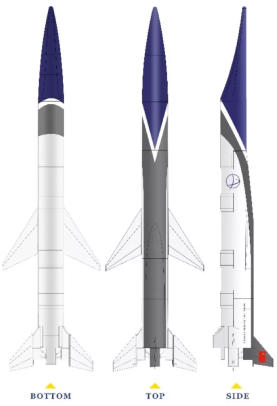
** The new Chinese company Space Transportation Co. is developing reusable rockets to orbit payloads in the 100 – 1000 kg payload range:  Space Transportation (凌空天行), yet another Chinese launcher start-up entering the NewSpace race – The China Aerospace Blog.

Diagrams of the first stage of the Tian Xing-1 rocket show short wings for gliding during its return. Parachutes will deploy for the landing phase:

Space Transportation’s Tian Xing-1 (Credit: Source Code Capital)

Note about Space Transportation on the website of the company that helped it raise funding: Source Code Capital WeChat Official account, March 7 2019 (Google Translate)

** Update from Copenhagen Suborbitals, the volunteer non-profit organization is moving step-by-step towards the launch of a person on a suborbital space flight:

** Firefly Aerospace becomes a smallsat launch provider for Airbus, though no specific launch contracts are yet included: Airbus Defence and Space Enters Memorandum of Understanding with Firefly Aerospace to Partner on Launch Solutions for Constellations – Firefly

“Firefly is pleased to enter into an MOU with Airbus to formulate an integrated market offering that will provide Airbus customers rapid deployment of Airbus manufactured satellites,” said Firefly CEO Dr. Tom Markusic. “We are very impressed by the versatility and low cost of the Airbus ARROW platform and Airbus’s investment in leading edge satellite mass production capabilities. We look forward to working closely with Airbus to bring economical launch solutions to their customers. This initial MOU covering several launches is the first step of a long-term relationship which will provide Airbus customers the highest level of flexibility for their small satellite launches.”

Frederic Sotenberg, Head of Constellations Launch Solutions at Airbus Space Systems, said, “Our partnership with Firefly will provide launch options with direct access to specific orbits, flexibility, and short notice. The Alpha vehicle addresses an unmet need in small satellite launch and will provide a further option for our customers in addition to legacy medium and large launchers in Europe.”

** Space elevators might one day offer an alternative to rockets. Here is the latest update from ISEC (International Space Elevator Consortium) : ISEC Space Elevator Newsletter Mid-March 2019

** SpaceX:

**** NASA Administrator Jim Bridenstine talked with Elon Musk of SpaceX in the crew access bridge at Pad 39A at Cape Kennedy on the day before the recent Crew Dragon demo flight:

**** The Crew Dragon docks to the ISS in this time lapse:

**** The Falcon 9 booster used to launch crew dragon is shown being lifted from the landing platform to the dock at Port Canaveral (via www.USLaunchReport.com):

This is four times speed. We think they may have a new crane operator. Port Canaveral purchased a huge new tower crane that can move the boosters much more easily.

**** The Crew Dragon’s Super Draco thrusters were designed for powered landings but SpaceX decided it would take to much time and money to obtain NASA certification for that. However, they might be used as backups to the parachutes for sea landings: SpaceX’s Crew Dragon could land with abort thrusters in emergencies, says Musk – Teslarati

While Musk noted that adding or enabling that capability during missions with astronauts would be entirely dependent upon NASA’s approval, the idea would be to trigger Crew Dragon’s SuperDraco abort thrusters in the event of a partial or total failure of the spacecraft’s parachutes. Although Crew Dragon is already capable of keeping its passengers safe if one of its four parachutes fails to properly deploy, the loss of any additional drag would likely create a situation where the force of impact on the ocean surface could severely injure or kill astronauts, much like a car crash without airbags. To prevent this, Crew Dragon could fire its thrusters at the last second, canceling out or at least minimizing the force of impact.

If this is implemented, it would be the first time that an orbital crew system has a backup during both launch (the Crew Dragon capsule can abort at any point from liftoff to orbital insertion) and landing.

**** The options for launching NASA’s Orion capsule with a Falcon Heavy or other rocket are discussed by Scott Manley:

**** Raptor engine on StarHopper may fire for the first time this week after it was installed last week on the vehicle:

On Friday, the company sent a notice to nearby residents saying it planned to conduct testing of the vehicle as soon as the week of March 18, and that it would be closing the main roadway of Highway 4 to non-residents during the tests. This “safety zone perimeter” is part of an agreement with the local county, and has been set up out of an abundance of caution.

On Sunday, company founder Elon Musk confirmed on Twitter that SpaceX was indeed close to beginning tests. Musk said that integration work remained to be done on test vehicle and its Raptor rocket engine, and that the first hops would lift off, but only “barely.” Eventually the “Starhopper” test vehicle will have three engines, but for now it appears as though the company will start with just one.

A public notice to local residents of Boca Chica says an attempt to fire the engine will happen on Wednesday: Cameron County publishes notice of SpaceX testing – Brownsville Herald

Cameron County has posted public notice that it will close Highway 4 to Boca Chica Beach for space flight activities from 10 a.m. to 4 p.m. Wednesday.

In the alternative, the public notice said Highway 4 to Boca Chica Beach will be closed for the same time duration on either Thursday or Friday.

**** The latest photos and drone video of StarHopper :

Note that the nosecone for the StarHopper was badly damaged in a windstorm last January but Elon now says a new one will not be built. The Starhopper will only do low altitude flights with slow ascent and descent so the nosecone serves no particular purpose other than to make the vehicle resemble a rocket ship.

**** An Orbital Starship demonstrator is also now under construction at Boca Chica Beach in addition to the ongoing work with the low altitude StarHopper demonstrator: SpaceX’s first orbital Starship begins assembly as steel heat shield passes tests – Teslarati

SpaceX CEO Elon Musk says that the company’s South Texas workforce has already begun to fabricate the first orbital-class Starship prototype, while Hawthorne engineers and technicians are in the midst of performing small-scale testing of the vehicle’s unprecedented stainless steel heat shield.

To be assembled out of hexagonal tiles of (presumably) stainless steel, Starship’s metallic heat shield will be one of the most crucial aspects of the orbital spacecraft, particularly with respect to ensuring that it’s extraordinarily easy to reuse. To survive extreme interplanetary-velocity reentry conditions at Mars, Earth, and beyond and remain in a functional, flight-ready condition after landing, SpaceX will need to implement the world’s first orbital-class, large-scale metallic heat shield with an immature technology known as transpirational cooling.

**** Super Heavy Booster and Starship vehicles may be built in multiple locations: SpaceX will build and launch Starship/Super Heavy in Texas and Florida, says Musk – Teslarati

According to SpaceX CEO Elon Musk, the company has plans to both build and launch BFR’s Starship upper stages and Super Heavy boosters at facilities located in Boca Chica, Texas and Cape Canaveral, Florida.

Indicative of SpaceX and Musk’s rapidly evolving plans for the next-generation, ultra-reusable launch system, the to stainless steel over carbon composites appears to continue to have a range of trickle-down consequences (or benefits) throughout the rocket’s design, production, launch, and operations. Given the 3+ radical, clean-sheet design changes the BFR program has undergone in about as many years, it’s hard to definitively conclude much about the latest iteration. Nevertheless, Musk’s indication that stainless steel BFRs may now be built simultaneously at multiple locations suggests that the construction of steel Starships and Super Heavies could be radically easier (and cheaper) than their composite predecessors.

====

The Space Barons: Elon Musk, Jeff Bezos, and the Quest to Colonize the Cosmos

Space transport roundup – Mar.14.2019

A sampling of recent items related to traveling to and through space:

[ Update: The Soyuz launch and docking with the ISS were successful:

]

** A Russian Soyuz is set to launch today with three new crew members to the ISS. Astronaut Christina Koch, on her first mission to space, joins cosmonaut Alexey Ovchinin and NASA flight engineer Tyler “Nick” Hague, who were both on the Soyuz MS-10 that suffered an in-flight abort last October. The Soyuz with the threesome will reach the station after a quick 6 hour flight.

Lift off is set for 3:14 pm EDT:

** United Launch Alliance (ULA) is set to launch a Delta IV rocket on Friday from Cape Canaveral with the 10th Wideband Global SATCOM spacecraft (Wideband Gapfiller Satellite), built by Boeing for the U.S. military. Delta IV WGS-10 – United Launch Alliance (ULA) Rocket Launch

The webcast starts at 6:56 p.m. EDT and the launch window extends to 9:05 p.m. EDT:

** China launched a Long March 3B on March 9th from the Xichang Satellite Launch Center. The rocket carried the Zhongxing-6C (ChinaSat-6C) communication satellite.

** The Chinese company OneSpace plans to launch the solid-fueled OS-M1 rocket this month on its first test flight to orbit. The rocket will carry a Lingque 1B remote sensing CubeSat for China’s ZeroG Lab, which aims to create its Magpie constellation consisting of over 375 earth observation CubeSats: China’s OneSpace completes rocket assembly ahead of first orbital launch – SpaceNews.com

** China’s LinkSpace tests vertical takeoff and landing rocket, similar to the type flown by Masten Space for many years. The LinkSpace goal is a reusable first stage for a rocket that will launch small satellites to low earth orbit:

** Rocket Lab plans to launch an Electron rocket in the latter half of this month with a DARPA satellite aboard: Rocket Lab launch of DARPA satellite slips – SpaceNews.com

** A Vega rocket is set to launch from French Guiana on March 21st with Italy’s PRISMA Earth observation satellite.

** European small rockets for smallsat launch are now a focus of ESA: Microlaunchers to grow Europe’s economy – ESA.

The Vega-C upgrade, however, is behind schedule: Vega C debut slips to 2020 – SpaceNews.com

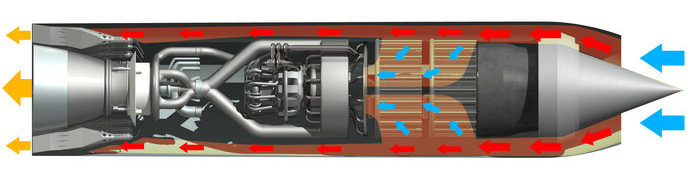
** Reaction Engines will start building a prototype Sabre rocket engine after an ESA review gives the design a thumbs-up. While powering a vehicle in the atmosphere, the Sabre’s pre-cooler would gather air, cool it, and feed it into the combustion chamber of the rocket along with hydrogen fuel. Once outside the atmosphere, oxygen from on-board tanks would feed the Sabre (Synergetic Air-Breathing Rocket Engine):

“The Synergistic Air-Breathing Rocket Engine is uniquely designed to scoop up atmospheric air during the early part of its flight to orbit. This slashes the need for the vehicle to carry bulky onboard oxygen for this part of the ascent, before switching to rocket mode drawing on internal propellants for its final climb to space. To allow SABRE to use the superfast onrushing airstream as oxidiser, the air must be cooled from 1000°C to –150°C within just a hundredth of second, at the same time avoiding the formation of dangerous ice.” – Engine Airflow/ESA

The air-cooler technology has been proven in a standalone test. The demo engine will include only the rocket

Reaction Engines launched a significant new element of its development programme in October 2016 to design, build and demonstrate a SABRE engine core. The test item consists of an engine core, which is a major module of the complete SABRE engine, but without the pre-cooler and rocket nozzle in place. This core design and development activity is a major undertaking and upon completion of the tests, major elements of the world’s first air-breathing engine capable of accelerating from zero to Mach 5 will have been demonstrated.

The SABRE engine core tests are part of a range of development activities currently underway at Reaction Engines. The company will shortly begin its HTX ‘hot’ heat exchanger testing in a unique test facility it has constructed in Colorado, United States. The HTX test programme is a manufacturing and performance ground-level demonstration of the SABRE engine ‘Pre-Cooler’ heat exchanger in a high temperature environment, similar to that expected to be seen by the SABRE engine during its air-breathing flight regime – up to 1000°C air inlet temperature.

The goal is an propulsion system efficient enough to power a single-stage-to-orbit vehicle like the Skylon.

** HyperSciences’ hypersonic projectiles can shoot downward for drilling and upward for reaching space: For HyperSciences, geothermal energy builds a path to space – Teslarati

[HyperSciences founder and CEO Mark] Russell and his team have developed a low-cost, multi-purpose projectile called the HyperDrone that can accelerate to velocities over five times the speed of sound and pulverize hard rock via their HyperDrill. This will enable tunneling speeds that are 5-10 times quicker than conventional methods, and more importantly, it opens up significant market viability in other industries that could benefit, namely when that acceleration is pointed skyward. NASA has already recognized this potential and is a current investor and major partner of HyperSciences.

** Nuclear propulsion for in-space transportation would open up the solar system to exploration and settlement: Nuclear rocket innovation is the future of space travel, exploration – USA Today

With a nuclear rocket like the ones researched in project NERVA, a trip to Mars could be done in  four months. (Interestingly, the astronauts would actually be exposed to less radiation with a nuclear ship, because shortening the trip reduces their exposure to cosmic rays in space.) And with higher thrust and higher efficiency, nuclear rockets would open up much of the solar system. They could even be designed to rendezvous with comets and use cometary ice as fuel for the return trip.

Now NASA is getting interested in nuclear rockets again.  In 2017, it awarded a nearly  $19 million contract for development. And this year’s NASA budget contains $100 million for nuclear thermal research, leading to a demonstration in 2024.

** SpaceX:

[ Update: The StarHopper will begin static firing tests and tethered hops soon: County approves authority for road closures for rocket testing – Brownsville Herald: Local News

Last Friday, SpaceX Spokesman James Gleeson said in an email that the Starship prototype was moved in preparation for non-public testing.

“SpaceX will conduct checkouts of the newly installed ground systems and perform a short static fire test in the days ahead,” Gleeson said. “Although the prototype is designed to perform sub-orbital flights, or hops, powered by the SpaceX Raptor engine, the vehicle will be tethered during initial testing and hops will not be visible from offsite. SpaceX will establish a safety zone perimeter in coordination with local enforcement and signage will be in place to alert the community prior to the testing.”

]

**** A Raptor engine arrived at Boca Chica Beach this week to be attached to the StarHopper: SpaceX’s Elon Musk says Raptor will be installed on Starship prototype this week – Teslarati

**** The latest view of the StarHopper from a drone flying above the SpaceX facilities:

**** Scott Manley gives his review of the Crew Dragon mission to the ISS:

Yesterday SpaceX’s crew capable Dragon 2 spacecraft completed its visit to the ISS, demonstrating the technology was sound and clearing one more hurdle on its way to becoming a commercial crew transportation provider.

**** Videos of the Crew Dragon and the Falcon 9 booster following the mission (via www.USLaunchReport.com):

====

Space 2.0: How Private Spaceflight, a Resurgent NASA, and International Partners are Creating a New Space Age

Space Access 2019 – April 18-21 in Fremont, California

A reminder for the upcoming Space Access 2019 meeting:

Space Access 2019 Conference

The Technology, Business, and Politics of
Radically Cheaper Space Transportation

at the Fremont Marriott Silicon Valley, April 18-21

SA2019 Conference Presentations Schedule Now Online!

This presentations schedule represents 90% of the final SA2019 three-day program. Things have evolved toward our having three major focus areas over the three days of the program: On Thursday, we feature the current Entrepreneurial Revolution in Smallsat Launch. On Friday, the near-future transition to Reusable-Rocket Transport Networks in Cislunar Space. And on Saturday, the eventual transition to Getting There Faster: Advanced High-Energy Space Propulsion. Stay tuned for minor schedule tweaks, more detail on presentations start-time & duration, and a few final program additions in the coming weeks.

Space Access 2019 will be the next round of Space Access Society’s conference on the technology, business, and politics of radically cheaper space transportation, brought to you this year in cooperation with the Bay Area’s own Experimental Rocket Propulsion Society.

And it’s coming up fast! Five weeks from this Thursday SA2019 gets underway. The Marriott is ten miles from the San Jose Airport, 24 from Oakland – book your flights soon before fares go up. And there’s no guarantee the Marriott will honor our special $130 room rates after March 26th – our rate block is already sold out for Wednesday night, and Thursday-Saturday are going fast, so book your room soon also! Conference Registration also goes up after the 26th, from the current $180 advance rate for Regular membership to $220, other rates also rising. Register now, and join us!

Latest SA2019 info will be at http://space-access.org/updates/sa2019info.html

Space transport roundup – March.8.2019

A sampling of recent items related to traveling to and through space:

** SpaceX:

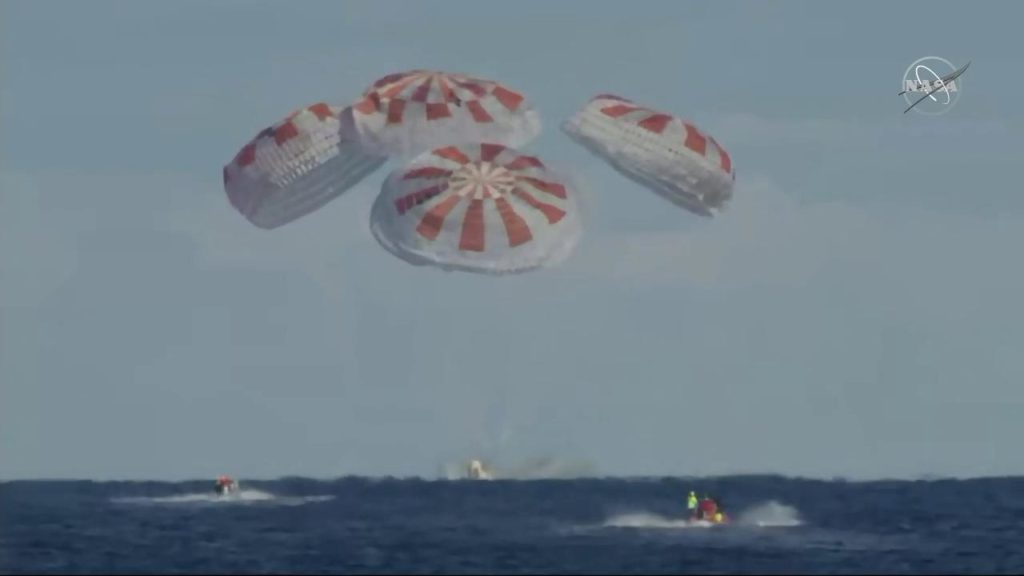
**** The Crew Dragon splashes down in the Atlantic off the coast of Florida: Crew Dragon Splashes Down in Atlantic Ending First Commercial Crew Mission – Space Station

“SpaceX’s Crew Dragon splashes down in the Atlantic Ocean after successful Demo-1 flight on March 8, 2019.”

**** The DM-1 mission was a great success. Everything from beginning to end seemed to go smoothly and according to plan. A video of  highlights of DM-1:

**** The closing of the hatch of the Crew Dragon 2 last night in preparation for its departure:

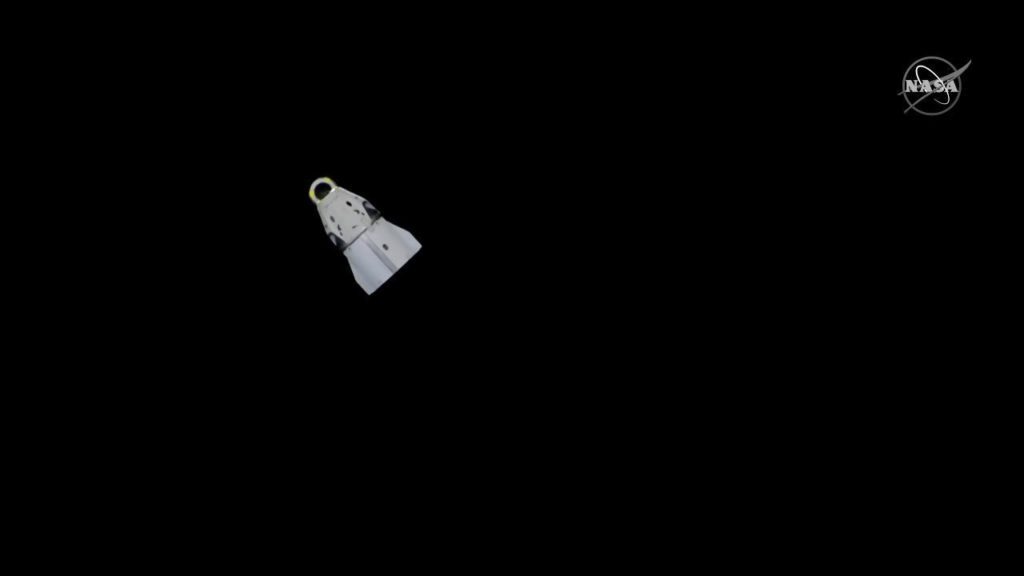
**** The Crew Dragon departs from the ISS in this video:

A view from the ISS of the Crew Dragon shortly after it left the station to return to earth. Note that the circle at the top is the nose-cap in the open position.

**** Some recent articles about the mission:

**** The first stage booster of the DM-1 Falcon 9 is shown in this SpaceX photo as it came in for a landing on the ocean platform:

Crew Demo-1 Mission

**** The booster returns to Port Canaveral in this video (via www.USLaunchReport.com):

**** An overview of SpaceX launch plans for the next few months: Falcon Heavy and Starlink headline SpaceX’s upcoming manifest – NASASpaceFlight.com

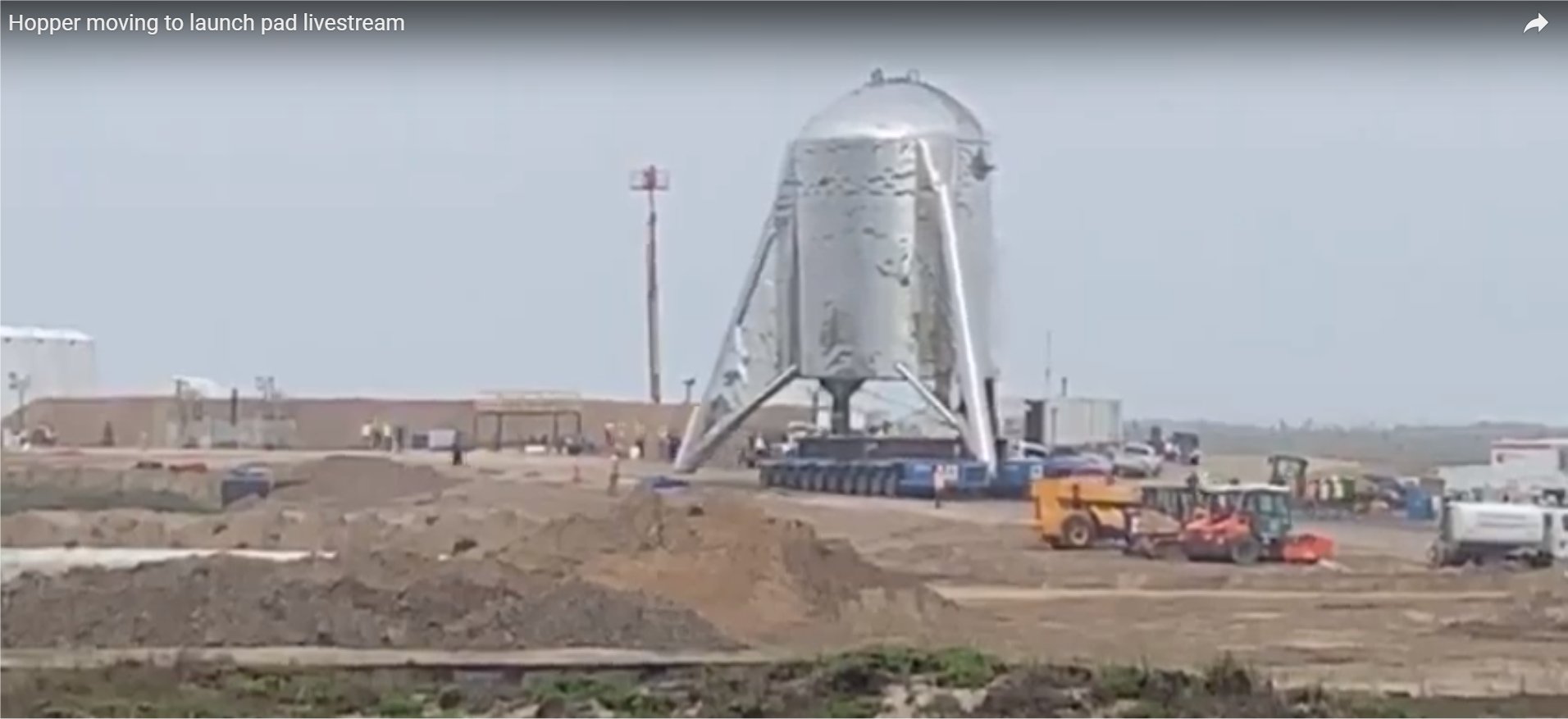
****  StarHopper moves to launch pad. Meanwhile, work continues at SpaceX’s facilities at Boca Chica Beach near Brownsville, Texas on the company’s next-generation launch system. While the Crew Dragon recovery was underway in the Atlantic, the booster section of the StarHopper low altitude test vehicle was slowly transported from the construction yard to the site of the launch pad:

StarHopper booster moves to the site of the launch pad at Boca Chica Beach.

[ Update: This move was reportedly due to plans for a pressure test of the propellant tanks. Once that is safely finished, it will be moved back to the construction yard.] The propulsion system with the Raptor engines have not yet been installed. A new nosecone is also under construction to replace the one damaged when it was overturned by high winds.

** The launch of the reusable SARGE rocket last Saturday by EXOS Aerospace went well overall, though it failed to reach the planned altitude. Strong winds at liftoff caused the rocket to move outside its allowed range and the guidance system turned off the engine before it completed its burn. The rocket was recovered via paraglider return and will launch again.

** Linkspace tests vertical takeoff and landing rocket in China:

** Generation Orbit X-60A hypersonic text vehicle project makes a step forward with the completion of the critical design reveiw: X-60A hypersonic flight research vehicle program completes critical design review – Generation Orbit

** Ariane 6 gets a OneWeb launch contract: OneWeb announced as customer for inaugural Ariane 6 launch – Spaceflight Now

====

Space 2.0: How Private Spaceflight, a Resurgent NASA, and International Partners are Creating a New Space Age