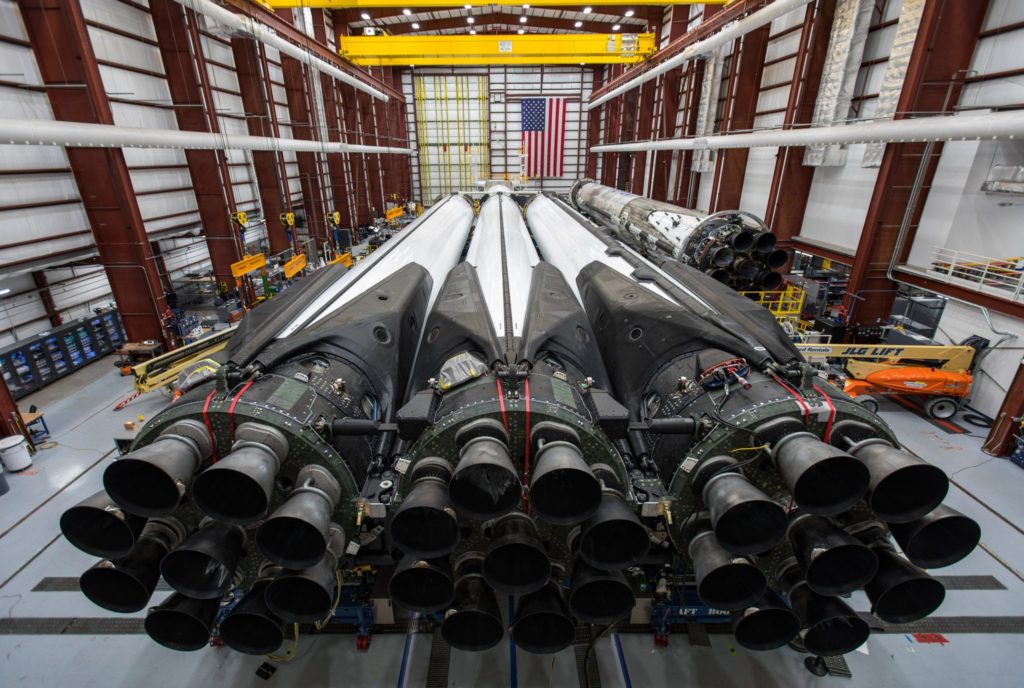
SpaceX this afternoon launched a Falcon Heavy rocket with the Arabsat-6A communications satellite from Cape Kennedy Space Center. This was the second launch of a FH but this time all 3 cores of the FH were the most up-to-date Block 5 versions. And all 3 boosters successfully landed. The 2 side boosters landed back on pads at Cape Canaveral while the center landed on a floating platform at sea.
A clip from the SpaceX webcast showing the liftoff:
Here is the segment of the webcast with the return flights and landings of the boosters:
After a coast period, the upper stage engine fired for about 85 seconds and 5 minutes later Arabsat-6A was deployed:
Successful deployment of Arabsat-6A to geosynchronous transfer orbit confirmed—completing Falcon Heavy’s first commercial mission! pic.twitter.com/KeKTP99xvv
Contact was later made with the satellite after the deployment.
The power of the FH sent the satellite into a long ellipse with an apogee of 90,000 km (55,500 mi) beyond Earth. The satellite will fire its on-board engine to circularize the orbit and bring it to its assigned slot in geostationary orbit (35,786 km above the equator). The initial extra high orbit will reduce the amount of fuel that the satellite needs to reach its spot as compared to a launch with, say, a Falcon 9 rocket. This extra fuel will give the satellite a few more years of operation since it needs to occasionally fire the engine to maintain its position.
The next Falcon Heavy launch is expected to lift off in June (presumably with the same two side boosters as this flight). The mission will be for the U.S. Air Force and is referred to as STP-2 (Space Test Program-2). STP-2 will carry several military and scientific research satellites including the Planetary Society’s LightSail-2 solar sail: SpaceX’s Falcon Heavy Flies Again; LightSail 2 Is Next! | The Planetary Society
Falcon Heavy’s 27 Merlin engines generate more than 5 million pounds of thrust at liftoff, making it the world’s most powerful operational rocket by a factor of two pic.twitter.com/0LGaLgdi13
Speaking of the Crew Dragon demo, SpaceX has posted new videos on the company’s Youtube Channel with the complete webcasts for each major event during the mission.
** Ariane V launches four O3b satellites on April 4th, bringing the total number of spacecraft in the medium earth orbit constellation to twenty. The constellation provides global broadband Internet services.
** Relativity Space will launch satellites for Telesat’s low earth orbit broadband Internet services constellation. Relativity is developing expendable rockets aimed at the growing market for launching small satellites. The company has not yet launched a rocket but is making progress in developing large 3D printing systems that will print all of the large structures of the company’s rockets, drastically reducing the number of individual parts and speeding up assembly of the rocket. Their first vehicle, the Terran 1 rocket, will put 700 kg into a 1200 km altitude sun-synchronous orbit and the debut launch is set for the end of 2020.
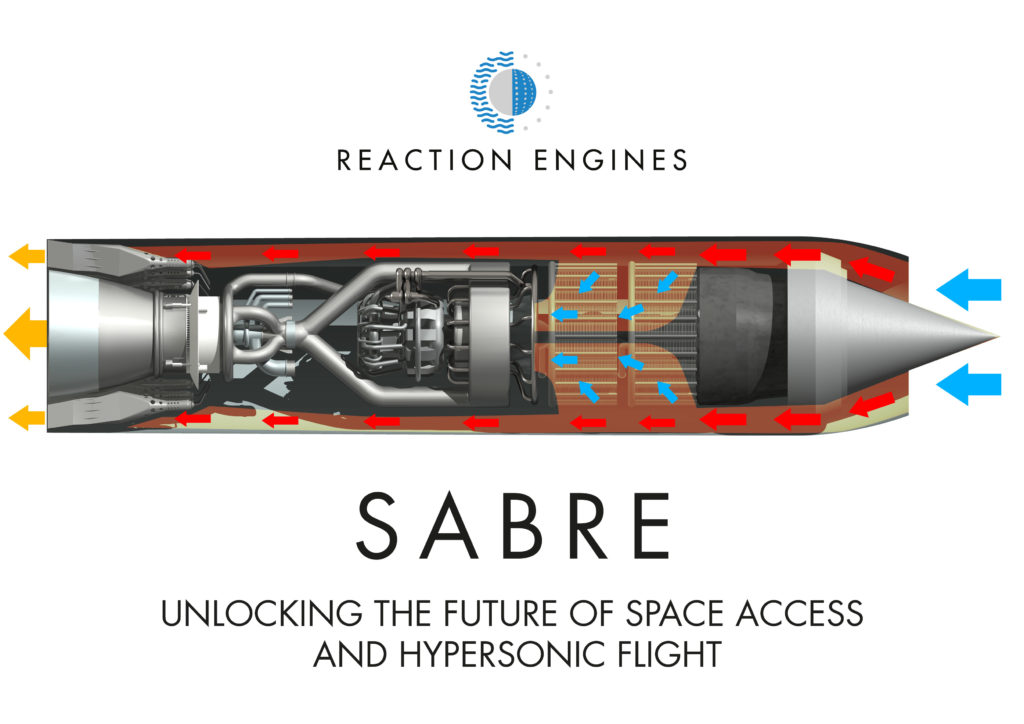
The pre-cooler is a key component of the Sabre rocket engine, which uses oxygen from the air during the initial atmospheric phase of a space launch vehicle’s flight before switching to on-board oxygen when the vehicle leaves the atmosphere. For combustion with the hydrogen fuel to take place properlyh, the incoming air must be cooled from ~1000°C to -150°C in 1/20th of a second.
Less than two weeks till the Space Access 2019 conference, April 18-20 at the Fremont Marriott Silicon Valley in Fremont California. Our near-final conference program is now available online. Links to each day’s schedule:
Discount Hotel Rooms Available Again at the Marriott
Our SA2019 $130 per night discount Marriott room rate has been extended and is available for bookings through Wednesday April 10th. Rooms are for the moment available at our rates for all nights of the conference, including a very limited number for Wednesday night 4/17. Call (510) 413-3700, hit “1” for Reservations, and mention “Space Access 2019” to get the $130 rate.
(If they are again out of discount Wednesday rooms when you call, you may find an affordable Wednesday 4/17/19 rate nearby at this link.)
And, our Hospitality Space needs your help! We’ve run into local budget problems with putting on our traditional Hospitality spread – Learn How You Can Help!
SpaceIL is a non-profit volunteer organization that designed the spacecraft and raised $100M for its development and launch. Israel becomes the 7th country with a spacecraft to make lunar orbit.
The landing attempt is set for Thursday, April 11th.
** The Russian Progress vehicle also successfully docked with the ISS just 3 hours and 20 minutes after its liftoff from Baikonur.
Update: A Russian Soyuz launched a Progress cargo vehicle to the ISS this morning. The craft is taking a fast route to the station with the time from liftoff to docking only about 3.5 hours.
** SpaceX Falcon Heavy rolled out to the pad last night and is currently upright in preparation for the static test firing of the engines sometime today. Images of the FH on the pad:
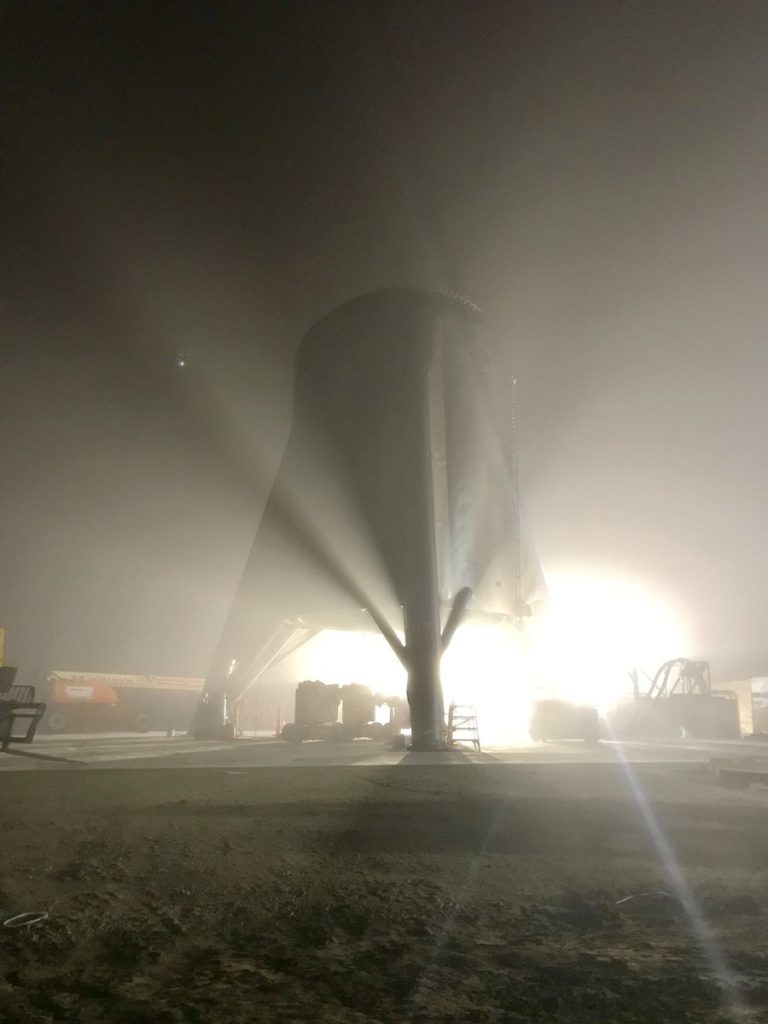
****The StarHopper fired its Raptor engine for the first time on Wednesday, April 3rd at the Boca Chica Beach facility. The 3 second firing and tethers kept the vehicle close to the ground:
Starhopper completed tethered hop. All systems green.
The Starhopper will continue a series of tests that will eventually include un-tethered low altitude flights. These flights will require the installation of two more Raptors.
**** Falcon Heavy static fire set for Thursday in preparation for launch from Cape Kennedy on Sunday, April 7th with the Arabsat 6A communications satellite. All three stages will attempt to return and land. The side boosters will return to pads at the Cape while the center core will land on a platform at sea.
** India launches 29 satellites on a PSLV (Polar Satellite Launch Vehicle) including the Emisat spysat for the Defence Research Development Organisation (DRDO) and 28 smallsats for commercial customers:
** China’s LinkSpace demos vertical takeoff and landing rocket as part of a step-by-step program to achieve an orbital rocket with a reusable first stage:
LinkSpace did a very successful test on rocket recycling on March 27, 2019. It will support us to open the next PLAN. Thank you Dr. @robert_zubrin for being here to witness this exciting milestone. Later, NewLine Baby(RLV-T5) will undergo higher flight tests in the future. pic.twitter.com/9aIpLopstW
These down-to-the-buzzer milestones are some of our trickiest to overcome yet, but we’re in the zone, we’re feeling confident and we’re ready to keep the ball rolling toward first flight.
Vector’s new plan targets the launch of a suborbital rocket, Vector-R B1001, for June. (There is no formal launch date yet set, Cantrell said, because “stuff happens.”) This mission will have a customer, but Cantrell isn’t ready to say who yet. Then, before the end of the year, the company intends to fly its first orbital rocket, Vector-R B1003, from the Pacific Spaceport Complex in Alaska.
Under the new plan, Vector now plans to skip an intermediate step in the development of its Vector-R rocket, which had been dubbed B1002. While this core would have been capable of reaching orbit, it would have only a very small payload capacity, unable to carry much more than some instrumentation. “For us, this turned out to be a dead-end configuration,” Cantrell said. Therefore, the company now plans to move directly from the suborbital test launch into a vehicle with larger tanks and more capable LP-1 engines.
A sampling of recent articles, videos, and images dealing with space transport:
** Rocket Lab will try again this evening (22:30 UTC time) to launch an Electron rocket with a DARPA technology demo satellite on board: Launch Complex 1 | Rocket Lab
[ Update: The launch was a success:
Payload deployed. Precise orbital insertion by Electron’s Kick Stage. Mission Success!
Liftoff is at about 12:30 into this recording of the webcast:
]
Rocket Lab is currently targeting no earlier than 22:30, Thursday 28 March UTC (11:30 am, Friday 29 March NZDT) [18:30 EDT, March 28] for the next Electron mission.
The mission is the Radio Frequency Risk Reduction Deployment Demonstration (R3D2) launch for DARPA.
The mission will lift-off from Launch Complex 1 carrying a prototype reflect array antenna designed to improve radio communications in small spacecraft.
“We will endeavor to launch another OS-M carrier rocket, as well as two to three OS-X suborbital rockets before the end of this year,” [Shu Chang, CEO of OneSpace,] said late Wednesday at the Jiuquan Satellite Launch Center in the Gobi Desert, where the first OS-M rocket mission was undertaken.
“I accept today’s failure,” he said. “Other solid-propellant carrier rockets before ours also have had setbacks in their development, but all of them passed through hard times and eventually succeeded. Explorations in science and technology have successes and failures. We will never flinch or quit.”
]
Video made by an observer:
An interview held before the launch with OneSpace CEO [Shu Chang]:
All that said, the commercial aviation revenue is projected to be $885 billion in 2019. Introducing a point-to-point suborbital product could convince 5/8ths of one percent of current long-haul fliers to choose suborbital point to point. That is the percentage required to hit $20 billion a year at $12,000 per flight. That supports UBS’ claim that when the suborbital point-to-point market does finally arrive, it could be much bigger than the orbital, lunar or Mars markets.
If there’s one part of the space industry that seems the most primed for a shakeout, it’s the small launch vehicle sector. So many ventures have announced plans to create rockets for dedicated launches of smallsats that it’s hard to keep track of just how many are in development. At events like the SmallSat Symposium in Silicon Valley in early February, it was common to hear estimates of 100 or more vehicles in work.
Carlos Niederstrasser of Northrop Grumman Innovation Systems has been keeping track of small launch vehicles programs for several years. As of January, he had identified 112 such vehicles worldwide in various phases of development. That figure, though, includes at least 10 that have since gone defunct and another 10 whose status is unknown. Many of the others are still little more than concepts.
The number of failed launch ventures will “start increasing significantly in the next two years,” he warned in a presentation at the annual meeting of the Transportation Research Board in Washington in January. “It has to. The market is simply not going to be able to support 112 of these companies moving forward.”
The first commercial launch of SpaceX’s Falcon Heavy rocket – this time in a Block 5 configuration – is as few as ten days away from a targeted window beginning at 6:36 pm EST (22:36 UTC), April 7th. That target hinges on whether Falcon Heavy is ready and able to roll out to Pad 39A and successfully conduct its first integrated static fire, currently scheduled on April 1st.
The payload for this mission – communications satellite Arabsat 6A – had its original Lockheed Martin manufacturing and SpaceX launch contracts signed back in the first half of 2015, while the 6000 kg (13,200 lb) spacecraft was effectively completed once it was shipped from California to Florida at the start of 2019. After approximately 12 months of delays from an original launch target shortly after Falcon Heavy’s 2018 debut, Arabsat 6A’s four-year journey will hopefully reach completion in a geostationary transfer orbit. At the same time, the US Air Force says that it will be watching this launch – and the one meant to follow soon after – as a critical test along the path to fully certifying the powerful rocket for military launches.
A source familiar with Russia’s aerospace industry recently informed state newspaper RIA Novosti that NASA has provided Russian space agency Roscosmos with an updated planning schedule for International Space Station (ISS) operations, including a preliminary target for SpaceX’s first Crew Dragon launch with astronauts aboard.
According to RIA’s source, NASA informed Roscosmos that the agency was tentatively planning for the launch of SpaceX’s Demonstration Mission 2 (DM-2) as early as July 25th, with the spacecraft departing the ISS, reentering the atmosphere, and safely returning astronauts Bob Behnken and Doug Hurley to Earth on August 5th. In a bizarre turn of events, Russian news agency TASS published a separate article barely 12 hours later, in which – once again – an anonymous space agency source told the outlet that “the [DM-2] launch of Crew Dragon is likely to be postponed to November”. For the time being, the reality likely stands somewhere in the middle.
**** Launch and landing highlights compilation video was quietly released recently by SpaceX:
Testing of SpaceX’s Starhopper suborbital vehicle in Boca Chica, Texas, achieved a new milestone on Monday with another Wet Dress Rehearsal (WDR) and pre-burner test of the Raptor engine. This is another step towards engine ignition, which will technically result in its first hop, albeit by just inches due to being tethered to the pad.
Aside from a unique lack of ablation for Starship’s stainless steel hull and curious hexagonal steel heat shield tiles, SpaceX may end up having to implement a wholly unproven technology known as transpiration cooling, in which some of Starship’s liquid methane propellant would be intentionally pushed out from micro-scale holes drilled or perhaps laser-cut in certain hexagonal plates. After traveling through the steel skin/shield and out of the holes, the liquid methane would almost instantly vaporize into gas and then plasma as it confronts the spacecraft’s superheated bow shock wave, reducing the thermal loads on tiles with such an active cooling solution installed.
It’s unclear what the resulting methane-rich plasma plume might look like but it’s not out of the question that SpaceX’s graphic design team have either done the math themselves, so to speak, or asked engineers to verify what color Starship’s plasma tail might end up looking like. As shown in the latest render, a plume of hues ranging from light blue and indigo to red through white seems entirely plausible. Regardless, Starship is bound to look spectacular during orbital reentries thanks to its metallic skin and shield and planned hot structure, meaning that the entire windward half of the vehicle could end up glowing red, orange, yellow, and even white-hot, precisely like the thermal testing video Musk recently shared.
**** Two webcams now watch SpaceX Boca Chica Beach facilities to allow you to monitor StarShip activities:
**** Crew Dragon from the recent demo mission without any astronauts on board is lifted from the recovery boat to the dock at Port Canaveral in this video courtesy www.USLaunchReport.com –