Category Archives: Rockets

Space transport roundup – Mar.29.2019

A sampling of recent articles, videos, and images dealing with space transport:

** Boeing successfully tests integrated propulsion system for the Starliner crew vehicle. This comes after the system suffered a leak of the highly toxic propellant during a test in 2018. Boeing Completes Starliner Hot Fire Test – Commercial Crew Program

Boeing’s CST-100 Starliner propulsion system was put to the test on Thursday at NASA’s White Sands Test Facility in New Mexico in support of NASA’s Commercial Crew Program. Teams ran multiple tests on Starliner’s in-space maneuvering system and the spacecraft’s launch abort system, which are key elements on the path to restore America’s capability to fly astronauts to the International Space Station on American rockets and spacecraft from U.S. soil.

The test used a flight-like Starliner service module with a full propulsion system comprising of fuel and helium tanks, reaction control system and orbital maneuvering and attitude control thrusters, launch abort engines and all necessary fuel lines and avionics.

** Rocket Lab making progress on the launch pad at Wallops Island, Virginia:

**ESA’s Expander-cycle Technology Integrated Demonstrator (ETID) project tests new technologies for next-gen upper-stage rocket engines: ‘Intelligent’ thrust for Europe’s future launchers – ESA

ESA has recently completed hot-firing tests that prove technologies in a move towards ‘intelligent’ engines to power the upper stages of next-generation launchers.

The Expander-cycle Technology Integrated Demonstrator, or ETID, is a full-scale integrated demonstrator for an upper-stage rocket engine.

Yesterday ESA, industrial partners and representatives of participating Member States met at DLR Lampoldshausen, Germany, to review the results of ETID’s extremely successful nine-month test campaign on the P3.2 test bench.

In total, four configurations of ETID with three new combustion chamber geometries and designs were tested.

Two different injector heads, including a fully 3D-printed version were also tested, as well
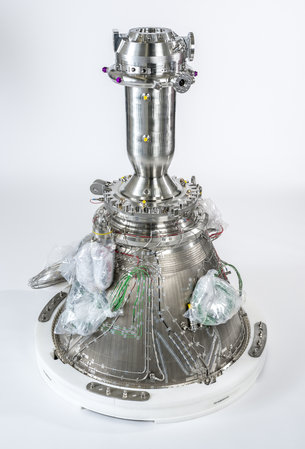
ETID - Expander-cycle Technology Integrated Demonstrator
ETID – Expander-cycle Technology Integrated Demonstrator

** ULA’s Vulcan and Northrop-Grumman’s OmegA rockets make some progress towards first flights in 2021: Two National Security Space Launch Rockets Moving Forward – Air Force Magazine

** Virgin Orbit flies a fully fueled LauncherOne rocket beneath their 747 carrier:

** Virgin Orbit works with NASA on 3D printing of propulsion system components: Exploring 3-D Printing Alongside NASA Marshall Space Flight Center | Virgin Orbit

** SpaceX:

** The chain of Starlink satellites launched last week by a Falcon 9 was easy to see from the ground when passing overhead:

*** The video of the deployment of the Starlink sats showed them slowly separating in clumps rather than scattering individually like dandelion seeds, which I think many viewers had expected. Here is an animation showing what was actually happening.

*** The brightness of the Starlinks set off a Twitter ado over what impact 1200 to 15000 such satellites will have on astronomy:

*** Initial broadband Internet services could begin with just 360 Starlinks: SpaceX wants to offer Starlink internet to consumers after just six launches – Teslarati.

*** Another view of the Starlink launch via the team at www.USLaunchReport.com:

*** The recovered Starlinks booster has returned to Port Canaveral:

*** The nosecone fairings from the were recovered as well and may be used again in a future launch:

*** Still no official explanation for the explosion during the Crew Dragon test but the investigation is making progress according to NASA officials:

From Space News:

More than a month after a Crew Dragon spacecraft was destroyed in a test of its propulsion system, NASA and SpaceX investigators are still working to determine the cause of the accident and its implications for upcoming test flights.

In a May 28 presentation to the NASA Advisory Council’s human exploration and operations committee, Kathy Lueders, manager of the commercial crew program at NASA, offered few updates on the progress of the investigation into the April 20 incident at a SpaceX pad at Cape Canaveral Air Force Station in Florida.

In that incident, SpaceX was testing both the Draco thrusters and larger SuperDraco abort thrusters in preparation for an in-flight abort test of the capsule that, at the time, was scheduled for the end of June. “An anomaly occurred during activation of the SuperDraco system,” she said, but offered no details on what caused that anomaly.

*** Work on the Starhopper and Starship orbital demonstrator vehicles at Boca Chica Beach, Texas and Cocoa, Florida appears to be making good progress. Observers are on the lookout at Boca Chica for the arrival of the Raptor engine that will power the Starhopper’s low altitude flights, the first of which is currently set for Monday of next week.

From NSF:

Meanwhile, SpaceX techs have begun to accelerate testing operations ahead of a crucial series of flights involving the Starhopper suborbital vehicle.

The Hopper last flew on April 5th, 2019, when it successfully performed a three foot hop test at the launch site while under power from a single Raptor flight-ready engine. During this test, the vehicle was held down by a group of tethers attached to each of the three landing legs.

Those tethers will not be present during upcoming hop tests, as confirmed by Musk on Twitter on April 26th.

He also stated in the same thread that the Hopper would use a single Raptor engine like before, though it would not be the same engine that was first used to propel the vehicle off the pad.

[ Update:

]

*** Elon Musk is expected to give an update on the Starship/Super Heavy project on June 20th and there appears to be an official website in preparation: SpaceX Starship website spotted ahead of Elon Musk’s June rocket update – Teslarati.

It appears that SpaceX is preparing a dedicated website for its proposed Starship point-to-point transport system, potentially capable of transporting dozens of passengers anywhere on Earth in just 30-60 minutes.

Assuming this website is actually a prelude to a SpaceX reveal (it could be completely unrelated), it seems likely that Starship.com will go live sometime around CEO Elon Musk’s planned June 20th update on Starship and Super Heavy. Much like Starlink.com went live on the day of SpaceX’s first dedicated launch, the company may be ready to tease more substantial details and fleshed-out plans for its aspirational Starship airline.

*** Tim Dodd, the Everyday Astronaut, provides a tutorial on the Raptor engine that will power the Starship and the Super Heavy booster: Is SpaceX’s Raptor engine the king of rocket engines? – Everyday Astronaut

====

The Case for Space:
How the Revolution in Spaceflight Opens Up
a Future of Limitless Possibility

Space transport roundup – May.23.2019

A sampling of recent articles, videos, and images dealing with space transport:

[ Update 2: Fairings recovered:

Update: The Starlink launch and deployment went well. The booster also landed successfully.

]

*** SpaceX set to launch Falcon 9 with 60 Starlink satellites. Following a stand-down of about a week since the initial launch attempts, liftoff of the Starlink mission is now set for a 90 minute window that opens at 10:30 pm EDT this evening (0230 GMT on May  24). The SpaceX webcast should go live about 15 minutes before liftoff time.

Note that the first stage booster will be carrying out its third launch.

Latest updates:

More about the Starlink project:

Find more SpaceX items below.

** USC student team‘s Traveler IV rocket flies past Kármán line to space on April 21st according to trajectory analysis results released this week. The RPL team says the Traveler IV is “the first entirely student-designed and built rocket to pass the Kármán line into outer space”: USC Rocket Propulsion Laboratory Shatters Student Altitude Record – USC Viterbi | School of Engineering.

From the caption:

On April 21, 2019, we, the USC Rocket Propulsion Lab, launched our latest space-shot rocket, Traveler IV, out of Spaceport America. Traveler IV reached an apogee of 339,800 ft with a confidence of 90% of having crossed the internationally-recognized border between Earth’s atmosphere and space known as the Kármán line. By flying higher than the Kármán line, Traveler IV has broken the world record for the highest altitude ever reached by a vehicle entirely designed and built by a collegiate rocketry team. USCRPL thanks the alumni, faculty, department staff, parents, the university, and all others who have supported the lab’s fourteen-year-long dream.

Even greater things lie ahead. Read the full data analysis and check out more information in the following links:

** College rocket teams to compete for the Spaceport America Cup at the New Mexico spaceport in June:

Save the Date: Spaceport America Cup is Coming in June!

Join us as we host hundreds of the world’s ambitious collegiate rocketeers at the third annual Spaceport America Cup June 18-22, 2019. The event brought to you by the Experimental Sounding Rocket Association and the Spaceport America Crew, is the world’s largest intercollegiate rocket engineering conference and competition.

The Spaceport America Cup will kick off on June 18th with the Spaceport America Cup Conference at the Las Cruces Convention Center in Las Cruces, NM. Spectators are invited to see the rockets displayed and interact with the rocket teams. The event is FREE.

June 19th will be flight preparation day where teams will have the entire day to assemble their rockets in the field and test components while being judged. (OPEN TO THE PUBLIC) Gates open: 11 am

Teams will be launching and recovering rockets June 20-22 at the Spaceport America Vertical Launch Area. (OPEN TO THE PUBLIC) Gates open: 8 am- 4 pm. If you are planning to attend as a spectator, you must purchase a spectator pass.

** Virgin Orbit test fires LauncherOne first stage for full mission duration:

We’re proud to announce that we completed perhaps the most challenging, most important, and most successful test in the history of our LauncherOne program: Last week, we lit up our Mojave site with our final full duration, full scale, full thrust – hell, full everything – test firing of LauncherOne’s main stage. That’s more than three minutes of controlled rocket thrust, using all of the same equipment we’ll use on our actual flights to orbit later this year. Here’s one fun way to think about it: the data proved that if this stage wasn’t physically bolted down, it had the oomph to make the journey into space.

** India launches RISAT 2B radar Earth observation satellite with PSLV (Polar Space Launch Vehicle):

From SFN:

Designed for a five-year mission, RISAT 2B carries an X-band radar imaging instrument capable of resolving structures and features on Earth’s surface, regardless of daylight or weather conditions. Earth-looking optical telescopes are inhibited by cloudy weather, and only produce usable imagery during daytime.

The satellite was developed by ISRO — the Indian space agency — and carries a dish-shaped radar antenna that was folded up to fit inside the rocket’s payload compartment. Now that the satellite is in space, its radial band antenna will be unfurled to its full diameter of 11.8 feet (3.6 meters).

“This has been a much-awaited satellite with complex new technologies, X-band synthetic aperture radar, and one of the most cutting edge technologies in the world — one that is world-class — the 3.6-meter radial band antenna,” said P. Kunhikrishnan, director of ISRO’s UR Rao Satellite Center in Bangalore.

** China Long March 4C rocket launch of a remote sensing satellite fails due to a problem in the third stage of the 3-stage vehicle:


** China launches another satellite for navigation constellation:

From CGTN:

The latest BeiDou Navigation Satellite System (BDS) launch took place from the Xichang Satellite Launch Center at 11:48 p.m. on May 17. Launched on a Long March-3C carrier rocket, it is the fourth BDS-2 backup satellite and the 45th satellite in the BDS network. It can provide users with more reliable services and enhance the stability of the satellite constellation.

** Chinese commercial company LandSpace tests LOX/Methane engine:

More about the engine:

** ULA Atlas V rocket for first Boeing Starliner crew vehicle test mission leaves factory:

** Brief NASA video about Commercial Crew Program safety : Safety a Top Priority of NASA’s Commercial Crew Program – YouTube

** Rocket shorts:

Hydros thruster: Hydros uses electrolysis to split water into hydrogen and oxygen gas, which can then be burned as rocket propellants. The concept meshes well with the idea of extracting water ice from the moon or near-Earth asteroids for spacecraft refueling. Three Hydros-M flight units already have been delivered to Millennium Space Systems, and Hoyt said a Hydros-C module is due for launch on the PTD-1 CubeSat mission in December.

Despite that warning, launch vehicle startups remain focused on unique engine designs. At last count, there were 129 rocket startups, Rich Pournelle, NanoRacks senior vice president for business development, said at the April conference.

How many will survive? Eric Salwan, Firefly Aerospace commercial business development director, suggested the market could support three, four or five.

** The cause of the failure of the Atlas-Agena B rocket with the Mariner 1 spacecraft in 1962 is discussed by Scott Manley:

** SpaceX:

*** Much delayed 3rd Falcon Heavy launch holding to June 22 date for a mission that includes 24 satellites: SpaceX’s third Falcon Heavy launch is just one month away

In support of the mission, SpaceX will need to completely integrate Falcon Heavy and prepare the rocket for a routine static fire test approximately one week prior to launch, sometime in mid-June. STP-2 will be critical to both SpaceX and the USAF for a number of reasons, ranging from rocket reusability to the future of US military launch procurement.

*** A lunar lander mission launched with a Falcon Heavy will be the subject of a SpaceX feasibility study: SpaceX wins NASA funds to study a Falcon Heavy-launched Moon lander – Teslarati

NASA has announced a series of awards as part of its 2024 Moon return ambitions, providing up to $45.5M for 11 companies to study lunar landers, spacecraft, and in-space refueling technologies.

Among those selected for studies are SpaceX, Blue Origin, Masten Space, and the Sierra Nevada Corporation, alongside usual suspects like Boeing and Lockheed Martin. The chances of NASA actually achieving a crewed return to the surface of the Moon by 2024 are admittedly minuscule. However, with the space agency’s relatively quick three-month turnaround from accepting proposals to awarding studies, those chances of success will at least be able to continue skirting the realm of impossibility for now. In fact, SpaceX believes its Moon lander could be ready for a lunar debut as early as 2023.

*** Watch the lifting of a Falcon Heavy to vertical on Pad 39A in this video (at 1:04): Construction of SpaceX’s largest spaceship ever could be taking place in Cocoa

*** Update on Raptor LOX/Methane engines and their use on the Starship vehicles: SpaceX’s space-optimized Starship engine could be ready sooner than later

SpaceX CEO Elon Musk says that there is now a chance that a vacuum-optimized version of the Raptor engine will be ready for near-term Starship launches, indicating that development has either been re-prioritized or is going more smoothly than expected.

This is a significant shift away from a strategy discussed by Musk just four months ago, in which a single variant of Raptor was to be used on Starship and Super Heavy to shorten the next-gen rocket’s path to orbit. For unknown reasons, that approach may have already been replaced with a new alternative that would lead to a Starship with six Raptors instead of seven and a 50-50 split between vacuum and sea level-optimized engines.

*** Starhopper awaits its Raptor(s):

*** Starship in Boca Chica Beach, Texas gets a nosecone:

*** A second Starship orbital vehicle is taking shape in Florida: SpaceX is constructing a second Starship prototype – Teslarati

SpaceX CEO Elon Musk has confirmed that the company’s second orbital Starship prototype is already in the early stages of integration at a parallel Florida facility, piggybacking on ongoing work in South Texas.

SpaceX’s plans to simultaneously build Starship prototypes in Texas and Florida have been public for some time. However, photos taken by forum members of NASASpaceflight.com offer the first direct confirmation that hardware is already being assembled in Florida. Likely unique in the annals of full-scale heavy-lift rocket development, SpaceX’s strategy of building largely identical prototypes in separate locations – and with separate teams – could be an ingenious method of speeding up development.

A comment from Elon on the two projects:

*** A visit to the Starship construction site in Cocoa, Florida by the people at www.USLaunchReport.com):

and by a local news team:

** Starships may launch from Pad 39A, which is currently used by Falcon 9s and Falcon Heavys:  SpaceX considering Starship test launches from Pad 39A – NASASpaceFlight.com

As SpaceX continues to make steady progress on multiple Starship test vehicles at their Boca Chica launch facility, the company’s CEO Elon Musk has confirmed that they are also constructing a Starship vehicle in Florida. The Florida-based Starship is expected to launch from one of SpaceX’s Cape Canaveral based facilities, as opposed to the company’s launch site in Boca Chica, Texas. NASASpaceflight.com understands that one facility under serious consideration is historic Launch Complex 39A at Kennedy Space Center.

SpaceX hopes to use the Starship spacecraft to return humans to the moon and colonize Mars. While plans for the vehicle are rapidly evolving, at present multiple sources have indicated that the company is hoping to perform orbital test flights of the Starship prototypes.

What level of testing remains an open question, as Elon Musk noted on Twitter that using SSTO (Single Stage To Orbit) test launches – where just the Starship launches without the Super Heavy booster – wouldn’t allow the vehicle to be reusable.

*** An estimate of how much money SpaceX took in on launches in 2018:  SpaceX revenue: $2 billion from rockets last year, Jefferies estimate – CNBC

====

Delta-v

Space transport roundup – May.14.2019

A sampling of recent articles, videos, and images dealing with space transport:

** Virgin Galactic begins moving operations to the New Mexico spaceport as the final test missions in Mojave lead the way to the first commercial space tourism flights as early as the end of this year:

** An update on Axiom Space, which is developing a commercial space station that would be serviced by commercial space transportation vehicles: Episode T+120: Dr. Mike Baine, Axiom Space – Main Engine Cut Off

Dr. Mike Baine, Chief Engineer of Axiom Space, joins us to talk through Axiom’s plans for commercial low Earth orbit space stations.

Axiom Station Design - May.2019
Latest Axiom space station design

Axiom and partner Alpha Space, which owns and operates the Materials International Space Station Experiment Flight Facility (MISSE) on the ISS,  are testing an acrylic material that could be used for windows of the  the Axom station: The Axiom Space tests key space station acrylic sample on ISS in Alpha Space’s MISSE facility – Axiom Space

A pair of private American companies brought a key material sample for an upcoming space station from simple concept to testing in space in only six months, in a sign of the burgeoning commercial space industry’s responsiveness and agility.

Axiom Space and Alpha Space Test & Research Alliance (Alpha Space), both based in Houston, released photos on Wednesday of a specially formulated acrylic sample belonging to Axiom flying on the exterior of the International Space Station (ISS) in Alpha Space’s MISSE Flight Facility. It was one of more than 400 samples contained in seven MISSE carriers launched Nov. 17 on the Northrop Grumman NG-10 ISS resupply mission.

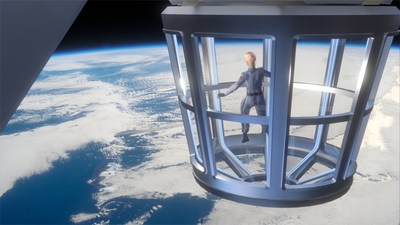
Axiom station observatory
The Axiom acrylic being tested will form the large windows of its forthcoming room-sized earth observatory in space.

The Axiom Earth Observatory (AxEO) will accommodate up to eight astronauts and provide unprecedented, 360-degree views of the planet from the earth-facing side of Axiom Station.

** Boeing highlights CST-100 Starliner parachute tests soon after news of SpaceX’s problems with a parachute test for the Crew Dragon became public. Reportedly the Starliner had parachute issues of its own last year.

** ULA will launch an inflatable heat shield demonstrator during an Atlas V mission: NASA, ULA find launch opportunity for inflatable heat shield demonstrator – Spaceflight Now

A flight demonstration of an inflatable heat shield that could be used to retrieve reusable engines from United Launch Alliance’s next-generation Vulcan rocket, and for the delivery of heavier cargo to the surface of Mars, is planned for launch in late 2021 or early 2022 as a piggyback payload on an Atlas 5 rocket with a NOAA weather satellite.

The inflatable re-entry decelerator will launch as a joint project between NASA and ULA, which foresee different uses for the technology.

** The Planetary Society‘s LightSail 2 set to go into orbit in June via a ride on a SpaceX Falcon Heavy mission: LightSail 2 set to launch next month aboard SpaceX Falcon Heavy rocket | The Planetary Society

The Planetary Society’s LightSail 2 spacecraft is ready to embark on a challenging mission to demonstrate the power of sunlight for propulsion.

Weighing just 5 kilograms, the loaf-of-bread-sized spacecraft, known as a CubeSat, is scheduled to lift off on 22 June 2019 aboard a SpaceX Falcon Heavy rocket from Kennedy Space Center, Florida. Once in space, LightSail 2 will deploy a boxing ring-sized solar sail and attempt to raise its orbit using the gentle push from solar photons.

It’s the culmination of a 10-year project with an origin story linked to the 3 scientist-engineers who founded The Planetary Society in 1980.

** ESA sponsors a demonstration of a composite upper stage structure: Contracts signed for prototype of a highly-optimised black upper stage – ESA

Rocket upper stages are commonly made of aluminium but switching to carbon composites lowers cost and could yield two metric tonnes spare payload capacity.

MT Aerospace and ArianeGroup signed contracts with ESA today to develop “Phoebus”, a Prototype of a Highly OptimisEd Black Upper Stage.

This project builds on legacy upper stage technologies and emerging composite cryogenic capabilities.

This low-cost lightweight Phoebus demonstrator introduces carbon composite materials, in particular for the metallic tanks containing the cryogenic propellants such as liquid hydrogen and oxygen, and for other primary and secondary structures.

** Rocket Lab’s next Electron launch to carry smallsats for Spaceflight Industries : Rocket Lab to launch rideshare mission for Spaceflight | Rocket Lab

Rocket Lab, the global leader in dedicated small satellite launch, announced today that its next flight will launch multiple spacecraft on a mission procured by satellite rideshare and mission management provider, Spaceflight. The launch window will open in June, with launch taking place from Rocket Lab Launch Complex 1 on New Zealand’s Māhia Peninsula.

The mission is Rocket Lab’s seventh Electron launch overall and the company’s third for 2019, continuing Rocket Lab’s average monthly launch cadence. The flight follows dedicated missions launched for DARPA and the U.S. Air Force’s Space Test Program in the first months of 2019.   

The mission is named ‘Make it Rain’ in a nod to the high volume of rainfall in Seattle, where Spaceflight is headquartered, as well in New Zealand where Launch Complex 1 is located. Among the satellites on the mission for Spaceflight are BlackSky’s Global-4, two U.S. Special Operations Command (USSOCOM) Prometheus and Melbourne Space Program’s ACRUX-1.

** Vector Launch tests Vector-R launch operations:

The latest on Vector from an interview with Cantrell:

** SpaceX:

*** A Falcon 9 with 60 SpaceX Starlink satellites is set to launch on Wednesday May 15th from Cape Canaveral. The 90 minute launch window opens at 010:30 pm EDT (0230 GMT on 16th).

A static test firing of the rocket took place on Monday evening. The test occurred with the satellites on top of the rocket, which differs from the approach taken since Sept. 1, 2016 when the Amos-6 satellite was destroyed while on a Falcon 9 that exploded shortly before a static firing test. Since then most all of the static fires have been done without the payload on the rocket. However, since SpaceX owns the payload this time, they were willing to take the chance and gain a day or so in time between the firing and the liftoff.

Here is a video (via www.USLaunchReport.com) from off site of the static test firing of the rocket (the firing starts at around 5:25):

** Falcon 9 booster from the CRS-17 mission leaves Port Canaveral with its legs folded back rather than removed. As mentioned in the previous Round-up, it has taken SpaceX about a year to get to this point:

*** Lots of Starhopper and Orbital Starship Demo vehicle activities these days at Boca Chica Beach. May see a flight of the Starhopper in the next few weeks: SpaceX stacks orbital Starship sections as Elon Musk teases June 20th event – Teslarati

SpaceX CEO Elon Musk says he will provide a public update on the development status of Starship and Super Heavy in an official presentation later this summer, possibly as soon as June 20th.

Meanwhile, SpaceX’s South Texas team have been busy at work on both Starhopper and a newer Starship, said by Musk to be the first orbit-capable prototype. In the last week, technicians have begun stacking several sections of the vehicle’s stainless steel hull, all fabricated and welded together side-by-side. On Thursday, May 9th, this progressed to the installation of the Starship’s first gently tapered nose section atop its cylindrical tank section. Likely the second- or third-to-last major stack before its aeroshell is assembled into one piece, the orbital prototype is starting to truly resemble a real Starship.

*** The Starship may be flying soon enough to launch the next-gen Turkish satellite: SpaceX’s Starship could launch secret Turkish satellite, says Gwynne Shotwell – Teslarati

According to SpaceX COO/President Gwynne Shotwell and a Turkish satellite industry official, Starship and Super Heavy may have a role to play in the launch of Turksat’s first domestically-procured communications satellite.

Per Shotwell’s specific phrasing, this comes as a bit of a surprise. Built by Airbus Defense and Space, SpaceX is already on contract to launch Turksat’s 5A and 5B communications satellites as early as Q2 2020 and Q1 2021, respectively. The spacecraft referred to in the context of Starship is the generation meant to follow 5A/5B: Turksat 6A and any follow-on variants. Turksat’s 6-series satellites will be designed and manufactured domestically rather than procured from non-Turkish heavyweights like Airbus or SSL. However, the Turksat 6A satellite’s current baseline specifications would make it an extremely odd fit for a launch vehicle as large as Starship/Super Heavy.

*** Scott Manley’s latest update focuses mostly on SpaceX activities:

*** A profile of SpaceX rocket enthusiasts: The Obsessive, Tumultuous Lives of SpaceX Rocket Chasers | WIRED

In late 2017 Chylinski gave in to his obsession. He sold his belongings, left his job, and hit the road in a Capri truck camper with his dog, Tuck, to photograph rockets full-time. Most people in their mid-thirties would balk at that kind of career move, and Chylinski, now 35, admits he had reservations too. But he told himself it would just be for six months. If it didn’t work out, he’d return to corporate IT.

He’s been on the road chasing rockets ever since.

Chylinski is part of a small group of (semi-)professional rocket chasers who are obsessively documenting the new space race and paying particular attention to the happenings at SpaceX. They’ll camp out for days in a remote part of Texas just to get a glimpse of the company’s experimental rocket engine. They lurk in Florida harbors as drone ship paparazzi. They attend every single launch, no matter how unglamorous the payload or inhospitable the hour. By showing up, these rocket chasers are uncovering news about the secretive happenings at SpaceX.

====

The Case for Space:
How the Revolution in Spaceflight Opens Up
a Future of Limitless Possibility

Space transport roundup – May.9.2019

A sampling of recent articles, videos, and images dealing with space transport:

[ Update: A message from Blue Origin today points to a video of the Blue Moon unveiling yesterday.

On May 9, 2019, our founder discussed his vision to go to space to benefit Earth.

Watch the full replay of this event

In addition, he also announced the Blue Moon lunar lander, which is capable of taking people and payloads to the lunar surface. Below you’ll find more information about these announcements.

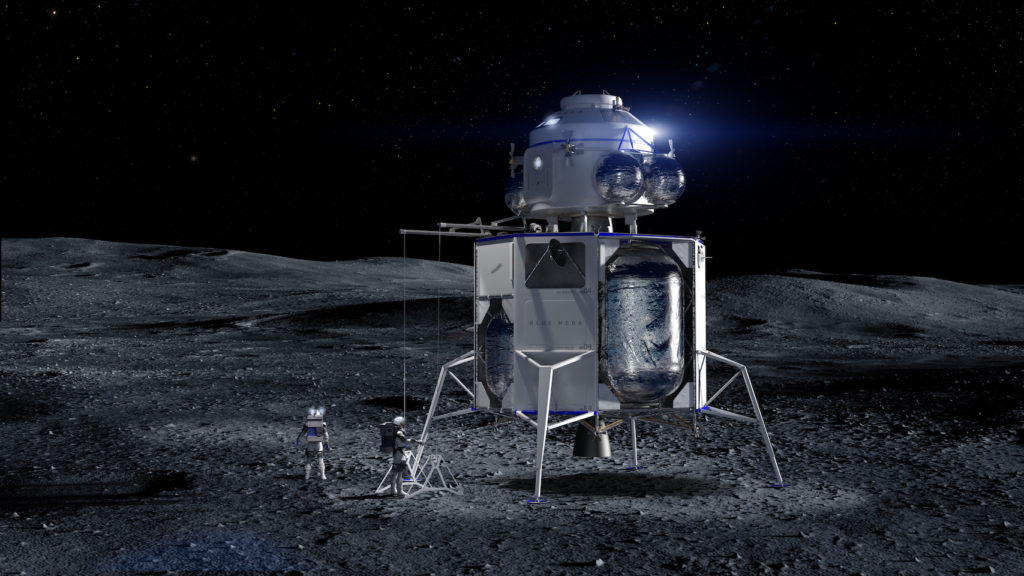
Blue Moon lunar landerBlue Origin announced Blue Moon, its large lunar lander capable of delivering multiple metric tons of payload to the lunar surface based on configuration and mission. The cargo variant revealed today can carry 3.6 metric tons to the surface. We have also designed a variant of the lander that can stretch to be capable of carrying a 6.5-metric-ton, human-rated ascent stage. Blue also announced it can meet the current Administration’s goal of putting Americans on the Moon by 2024 with the Blue Moon lunar lander. 

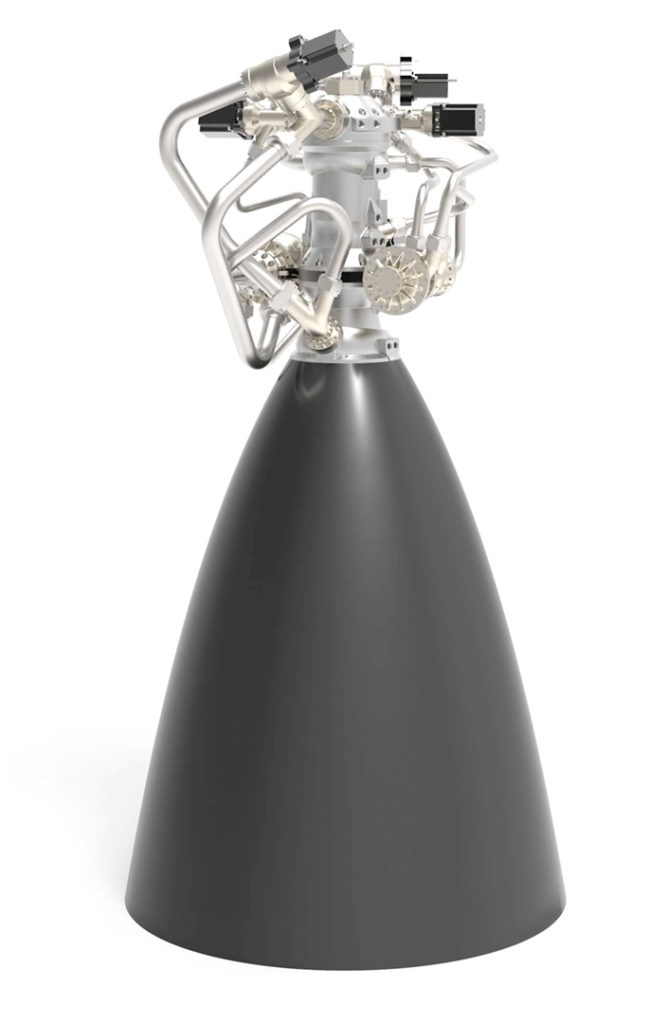
BE-7 engineThe Blue Moon lunar lander will be powered by the BE-7 engine, a new addition to Blue Origin’s family of engines. The BE-7’s 40 kN (10,000 lbf) thrust is designed for large lunar payload transport. The engine’s propellants are a highly-efficient combination of liquid oxygen and liquid hydrogen. The BE-7 will have its first hotfire this summer. The engine will be available for sale to other companies for use in in-space and lander applications.

Club For the Future: A non-profit founded by Blue Origin dedicated to inspiring and engaging the next generation of dreamers and space entrepreneurs as we journey to preserve Earth and unlock the potential of living and working in space. The Club will bring together K-12 students, educators and leaders for campaigns and initiatives utilizing Blue Origin’s unique access to space. The Club’s first activity will be to send a postcard to space and back on a future New Shepard mission—the first ever space mail. Learn more on the website (www.clubforfuture.org). Follow @ClubforFuture on Twitter and Instagram.

]

**  Jeff Bezos unveiled Blue Origin‘s Blue Moon lunar lander design at an event today –

Blue Moon is a flexible lander delivering a wide variety of small, medium and large payloads to the lunar surface. Its capability to provide precise and soft landings will enable a sustained human presence on the Moon.

Initially for cargo and later for human transport:

The Blue Moon lander can deliver large infrastructure payloads with high accuracy to pre-position systems for future missions. The larger variant of Blue Moon has been designed to land an ascent vehicle that will allow us to return Americans to the Moon by 2024.

Blue Moon with Ascent Vehicle
Blue Moon with ascent vehicle.

The lander is powered by the BE-7 Liquid Oxygen/Liquid Hydrogen engine, which will begin hot fire tests this summer.

… high specific impulse, deep throttling and restart capabilities of the BE-7 make the engine ideal for large lunar payload transport, while enabling Blue Moon’s oxygen/hydrogen fuel cell power system.

Blue Origin BE-7 Engine

** Highlights of engine development by PLD Space in Spain, which is developing suborbital and orbital rockets with reusable boosters:

** More about Spinlaunch‘s facility under construction at Spaceport America in New Mexico:

From Space.com:

This fact sheet lays out the envisioned launch cost and frequency, for instance, and states that SpinLaunch aims to loft its first payload by 2022. And we get the following description of the launch system:

“SpinLaunch utilizes existing technology and components from oil/gas/mining and wind turbine industries to construct an innovative mass-acceleration system, which achieves very high launch speeds without the need for enormous power generation or massive infrastructure. After ascending above the atmosphere, a relatively small, low-cost onboard rocket will be used to provide the final required velocity for orbital insertion. Because the majority of the energy required to reach orbit is sourced from ground-based electricity, as opposed to complex onboard rocket propulsion, total launch cost is reduced by an order of magnitude over existing launch systems.”

** Rocket Crafters partners with RUAG of Switzerland on development of rockets based on Rocket Crafters’s hybrid motor technology:

From the press release:

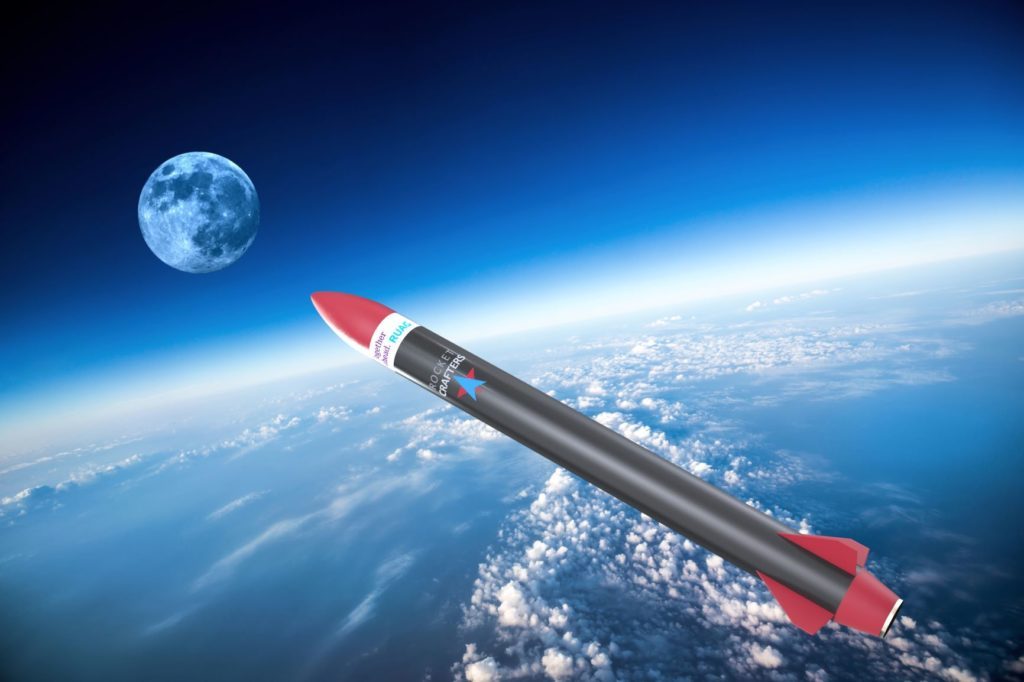
Rocket Crafters, a manufacturer of advanced rockets operating from the Florida Space Coast, and RUAG Space, a leading independent product supplier for spacecraft, electronics and launchers, signed a Memorandum of Understanding (MOU) at Satellite Conference 2019 in Washington D.C. – creating a new supplier agreement in the small launcher market.

Rocket Crafters will collaborate with RUAG on the design, development and procurement of a sounding rocket guidance and navigation system, nose cone and aeroshell in order to support an initial test flight, with the goal to achieve reliable, cost effective and fast time-to-market.

Sub-Orbital Flight Rocket Crafters rocket
A Rocket Crafters suborbital rocket in flight.

** Leaders of launch services providers gave their views on the status of the industry this week during panels at the Satellite 2019 conference:

** SpaceX:

*** A Dragon Crew vehicle parachute test went awry back in April: SpaceX had a problem during a parachute test in April | Ars Technica

The test appears to have occurred last month at Delamar Dry Lake in Nevada, where SpaceX was conducting one of dozens of drop tests it intends to perform to demonstrate the safety of its Crew Dragon spacecraft. This was a “single-out” test in which one of Dragon’s four parachutes intentionally failed before the test. “The three remaining chutes did not operate properly,” [NASA’s chief of human spaceflight Bill Gerstenmaier] said.

A follow-up:

*** Aerospace Corp is “overseeing the process of safely packing more than two dozen satellites” into the fairing of the Falcon Heavy for the STP-2 mission set for June : SpaceX’s Falcon Heavy Hauls a Complex Payload | The Aerospace Corporation

The Aerospace team in Albuquerque, New Mexico, is playing a major role in the flight, making sure all the satellites fit together aboard the world’s most powerful rocket. Aerospace engineers ensure the payloads don’t negatively affect each other in this complex arrangement by using a rideshare mission assurance protocol called “Do-No-Harm” (DNH). DNH is a process that focuses on ensuring no payload on a rideshare mission will negatively affect the on-orbit functionality of any other payload. The individual payloads on STP-2 are all responsible for their own mission success, but through the DNH process, Aerospace is ensuring that everyone inside the Falcon Heavy nose cone plays nice with each other.

*** Gwynne Shotwell talked about the upcoming launch of Starlink satellites during the recent launch providers panel at the Satellite 2019 conference: SpaceX to launch “dozens” of Starlink satellites May 15, more Starlink launches to follow – SpaceNews.com

Gwynne Shotwell, SpaceX’s president and chief operating officer, said the launch will carry “dozens of satellites,” adding more prototypes to the two currently in low Earth orbit.

“This next batch of satellites will really be a demonstration set for us to see the deployment scheme and start putting our network together,” she said at the Satellite 2019 conference here. “We start launching satellites for actual service later this year.”

Shotwell said SpaceX anticipates launching two to six more times for its Starlink broadband constellation in addition to the May 15 launch. How many Starlink launches occur this year depend on the results of this first batch, she said.

*** Falcon 9 booster legs retracted rather than removed. SpaceX introduced the Block 5 Falcon first stage boosters in 2018, hailing the design as the culmination of many lessons learned from landing and reusing the earlier generation boosters. Blk 5 boosters should provide up to a dozen launches between overhauls and to re-fly as soon as 24 hours after a launch. This requires quick operations such as simply retracting the landing legs back into their launch positions. During the past year, though, observers at Port Canaveral saw workers removing the legs before recovered Blk 5 boosters were transported back to the hangars.

That changed for the booster recovered from the recent Cargo Dragon CRS-17 mission to the ISS: SpaceX hits new Falcon 9 reusability milestone, retracts all four landing legs – Teslarati

SpaceX – All Legs Retracted – Historic Step 05-07-2019  (www.USLaunchReport.com) –

Still more video to come of Load and Transport. This is CRS-17, B1056 Booster. This video runs in real time{ No fast motion}. Takes place over three days. We know it’s long, we left out hours of footage.

** Low latitude flights of Starhopper may start happening in the next few weeks: SpaceX’s Starhopper gains thruster pods as hop test preparations ramp up – Teslararti

Amid a flurry of new construction at SpaceX’s Boca Chica facilities, technicians have begun to install thruster pods on Starhopper in anticipation of the prototype’s first untethered flights.

According to CEO Elon Musk, Starhopper’s “untethered hover tests” will begin with just one Raptor engine installed, potentially allowing hops to restart within the next few weeks. SpaceX is currently testing Raptor SN03 (and possibly SN02) a few hundred miles north in McGregor, Texas, just a few hours’ drive south once the engine is deemed flight-ready. Meanwhile, Starhopper itself needs a considerable amount of new hardware before it can begin Raptor-powered flight testing.

** Assembly of the demo orbital Starship prototype continues at Boca Chica as well:


====

Safe Is Not an Option

Videos: TMRO Orbit 12.16 – “Small rapid reusable rockets”

Here is the latest TMRO.tv space show:

Exos Aerospace’s COO John Quinn joins us to talk how rapidly reusable rockets could send experiments to space and have them back in scientists hands in just hours – leading to big advancements in medicine and research. Find out more about Exos Aerospace at https://exosaero.com/ Subscribe to their Youtube channel so they can stream their next launch! https://www.youtube.com/channel/UCh2d…

** The latest TMRO space news report:

In this weeks Space News from TMRO we start off with three launches: Blue Origin, SpaceX and Rocket Lab. Jared brings us an update on the SpaceX Starlink constellation and Jade talk about a very metallic universe! Our local sun has been very active this last week and Dr. Tamitha Skov bring us the latest space weather report.

*** And a news report from the week before:

====

Space 2.0: How Private Spaceflight, a Resurgent NASA,
and International Partners are Creating a New Space Age