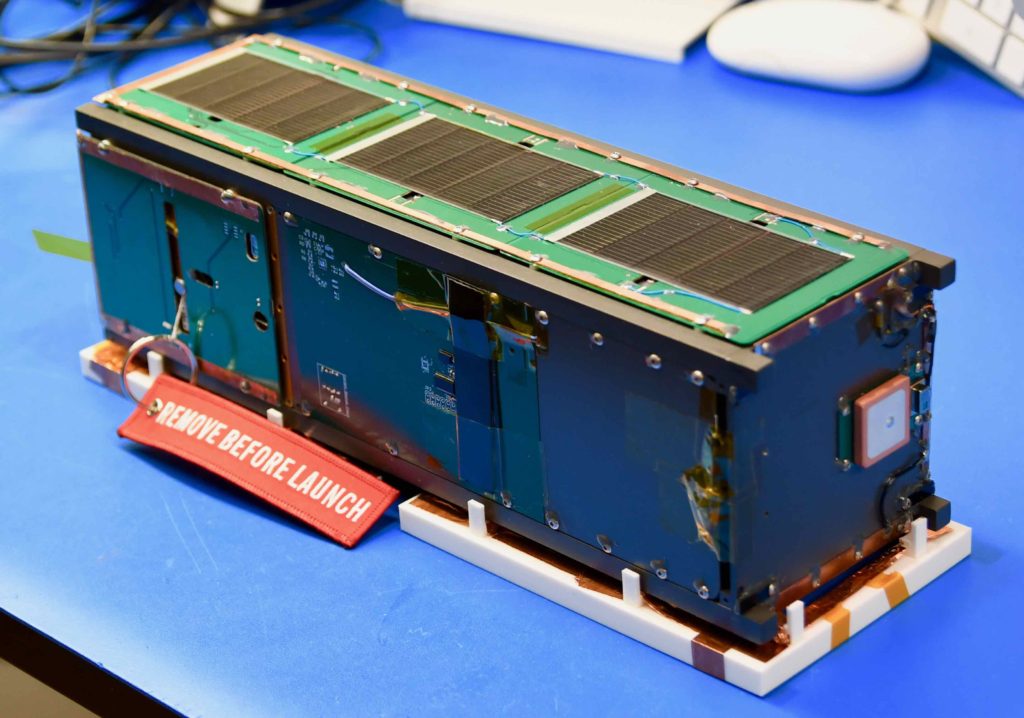
This Sunday, a Falcon 9 rocket will launch a SpaceX Dragon capsule that will rendezvous with the International Space Station. Part of this mission will include RFTSat, developed by a team of Northwest Nazarene University (Boise, Idaho) led by Prof. Joshua Griffin and a team of Georgia Tech Researchers in ECE.
This CubeSat experiment will have a unique RF energy-harvesting radio designed and built by the Georgia Tech Propagation Group. PhD student researcher Cheng Qi has built a one-of-a-kind microwave backscatter reader and tag-sensor combo that will drive the mission science package.
The low-powered reader designed by our team deploys a sensor that unfurls a distance away from the spacecraft. The reader then energizes and receives backscatter information from the device using a 5.8 GHz transmission. The launch info can be tracked here. Interesting articles on the launch can be found here and here.
The project was funded by NASA, but could not have been completed without private matching funds from the Space Solar Power Institute. Complete with generator, retrodirective antenna, and rectenna harvester, the radio package qualifies as the first microwave space-based solar power satellite ever tested — despite the somewhat limited 1m range. You have to start somewhere!
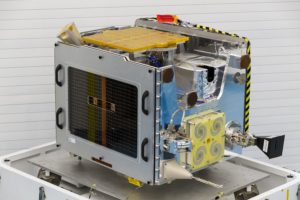
RFTSat (Radio Frequency Tag Satellite) CubeSat built by teams at Northwest Nazarene University and Georgia Tech. It will demonstrate RF energy harvesting and backscatter communication.
Professor Bland, from Curtin’s School of Earth and Planetary Sciences, said a Curtin team of 12 staff and student engineers developed the miniaturised satellite.
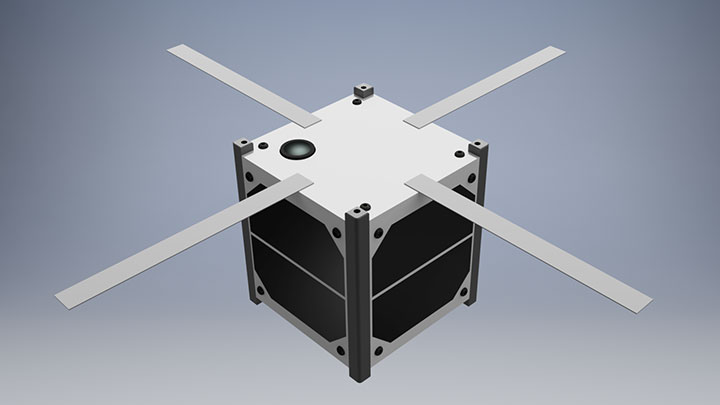
“The Curtin team has managed to put all the systems required to operate the satellite, including the power, computer, steering and communications, on a single eight-layer printed circuit board, which at 10cm by 10cm by 2.5cm is about the size of a rather small sandwich,” Professor Bland said.
“Having everything on a single circuit board means there is more room for what the satellite is carrying, which in this case will be a camera that will capture beautiful images of Australia taken from orbit.”
A diagram of the CubeSat in development in the Binar Cubesat Program at Curing University.
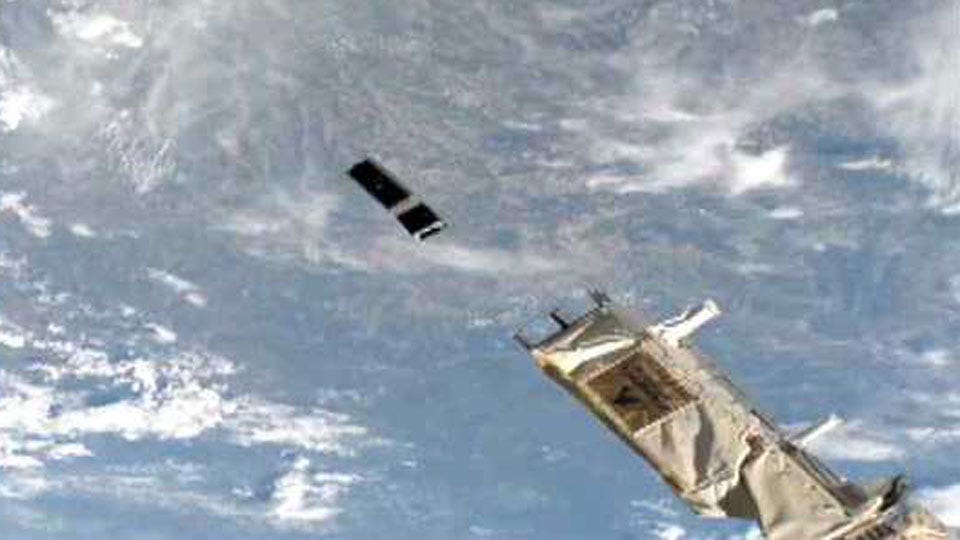
Three Virginia university satellites were deployed into nearly simultaneous orbit from the International Space Station via the NanoRacks CubeSat Deployer at 10:50 a.m. EDT this morning. The Virginia CubeSat Constellation mission is a collaborative project of the Virginia Space Grant Consortium and four of its member universities: Old Dominion University (ODU), Virginia Tech (VT), University of Virginia (UVA), and Hampton University (HU). The three nano-satellites, each about 4 inches cubed and weighing approximately 3 pounds, have been developed and instrumented (one each at ODU, VT and UVA) to obtain measurements of atmospheric properties and quantify atmospheric density with respect to orbital decay.
Deployment of three Virginia CubeSat Constellation satellites from the ISS. Photo credits: Virginia Space Grant Consortium
Data collected will ultimately contribute to the scientific knowledge base around orbital decay and will be widely shared. Ground stations at UVA, ODU and Virginia Tech will now begin making contact with their satellites. Data analysis will take place using an analytical tool being developed by students from Hampton University’s Atmospheric and Planetary Sciences Department.
“To know that all three satellites are now in orbit is extremely gratifying. Kudos to the students who have worked hard and gained immeasurable knowledge and experience from participating in this student-led mission and to the faculty who have advised them,” said Mary Sandy, Virginia Space Grant director and mission principal investigator. “Achieving Earth orbit is a huge mission milestone. These are the first student-developed satellites in orbit for all three of the universities.”
…
More than 150 undergraduate students across many disciplines at the participating universities have worked on the mission for the past three years under the guidance of faculty advisors
KRAKsat is a project focused on sending scientific satellite into space, made by students of University of Science and Technology and Jagiellonian University. Not only it is one of the first Cubesat type satellites in Poland but also the first satellite in the world which uses magnetic liquid, called ferrofluid, for orientation control.
A CubeSat from the Polish company SatRevolution was also deployed from the ISS along with KRAKsat. Find updates on the two projects at
UPDATE: The #LightSail2 mission team has opted to spend another day testing the spacecraft’s attitude control system. Sail deployment now expected no earlier than Tuesday, 9 July. The spacecraft is healthy. https://t.co/PvaKKe0iIr
— Planetary Society (@exploreplanets) July 8, 2019
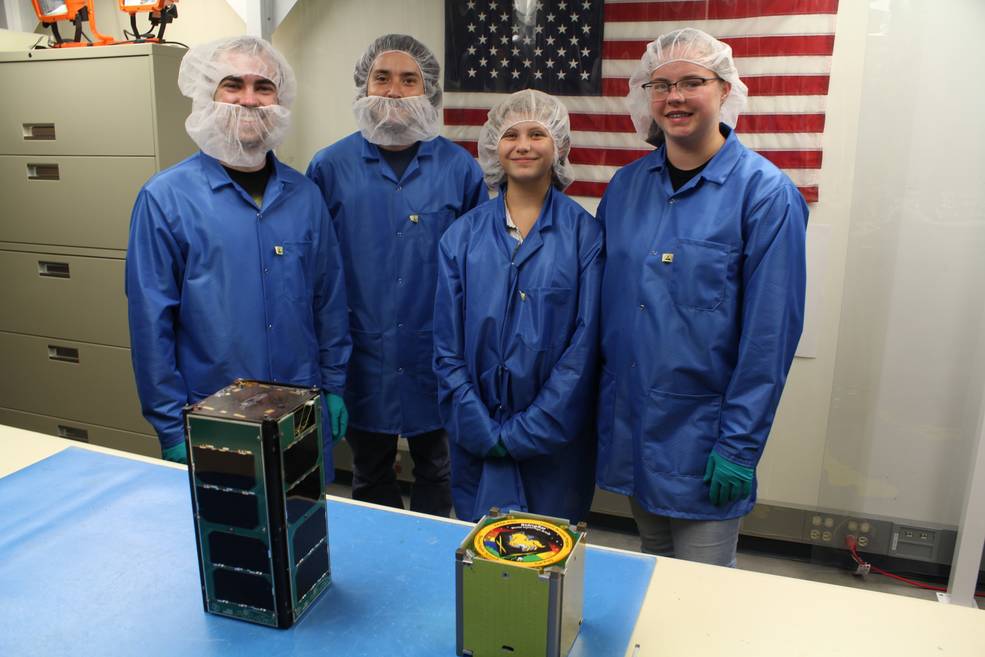
“Merritt Island High School students are photographed at the Kennedy Space Center with StangSat – a cube satellite (CubeSat) that was built and developed by students at the school. StangSat [launched] on a SpaceX Falcon Heavy rocket as part of the Department of Defense Space Test Program-2 mission, managed by the U.S. Air Force Space and Missile Systems Center… Credits: NASA/Shaun Daly”** Georgia Tech’s Prox-1 with LightSail-2 was successfully put into orbit by the Falcon Heavy as well. Prox-1 was built by Georgia Tech students with funding from the University Nanosat Program (UNP) and LightSail-2 was built by a team led by Ecliptic Enterprises and funded by the Planetary Society.
The sail’s cubesat will be ejected from Prox-1 this week:
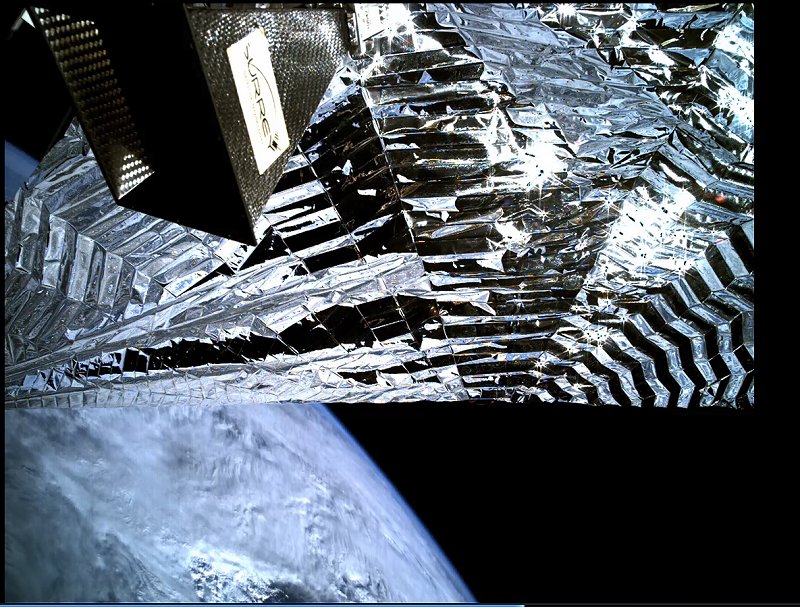
LightSail 2 team members will soon converge at Cal Poly San Luis Obispo in California, where the spacecraft’s mission control is located. Once LightSail 2 is released from Prox-1 on 2 July, the team will spend several days checking out the CubeSat’s systems before commanding its dual-sided solar panels to deploy. Following that, the spacecraft’s solar sails will be deployed, roughly 2 weeks in total from launch day.
** Students at Cal State Poly at San Luis Obispo were involved closely with LightSail-2 and with LEO (Launch Environment Observer) cubesat also on board the FH:
Designed and built by a team of nine students pursuing a Master’s degree with Space Systems and Technology Concentration, MYSAT-2 features significant upgrades from MYSAT-1. Its primary mission is to enable students to design, implement, and test new Attitude Determination and Control (ADC) Algorithms, developed by the Khalifa University students. The algorithms help determine a CubeSat’s orientation in space, and are estimated to be 15 to 20 percent more power-efficient, in comparison with similar algorithms implemented on other spacecrafts. If successful, the new algorithms will establish the UAE as a contributor to the global space industry.
TechDemoSat-1, a 150 kg in-orbit technology demonstration small satellite mission, validated 8 innovative UK spacecraft instruments and software payloads and also acquired ocean wind speed datasets using GNSS reflectometry.
The deployed sail measures approximately 6.7 m2 and is designed to significantly increase the spacecraft’s rate of orbital decay, in compliance with current Space Debris Mitigation best practice and guidelines.
Stephen Hobbs, Head of Cranfield University’s Space Group, commented “At Cranfield we are delighted to see our Icarus de-orbit technology demonstrated successfully in orbit – again. With the Icarus sails now deployed on both TechDemoSat-1 and Carbonite-1, SSTL and Cranfield have demonstrated clear leadership in this technology. We hope to see many more satellites following TechDemoSat-1’s example to keep space clear of debris. It’s been great to work with SSTL on this mission.”
The Icarus-1 drag sail consists of a thin aluminium frame fitted around one of the external panels of the spacecraft in which four trapezoidal Kapton sails and booms are stowed and restrained by a cord. Deployment is achieved by activating cord-cutter actuators, allowing the stored energy in the spring hinges to unfold the booms and the sail.
TechDemoSat-1 built by Surrey Satellite Systems, Ltd.
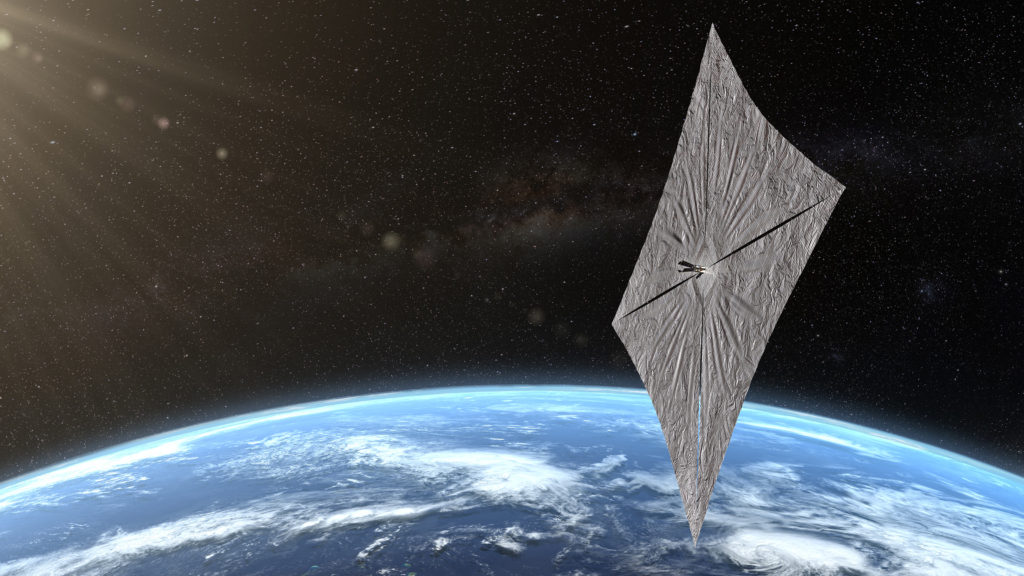
** The Planetary Society’s LightSail-2 to launch on the SpaceX Falcon Heavy STP-2 mission. The sail follows several previous solar sail projects (Japan’s IKAROS 2010 was the first to demonstrate sunlight driven propulsion) and aims to be the first of the Society’s sails to demonstrate net thrust. The sail will be released from the Georgia Tech Prox-1 carrier satellite (see below) about a week after the launch.
** Georgia Tech’s Prox-1 smallsat was built by students and will be student-operated as well. The goal of the mission is to
… demonstrate proximity operations for space situational awareness, through the use of a low thrust propulsion system for orbital maneuvering, and visible and infrared imaging for reconnaissance. The Prox-1 mission is directly applicable to Air Force Space Command’s priority to develop and maintain complete knowledge of assets in the on-orbit environment.
Prox-1 will conduct rendezvous and proximity operations with an on-orbit “objective”: the expended launch vehicle that delivers Prox-1 to orbit. Through multiple circumnavigations of the objective while acquiring visible and infrared images, a three-dimensional model of the objective will be developed and material properties will be established. The orbit of the objective will be determined, and a time-history of the objective attitude will be acquired. As an extended mission goal, Prox-1 will conduct proximity operations with additional objects in the near-space environment. The primary mission duration is three months.
This animation is somewhat dated but shows the primary operational tasks of the mission:
** Northwestern Univ. & Univ. of Illinois students work to get SpaceICE CubeSat ready for space after the project missed the first launch opportunity.
we are sending freeze-casting to Low Earth Orbit! At Northwestern, we are designing the experiment and payload, while UIUC (CubeSat Project) is building the satellite. This project is funded by NASA’s Office of Education through the Undergraduate Student Instrument Project. Our anticipated launch date is late 2018.
Once in orbit, we’ll collect image and temperature data while freezing aqueous suspensions of silver coated glass beads and salt water solutions. Whereas we were limited to freezing very quickly during our parabolic flight work, the CubeSat platform will allow us to test a range of freezing velocities.
Young scientists are racing to deliver by October a satellite payload of instruments to test freeze-casting — technology that could free space explorers from expensive, time-consuming deliveries of supplies from Earth.
The team of Northwestern University undergraduates building the innards for a small satellite called a “CubeSat” missed the launch window last year but are getting ready for another try.
“The sample container failed,” explains Kristen Scotti, a graduate student and mentor for SpaceICE, the initiative creating the CubeSat instrumentation to test freeze-casting for eventual manufacturing needs in space. Essentially, the glass containers for three sample suspensions were cracking, and anything less than airtight would jeopardize the freeze-casting process, dependent upon controlled temperatures and accurate readings.
MagQuest is designed to attract new ideas to increase the efficiency, reliability, and sustainability of geomagnetic data collection. With this open innovation challenge, NGA is inspiring solvers to apply their expertise to a wide range of potential solution areas. “From seafloor observatories to satellites, the breadth of ideas that emerged from Phase 1 of MagQuest is impressive and energizing,” said Richard Salman, Director of NGA’s Office of Geomatics. “We look forward to seeing the novel thinking and new technologies solvers will bring to Phase 2 of the challenge.”
** Nepal and Sri Lanka now have their first satellites in orbit. The BIRDS 3 CubeSats were built in collaboration with Japan’s Kyushu Institute of Technology, whose BIRDS project is intended to help non-spacefaring developing countries get into orbit. (See posting here.) The Birds-3 satellites were deployed from the ISS into orbit last week. ISS crew member Nick Hague posted images of the deployments:
Yesterday I monitored the deployment of 4 small satellites (CubeSats), as they were ejected outside of the JEM laboratory on @Space_Station. The first set of CubeSats deployed were from Nepal, Sri Lanka & Japan, & the last CubeSat was from Singapore. https://t.co/3YIvo0P40B pic.twitter.com/DAKvl2mskj
— Nick Hague (@AstroHague) June 18, 2019
This video shows the Birds-3 deployment at around the 15:15 point:
ACRUX-1 was designed and built by engineering students, with the support of regulatory and business teams as well as professional development and marketing teams.
The Melbourne Space Program is a not-for-profit education organisation run entirely by volunteers – students from universities across Melbourne with a vision to launch the next generation of technology pioneers.
“ACRUX-1 is MSP’s inaugural cubesat and marks a significant crux for the organisation. Credit: Blake Fuller, MSP.”
A team of University of North TexasCollege of Engineering seniors have created an energy efficient system for controlling solar panels on CubeSats using a nickel-titanium shape memory alloy.
Their design beat out teams from nine other universities to take first place at the CASMART 3rd Student Design Challenge in Germany. The international engineering competition for undergrad and graduate students asked teams to create innovative technologies using shape memory alloy.
…
The system designed by Ayers, and fellow Department of Mechanical and Energy Engineering students Brittany Thurstin, Kelsa Adams, Jordan Barnes, Robert Boone and David Evers opens, closes and moves a CubeSat’s solar panels in space using just 20 watts of battery power.
“For this project, we developed three separate shape memory alloy mechanisms for our CubeSat, named Penny, a retention mechanism that holds the solar panels in place during launch, a deployment mechanism that extends the solar panels into space and an actuator that moves the panels to follow the sun,” said Thurstin. “Applying a minimal amount of electricity provides all the mechanical energy needed to get the satellite up and running. We actually built a CubeSat to show just how the shape memory alloy system would work.”
is making a next-generation CubeSat, a small satellite that can fit in the palm of your hand. His satellite parts will cost 10-100x less than usual, using smartphone technologies. By substantially lowering prices to affordable levels for schools and individuals, Geffen plans to democratize space.
Noteworthy: Geffen designed a CubeSat mission to one of Saturn’s moons, leading him to become the only high-schooler invited to an academic space conference in China. Last year, at 16, he left school to pursue his passion for building satellites at a local laboratory. He’s also currently working on a program to tell where (on Earth) a satellite picture was taken.