The call everyone was waiting for is in. NASA’s New Horizons spacecraft phoned home just before 9 p.m. EDT Tuesday to tell the mission team and the world it had accomplished the historic first-ever flyby of Pluto.
“I know today we’ve inspired a whole new generation of explorers with this great success, and we look forward to the discoveries yet to come,” NASA Administrator Charles Bolden said. “This is a historic win for science and for exploration. We’ve truly, once again raised the bar of human potential.”
New Horizons Flight Controllers celebrate after they received confirmation from the spacecraft that it had successfully completed the flyby of Pluto, Tuesday, July 14, 2015 in the Mission Operations Center (MOC) of the Johns Hopkins University Applied Physics Laboratory (APL), Laurel, Maryland. Photo Credit: (NASA/Bill Ingalls)
The preprogrammed “phone call” — a 15-minute series of status messages beamed back to mission operations at the Johns Hopkins University Applied Physics Laboratory in Maryland through NASA’s Deep Space Network — ended a very suspenseful 21-hour waiting period. New Horizons had been instructed to spend the day gathering the maximum amount of data, and not communicating with Earth until it was beyond the Pluto system.
“With the successful flyby of Pluto we are celebrating the capstone event in a golden age of planetary exploration,” said John Grunsfeld, associate administrator for NASA’s Science Mission Directorate in Washington. “While this historic event is still unfolding –with the most exciting Pluto science still ahead of us — a new era of solar system exploration is just beginning. NASA missions will unravel the mysteries of Mars, Jupiter, Europa and worlds around other suns in the coming years.”
Pluto is the first Kuiper Belt object visited by a mission from Earth. New Horizons will continue on its adventure deeper into the Kuiper Belt, where thousands of objects hold frozen clues as to how the solar system formed.
“Following in the footsteps of planetary exploration missions such as Mariner, Pioneer and Voyager, New Horizons has triumphed at Pluto,” says New Horizons principal investigator Alan Stern of the Southwest Research Institute in Boulder, Colorado. “The New Horizons flyby completes the first era of planetary reconnaissance, a half century long endeavor that will forever be a legacy of our time.”
New Horizons is collecting so much data it will take 16 months to send it all back to Earth.
“On behalf of everyone at the Johns Hopkins University Applied Physics Laboratory, I want to congratulate the New Horizons team for the dedication, skill, creativity, and determination they demonstrated to reach this historic milestone,” said APL Director Ralph Semmel. “We are proud to be a part of a truly amazing team of scientists, engineers, and mission operations experts from across our nation who worked tirelessly to ensure the success of this mission.”
APL designed, built and operates the New Horizons spacecraft and manages the mission for NASA’s Science Mission Directorate. SwRI leads the mission, science team, payload operations and encounter science planning. New Horizons is part of NASA’s New Frontiers Program, managed by the agency’s Marshall Space Flight Center in Huntsville, Alabama.
Follow the New Horizons mission on Twitter and use the hashtag #PlutoFlyby to join the conversation. Live updates also will be available on the mission Facebook page.
For more information on the New Horizons mission, including fact sheets, schedules, video and images, visit:
New Horizons Composition Team Uses July 13 Data to Study Pluto’s Puzzling Surface
New Horizons has obtained impressive new images of Pluto and its large moon Charon that highlight their compositional diversity. These are not actual color images of Pluto and Charon—they are shown here in exaggerated colors that make it easy to note the differences in surface material and features on each planetary body.
Pluto and Charon in False Color Show Compositional Diversity – July 14, 2015: This July 13, 2015, image of Pluto and Charon is presented in false colors to make differences in surface material and features easy to see. It was obtained by the Ralph instrument on NASA’s New Horizons spacecraft, using three filters to obtain color information, which is exaggerated in the image. These are not the actual colors of Pluto and Charon, and the apparent distance between the two bodies has been reduced for this side-by-side view.
The image reveals that the bright heart-shaped region of Pluto includes areas that differ in color characteristics. The western lobe, shaped like an ice-cream cone, appears peach color in this image. A mottled area on the right (east) appears bluish. Even within Pluto’s northern polar cap, in the upper part of the image, various shades of yellow-orange indicate subtle compositional differences.
The surface of Charon is viewed using the same exaggerated color. The red on the dark northern polar cap of Charon is attributed to hydrocarbon materials including a class of chemical compounds called tholins. The mottled colors at lower latitudes point to the diversity of terrains on Charon.
This image was taken at 3:38 a.m. EDT on July 13, one day before New Horizons’ closest approach to Pluto.
The images were obtained using three of the color filters of the “Ralph” instrument on July 13 at 3:38 am EDT. New Horizons has seven science instruments on board the spacecraft—including “Ralph” and “Alice”, whose names are a throwback to the “Honeymooners,” a popular 1950s sitcom.
“These images show that Pluto and Charon are truly complex worlds. There’s a whole lot going on here,” said New Horizons co-investigator Will Grundy, Lowell Observatory, Flagstaff, Arizona. “Our surface composition team is working as fast as we can to identify the substances in different regions on Pluto and unravel the processes that put them where they are.”
The color data helps scientists understand the molecular make-up of ices on the surfaces of Pluto and Charon, as well as the age of geologic features such as craters. They can also tell us about surface changes caused by space “weather,” such as radiation.
The new color images reveal that the “heart” of Pluto actually consists of two remarkably different-colored regions. In the false-color image, the heart consists of a western lobe shaped like an ice cream cone that appears peach color in this image. A mottled area on the right (east) side looks bluish. A mid-latitude band appears in shades ranging from pale blue through red. Even within the northern polar cap, in the upper part of the image, various shades of yellow-orange indicate subtle compositional differences. This image was obtained using three of the color filters of the Ralph instrument on July 13 at 3:38 am EDT and received on the ground on at 12:25 pm.
Charon is just as colorful
The surface of Charon is viewed using the same exaggerated color. The red on the dark northern polar cap of Charon is attributed to hydrocarbon and other molecules, a class of chemical compounds called tholins. The mottled colors at lower latitudes point to the diversity of terrains on Charon. This image was obtained using three of the color filters of the Ralph instrument on July 13 at 3:38 am EDT and received on the ground on at 12:25 pm.
“We make these color images to highlight the variety of surface environments present in the Pluto system,” said Dennis Reuter, co-investigator with the New Horizons Composition Team. “They show us in an intuitive way that there is much still to learn from the data coming down.” Due to the three-billion-mile distance to Pluto, data takes 4 ½ hours to come to Earth, even at the speed of light. It will take 16 months for all of New Horizons’ science data to be received, and the treasure trove from this mission will be studied for decades to come.
After a decade-long journey through our solar system, New Horizons made its closest approach to Pluto Tuesday, about 7,750 miles above the surface — roughly the same distance from New York to Mumbai, India — making it the first-ever space mission to explore a world so far from Earth.
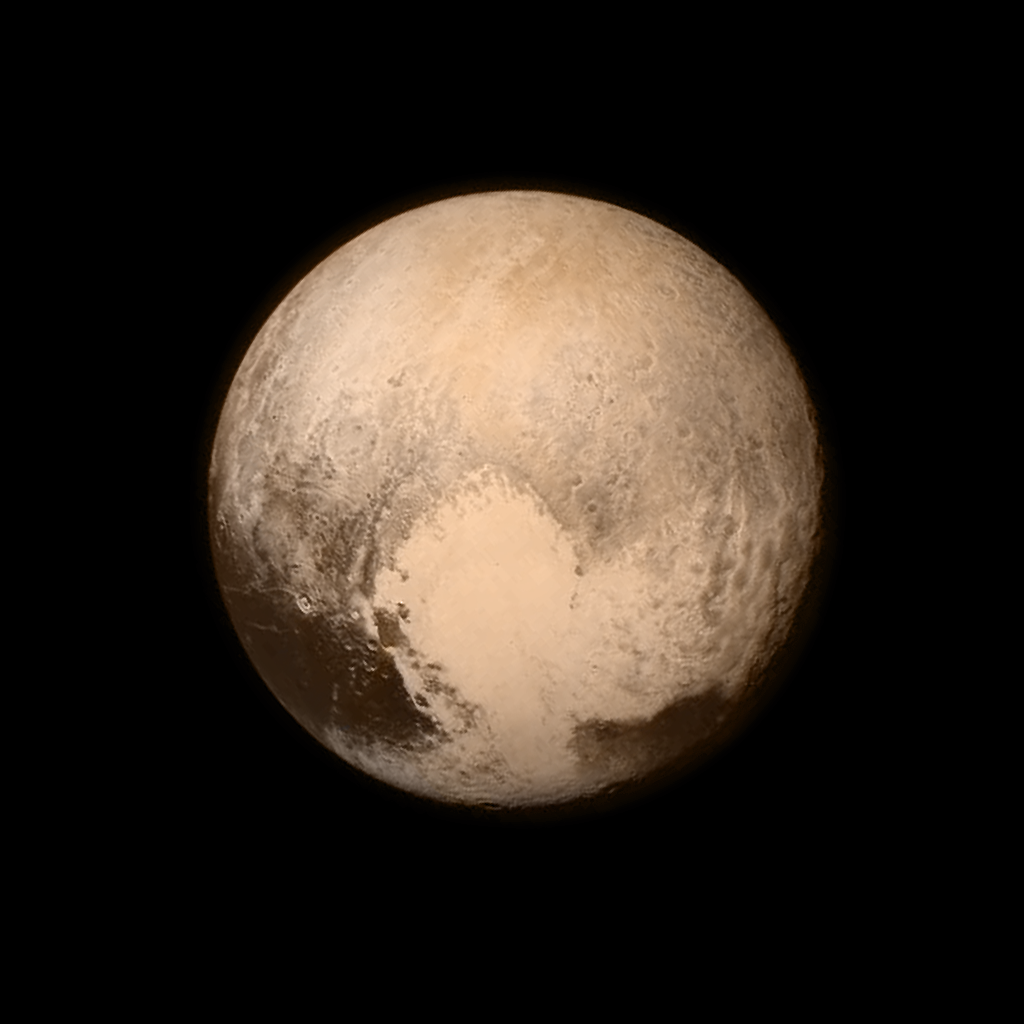
Pluto nearly fills the frame in this image from the Long Range Reconnaissance Imager (LORRI) aboard NASA’s New Horizons spacecraft, taken on July 13, 2015 when the spacecraft was 476,000 miles (768,000 kilometers) from the surface. This is the last and most detailed image sent to Earth before the spacecraft’s closest approach to Pluto on July 14. The color image has been combined with lower-resolution color information from the Ralph instrument that was acquired earlier on July 13. This view is dominated by the large, bright feature informally named the “heart,” which measures approximately 1,000 miles (1,600 kilometers) across. The heart borders darker equatorial terrains, and the mottled terrain to its east (right) are complex. However, even at this resolution, much of the heart’s interior appears remarkably featureless—possibly a sign of ongoing geologic processes. Credits: NASA/APL/SwRI
This view is dominated by the large, bright feature informally named the “heart,” which measures approximately 1,000 miles (1,600 kilometers) across. The heart borders darker equatorial terrains, and the mottled terrain to its east (right) are complex. However, even at this resolution, much of the heart’s interior appears remarkably featureless—possibly a sign of ongoing geologic processes.
“I’m delighted at this latest accomplishment by NASA, another first that demonstrates once again how the United States leads the world in space,” said John Holdren, assistant to the President for Science and Technology and director of the White House Office of Science and Technology Policy. “New Horizons is the latest in a long line of scientific accomplishments at NASA, including multiple missions orbiting and exploring the surface of Mars in advance of human visits still to come; the remarkable Kepler mission to identify Earth-like planets around stars other than our own; and the DSCOVR satellite that soon will be beaming back images of the whole Earth in near real-time from a vantage point a million miles away. As New Horizons completes its flyby of Pluto and continues deeper into the Kuiper Belt, NASA’s multifaceted journey of discovery continues.”
“The exploration of Pluto and its moons by New Horizons represents the capstone event to 50 years of planetary exploration by NASA and the United States,” said NASA Administrator Charles Bolden. “Once again we have achieved a historic first. The United States is the first nation to reach Pluto, and with this mission has completed the initial survey of our solar system, a remarkable accomplishment that no other nation can match.”
Per the plan, the spacecraft currently is in data-gathering mode and not in contact with flight controllers at the Johns Hopkins University Applied Physical Laboratory (APL) in Laurel, Maryland. Scientists are waiting to find out whether New Horizons “phones home,” transmitting to Earth a series of status updates that indicate the spacecraft survived the flyby and is in good health. The “call” is expected shortly after 9 p.m. tonight.
The Pluto story began only a generation ago when young Clyde Tombaugh was tasked to look for Planet X, theorized to exist beyond the orbit of Neptune. He discovered a faint point of light that we now see as a complex and fascinating world.
“Pluto was discovered just 85 years ago by a farmer’s son from Kansas, inspired by a visionary from Boston, using a telescope in Flagstaff, Arizona,” said John Grunsfeld, associate administrator for NASA’s Science Mission Directorate in Washington. “Today, science takes a great leap observing the Pluto system up close and flying into a new frontier that will help us better understand the origins of the solar system.”
New Horizons’ flyby of the dwarf planet and its five known moons is providing an up-close introduction to the solar system’s Kuiper Belt, an outer region populated by icy objects ranging in size from boulders to dwarf planets. Kuiper Belt objects, such as Pluto, preserve evidence about the early formation of the solar system.
New Horizons principal investigator Alan Stern of the Southwest Research Institute (SwRI) in Boulder, Colorado, says the mission now is writing the textbook on Pluto.
“The New Horizons team is proud to have accomplished the first exploration of the Pluto system,” Stern said. “This mission has inspired people across the world with the excitement of exploration and what humankind can achieve.”
New Horizons’ almost 10-year, three-billion-mile journey to closest approach at Pluto took about one minute less than predicted when the craft was launched in January 2006. The spacecraft threaded the needle through a 36-by-57 mile (60 by 90 kilometers) window in space — the equivalent of a commercial airliner arriving no more off target than the width of a tennis ball.
Because New Horizons is the fastest spacecraft ever launched – hurtling through the Pluto system at more than 30,000 mph, a collision with a particle as small as a grain of rice could incapacitate the spacecraft. Once it reestablishes contact Tuesday night, it will take 16 months for New Horizons to send its cache of data — 10 years’ worth — back to Earth.
New Horizons is the latest in a long line of scientific accomplishments at NASA, including multiple rovers exploring the surface of Mars, the Cassini spacecraft that has revolutionized our understanding of Saturn and the Hubble Space Telescope, which recently celebrated its 25th anniversary. All of this scientific research and discovery is helping to inform the agency’s plan to send American astronauts to Mars in the 2030’s.
“After nearly 15 years of planning, building, and flying the New Horizons spacecraft across the solar system, we’ve reached our goal,” said project manager Glen Fountain at APL “The bounty of what we’ve collected is about to unfold.”
APL designed, built and operates the New Horizons spacecraft and manages the mission for NASA’s Science Mission Directorate. SwRI leads the mission, science team, payload operations and encounter science planning. New Horizons is part of NASA’s New Frontiers Program, managed by the agency’s Marshall Space Flight Center in Huntsville, Alabama.
Follow the New Horizons mission on Twitter and use the hashtag #PlutoFlyby to join the conversation. Live updates also will be available on the mission Facebook page.
For more information on the New Horizons mission, including fact sheets, schedules, video and images, visit:
Members of the New Horizons science team react to seeing the spacecraft’s last and sharpest image of Pluto before closest approach later in the day, Tuesday, July 14, 2015 at the Johns Hopkins University Applied Physics Laboratory (APL) in Laurel, Maryland. Photo Credit: (NASA/Bill Ingalls)
The New Horizons fly-by of Pluto will happen on Tuesday with the closest approach at around 7:50 am EDT. It won’t be known until Wednesday if there were any problems with the imaging and sensor measurements since the high gain antenna cannot point at earth while the camera and sensors are pointed at the planet.
—
Here is the video of the New Horizons briefing on Monday:
NASA’s New Horizons mission has answered one of the most basic questions about Pluto—its size.
Mission scientists have found Pluto to be 1,473 miles (2,370 kilometers) in diameter, somewhat larger than many prior estimates. Images acquired with the Long Range Reconnaissance Imager (LORRI) were used to make this determination. This result confirms what was already suspected: Pluto is larger than all other known solar system objects beyond the orbit of Neptune.
Pluto’s Heart – July.13.15: Pluto’s bright, mysterious “heart” is rotating into view, ready for its close-up on close approach, in this image taken by New Horizons on July 12 from a distance of 1.6 million miles (2.5 million kilometers). It is the target of the highest-resolution images that will be taken during the spacecraft’s closest approach to Pluto on July 14. The intriguing “bulls-eye” feature at right is rotating out of view, and will not be seen in greater detail.
“The size of Pluto has been debated since its discovery in 1930. We are excited to finally lay this question to rest,” said mission scientist Bill McKinnon, Washington University, St. Louis.
Pluto’s newly estimated size means that its density is slightly lower than previously thought, and the fraction of ice in its interior is slightly higher. Also, the lowest layer of Pluto’s atmosphere, called the troposphere, is shallower than previously believed.
Charon’s Features – July.13.15: Charon’s newly-discovered system of chasms, larger than the Grand Canyon on Earth, rotates out of view in New Horizons’ sharpest image yet of the Texas-sized moon. It’s trailed by a large equatorial impact crater that is ringed by bright rays of ejected material. In this latest image, the dark north polar region is displaying new and intriguing patterns. This image was taken on July 12 from a distance of 1.6 million miles (2.5 million kilometers).
Measuring Pluto’s size has been a decades-long challenge due to complicating factors from its atmosphere. Its largest moon Charon lacks a substantial atmosphere, and its diameter was easier to determine using ground-based telescopes. New Horizons observations of Charon confirm previous estimates of 751 miles (1208 km) kilometers) across
LORRI has also zoomed in on two of Pluto’s smaller moons, Nix and Hydra.
“We knew from the time we designed our flyby that we would only be able to study the small moons in detail for just a few days before closest approach,” said New Horizons Principal Investigator Alan Stern of the Southwest Research Institute, Boulder, Colorado. “Now, deep inside Pluto’s sphere of influence, that time has come.”
Nix and Hydra were discovered using the Hubble Space Telescope in 2005. Even to Hubble, they appeared as points of light, and that’s how they looked to New Horizons until the final week of its approach to Pluto. Now, the latest LORRI images show the two diminutive satellites not as pinpoints, but as moons seen well enough to measure their sizes. Nix is estimated to be about 20 miles (about 35 kilometers) across, while Hydra is roughly 30 miles (roughly 45 kilometers) across. These sizes lead mission scientists to conclude that their surfaces are quite bright, possibly due to the presence of ice.
What about Pluto’s two smallest moons, Kerberos and Styx? Smaller and fainter than Nix and Hydra, they are harder to measure. Mission scientists should be able to determine their sizes with observations New Horizons will make during the flyby and will transmit to Earth at a later date.
Pluto’s moons Nix and Hydra – July 13, 2015: The approximate sizes of Pluto’s moons Nix and Hydra compared to Denver, Colorado. While Nix and Hydra are illustrated as circles in this diagram, mission scientists anticipate that future observations by New Horizons will show that they are irregular in shape.
Check the New Horizons current position page to follow the location of the spacecraft as it passes by Pluto and its moons. Note that Pluto’s moons rotate perpendicular to the plane of the Solar System (Pluto rotates “on its side” like Uranus and it’s orbit around the sun is also unusual). So the Plutonian system looks like a target and New Horizons will shoot through its bulls eye.
As NASA’s unmanned New Horizons spacecraft speeds closer to a historic July 14 Pluto flyby, it’s continuing to multi-task, producing images of an icy world that’s growing more fascinating and complex every day.
Pluto as seen from New Horizons on July 11, 2015. Credit: NASA/JHUAPL/SWRI
On July 11, 2015, New Horizons captured this image, which suggests some new features that are of keen interest to the Geology, Geophysics and Imaging (GGI) team now assembled at the Johns Hopkins University Applied Physics Lab in Laurel, Maryland. For the first time on Pluto, this view reveals linear features that may be cliffs, as well as a circular feature that could be an impact crater. Just starting to rotate into view on the left side of the image is the bright heart-shaped feature that will be seen in more detail during New Horizons’ closest approach.
The New Horizons spacecraft is now approaching a milestone – only one million miles to Pluto – which will occur at 11:23 p.m. EDT tonight, Sunday, July 12. It’s approaching Pluto after a more than nine-year, three-billion mile journey. At 7:49 AM EDT on Tuesday, July 14 the unmanned spacecraft will zip past Pluto at 30,800 miles per hour (49,600 kilometers per hour), with a suite of seven science instruments busily gathering data. The mission will complete the initial reconnaissance of the solar system with the first-ever look at the icy dwarf planet.
Pluto is More Intriguing than Ever (annotated) – July 12, 2015: On July 11, 2015, New Horizons captured a world that is growing more fascinating by the day. For the first time on Pluto, this view reveals linear features that may be cliffs, as well as a circular feature that could be an impact crater. Rotating into view is the bright heart-shaped feature that will be seen in more detail during New Horizons’ closest approach on July 14. The annotated version includes a diagram indicating Pluto’s north pole, equator, and central meridian.
Follow the path of the spacecraft in coming days in real time with a visualization of the actual trajectory data, using NASA’s online Eyes on Pluto.

![nh-071315_falsecolorcomposite[1]](http://hobbyspace.com/Blog/wp-content/uploads/2015/07/nh-071315_falsecolorcomposite1.jpg)

![7-13-15_Pluto_image_NASA-JHUAPL-SWRI[1]](http://hobbyspace.com/Blog/wp-content/uploads/2015/07/7-13-15_Pluto_image_NASA-JHUAPL-SWRI1.png)
![7-13-15_Charon_image_NASA-JHUAPL-SWRI[1]](http://hobbyspace.com/Blog/wp-content/uploads/2015/07/7-13-15_Charon_image_NASA-JHUAPL-SWRI1.png)
![7-13-15_Denver_Nix_Hydra_JHUAPL[1]](http://hobbyspace.com/Blog/wp-content/uploads/2015/07/7-13-15_Denver_Nix_Hydra_JHUAPL1.jpg)
![071215_Pluto_Alone[1]](http://hobbyspace.com/Blog/wp-content/uploads/2015/07/071215_Pluto_Alone1.png)
![Pluto%20Annotated%207-12-15[1]](http://hobbyspace.com/Blog/wp-content/uploads/2015/07/Pluto-Annotated-7-12-151.jpg)
